





 Navigation
News


05/04/2024
|
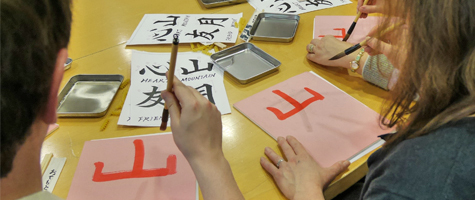
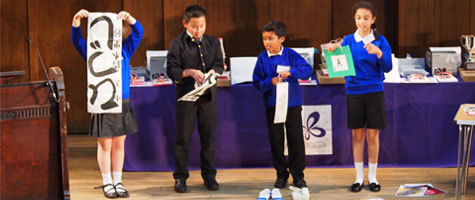
The UCL-Japan Youth Challenge is now open for applications from pre-university aged students in the UK!
This week-long summer school is now in its 10th year, and is a unique opportunity for UK-based students to meet and interact with students from Japan. It is an chance to exchange cultures and make new friends, while gaining valuable new skills attending university-style lectures and workshops.
This year’s theme will be Space and Us.
When? Saturday 27 July – Sunday 4 August 2024*
Where? Three locations – Rikkyo School in England (West Sussex), Cambridge University, and University College London (UCL).
Fee: £100**
Application Deadline: Sunday 30th June
* There are compulsory and non-compulsory days. For details please view the PDF attached here
** If accommodation is required, additional charges will apply
Click here to see a PDF containing more details, or visit the official website for more information, including how to apply: https://www.ucl-japan-youth-challenge.com/join-us/
05/05/2020

|
During this unprecedented situation we all find oursleves in, we believe it important to share the beauty of Japanese cinema through free streaming services. The below links will take you to two film sharing initiatives that the Japan Foundation has been involved in.
We hope you enjoy the complimentary access these films while they are available!
'Asian Three-Fold Mirror 2016: Reflections'
A great opportunity to watch three fantastic pieces of cinema produced by the Japan Foundation Asia Centre and Tokyo International Film Festival. A journey through space and time!
Available online until June 30, 2020
Moosic Lab X Japanese Film Festival
Thanks to Moosic Lab, our film festival in Asia has set up a free streaming service where you can watch both feature and short Japanese indie films.
No subscription needed!
Expires early June 2020
30/09/2019
The Japan Foundation London is inviting IT companies based in the UK to submit their offer for the resourcing our office with PCs by 13th January 2020.
The necessarily procedures and specifications can be downloaded from here.
All the information, as well as communication concerning this procedure, is either provided or conducted only in Japanese.
26/04/2019
The number of local authorities in Japan wishing to employ foreign human resources is increasing, in order to deal with the growing number of inbound tourists and expand overseas markets for local products.
Therefore, the Secretariat of the Headquarters for Overcoming Population Decline and Vitalizing Local Economy in Japan of the Cabinet Secretariat has launched the Support System for Vitalizing Local Economy in Japan through Foreign Human Resources and opened its website. This system aims to support matching between foreign nationals living in countries/regions outside Japan who wish to work for local authorities or their related organizations in Japan and local authorities that wish to employ those foreign nationals.
If you are a foreign national who meets the requirements and wishes to be employed by a Japanese local authority, please check the job offer information posted on the website, and submit an application for your desired job directly to the local authority on your own responsibility. For inquiries on individual job offer information, please directly contact the local authority that has posted the job offer.
- Applications close on 17th May 2019.
- Depending on the situation of applications, the closing date is subject to change without notice.
For details of the job offer information, please click here.
12/04/2019
現在、国際交流基金では、2019年度にアジア5カ国に派遣する日本語専門家を募集しています。海外在住の方の面接希望については、オンラインでも実施予定です。
本募集に関する提出期限を含めた詳細情報やお問い合わせ先については以下リンク先をご覧ください。
06/08/2018

|
The ESRC and the Arts and Humanities Research Council (AHRC) are please to invite applications for the UK-Japan Social Sciences, Arts and Humanities Connections Grants, aimed at fostering the development of long-term relationships with Japanese researchers in the field of social sciences and humanities. (SSH)
Application period: July 17 - September 27, 2018
Projects commence from: November 2018
Projects must conclude by: April 2020
For more information and applications, please visit the ESRC website
11/06/2018

The Hakuho Foundation is now accepting applications for the 14th Hakuho Foundation Japanese Research Fellowship.
With the goals of further strengthening the fundamentals of international research into Japan and deepening international understanding of Japan, the Hakuho Foundation Japanese Research Fellowship invites leading international researchers of the Japanese language, Japanese language education, Japanese literature and Japanese culture to Japan to conduct residential research.
Application period: June 8 - October 31, 2018
Fellowship period:
Long-term (1 year): September 1, 2019 - August 31, 2020
Short-term (6 months): September 1, 2019 - February 29, 2020 (Round 1), or March 1 - August 31, 2020 (Round 2)
For further details please visit the Hakuho Foundation’s website:
https://www.hakuhofoundation.or.jp/en/program/
23/08/2016
|
We are delighted to announce the launch of Hirogaru, get more of Japan and Japanese, a Japanese learning website where you can enjoy studying Japanese through learning all about Japan. It is aimed at Japanese language learners with a proficiency level of A1 or A2 (Starter to Elementary) in the JF Standard for Japanese-Language Education.
Free and smartphone-responsive, Hirogaru enables Japanese learners of all kinds to:
- Personally experience understanding and using basic Japanese
- Engage with various aspects about Japan and the Japanese language through reading articles and watching movies related to 12 topics about Japan
- Through user comments, learn more about not only Japan but also your own culture and the culture of places where other learners live.
Try it now at hirogaru-nihongo.jp
29/07/2016

The Japan Foundation London is delighted to announce the launch of a brand new e-learning platform for Japanese!
The Japan Foundation Japanese-Language Institute, Kansai has released the Japanese language learning platform, JF Japanese e-Learning Minato (https://minato-jf.jp ), in order to provide an opportunity to study Japanese for all those people in the world who may wish to begin learning, but cannot attend an actual Japanese language school.
The main course of Minato is the Marugoto Japanese Online Course, which we recommend for those who wish to comprehensively learn about the Japanese language and culture. With this course you can have an integrated learning experience by using interactive e-learning materials to study the language skills needed for communication (listening, speaking, reading, and writing).
Currently only the A1 Marugoto Course is available, but more levels will be released in the future. There are also Hiragana and Katakana self-study courses available.
21/07/2016

A big thank you to the 2,000 visitors who came to the Japan Foundation’s stand at Hyper Japan on the 15th, 16th and 17th July 2016.
HYPER JAPAN is the UK's biggest celebration of Japanese culture, Japanese cuisine, and Japanese cool. The Japan Foundation London’s stand gave visitors a chance to find out more about Japanese arts and culture, and studying Japanese language. In celebration of the Tanabata “Star Festival” on July 7th, we also displayed bamboo on which visitors could make wishes by writing their wish on paper and hanging them on the branches.
One of the highlights of our stand was our Japan Quiz, which over 1,000 people entered. Most of the entrants got the answers right – the capital of Japan is Tokyo, and the Japanese word for “cartoon” is anime!
Out of those who answered the quiz correctly, only six people could win the Japan Foundation goody bag. Well done to our lucky winners!
We also hope that everyone who wished on our Tanabata bamboo finds their wishes come true! Photos of some of the wishes can be viewed on our Facebook page here.
Join the Japan Foundation when we hit the road at Japan Matsuri on September 25th at Trafalgar Square, and the Language Show Live at the Olympia on October 14th – 16th.
13/07/2016
 Japan Foundation London are delighted to welcome the newest member of staff, Kanako Ukai, to the Japanese Language team as Assistant Japanese Language Advisor! Here is a message from Ukai-san:
「はじめまして。国際交流基金ロンドン日本文化センターに日本語教育指導助手として参りました、鵜飼香奈子です。今までアメリカ、タイ、モルドバ、日本で日本語教育に携わってきました。特に興味のあるテーマは社会言語学、多文化共生、教師の成長です。ロンドンは昨年UCL IOEで1年間応用言語学を学んでいたこともあり、2度目となりますがまだまだ知らないことも多く、これからも色々な事を学んでいきたいと思いますので、どうぞよろしくお願いいたします。」
"My name is Kanako Ukai and I am Assistant Japanese Language Advisor at the Japan Foundation, London. I have taught Japanese in America, Thailand, Moldova and Japan. I am particularly interested in sociolinguistics, multiculturalism and teachers development within Japanese language education. I studied MA Applied linguistics at UCL IOE last year, so I am very happy to come back and be able to work in the UK. Thank you very much."
28/06/2016
|
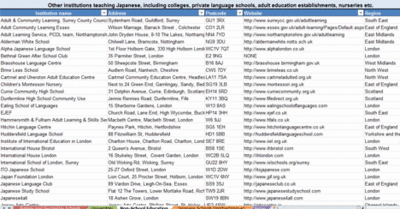
Japan Foundation London has launched a new directory of establishments teaching Japanese in the UK, based on the basic, public information provided by all establishments that contributed to our Japan Foundation Survey on Japanese Language Education in the UK 2015.
This directory includes all schools, universities, colleges and other establishments that our records show are teaching Japanese language. Those looking to learn Japanese can use the list to find the right course for them, while teachers of Japanese and other members of Japanese teaching establishments can use the list to build stronger links with this network.
You can read more about this directory and download it yourself here
20/06/2016
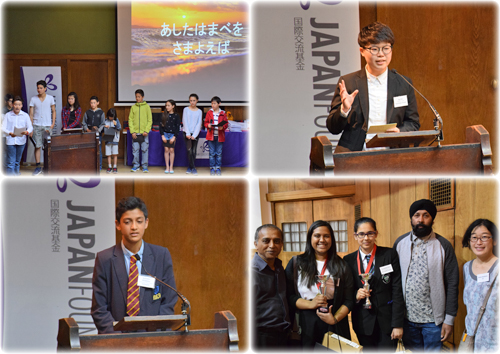
The ideal school, Japanese food and Japanese literature were some of the topics explored in the outstanding speeches given by the finalists of the Nihongo Cup Japanese Speech Contest for Secondary School Students 2016, which was held on 18th June at Conway Hall in London.
The 18 finalists, who had been selected from 147 applicants from 20 different schools across the UK, all demonstrated great creativity, thoughtfulness and incredible ability in Japanese in performing their speeches – not to mention extraordinary courage to present their ideas in a foreign language to an audience of over 100 people!
Between each of the three categories of speeches, the audience had the opportunity to watch a performance of a Japanese story featuring music and song by some very talented school students, and have a go at “radio taisō” exercises!
Due to the extremely high level of Japanese and the thought-provoking content of the speeches delivered by all finalists, the judges had extremely difficult decisions to make when choosing the final winners of the 2015 Nihongo Cup. In the end, Shanara Atukorala of Greenford High School came first in the Key Stage 4 and 5 Post-GCSE for her review of the Japanese story “Ooi, Detekooi ,” winning the top prize of a trip to Japan courtesy of JOBA’s Japanese Speech Awards! In the pre-GCSE category, Taranpreet Kalra (also from Greenford High School) won first prize for her speech about racial discrimination, while Krishanth Dilrukshan came first in the Key Stage 3 category.
Many congratulations and a big thank-you to everyone who came together to make the day such a success. The full results of the contest are as follows:
Key Stage 4 and 5 Post-GCSE Category
Winner: Shanara Atukorala (Greenford High School, Year 13) Speech title: “Ooi, Detekooi Review”
2nd Prize: Amy Watson (Wolfreton School and Sixth form College, Year 12) Speech title: “Literature and Women”
3rd Prize: Alex Wang (Eton College, Year 12) Speech title: “Nattō”
Runners-up:
Cameron Thater (Aquinas College, Year 13) Speech title: “The Importance of Language”
Hei Tung Cheng (Wolverhampton Girls' High School , Year 12) Speech title: “Proverbs”
Joy Chu (Wycliffe College , Year 13) Speech title: “Hidden Secrets in Films”
Key Stage 4 and 5 Pre-GCSE Category
Winner: Taranpreet Kalra (Greenford High School, Year 11 ) Speech title: “Is There Racial Discrimination?”
2nd Prize: Joseph Wang (Eton College, Year 11) Speech title: “The Differences in Societies Between Japan and the West”
3rd Prize: Joseph Barber (Whitgift School, Year 10) Speech title: “Japanese Packed Lunch”
Runners-up:
Tahsin Ali (Tile Hill Wood School, Year 10) Speech title: “My Country and Religion”
Anastaseia Talalakina (St Helen’s School, Year 11) Speech title: “My Exchange School”
Da-Young Kim (St Helen’s School, Year 11) Speech title: “My Favourite Video Game”
Key Stage 3 Category (Speech theme: “My Ideal School”)
Winner: Krishanth Dilrukshan (Dartford Grammar School, Year 9)
2nd Prize: Alex Quinlan (Campion School, Year 9)
3rd Prize: Oliver Tolson Boxall (Aylesbury Grammar School, Year 8)
Runners-up:
Maryam Jaama (Greenford High School , Year 9)
Theo Hall (Hockerill Anglo-European College, Year 9)
Olivia Boutell (Hockerill Anglo-European College, Year 8)
The event was organised by the Japanese Language Committee of the Association for Language Learning, in association with the Japan Foundation London.
We are very grateful to Japan Centre, JOBA, JP Books, LinguaLift, Oxford Brookes University, Ricoh UK and Toshiba of Europe Limited donating prizes, to the Great Britain Sasakawa Foundation and Sumisho Computer Systems for their generous sponsorship, and to the Embassy of Japan for their support.
More photos from the contest can be viewed on our Facebook page here.
You can download the event programme with details of all the speeches and judges below.
16/06/2016
.jpg)
The Japan Foundation London will be waving a tearful goodbye to our Assistant Japanese Language Advisor, Mio Tsunematsu, when she returns to Japan on July 5th after working with us for two years.
During her time at Japan Foundation London, Tsunematsu-sensei has had great success running a number of courses and workshops, including Japanese Plus, Japanese from Scratch and Japanese for Juniors, in addition to assisting with countless other events and projects related to Japanese language education.
Here is a message from Tsunematsu-sensei to all of her friends and colleagues that she has got to know through Japan Foundation.
「2014年7月より2年間、たくさんの学習者、先生方にお会いできとても楽しかったです。講座に参加してくださった皆様、本当にありがとうございました。研修や教師会でお世話になった先生方、本当にありがとうございました。」
“I’ve really enjoyed meeting so many different learners and teachers across the two years since July 2014. Thank you so much to everyone who has taken part in our courses, and to all the teachers who have helped me at seminars and workshops.”
We all wish Tsunematsu-sensei the very best of luck with her future path and hope that she leaves with good memories of London.
Tsunematsu-sensei will be succeeded by Kanako Ukai, who will arrive in London on July 7th. We all look forward to welcoming her.
08/06/2016
The Japan Foundation London is inviting travel agents based in the UK to submit their offer for the service of coordinating an organised group tour to Japan in this autumn. The necessarily procedures and specifications can be downloaded below.
Because of the nature of the tour (i.e. most of the arrangements will occur within Japan), all the information as well as communication concerning this procedure is either provided or conducted only in Japanese.
02/06/2016
|
We are very excited to announce the release of a brand new online resource for learners and teachers of Japanese!
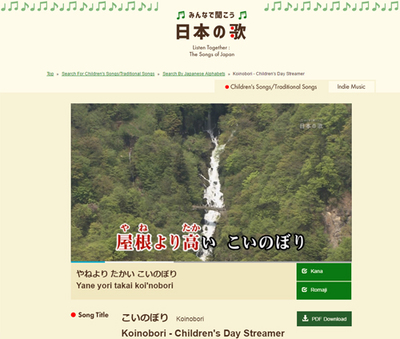
"Listen Together : The Songs of Japan" 「みんなで聞こう 日本の歌」 is a site where you can search for and listen to Japanese songs that suit your interests and the level of your Japanese language ability. Aimed at students of Japanese language and people from around the world who are interested in Japanese songs, language, and culture, this website features a collection of Japanese songs catalogued according to genre, theme, level of Japanese language difficulty, title, view ranking, and so forth.
The videos include lyrics that can be displayed in hiragana, katakana, or romaji. You can also download printable lyric sheets. The site is fully compatible with smartphones and tablets as well as standard desktop browsers.
The songs featured on “Listen Together” are traditional or independently produced.
We hope teachers and learners alike will enjoy using this resource! If you have any feedback, or even videos of you or your students singing these songs, please do share them with us! Take a look for yourself at http://nihon-no-uta.jp/.
A Japanese press release for “Listen Together: The Songs of Japan” can be found here.
31/05/2016
|
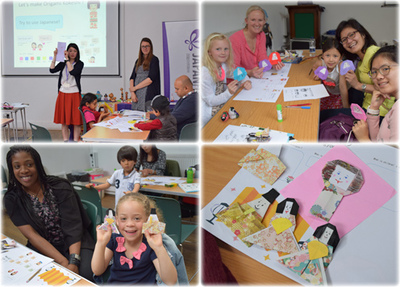
On May 28th 2016, more than 40 children and grown-ups came along to the “Japanese for Juniors” workshop held at Conway Hall by the Japan Foundation London, in which they learned a little Japanese language and culture while making origami Japanese dolls!
The workshop instructor, Mio Tsunematsu, introduced the meanings of different kinds of traditional Japanese dolls, and explained the culture associated with them. She also taught words in Japanese for describing dolls and toys, such as kawaii (cute) and kakkoii (cool), in addition to words and expressions that would help the participants when making origami, like different colours in Japanese.
Tsunematsu-sensei then explained how to make three types of Japanese doll through origami – hina ningyou, daruma and kokeshi. She explained this in Japanese with English interpretation, allowing participants to hear native Japanese language spoken naturally. Towards the end, all participants enjoyed watching a video to see how wooden kokeshi dolls are hand-crafted in Japan.
Although it was quite a challenge to make origami dolls, the children (and their accompanying grown-ups!) worked very hard and everyone did a fantastic job of making beautiful, kawaii dolls to take home with them. Many children were delighted with their achievements and said “yatta!” and “dekita!” (“I did it!”), Japanese words which they had just learned!
Some of the participants’ feedback included:
“Very well organised, staffed and resourced. Knowledgeable and kind (and patient!) staff who were excellent with the children. A lovely way to bring language and culture together.”
“Very, very good! My boys had fun and learned some Japanese. I could practise some Japanese too!”
“It was amazing to learn about Japanese culture through doll making!”
We would like to thank everyone who came to our workshop – ARIGATOU GOZAIMASHITA!
You can view photos from this event at the Japan Foundation Facebook page here.
19/05/2016

JFロンドンでは、JFスタンダード準拠教材『まるごと 日本のことばと文化』を使っている英国の先生方に対するサポートを企画しています。現在使用されている、または使用を検討している先生方は、かんたんなアンケートへのご協力をお願いいたします。
なお、『まるごと』についての詳細はこちらの書籍紹介ページをご覧ください。
If you teach Japanese using Marugoto text books with your students OR if you are considering using Marugoto in the future we would love to hear from you. We are thinking about setting up more support for teachers in the UK, so we'd like to find out who actually uses these textbooks, and what kind of support you might need.
If you teach using Marugoto please fill in our short questionnaire here.
If you would like to find out more about Marugoto, please take a look at the Marugoto Introduction page.
29/04/2016

On the 26th and 28th of April 2016 two groups of independent learners of Japanese joined Mio Tsunematsu, the assistant Japanese language advisor at the Japan Foundation London, to find out more about online resources available for Japanese language learning.
The event took place in King’s College London’s Language Resource Centre, so each attendee had access to a computer and the chance to try out resources for themselves. The workshop included an in-depth explanation of Marugoto Plus A2, a free website created by the Japan Foundation designed to help people study Japanese in their own time. Participants also had the chance to try out some of their new Japanese language skills in conversations with each other. The event finished with time for people to exchange ideas and tips about supporting Japanese language learning.
One participant commented, “I was aware of the website but it was interesting to be shown how to use it effectively.” Another told us the following: “The event looked very well organised with professional, enthusiastic and warm people helping out, which is very much appreciated when you are a complete starter like myself. I felt welcomed from the moment I walked in. Arigatou.”
We'd like to thank all the participants, and of course all the staff at King's College London, for making this event such a success!
We hope all participants will be able to continue Japanese with the resources introduced during these events.
07/04/2016
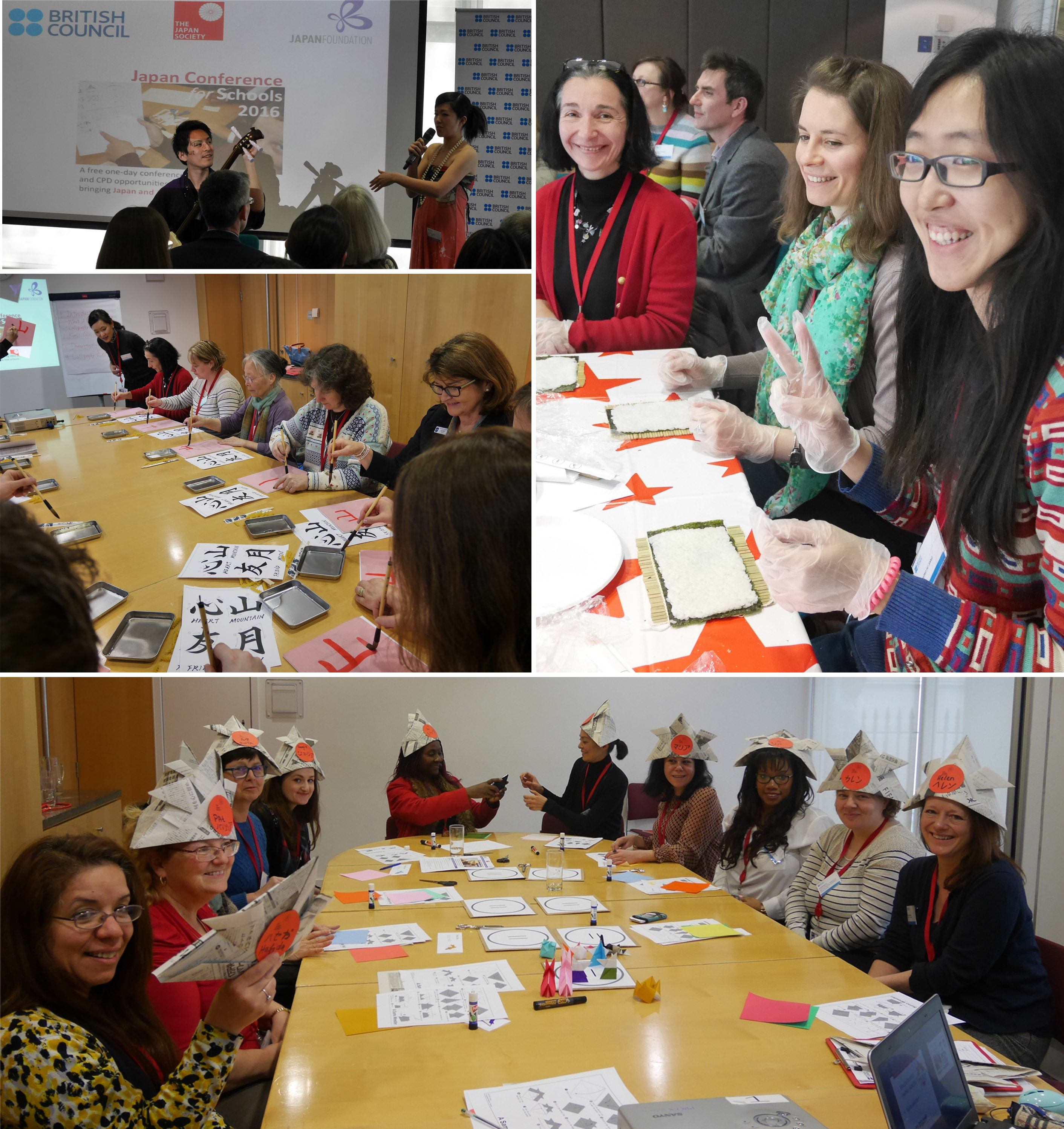
On March 7th 2016 nearly 100 participants joined the Japan Conference for Schools, held at the British Council in London. Co-organised by the British Council, the Japan Foundation and the Japan Society, the event was an opportunity for teachers to network and share practical ideas about projects for introducing Japanese into their schools or to enhance their existing Japan-related activities.
The event started with a welcome message from Mr Mark Herbert, the Head of Schools at the British Council and Minister Motohiko Kato, Minister Plenipotentiary from the Embassy of Japan. Next Baroness Jean Coussins, Co-Chair of the All-Party Parliamentary Group on Modern Languages in the House of Lords spoke about language education in the UK and how important it is to maintain less-widely taught languages like Japanese. Alan Greaves, from the Wavell School mentioned that it was “fascinating to hear insight into the workings of government by Baroness Coussins.” Participants were then transported to Japan with a performance from Hibiki Shamisen, who can visit schools to show off the beautiful sound of their Tsugaru shamisen.
This was followed by a full day of workshops and group discussions. There were cultural-related workshops teaching sushi, origami, kamishibai (Japanese storytelling), and calligraphy. In addition to this teachers could hear from Pearson about the new Japanese GCSEs, or learn about flipped learning resources or resources for primary level Japanese. Severine Mizeret from Gunton Academy told us the “calligraphy and sushi were fantastic workshops.” Mary-Grace Browning from County Upper School said that the “flipped learning was excellent- Just what I need!”
There were also group discussions on a wide range of topics from school linking and science exchanges to how to introduce Japanese into schools, how to prepare students for speaking exams, and an introduction to Online Resource for Japanese Archaeology and Cultural Heritage (ORJAC). There was lots of good feedback for each session. One teacher commented , “This was a really great event. As someone who knows a little (and not a lot!) of Japanese, I feel much more confident to teach the language.”
This year the conference had a fantastic turnout and included diverse mix of both primary and secondary schools, and was also a mix of schools that teach Japanese already, schools that are hoping to start as well as schools that run Japan related activities as clubs or as cross-curricular activities. Thank you to all the participants, speakers and the other organisers for making the conference such a success. We hope to see you again next year!
*Handouts from the conference are available to download below.*
**Photos supplied by the Japan Foundation London. More are available on our facebook page here.
18/03/2016
|
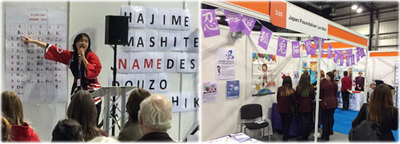
A big thank you to everyone who visited the Japan Foundation’s stand at the Language Show Live Scotland on March 10th and 11th at the Scottish Exhibition and Conference Centre (SECC).
The Japan Foundation’s stand gave visitors a chance to experience Japanese language and culture, including having a go at origami and contributing to our research into Japanese language education in the UK by taking part in our survey.
On Saturday, we were very lucky to be joined by Mihoko Pooley, Japanese language teacher at the University of Edinburgh, who held a Japanese Language Taster session. It was one of the most popular language tasters at the show, attended by enthusiastic language learners of all ages who learned some basic Japanese including greetings, self introductions and the writing system.
We would like to thank Pooley-sensei and all visitors for sharing in our Language Show experience. Doumo arigatou gozaimashita!
Japan Foundation will also be attending the 2016 Language Show Live in London on October 14th – 16th. We hope to see you there!
08/03/2016
|
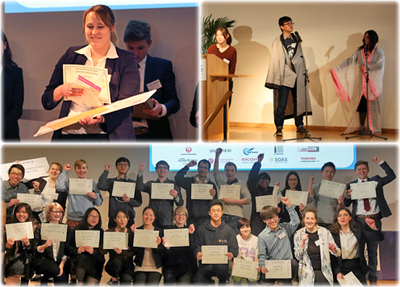
Chinese culture and society, gender roles in Japan and the drinking culture of Britain were some of the fascinating topics explored by finalists in the Eleventh Japanese Speech Contest for University Students, which was held on February 27th 2016 at SOAS University of London.
The day began with the Individual Presentation category finalists, all of whom are studying Japanese at post-beginner level. The presentations were all of a very high standard and it was very difficult for the judges to decide the winner. However, the first prize eventually went to Dennis Sun, a 1st year student from SOAS, for his powerful and enlightening presentation on “The Internet in China.” In second place was Danny Wray, a 2nd year student at the University of Bristol, for his highly entertaining and animated presentation entitled “Guinness: Ireland's National Drink.”
Speaking about his success, Dennis said, “I decided to enter the contest to give myself a challenge. Having been to Japan on exchange visits, I’d become more or less comfortable speaking Japanese casually among friends, so I wanted to take that a step further and practice my formal public speaking skills...On the day I was impressed not just by everyone’s level of Japanese but also by the genuinely fascinating contents of their various speeches and presentations.”
The Individual Presentation Category was followed by the Speech Category. All six finalists demonstrated not only exceptional Japanese ability, but also a great degree of insight and knowledge of their chosen subjects. After much deliberation, first prize was awarded to Laura Onciu, a 3rd year student at Newcastle University who was a finalist in the Individual Presentation Category at the Ninth Japanese Speech Contest, for her thought-provoking speech on “"Norms" that create reverse discrimination - Adverse effects of conventional wisdom in Japan.” Laura's prizes included prize money, a Japan rail pass and a plane ticket to Japan! The second prize was awarded to Joseph McElhill, a 3rd year at the University of Leeds, for his engaging speech on the theme of “The Importance of Non-Verbal Communication when learning Languages”. The third prize was awarded to Wanming Ding, who gave a fascinating insight into “Japanese anime: the reasons for its success and problems with further development.”
On explaining why she decided to enter the contest, one of the finalists in the Speech Category, Rosanna Jackson, commented, “There aren't many opportunities to have an audience of Japanese speakers who you can directly tell how you feel about an aspect of their society or your own society. It's an opportunity to start dialogue, no matter how small and that's why I entered the contest.”
This year’s Group Presentation Category gave beginner-level students the chance to give presentations on a topic of their choice. The four outstanding groups that made it through to Saturday’s finals were chosen from an initial 17 groups that applied, and represented University College London, SOAS University of London, Aston University and Imperial College London. They gave talks on “Traditional Chinese Festivals,” “Anime in our countries,” “Differences between England and China” and “South Kensington's Museum.” These groups were not placed individually, but instead received special prizes based on their chosen topics.
We would like to thank all participants, their teachers and supporters, the judges, audience members and BATJ for making the contest such a success. In addition, special thanks must go to the generous sponsors: Baker & McKenzie LLP, Bloomberg L.P., Central Japan Railway Company, Gendai Travel Limited, The Great Britain Sasakawa Foundation, Japan Airlines, Japan Centre, Job Tessio Inc., JP BOOKS, NHK World, Nikkei Europe Ltd., Oxford Brookes University, Ricoh UK Ltd, SOAS University of London, and Toshiba of Europe Ltd.

We would like to encourage as many undergraduate students of Japanese language as possible to apply for next year’s contest! Finally, students still at school may be interesting in applying for the Nihongo Cup Japanese Speech Contest for Secondary Schools, the deadline for which is March 31st 2016.
You can download the full results of the contest below.
All photos from the contest can be viewed at our Facebook page here.
02/03/2016

|
| JTS taster at Hunton Church of England Primary School |
These are some of the Japanese taster sessions that our volunteers in the Japanese Tasters for Schools (JTS) Programme have held in schools around the UK this year so far. We would like to thank all the volunteers for their extremely hard work on the programme!
If you would like to arrange a Japanese Taster Session at your school, or if you speak good Japanese and you would like to become a JTS volunteer yourself, click here to find out more about the JTS Programme.
 Gonville Academy, 2nd December 2016
Primary academy in Croydon
Aims of taster: Part of an International Day
Activities in taster: Japanese greetings, numbers in Japanese, Japanese writing
Feedback: "Both teachers delivered very engaging lessons to the classroom, which resonated with the children after they left. The lessons were geared appropriately to the children taught, and involved cultural references which the children very much enjoyed. The lessons were very active, and all the children participated throughout the lesson. The children 2 weeks later still remember the facts and songs that were taught during the lesson." (Miss Melvin, Class Teacher)
After the taster... The school is looking into funding for Japanese lessons.
St Matthias Church of England Primary School, 22 November 2016
Primary academy in Worcestershire
Aims of taster: Part of a Japan Day. Additionally, the school’s Head Teacher took part in the Japan Foundations’ Group Tour Programme for Head Teachers in Japan.
Activities in taster: Introduction to Japan, Japanese greetings, numbers in Japanese, origami, introduction to Japanese kanji characters
Feedback: "We thoroughly enjoyed the day. The children had the opportunity to learn different greetings - and how to count to 10. The volunteer was fabulous and showed classes a powerpoint all about Japan. I think the day will be very memorable to all." (Mrs Davies, Headteacher)
After the taster... The school is interested in starting Japanese lessons.
St Mary's Catholic Primary School, Whitstable, 18 November 2016
Primary academy in Kent
Aims of taster: School has links with Japanese student exchange programme in Canterbury
Activities in taster: Introduction to Japan, quiz about Japan, introducing Japanese numbers, making origami
Feedback: " The 2 volunteers were absolutely fantastic. They were enthusiastic and professional and all the children were incredibly engaged" (Mrs Underhill, MFL Coordinator)
After the taster... The school would like to explore the possibility of opening a Japanese club.
St Margaret's School, 17 November 2016
Independent School in Camden
Aims of taster: School interested in exploring the possibilities of extra-curricular Japanese
Activities in taster: Japanese greetings including bowing, making origami cats and dogs, learning Japanese numbers
Feedback: "A perfect blend of culture and language" (Mr Webster, Principal)
After the taster... The school and the pupils would like to continue their Japanese studies
Newman Catholic College, 18th October 2016
Voluntary Aided Secondary School in Brent
Aims of taster: Part of celebrating languages initiative at school.
Activities in taster: Japan quiz, Japanese greetings, introduction to Japanese writing, Japanese numbers and practising with “bingo” game
Feedback: " "The sessions were planned well with variety of opportunities to learn about the culture, language, facts and all had an aspect of fun and competition which really help engage our learners.” (Mrs Pattel Burke, Head of MFL)
After the taster... The school has said that they would love to start Japanese lessons
Westdene Primary School, 13th October 2016
Community Primary School in Brighton
Aims of taster: The Head Teacher visited Japan in Autumn with the aim of developing links and introducing Japanese into the school
Activities in taster: Japanese greetings, Japanese self-introductions, making origami kabuto (samurai helmets), making origami book marks
After the taster... The school has been awarded funding through our Japanese Language Local Project Support Programme to help them launch Japanese classes.
St Vincent's Catholic Primary School, 5th October 2016
Voluntary Aided Primary School in Barnet
Aims of taster: School interested in setting up a Japanese learning for KS1 group of SEN children.
Activities in taster: Japanese greetings, Japan quiz, Japanese numbers, Japanese janken (rock, scissors, paper) game, making origami dogs
Feedback: "Was really well planned, delivered at a really good pace." (Mrs Yatagai, Class teacher and Interventions Manager)
After the taster...The school are considering launching a Gifted and Talented group for Japanese
St Michael's Primary School, 28 September 2016
Community Primary School in Reading
Aims of taster: Year 6 learning all about Japan as their theme
Activities in taster: Introduction to Japan, quiz about school life in Japan, Japanese numbers, Japanese writing, writing names in Japanese, learning to use chopsticks.
Feedback: "The pupils really enjoyed learning to write their names in Japanese, and continued practicing them. Some students are now able to write their Japanese names from memory."
Avenue House School, 23rd September 2016
Independent Primary School in Ealing
Aims of taster: Part of “Asia Day”
Activities in taster: Japanese greetings, Japanese numbers 1-10, Japan quiz, telling Japanese story of “Tanabata,” making origami.
Feedback: "The volunteers were very organised, full of energy and enthusiasm. They targeted the different age groups very well. The children were full engaged throughout the lessons. A wonderful experience for the children - learning the language ,learning about the culture and participating in hands-on activities with the Origami activity." (Mrs Monteforte, Geography Co-ordinator)
After the taster...The school looked into the possibility of starting a Japanese club
Castle Hill High School, July 21st 2016
Community Special Secondary School in Stockport
Aims of taster: The school librarian who organised the taster is learning Japanese herself and wanted to introduce it to the pupils
Activities in taster: Greetings in Japanese (with bowing), Japanese numbers 1-10, introduction to Japanese writing
Feedback: "[The volunteer]was fantastic with our students and I was amazed at how quickly some of them picked up words and expressions as well as writing their own names!"
After the taster...The school plans to offer extra-curricular Japanese to all pupils
Longsands Academy, July 15th 2016
Secondary Academy Converter in Cambridgeshire
Aims of taster: Part of the school Arts Week with a focus on Internationalism
Activities in taster: Japanese numbers, Japanese greetings, writing names in Japanese
Feedback: "[The volunteer] was extremely helpful on the day and interacted really well with our students. We are very grateful to her for coming to deliver such a varied session covering aspects of Japanese language and culture which engaged our students."
After the taster...The school has been awarded funding through our Japanese Language Local Project Support Programme to help them launch Japanese classes.
Heaton St Barnabas' CofE Aided Primary School, July 14th 2016
Voluntary Aided Primary School in Bradford
Aims of taster: Part of International Week at school
Activities in taster: Greetings in Japanese, numbers 1-10 in Japanese, Japanese bingo game, learning other useful Japanese expressions
Feedback: "It was a great session, very well-pitched and paced. [The volunteer] delivered the session with enthusiasm and made it very interactive.. .it capped off a great week studying Japan for our Year 6s."
Chaddesley Corbett Endowed Primary School, July 14th 2016
Voluntary Aided Primary School in Worcestershire
Aims of taster: The school intends to replace French with Japanese throughout Key Stage 2.
Activities in taster: Greetings in Japanese, learning about Japanese school life, “Heads, Shoulders, Knees and Toes” in Japanese, making origami cats, learning Japanese numbers
Feedback: "Today's lessons were excellent. They were very well planned and included a lot of practical activity which really got the children engaged. [The volunteer] taught them interesting aspects of Japanese life and showed relevant photographs and props. The children were really interested and behaved very well. The quality of the questions they asked..showed the level of their interest. [The volunteer] was extremely positive and engaging. We were all really impressed."
After the taster...The school has been awarded funding through our Japanese Language Local Project Support Programme to help them launch Japanese classes. The Headteacher will be visiting Japan in the autumn.
The visit was also reported in the school newsletter, which said:
“Last Thursday, to fit in with our Japanese theme and Japanese language lessons next year, we had a Japanese language taster day. We were very fortunate to have a Japanese language specialist, Ceri Edwards, a volunteer from the Japan Foundation London, visit us for the day. Ceri taught KS2 lots of vocabulary including counting and doing mathematics in Japanese. We found out all about school life in Japan. In the pictures Year 3 were singing Head, Shoulders, Knees and Toes in Japanese! It was a very informative day and the children had a great time learning new skills which will be great foundation for our theme next year."
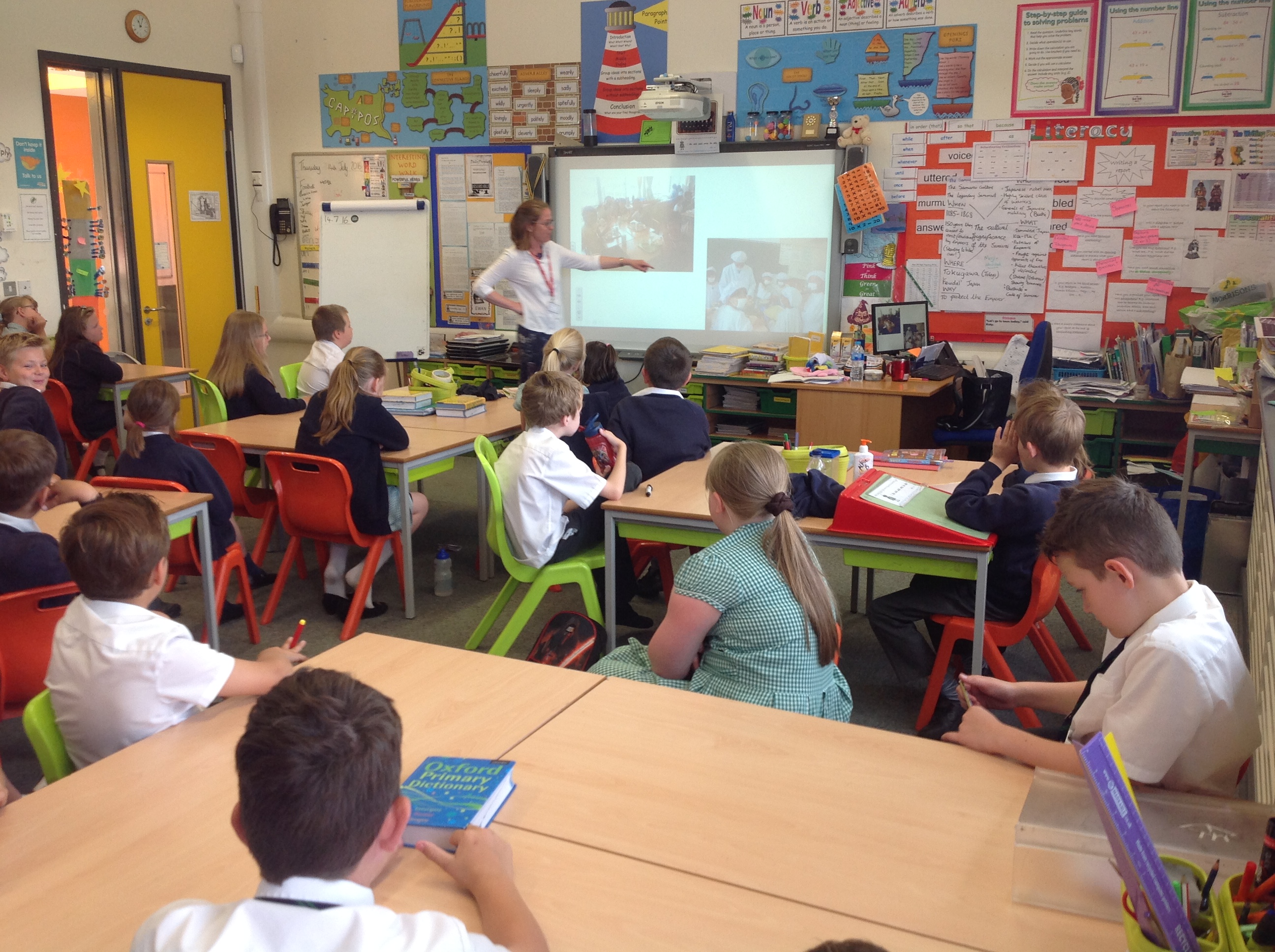
St Michael's Catholic College, July 4th 2016
Secondary Academy in Southwark
Aims of taster: In view of offering Japanese to the next Year 7
Activities in taster: Presentation about Japan, self-introductions in Japanese, describing likes in Japanese
Feedback: "The students really enjoyed learning about school in Japan." (Ms Vallade, Head of Faculty)
After the taster...Continue to be interested in starting Japanese classes
All Hallows Catholic School, July 12th 2016
Voluntary Aided Secondary School in Surrey
Aims of taster: Part of a cultural activities week
Activities in taster: Greetings in Japanese, Japanese numbers, name writing in Japanese, introducing about Japan
Feedback: "All students enjoyed it and particularly enjoyed writing their name in Japanese" (Mrs Sarrazin, 2nd i/c of MFL department)
St Anthony's Catholic Primary School, June 24th 2016
Voluntary Aided Primary School in Southwark
Aims of taster: The class is learning about Japan for a whole half-term as a cross-curricular project.
Activities in taster: Greetings with bowing, learning about the Tanabata “Star Festival” and making Tanabata wishes, learning Japanese numbers, self-introductions in Japanese
Feedback: "I would like to sincerely thank Kyoko for a wonderful session- the children loved it and learned so much! She was a fantastic teacher who had the children engaged and interested throughout. The children were all asking whether she would be coming back to teach them next week!”
After the taster... The taster was featured on the class blog here.
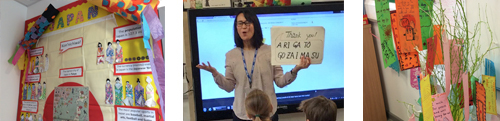
Ilford County High School March 21st 2016
Community Secondary School in Redbridge
Aims of taster: To promote language learning and exposure to different cultures, preceding the school’s international day celebrations later in the year.
Activities in taster: Greetings, self-introductions, numbers 1-100 in Japanese with kanji characters, saying age in Japanese, colours in Japanese, making bookmarks, introduction to Japanese writing
Feedback: "It was an insightful experience for the students and they enjoyed every aspect of it." (Mr Ababio, Head of Department)
Laureate Community Primary School and Nursery March 21st 2016
Community Primary School in Suffolk
Aims of taster: Part of the school’s 'Japan Day', following on from having read the book Kensuke's Kingdom by Michael Morpurgo throughout the term.
Activities in taster: Greetings, classroom expressions and self-introductions in Japanese, numbers 1-10 in Japanese with kanji characters, practising words from Kensuke’s Kingdom.
Feedback: "An excellent, fun and enjoyable morning" (Mr Wayland, Class Teacher)
After the taster...The school has enquired about resources for teaching primary Japanese.
Abbey Court Community Special School March 9th 2016
Community Special School in Medway
Aims of taster: Part of the school’s Japan Day for Key Stage 3 students
Activities in taster: Greetings in Japanese, counting numbers 1-10, singing a Japanese song, introduction to kanji.
Feedback: " I would very much like to commend the Japan Foundation on what they aim to do. It was an amazing experience you facilitated to allow our special pupils the opportunity to learn some basic Japanese in their own safe and fun environment. [The volunteer] was brilliant and settled very well to delivering each session that fit our pupils perfectly." (Mrs Bright, Class Teacher)
After the taster...The visit was featured in the school newsletter, which you can download here (visit report with photos on p.9). You can view more photos from the visit here.
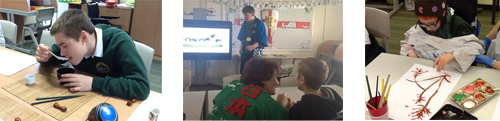
Hunton Church of England Primary School February 26th 2016
Voluntary Aided Primary School in Kent
Aims of taster: Part of the school’s “International Day” and to support the school’s newly-launched Japanese classes
Activities in taster: Introduction to Japan, Japan Quiz, learning greetings in Japanese to the tune of “Frere Jacques,” learning Japanese numbers, origami
Feedback: "Very well planned, exciting, interesting, fun and most importantly appropriate for the ages and the ability of the children taught. The children now excited to learn more about the language and the culture." (Mrs Gibbs-Naguar, Headteacher)
A report, including photos and a videos, from the visit can be found on the school’s website here.
After the taster...This school now teaches Japanese lessons, funded by the Japan Foundation’s Local Project Support Programme.
Baylis Court School February 4th 2016
Secondary Academy in Slough
Aims of taster: Part of the school’s PSHE day which involved learning about the wider community, combining Geography with MFL to get students to think about the importance of learning a language.
Activities in taster: Self introduction in Japanese (including bowing and Japanese sign language), learning the numbers 1-10 in Japanese, introduction to the Japanese film “My Neighbour Totoro”
Feedback: " "Fantastic, very fun and enthusiastic and interesting"
After the taster...The school is interested in finding a teacher to run Japanese classes.
The Wyvern School (Buxford) January 29th 2016
Foundation Special Secondary School in Kent
Aims of taster: Part of an art project looking at Japanese ceramics
Activities in taster: Greetings in Japanese, Japanese numbers, singing a Japanese song, writing Japanese characters
Feedback: "Very well planned and appropriate for the ages and the ability of the children taught. The children were very excited and talked about it for a long time after. It added an extra dimension to our topic on Japan." (Mrs Copeland, Art Teacher)
Riverside School, January 22nd 2016
Secondary Free School in Barking
Activities in taster: Greetings in Japanese, quiz about Japan, numbers 1-100 in Japanese, learning names in Japanese katakana characters
Feedback: "The students loved the taster. The delivery was very professional and the volunteers exceptional." (Miss Moseley, Head of Languages)
After the taster...The school now wants to set up an extra-curricular Japanese club
Carden Primary School January 22nd 2016
Community Primary School in Brighton
Aims of taster: Part of a “Japan Day.” The school was also interested in teaching Japanese.
Activities in taster: Self-introductions in Japanese, making origami samurai helmets, writing names in Japanese
Feedback: "Both [volunteers] delivered a lovely activity that all that engaged all the children.” (Mr McEwen, Head of KS2)
After the taster...The volunteer who ran the JTS taster now teaches a regular Japanese club at the school
Maria Fidelis Roman Catholic Convent School FCJ January 11th 2016
Voluntary Aided Secondary School in Camden
Aims of taster: To explore the possibility of launching extra-curricular Japanese classes
Activities in taster: Introduction to Japan, introducing numbers 1-10 in Japanese, Japanese kanji characters, Japanese self-introductions with bowing, telling the Japanese story of Tanabata.
Feedback: "The lesson was very well received and as a result, [the volunteer] has come back to deliver more lessons for our pupils.” (Mr Anthony, Deputy Headteacher)
After the taster...The volunteer who ran the JTS taster now teaches a regular Japanese club at the school
Husborne Crawley Lower School January 6th 2016
Community Primary School in Central Bedfordshire
Aims of taster: The school are interested in all things Japanese, and are interested in teaching Japanese
Activities in taster: Greetings in Japanese, Japanese numbers, singing a Japanese song, writing Japanese characters
Feedback: "Very well planned and appropriate for the ages and the ability of the children taught. The children now want to learn Japanese and find out more about Japan" (Mrs Isaacs, Headteacher)
After the taster...The school has since expressed an interested in offering Japanese language classes.
23/12/2015
|
We are delighted to share the latest two units of the JFL Scheme of Work for primary schools, written by Mr Makoto Netsu, the Chief Language Advisor for the Japan Foundation London as well as Dr Seiji Fukushima, former Chief Language Advisor and Dr Norifumi Hida, a specialist in drama education. You can download these units below. These resources include lesson plans, interactive whiteboard files, activites and more!
Unit 7: Trip to Japan
Unit 8: Red Demon Cried (Japanese story)
We will add these resources to the JFL Japanese Scheme of Work for primary schools page in the new year in 2016.
11/12/2015

The Japan Foundation are delighted to say okaerinasai (welcome back!) to Kelvin Liu, the UK participant of the Japanese-Language Programme for Outstanding Students of JF Japanese-Language Courses 2015. In this programme, a participant of the Japan Foundation’s Marugoto Japanese Language & Culture was selected to visit the Japan Foundation Japanese Language Institute, Kansai in Japan and to take part in activities to deepen their knowledge of Japanese language, society, and culture.
We interviewed Kelvin to find out what he thought about the programme and to hear all about his exciting experiences....
***
What did you like most about the Programme?
“The programme had exceeded all expectations by far. I was looked after from even before I flew from the UK to the minute of departure. My stay at Kansai Centre was great as the facilities at the centre was very good and all staff were very friendly and helpful. The location of the centre was conveniently sited, being next to Kansai Airport and within easy reach from Osaka. The location itself, Rinku Town was brilliant too as it offered a variety of shops and entertainment options. Each day was exceptionally great both during official hours as well as after hours. There was not a single day which I felt was average. Although this was mainly a study trip, there was still time in the evenings to do some of things I wanted to do like riding the Rinku Town Ferris wheel with others.
I was with 28 other participants from various countries and had the chance to practice speaking Japanese on a daily bases with someone who is also a learner. Although I was probably the weakest one in the group in terms of language ability being Elementary and not even done JLPT N5 and at times had difficulties understanding, nevertheless I still had great fun speaking the language and testing my language abilities to the limit. In the end, I made a lot of international friends and we still keep in contact via the Facebook group which I had created and through an instant messaging chat room.
The time when the programme took place was ideal. Being in autumn, I had the exclusive opportunity to see for myself what momiji (the red autumn leaves) is all about and learn why Japanese people appreciate the season so much. Furthermore, the Osaka Orienteering task took place on the 31st October which conveniently placed me in the city to witness how Japanese people do Halloween, which is very different to what we see here. It was 100 times better and the costumes varied hugely from being super kawaii (cute) to super kowai (scary).
The day which particularly touched me was the day when we visited the elementary school. The children were very well behaved, friendly and "genki" (lively). I have only ever witnessed a Japanese school in anime and films of which school settings are very popular. This visit has allowed me to experience what a typical school day for a young Japanese person is and see how a school is ran. Next time I watch something, I can better understand the scene setting and surroundings.”

How did the Programme help you to learn about Japanese and Japan?
“I returned to the UK knowing much more about Japan than I had before I left. I learnt about school and the Japanese education system. I gained keeper knowledge about religions in Japan and its shrine/temple culture and how Japanese people worship their kami-sama (gods).
By undertaking the two cultural activities, I gained a deeper knowledge into ikebana (flower arranging) and sadou (tea ceremony), for example, I never realised that conducting a tea ceremony involves so much work and such there are three year courses available just to learn how to serve tea! In the two hours I was there, I must have only had a brief glimpse of the art of sadou.
I had definitely improved on my conversational Japanese especially the usage of informal words, which wasn't taught in the Marugoto course or in past self-study text books.”
Do you have any advice for Japanese language learners thinking of going to Japan to study?
“My advice is just to go for it. It is very different between reading up about something to actually being there to experience it and speaking the language on a daily basis. Lots of knowledge to be gained, lots of fun, laughter and potentially friends for life.”
***
We may be offering the chance to participate in the Japanese-Language Programme for Outstanding Students of JF Japanese-Language Courses 2015 to participants of our Marugoto courses in the future. If you would like to receive updates about enrolment on the Marugoto courses and all our other activities, please sign up for our e-bulletin here.
20/11/2015
|
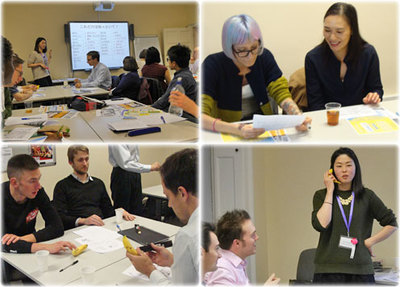
Yayakoshii (difficult), chau (different) and akan (no good) were some of the words of Kansai-ben (the dialect of Osaka and the surrounding Kansai region) that participants learned at the Japan Foundation’s Japanese Plus course for advanced learners of Japanese, which ran 11th – 19th November.
The course, attended by 36 participants in total over the course of two weeks, was led by the Japan Foundation’s Assistant Japanese Language Advisor, Mio Tsunematsu – who is also a native speaker of Kansai-ben. First, Tsunematsu-sensei introduced the Kansai region of Japan, and the image that Japanese people have of Kansai’s culture. She then taught participants the characteristic pronunciation, grammar and vocabulary that distinguishes Kansai-ben from standard Japanese. Participants had plenty of opportunities to have fun practising listening, speaking, reading and writing skills using Kansai-ben while learning more about Kansai culture: They listened to songs sung in Kansai-ben, read manga written in Kansai-ben, watched manzai (double-act comedy originating from Osaka) and even had a go at Osakan comedic art of nori-tsukkomi (playing along with a joke) by pretending to use bananas and chopsticks as phones and pens!
The participants had a lot of fun learning Kansai-ben, with many describing the course as “omorokatta” (“fun” in Kansai-ben)
We’d like to thank all participants for taking part in Japanese Plus, and we hope to see more people take part in our next course!
To learn more about Japanese Plus, please click here.
Photos from this event can be found on our Facebook page here.
18/11/2015
|
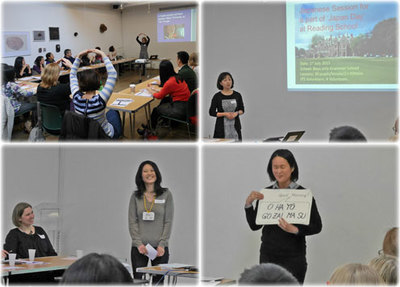
On November 16th 2015, 24 current and prospective volunteers attended a Training Day for the Japan Foundation’s Japanese Taster for Schools (JTS) Programme, in which native and fluent Japanese speakers conduct free Japanese taster sessions in UK schools. The Training Day was held at Conway Hall in London.
After an overview for new volunteers about the Japan Foundation and the JTS programme itself, the participants heard reports from volunteers who had held Japanese tasters at schools via the JTS Programme. Miss Lisa Barrett reported on her visit to The Priory School, which was an unusual taster as not only students, but also the teachers, took part as part of a staff training session. Next, Dr Eunmi Pearson talked about her visit to Reading School, which had been a complex visit involving 4 volunteers but had gone really well.
This was followed by workshops held by two of the JTS Programme’s most experienced volunteers. Mrs Kyoko Delaforce, who has been volunteering for JTS for over 2 years and has visited 8 schools, presented some of the ways to teach Japanese in Primary Schools, including the use of song. She was followed by Ms Emi Yabe, who has been a JTS volunteer for over 5 years and has visited 19 schools, and she presented on teaching activities for Secondary School pupils.
At the end, the Japan Foundation announced that we would now be issuing certificates and prizes to volunteers according to the number of schools they had visited, and presented volunteers present at the training day with a Silver or Gold certificate plus prizes.
All the volunteers enjoyed the training day and said that they found it useful. Miss Sarah Dopierala, who was attending the training day for the first time, said, “I was glad to meet people in our taster community and to get such wonderful ideas for sessions.”
We would like to thank all participants for coming, especially our guest speakers!
Photos from the event can be found here.
If you are interested in taking part in the JTS programme as a volunteer, please click here for more information.
02/11/2015
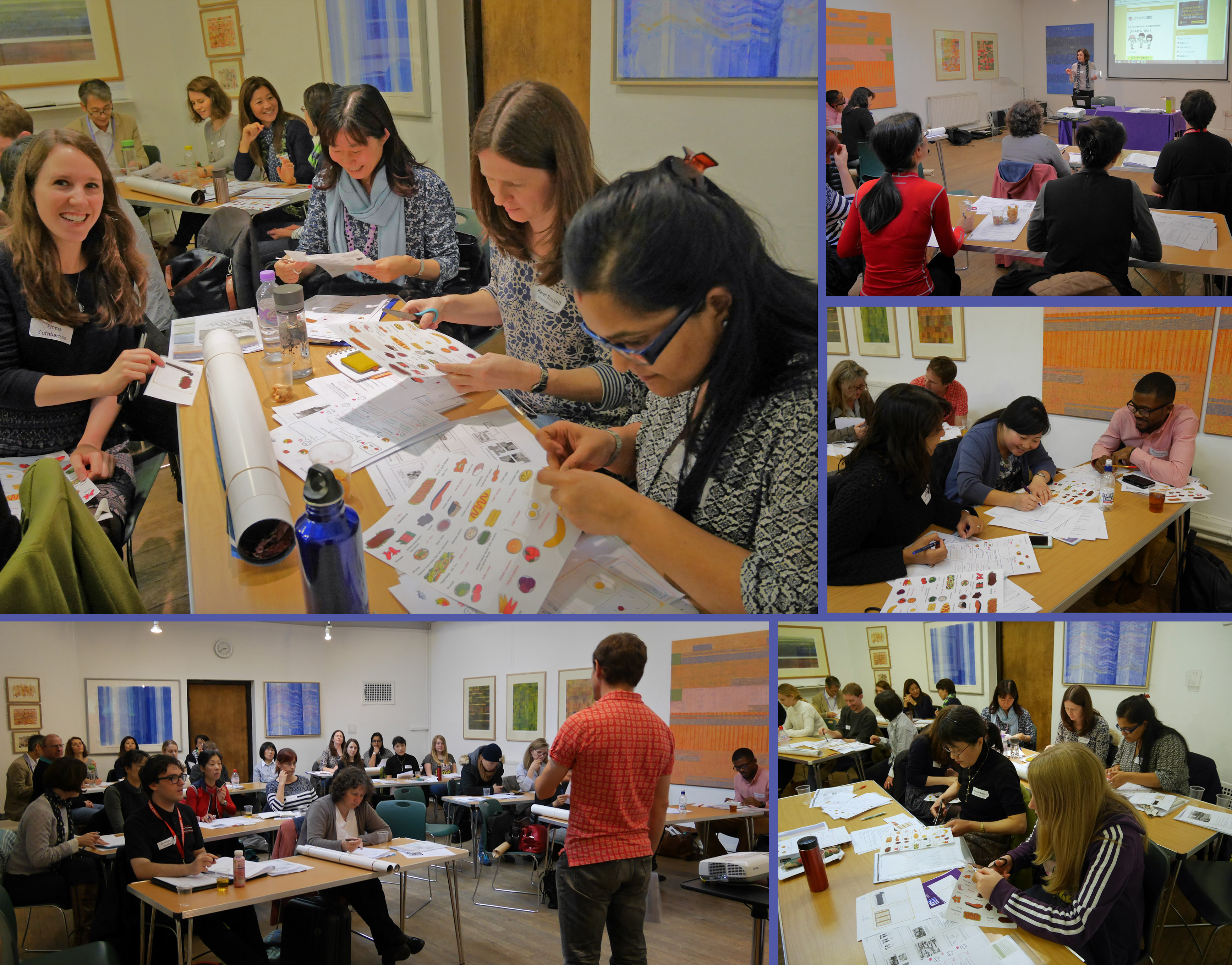 On the 29th October, 26 teachers came to Conway Hall to share ideas about how to teach Japanese as a club activity in schools. The event involved presentations by school teachers about their Japanese club activities, followed by discussion time to allow all the participants to share their own experiences and ideas.
First Alan Greaves from The Wavell School spoke about how students can experience Japan without ever leaving the UK. He shared ideas for excursions, such as visiting Club Taishikan, various museums, Japanese schools, Hyper Japan, a taiko drumming concert and Chiddingstone Castle. He also shared his school procedures and tips for ensuring excursions are fun, rewarding and safe. You can view videos of what Alan’s students thought about their trips here.
Next Yoko Leedham, from Thomas Hardye School, shared her ideas to help teach basic sentences in Japanese. She showed how she builds up students’ vocabulary at the same time as teaching hiragana, then how she teaches basic sentence structures to allow students to be able to say quite a lot, even with limited contact time.
This was followed by Dr Marina Sereda-Linley who introduced several te-asobi songs, including the original Japanese, the romaji versions, and their English translations. These would be excellent examples of authentic texts that could be fun to teach to children along with their hand gestures.
Lastly the Japan Foundation’s Assistant Japanese Language Advisor, Mio Tsunematsu, introduced her interactive lesson to teach about Japanese bento boxes. The participants then all had a go speaking to each other in Japanese to discover their food preferences so they could design each other a perfect bento box.
One participant, Tiki Ebun-Cole, commented that it was “great to come to these events as it’s a way of feeling connected to Japan and others working in promoting Japanese language and culture.” Another mentioned that there were “so many great ideas to take back to school!” The Japan Foundation would like to thank all the fantastic teachers that were willing to share their ideas.
If you are interested in the ideas and resources shared during this event, they are all available to download below.
28/10/2015
|
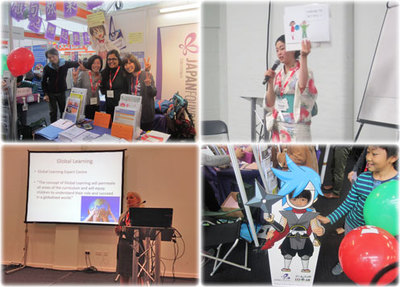
A big thank you to everyone who visited the Japan Foundation’s stand at the Language Show Live on 16th, 17th and 18th October at Olympia.
Held once a year, the Language Show is the UK's biggest event for language learners, teachers, linguists and anyone with a passion for languages. The Japan Foundation’s stand gave visitors a chance to experience Japanese language and culture, including writing their name in Japanese.
On Friday, we were very lucky to be joined by Catherine Rodrigues, teacher at St Edmund Campion Catholic Primary School Maidenhead and 2015 winner of the Association for Language Learning’s Primary Language Teacher of the Year for her work in Japanese. She held a seminar on her school as a case study of a UK primary school's mission to embed global learning into the curriculum by introducing a multi-lingual approach including Japanese. You can read more about her school here.
On Saturday, we held a Japanese Language Taster session led by the Japan Foundation’s Assistant Japanese Language Advisor, Mio Tsunematsu. It was attended by enthusiastic language learners of all ages, who learned basic Japanese greetings and the writing system.
Finally, on Sunday, the Japan Foundation held a presentation on kami-shibai (a traditional form of Japanese story-telling with pictures), and how this can be used effectively to teach not only Japanese, but any foreign language. This presentation used resources from the Japanese Language Scheme of Work for Primary Schools, as well as videos of students performing kami-shibai from the webpages of Tenbury Cof E Primary School and Holbrook Primary School, both previous winners of the Japan Webpage Contest for Schools.
Additionally, we held a Japan Quiz, which approximately 600 people entered.
The answers to the quiz were as follows:
1. What colour is the Japanese flag?
a) Red and yellow b) Red and white c) Pink and white
ANSWER b) The Japanese flag is a red circle on a white background
2. What is the Japanese art of artistic paper folding called?
a) Origami b) Kendo c) Karaoke
ANSWER a) Origami literally means “folding paper”
3. The kanji (Japanese character) 花(hana) means “flower” and the kanji 火 (hi) means “fire.” What do you think their combination, 花火, (hanabi) means?
a) Daisy b) Explosion c) Firework
ANSWER c) “Hanabi” means “firework” in Japanese.
Out of those who answered the quiz correctly, we picked five at random to send our Japan Foundation Goody Bag. Congratulations to Joyce from London, Jackie from Middlesex, Emma from Croydon and Artyom from Cambridge who have all been sent Goody Bags!
We would like to thank Catherine Rodrigues and all our Japanese Taster for Schools volunteers who generously donated their time and expertise for the show. Domo arigato gozaimashita!
Japan Foundation will also be attending the Language Show Scotland on March 11th and 12th 2016, and the 2016 Language Show Live in London on October 14th – 16th. We hope to see you there!
Click here to view more photos from the event.
19/10/2015
|
19th October 2015
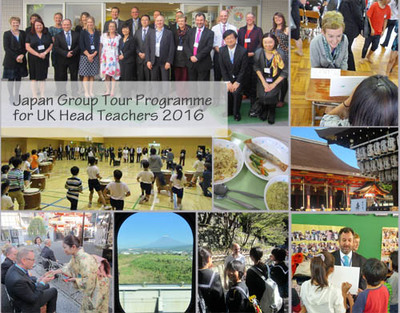
The Japan Foundation London is inviting travel agents based in the UK to submit their offer for the service of coordinating an organised group tour to Japan in February 2016. The necessarily procedures and specifications can be downloaded from here.
Because of the nature of the tour (i.e. most of the arrangements will occur within Japan), all the information concerning this procedure is provided in Japanese language only.
13/10/2015
The Japan Foundation is now accepting proposals for projects to receive Grants for Intellectual Exchange Conferences for the 2016-2017 fiscal year.
This grant provides support to non-profit making organisations (eg. institutions of higher education, research centres, think tanks, NGOs, cultural organisations etc.) wishing to carry out collaborative intellectual projects, such as international conferences, seminars and workshops, that address common challenges faced by Japan and other nations, or contribute to facilitating a greater understanding of Japan overseas.
To apply for the programme, please read the information on the Japanese Studies page carefully and contact Julie Anne Robb at the Japan Foundation to discuss eligibility. Projects should be implemented and completed between April 1st 2016 and March 31st 2017. The deadline for applications is Friday, 1 December 2015.
29/09/2015
|
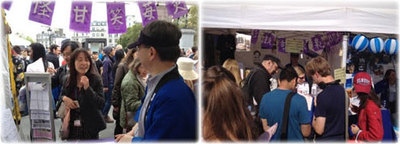
Japan Matsuri returned to Trafalgar Square in London on Saturday 19th September 2015. This popular annual festival brings members of the Japanese community and Londoners together to enjoy the many aspects of Japan with Japanese food, music, dance and other activities.
The Japan Foundation ran a stall at the festival providing information about studying Japanese in the UK, useful handouts about our support for schools and details about all of our upcoming events. In addition, we held a Japan Quiz, which 700 people entered.
The answers to the quiz were as follows:
1. What colour is the Japanese flag?
a) Red and yellow b) Red and white c) Pink and white
ANSWER b) The Japanese flag is a red circle on a white background
2. What is the Japanese art of artistic paper folding called?
a) Origami b) Kendo c) Karaoke
ANSWER a) Origami literally means “folding paper”
3. The kanji (Japanese character) 花(hana) means “flower” and the kanji 火 (hi) means “fire.” What do you think their combination, 花火, (hanabi) means?
a) Daisy b) Explosion c) Firework
ANSWER c) “Hanabi” means “firework” in Japanese.
Out of those who answered the quiz correctly, we picked three at random to send our Japan Foundation Goody Bag. Congratulations to the winners Holly from Hertfordshire, Ann from Hampshire and Sarah from Hertfordshire, who have now been sent their good bags!
Japan Foundation will also be at Bristol Anime Con on October 3rd, and the Language Show Live in London on October 16 - 18. We hope to see you there!
15/09/2015
|
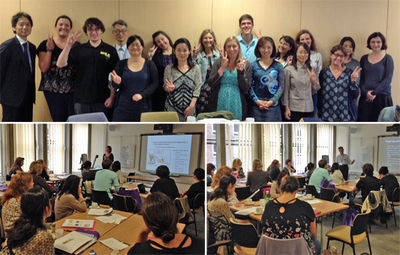
On the 8th of September, approximately 17 teachers came to the Institute of Education to share ideas about teaching Japanese in their primary schools and then hear about the new Japan Foundation Japanese Scheme of Work for Primary Schools. The event started with presentations from primary school teachers to share how they have used the scheme of work along with showing useful resources that they have tried in their classes.
First Catherine Duke, from Holbrook Primary School, in Trowbridge, introduced how to make animations with the children while they learn Japanese. She showed how her class had used an ipad and their own drawings to create an animation for “We’re Going on a Bear Hunt” which the children had narrated in Japanese. Catherine also showed lots of other ways this could be adapted to use kamishibai or other stories in Japanese.
Then, Helen Morris, from Madley Primary School in Herefordshire, showed how she used and adapted the Japan Foundation’s scheme of work for her classes. Her lesson plans extended the scheme of work to include shopping dialogues. Her pupils acted out shopping for cute erasers using animal vocabulary, colours and prices and then researched about Japanese erasers online. It was great to see how her classes loved learning and performing dialogues, especially when they could vary the vocabulary themselves.
Next , Yoko Leedham shared her lesson plans and ideas for her Japanese Enrichment classes at St Osmund's school in Dorchester. Yoko teaches a set of 7 weeks of Japanese classes including activities ranging from teaching basic greetings to making hanko stamps, and writing their names using Japanese calligraphy.
This was followed by a talk by Dr Marina Sereda-Linley who spoke about differentiation in Primary Japanese Lessons, giving several examples of how it is possible to give slightly different activities to children within the same class, depending on their competencies. Dr Sereda-Linley gave lots of concrete examples of using materials with different levels of support and different levels of challenge. She showed how it is possible to present ideas through auditory, visual and kinesthetic means, to help children’s varied learning styles.
Lastly the Japan Foundation’s Chief Language Advisor, Makoto Netsu, introduced the new resources for the Japan Foundation Japanese Scheme of Work for Primary Schools. These teaching materials have been tested with two classes of Year 4 pupils at Southfield Primary School so Mr Netsu gave explanations about how he has used them, and how they might be adapted for other primary Japanese classes. The resources themselves include worksheets, plans, activities, games etc.
One participant, Emily Mellor, commented “I feel very inspired to get started in school and have loads of ideas." Another mentioned that “It was very interesting to see what other teachers are doing in their classes." The Japan Foundation would like to thank all the fantastic teachers that were willing to share their ideas. If you are interested in the ideas and resources shared during this event, some of them are available to download below.
10/09/2015
|
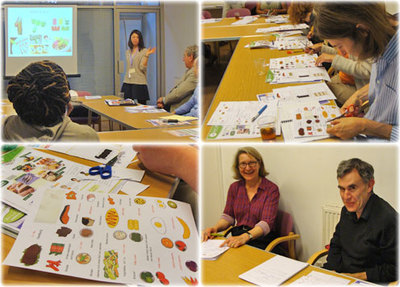
24 people had a chance to learn all about bento – Japanese boxed meals – as well as some basic Japanese at the Japan Foundation London’s Japanese from Scratch workshop for absolute beginners of Japanese language, which was held on September 8th and 9th.
Led by Mio Tsunematsu, Assistant Japanese Language Advisor at the Japan Foundation London, the workshop began with an introduction to the concept of bento in Japan, and the basics of what a good bento should contain. The introduction to bento also explored looking at what bento mean to Japanese people and the role bento play in Japanese culture.
This was followed by learning useful Japanese language, including vocabulary for common food found in bento and how to express likes and dislikes in Japanese. This vocabulary, and other useful words and phrases to do with eating in Japan, can be found in the Japan Foundation’s Marugoto A1 textbook and website.
Finally, participants enjoyed practising their new Japanese language skills by making partners their ideal bento using stickers!
Some of the comments from participants included:
“I enjoyed how interactive it was.”
“It’s been interesting and fun.”
“It was a great introduction to Japanese language and culture.”
“Everything was really nice! Thank you!”
We would like to thank all the participants for coming, and hope that this session has inspired them to learn more about Japanese and Japan!
You can view more photos from the event on our Facebook page here.
12/08/2015
|
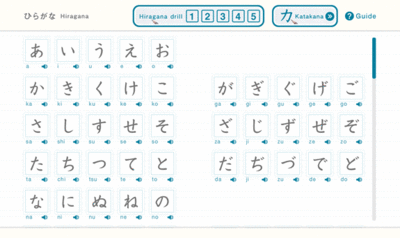
Whether you are about to start a Japanese degree course and need to learn the kana (the two basic Japanese scripts of hiragana and katakana) in advance, or are simply studying Japanese on your own and need a little help, here’s some helpful free resources that can give you hand in learning hiragana and katakana.
- Marugoto Plus (A1) – This has a fantastic Basic Training section for learning how to read and write hiragana and katakana. You can hear their pronunciation, see animations for how they are written, and even test yourself.
- Hiragana Memory Hint - Study hiragana the fun way using mnemonic pictures with this fun app from the Japan Foundation Japanese Language Institute Kansai! It includes mnemonic memory hints, quizzes and a hiragana table in which you can listen to how each hiragana is pronounced. It can be downloaded for free from iTunes, Google Play and Amazon.
- “Everything you ever wanted to know about the GCSE-Level Japanese Course” – Unit 1 – Pages 2-28 are all about how to read and write hiragana and katakana, and even include in-text links to the relevant tutorials on YouTube that will teach you how to write the kana, including very helpful mnemonics! This document is part of http://japanese4schools.co.uk , which has a lot of other very useful resources for beginner learners of Japanese.
- Nihongo ena – Beginner Kana Sites – The Nihongo e na Web Portal has a large list of carefully selected websites that can help you to learn the kana (hiragana and katakana) from scratch, complete with screenshots and descriptions so you can select the best resources for you
- Japan Foundation London’s Writing Resource Section – This section of our Japanese language teaching & learning resources page includes printable practise mats to help you learn how to write the kana, hiragana and katakana charts, and even a downloadable free “hand written” Japanese font so you can make your own learning resources!
10/08/2015
Performing Arts Japan Programme for Europe 2016-2017
The Japan Foundation is now accepting proposals for projects to receive Performing Arts Japan Programme for Europe (PAJ Europe) Touring and Collaboration grants for the 2016-2017 fiscal year. To apply for the programme, please read the information on the Performing Arts Funding page carefully and contact the relevant Japan Foundation office in Europe to discuss eligibility. The deadline for projects taking place between 1 April 2016 and 30 June 2017 is Friday, 30 October 2015.
Overview
Performing Arts Japan Programme for Europe (PAJ Europe) was started by the Japan Foundation in 2006 to revitalise and facilitate the exchange between leading artists in Europe and Japan. The main feature of this scheme is that this grant will be made available to those organisers based in Europe who are planning to organise Japan-related performing arts projects in European regions. The applications will be screened by an annually appointed panel of advisors who are specialists in the area of performing arts in Europe. Successful applicants will receive grants towards part of the cost of implementing their project.
To date, PAJ Europe has funded 116 projects (including 65 touring and 51 collaboration projects) of Japanese performing arts in both traditional and contemporary art forms. In the 2015-2016 fiscal year, 7 projects (3 Touring and 4 Collaboration projects) were selected under the programme, for a total amount of €85,000.
03/08/2015
|
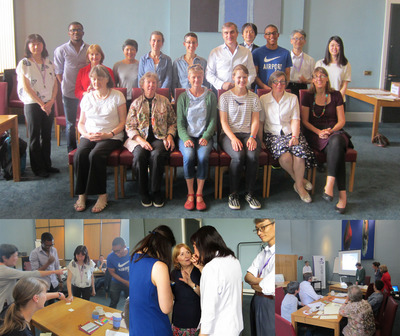
From July 28th to July 30th, 15 intermediate and advanced speakers of Japanese came to the annual Japanese Refresher Course for Teachers to refresh their Japanese to get ready for the new school year. This year’s attendees were non-native Japanese language teachers from a wide range of teaching backgrounds, including private tutors as well and primary and secondary school teachers.
The theme for this course was 「日本の最新事情」- "The Latest from Japan." This was a chance for participants to update their knowledge about Japanese society and culture, while brushing up their Japanese language ability. Lead by the Japan Foundation’s Japanese Language Advisors, Mr Makoto Netsu, Ms Hiroko Tanaka and Ms Mio Tsunematsu, the course gave participants the opportunity to explore various classroom activities and ideas for teaching Japanese.
The course began with a look at some Japanese TV adverts, showing how these can be used to teach Japanese and spark interest in students. This was followed with a video from the Japan Foundation’s Marugoto Plus website and collaborative reading (appropriate for various levels) about the changing roles of Japanese families. Next there was an introduction to some recent Japanese apps that provide an insight into Japanese culture. These included “Henshin camera” app that allows people to take interesting photos of themselves, an “amazing choir” app that makes your singing voice sound like a whole choir, “naki pita” app which is designed to play sounds to help stop babies from crying and a “sumimasen” app that will call out sumimasen in various different ways when someone is too shy to call out themselves. Finally, participants presented their own lesson plans for teaching Japanese using ideas related to one of these topics.
All participants enjoyed learning about new trends in Japan and exploring teaching methods. Several teachers also mentioned that it was great to have the opportunity to network and practice their Japanese with fellow Japanese teachers. Some of the comments we received from participants included:
- “The Refresher is always a much needed “injection” of new ideas for the Japanese classroom! ありがとうございます!(Thank you!) ” Kornelia Mund
- “I really enjoyed the CM and technology sessions. Mainly, it was great to meet other non-Japanese Japanese teachers.”
- “It was very good for networking and lesson planning ideas.” Jordan Cascoe
You can see photos of this event on the Japan Foundation’s facebook page. We would like to thank all participants for coming to the Refresher Course, and really hope to see them again at future events. お疲れ様でした!
16/07/2015

The Japan Foundation Japanese Studies Student Survey is part of the Japan Foundation’s periodic assessment of the state of Japanese Studies in the UK which has been conducted once every 3-4 years since 1996.
The Japan Foundation is Japan’s principal organisation for promoting international cultural exchange worldwide and through our funding programmes we offer support to organisations and individuals working in the field of Japanese Studies throughout the UK.
In order for us to consider future plans for the enhancement of Japanese studies, we are eager to learn the views of Japanese Studies students in the UK, both at undergraduate and postgraduate level, so that we can continue to support you and the field of Japanese Studies as effectively as possible.
Please note that the deadline for completing the survey has been extended to 30th September 2015.
Who can take part in the survey:
Any students undertaking Japan-related study at a higher education institution in the UK. Whether you are at undergraduate level or postgraduate, undertaking a single or joint honours Japanese Studies degree, or simply taking a module in a Japan related subject, we would be delighted to hear from you.
Taking the survey:
The survey can be accessed through the following link: https://www.surveymonkey.com/s/jssurvey_students
We estimate that the entire survey can be completed in around 15 minutes.
Deadline and Publication:
Please fill out the survey before 30th September 2015.
The results of the survey will be published in late 2015, and individual answers will remain anonymous.
You can find the results of the Japanese Studies Students Survey 2010 on the Japan Foundation Japanese Studies Survey website here.
Prize draw:
If you choose to provide us with your name and e-mail address, you will be entered into a prize draw, for a chance to win one of up to 10 Japan-related book tokens worth £20 each.
If you have any questions about the survey, please email Julie Anne Robb, Programme Officer for Japanese Studies and Intellectual Exchange, Japan Foundation London: julieanne.robb@jpf.org.uk
Japanese Studies Institutions Survey
As part of our overall assessment of the state of Japanese Studies in the UK, the Japan Foundation is also conducting a survey of higher education institutions in the UK which provide opportunities for Japan related study. If you are a member of staff at a higher education institution which offers Japan related study please get in touch with Julie Anne Robb to take the survey: julieanne.robb@jpf.org.uk
15/07/2015
|
A big thank you to the 2,000 visitors who came to the Japan Foundation’s stand at Hyper Japan on the 10th, 11th and 12th July 2015.
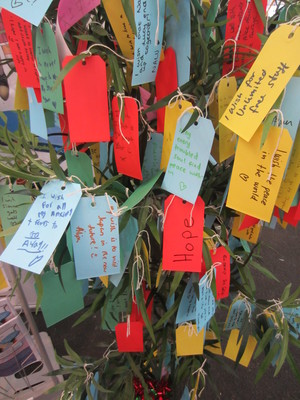
HYPER JAPAN is the UK's biggest celebration of Japanese culture, Japanese cuisine, and Japanese cool. The Japan Foundation London’s stand gave visitors a chance to find out more about Japanese arts and culture, and studying Japanese language. In celebration of the Tanabata “Star Festival” on July 7th, we also displayed bamboo on which visitors could make wishes by writing their wish on paper and hanging them on the branches.
One of the highlights of our stand was our Japan Quiz, which over 1,000 people entered.
The answers to the quiz were as follows:
1. What colour is the Japanese flag?
a) Red and yellow b) Red and white c) Pink and white
ANSWER b) The Japanese flag is a red circle on a white background
2. What is the Japanese art of artistic paper folding called?
a) Origami b) Kendo c) Karaoke
ANSWER a) Origami literally means “folding paper”
3. The kanji (Japanese character) 花(hana) means “flower” and the kanji 火 (hi) means “fire.” What do you think their combination, 花火, (hanabi) means?
a) Daisy b) Explosion c) Firework
ANSWER c) “Hanabi” means “firework” in Japanese.
Out of those who answered the quiz correctly, only twenty people could win the Japan Foundation goody bag. Well done to our lucky winners!
We also hope that everyone who wished on our Tanabata bamboo finds their wishes come true! Photos of some of the wishes can be viewed on our Facebook page here.
Join the Japan Foundation when we hit the road next time at the following events:
- August 22nd – Cardiff Anime Con
- September 5th – Alcon 2015
- September 19th – Japan Matsuri 2015
- October 3rd – Bristol Anime Con
- October 16th – 18th – Language Show Live
25/06/2015
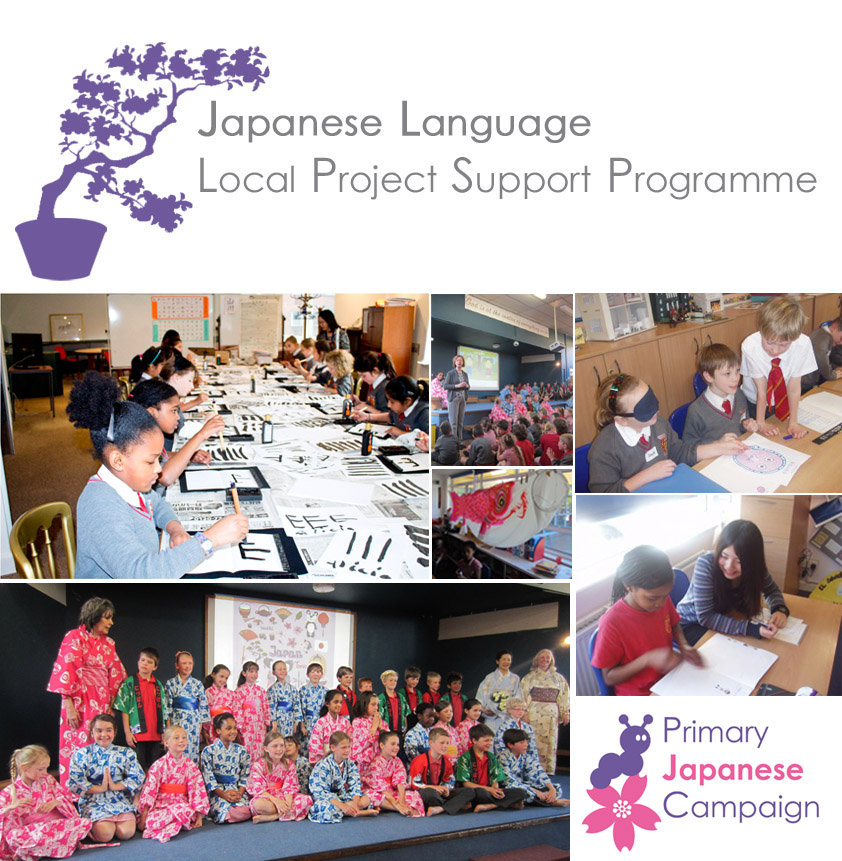
We have added an extra deadline for the Japanese Language Local Project Support Programme this year for primary schools.
If you are a primary school, and you are considering applying for funding for Japanese language classes in September 2015, please send in your application by the 14th of July 2015. In addition to this, there are two other deadlines left this year: September 18th 2015 and November 20th 2015. For further details and an application form, please see our funding page.
If you would like to see an example of the kind of activities primary schools have used to introduce Japanese, please see the case study on St Edmund Campion Catholic Primary School attached below, or the other case studies here.
25/06/2015
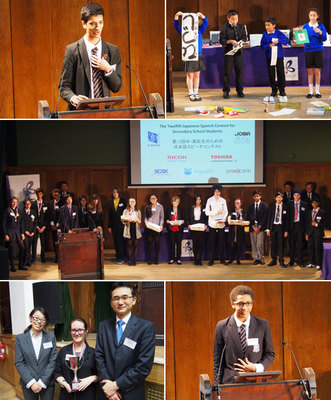
|
The Nihongo Cup Japanese Speech Contest for secondary school students was held at Conway Hall in London on June 20th 2015, open to the public for the very first time.
The 18 finalists, who had been selected from 180 applicants from 20 different schools across the UK, all demonstrated great creativity, thoughtfulness and outstanding ability in Japanese in performing their speeches – not to mention extraordinary courage to present their ideas in a foreign language to an audience of 180 people!
Between each of the three categories of speeches, the audience had the opportunity to watch presentations from schools that had taken part in the Japan Webpage Contest for Schools 2014-15, including Greenford High School, Hockerill Anglo-European College, Holbrook Primary School, Newstead Wood School and Wycliffe College. Their presentations not only showcased their fantastic websites, but also the work they had been doing with Japanese and Japan within their school.
Due to the extremely high level of Japanese and the thought-provoking content of the speeches delivered by all finalists, the judges had extremely difficult decisions to make when choosing the final winners of the 2015 Nihongo Cup. In the end, Grace Oliver (Key Stage 4 and 5 Post-GCSE), Oliver Binns (Key Stage 4 and 5 Pre-GCSE) and heo Nze (Key Stage 3) were awarded first prize in each of their categories.
Many congratulations and a big thank-you to everyone who came together to make the day such a success. The full results of the contest are as follows:
Key Stage 4 and 5 Post-GCSE Category
Winner: Grace Oliver (Queenswood School, Year 12)
Speech title: “Japanese Music”
2nd Prize: Chad Beaman (International Community School, Year 13)
Speech title: “Aikido”
3rd Prize: Rachel McVeigh (Newstead Wood School, Year 12)
Speech title: 「Japan and Confucianism」
Other finalists:
Yu Yeen Fung (St Helen’s School)
Jane Liu (Wycliffe College)
Christina Vivian (Greenford High School)
Key Stage 4 and 5 Pre-GCSE Category
Winner: Oliver Binns (Aylesbury Grammar School, Year 11)
Speech title: “How I imagined Japan to be like”
2nd Prize: Krishan Emmanuel (Harrow School, Year 11)
Speech title: “My Experience at Mount Koya”
3rd Prize: Ho Ting Lok (Whitgift School, Year 12)
Speech title: “Promise of Gunpla”
Other finalists:
Dominic Hilyer (Campion School)
Taranpreet Kalra (Greenford High School)
Yuhua Feng (Wolfreton School & Sixth Form College)
Key Stage 3 Category (Speech theme: “My Favourite Person”)
Winner: Theo Nze (Aylesbury Grammar School, Year 8)
2nd Prize: Japji Gaba (Greenford High School, Year 9)
3rd Prize: Gabby Sherwood (Oxford High School, Year 9)
Other finalists:
Anna Hayward (Queen Mary’s High School)
Luke Bassett (King Edward VII School)
Dan Bui (Dartford Grammar School)
Photos from the contest can be viewed on Facebook here.
The event was organised by the Japanese Language Committee of the Association for Language Learning, in association with the Japan Foundation London.
We are very grateful to Japan Centre, JOBA, JP Books, LinguaLift, Oxford Brookes University, Ricoh UK and Toshiba of Europe Limited donating prizes, to the Great Britain Sasakawa Foundation and Sumisho Computer Systems for their generous sponsorship, and to the Embassy of Japan for their support.
25/06/2015
This year the Japan Foundation London will carry out our Survey on Japanese Language Education in the UK. This is part of the Japan Foundation’s worldwide survey that takes place every three years and aims to find out about the state of Japanese language education around the world.
When the new school year starts in September, we will send details about this survey to every school and institution that we think teaches Japanese. If you know of any institutions that have recently started teaching Japanese, please do let us know, so that we can include them in this survey. We need to have an accurate idea about the state of Japanese language education in the UK. We hope this will enable us to find better ways to support both teachers and learners of Japanese.
I would like to thank you all very much in advance for your cooperation.
Kenichi Yanagisawa
Director General
Japan Foundation London
02/06/2015
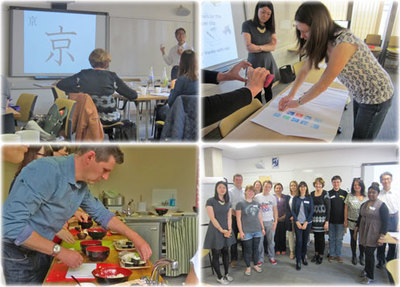
|
On May 27th and 28th, 14 teachers learned basic Japanese language skills through a wide range of fun and educational activities at Learn & Teach Primary Japanese, a course especially for primary school teachers learning Japanese from scratch as part of the Japan Foundation’s Primary Japanese Campaign.
The two-day course began at the Institute of Education in London, where teachers first learned some basic Japanese greetings and phrases for self-introductions. This was followed by a workshop in making Japanese hanko rubber stamps, taught by the Japan Foundation’s Assistant Japanese Language Advisor, Mio Tsunematsu. By learning about Japan’s hanko culture and in making their own, participants also learned the basics of the Japanese writing system. After lunch, the participants learned about the support available from the Japan Foundation for schools looking to start or further develop Japanese language provisions, and then found out more about travelling in Japan while learning Japanese language associated with visiting places.
On day 2, the participants came to Kuriya Keiko for a special workshop on making sushi. This began with learning Japanese vocabulary associated with food, taught by Makoto Netsu (Chief Japanese Language Advisor at the Japan Foundation London). The participants were then taught by Keiko Urakawa, proprietor and instructor at Kuriya Keiko, how to make different kinds of sushi. Despite most of the participants having never made sushi before, everyone created beautiful pieces of culinary art which they then ate for lunch!
After lunch, Netsu-sensei demonstrated how Japanese could be integrated into other parts of the curriculum, by teaching Japanese words and phrases associated with the topic of healthy eating. Much of this content can be found in Japan Foundation’s Japanese Scheme of Work for Primary Schools, which is free to download. Finally, everyone shared ideas about how they could integrate some of the activities and language skills they learned over the two days into their own lessons. All participants expressed that they had not only enjoyed the course but had learned a great deal as well – one participant said it was one of the best courses she had ever been on!
Some of the other feedback from participants included:
“Really friendly and well organised and delivered in a really friendly way.” (Chris Williams, Lavant C.E. Primary School)
“Excellent course, packed with useful information and very interesting activities.” (Elisavet Athanasiadou-Mangwana, St. Mary's School for Girls, Colchester)
“Cannot fault any part of the event/course. Teaching and materials second to none.” (Christopher Weadick, Burleigh Primary School)
We would like to thank all our participants for taking the time out of their half-term break to come on the course, and to everyone at Kuriya Keiko for their brilliant sushi workshop!
If you are interested in introducing Japanese at your primary school, you can find out more about the Primary Japanese Campaign here.
20/05/2015
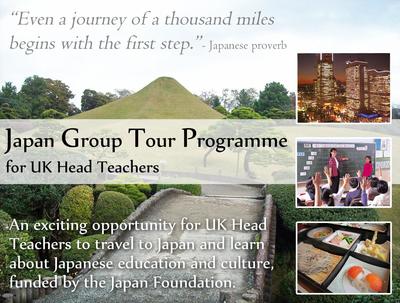
|
The Japan Foundation London would like to invite travel agents based in the UK to submit bids for the service of coordinating an organised group tour to Japan in this autumn. The necessarily procedures and specifications can be downloaded below.
Please be advised that all the relevant documents concerning this project are provided in Japanese as, due to the nature of the tour, we will require the successful travel agent to be able to communicate comfortably in Japanese.
13/05/2015
As a new financial year begins, funding (up to £1,500) is once again available in the area of Japanese Studies/Intellectual Exchange for projects that help to promote a greater awareness of Japan, as well as travel grants (up to £600) for applicants who are planning to visit Japan for research.
:: Click here for more information about the Local Project Support Programme and Study Support Programme.
13/05/2015
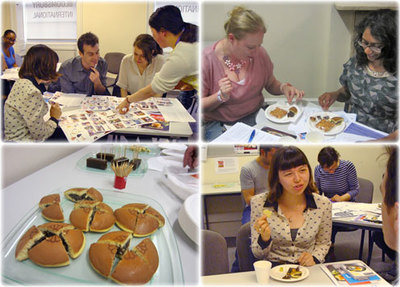
|
More than 30 people learned about the omoshiroi (interesting) world of Japanese sweets and souvenirs at the Japan Foundation London’s Japanese from Scratch workshop for absolute beginners of Japanese language, which was held on May 11th and 12th.
Led by Mio Tsunematsu, Assistant Japanese Language Advisor at the Japan Foundation London, the workshop began with an introduction to adjectives in Japanese, such as kirei (pretty), kakkoii (cool) and kawaii (cute). This vocabulary, and other useful words and phrases to do with sight-seeing and shopping in Japan, can be found in the Japan Foundation’s Marugoto A1 textbook and website.
After practising these words together in their groups, the participants then learned all about the Japanese culture of giving omiyage – edible souvenirs that one brings back home after travelling to share with friends and family, a culture that originates from the ancient customs surrounding pilgrimages. They also learned about the many different kinds of Japanese sweets, from traditional wagashi using ingredients such as pounded rice (mochi) and anko sweet bean jam, to Japanese versions of Western favourites such as the many different regional varieties of KitKat!
At the end of the session, all of the participants had the opportunity to try some oishii (tasty) Japanese sweets, such as daifuku (rice cakes filled with anko), dorayaki (pancakes with anko filling), and crisps flavoured with ume (Japanese plum) – all washed down with Japanese green tea!
Some of the comments from participants included:
“Very original (and delicious!) way to start learning Japanese.”
“Love the regional breakdown of sweets. Very interesting content for a first lesson”
“Very interactive and practical. Really useful!”
We would like to thank all the participants for coming, and hope that this session has inspired them to learn more about Japanese and Japan!
Photos from the event can be viewed on our Facebook page here.
23/04/2015
|
The British Academy is inviting applications from schools, colleges and other education providers, including supplementary schools, that encourage excellence in language learning. A total of 14 awards of £4,000 will be made to winners around the UK, plus an extra £2,000 for two national winners.
They are looking for exciting projects that encourage larger numbers of students to learn languages to a higher level. They are especially interested to receive applications that teach a wide range of languages or projects that include several languages.
We hope some schools teaching Japanese will be able to apply. You can see the flyer below, and find further information here.
10/04/2015
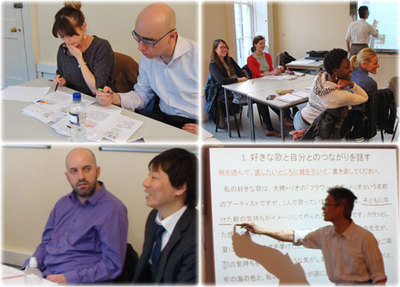
|
Japanese language learners discovered how to express what their favourite songs mean to them at this year’s first Japanese Plus course for advanced learners of Japanese, which ran 1st – 9th April.
The course, attended by 28 participants in total over the course of two weeks, was led by the Japan Foundation’s Chief Japanese Language Advisor, Makoto Netsu. In the first week, Netsu-sensei taught useful vocabulary and grammar structures for describing music and the feelings it evokes, and encouraged participants to talk to one another about their favourite song and artist. The participants then had the opportunity to put their new Japanese to the test by introducing their favourite song and Facebook, and share their opinions about each other’s musical preferences. In the second session, the participants examined each other’s Facebook comments and learned about the many ways people can express their feelings and opinions on the internet, including “Net Slang.” Finally, all participants were encouraged to continue their studies at home, by joining Japanese online music communities and chatting to others in Japanese on the net.
Some of the comments participants gave about the course included:
“It was just the right level for me. I enjoyed talking to others in my group.”
“It was fun, and Netsu-sensei was entertaining and easy to understand.”
“These two classes were very enjoyable – I hope to participate again soon!”
We’d like to thank all participants for taking part in Japanese Plus, and we hope to see more people take part in our next course!
To learn more about Japanese Plus, please click here.
02/04/2015
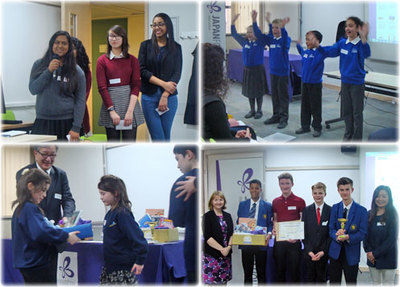
|
The Japan Webpage Contest for Schools 2014-15, which had taken place over the past six months, finally came to its conclusion at the Award Ceremony on March 28th at the Institute of Education in London.
Five schools had won prizes in the contest – Bexley Grammar School, Greenford High School, Hockerill Anglo-European College, Holbrook Primary School, and Prince Rock Primary School. The winner of the Gold Prize, taking home £1,000 worth of prizes, was Hockerill Anglo-European College for their website “Japanese at Hockerill” which the judges described as “a must-see website for all teachers and learners of Japanese.” Greenford High School were awarded the Silver Prize, worth £600, for “Admire Japan,” which appealed to the judges as “its attractive and easy-to-browse layout was combined with a wide breadth of excellent ideas and resources.” Holbrook Primary School won the £200-value for the Bronze Prize for “Japan Year,” which impressed the judges with “its excellent use of multimedia, including fantastic performances of songs and videos in Japanese by the pupils.”
Prince Rock Primary School’s “Japanese Club” and Bexley Grammar School’s “BGS Japanese Website” won the Primary and Secondary School Public Vote Awards, respectively.
Full details about the winning schools can be downloaded below. All websites that entered the competition can be viewed at the Japan Webpage Contest for Schools website, www.japanwebpagecontest.org.uk.
After receiving the awards, each school had the opportunity to present their websites and their Japanese and Japan-related projects. It was wonderful to hear how much effort both staff and students had put into their work, and to see them present with such enthusiasm.
We would like to thank all schools and supporters for their participation in this contest, and hope that all the schools continue their excellent Japan-related projects and inspire others!
This contest was supported by the Association for Language Learning (ALL), the British Council, Great Britain Sasakawa Foundation, Japan Centre, JP Books and the Japan Society.
Photos from the event can be viewed on our Facebook page here
The event was also reported in the Wiltshire Times.
01/04/2015
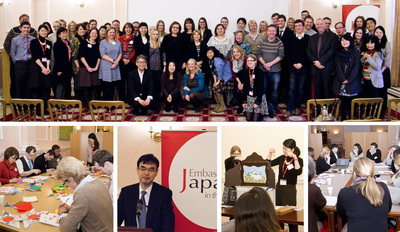
|
On March 3rd 2015 over 60 participants joined the Japan Conference for Schools, held at the Embassy of Japan in London. Co-organised by the Embassy of Japan, the Japan Foundation and the Japan Society, the event was an opportunity for teachers to network and share practical ideas about projects for introducing Japanese into their schools or to enhance their existing Japan-related activities.
Participants were welcomed to the Embassy by Minister Hideki Asari, Director of the Japan Information and Cultural Centre (JICC). This was followed by a key note speech by Lorraine Cooper, Deputy Head at Maryland Primary School about her fascinating educational research project. She visited Japan with her Headteacher, Lorna Jackson, as part of their research into critical thinking skills. It was very interesting to hear about what they learnt from Japanese schools, and how they have adapted these ideas to change some policies in their East London school and in the wider educational community.
This thought-provoking key note speech was followed by two workshops. Attendees were able to choose from the following:
- Finding a place for Japan in the Geography curriculum
- Kamishibai – a traditional form of storytelling in Japan
- Flipped Learning – Introducing Anne Rajakuma’s brilliant resources and giving a taster of how they can be used in the classroom to improve exam results
- Origami workshop
Helen Morris told us it was “useful to actually have teaching materials(as well as ideas) from Kamishibai and geography workshops.” Another participant mentioned that “these were all very informative, I particularly found the flipped learning session and secondary teaching ideas session very useful as we can take the ideas away and put them into practice straight away.”
A Japanese lunch was then followed by two sessions of small panel discussions, where attendees could join groups and learn more on the topic they were most interested in. This year the topics were things such as school linking, sharing teaching ideas, teaching Japanese to dyslexic students and introducing the Japan Foundation’s Key Stage 2 Scheme of Work.
The event was closed with a few words from the Deputy Director of the Japan Foundation London, Tomoki Akazawa. This year the conference had a good mix of both primary and secondary schools, and was also a mix of schools that teach Japanese already, schools that are hoping to start as well as schools that run Japan related activities as clubs or as cross-curricular activities.
Katy Simpson from Dartford Grammar School commented “The conference has inspired me to be creative! The whole day was a fantastic opportunity to network and share knowledge and ideas on how to inspire our students.” Another participant mentioned the event was “Extremely informative with fantastic ideas for teaching Japanese. I was really surprised by the abundance of teaching materials and funding opportunities”.
Thank you to all the participants, speakers and the other organisers for making the conference such a success. We hope to see you again next year!
*Handouts from the conference are available to download below.*
**Photos supplied by the Embassy of Japan
24/03/2015
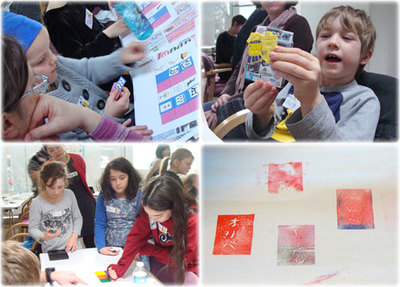
|
On March 22nd 2015, 33 children and grown-ups came along to a special “Japanese for Juniors” workshop held at Conway Hall by the Japan Foundation London, in which they took on the challenge of learning about the Japanese language while creating their own Japanese hanko stamps!
The workshop instructor, Mio Tsunematsu, began with explaining the three different writing systems of Japanese (hiragana, katakana and kanji) and their origin. The participants learnt that many kanji are derived from pictures of the things they represent, and attempted a puzzle in which they had to match the picture with the right kanji. The children were then given a special Japanese toy, “moji-bakeru,” which are plastic kanji characters representing animal names that can be reconstructed into a model of the animals themselves!
After transforming their moji-bakeru, the participants then learned how to write their names in katakana characters, and finally set about creating hanko stamps by carving their katakana names into erasers. It was quite hard work, but when the children came to stamp their names with ink, the results were fantastic!
The children, parents and all other participants really enjoyed learning Japanese and making hanko. Some of their feedback included:
“We learnt a lot about the Japanese language and had a lot of fun.”
“Very hands-on and well-targeted to this age group.”
“I loved making the Japanese toys and making my own stamp. I really want Mio to come to my school and teach Japanese!”
We would like to thank everyone who came to our workshop – ARIGATOU GOZAIMASHITA!
You can view photos from the event on our Facebook page here.
18/03/2015
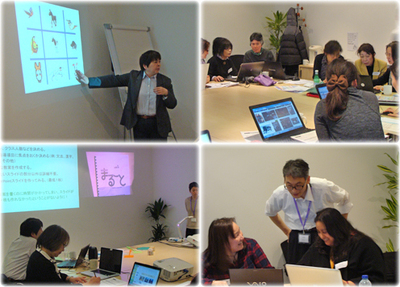
|
Approximately 25 teachers of Japanese learned how to employ ICT in creating fun and effective teaching resources at the “Make Your Own Japanese Teaching Resources with PowerPoint” seminars held at Japan Foundation London on February 19th and 20th.
Led by Hisaka Bunting, teacher of GCSE and A-level Japanese at Newstead Wood School and teacher of Japanese at several other schools, the seminar demonstrated how teachers can use Microsoft PowerPoint to enhance beginner-level Japanese classes. Giving real life examples from her own classes, Bunting-sensei provided step-by-step instruction on making effective and entertaining presentations, games and activities with PowerPoint. Participants were not only able to make their own PowerPoint resources in the session, but also had the opportunity to share their resources with each other.
Some of the feedback received from the workshop included:
“Excellent workshop...JF staff really helped and the lecturer gave us brilliant resources.” (Kazuko Gibson Koike)
“It was excellent, well-structured and fun.” (Angelica Kurtina)
We would like to thank Hisaka Bunting and all the participants for their contributions to the event.
12/03/2015
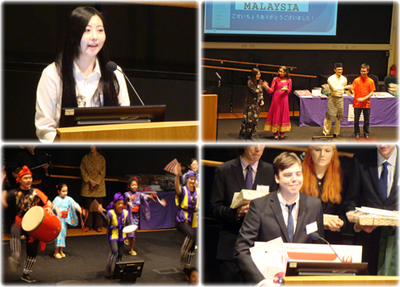
|
On February 28th 2015, the Finals Day of the Tenth Japanese Speech Contest for University Students was held at Regent’s University London, showcasing six individual speeches, five individual presentations and four group presentations by UK university students.
The day began with the Individual Presentation category finalists, all of whom are studying Japanese at post-beginner level. The presentations were all of a very high standard and it was very difficult for the judges to decide the winner. However, the first prize eventually went to Ying Liu, a 2nd year student from the University of Nottingham, for her powerful and moving presentation on “Homeless dogs in China.” In second place was Daren Sin, a 2nd year student at Imperial College London, for his fascinating speech entitled “Singlish: A language of Singapore.” Commenting on the reasons for choosing this subject, Daren said, “I ultimately chose to discuss about Singlish, because I thought it makes us unique from other cultures, like how I can easily identify Singaporeans in the UK from the way they speak!”
The Individual Presentation Category was followed by the Speech Category. All six finalists demonstrated not only exceptional Japanese ability, but also a great degree of insight and knowledge of their chosen subjects. After much deliberation, first prize was awarded to Ash Leigh Spreadbury, a 4th year student at the University of Sheffield, for his thought-provoking speech on “Globalisation and English Curriculum in Japan.” The second prize was awarded to Sakari Mesimäki, a 4th year student at the University of Cambridge, for his passionate speech on the theme of “Burikko vs. ’Career woman’ - How Japan’s culture of cute is getting in the way.” The third prize was awarded to Jason Peter Fernandes, who was also a finalist last year; this time, he spoke on the topic of “The portrayal of women in the Japanese media.”
On explaining why he decided to enter the contest, Sakari Mesimäki commented, “I enjoy all sorts of performing and have had some success with giving speeches before, so I thought I would give it a go. It's a good opportunity to practice Japanese too of course. And the prizes are amazing - that definitely motivated me to enter!”
This year’s Group Presentation Category gave beginner-level students the chance to give presentations on a topic of their choice. The four outstanding groups that made it through to Saturday’s finals were chosen from an initial 25 applications, and represented Imperial College London, SOAS University of London, the University of Nottingham and the University of Birmingham. They gave talks on “An Introduction to Malaysian Culture and Traditions,” “Tourism in different countries,” “Funeral customs – differences between the north and south of China,” and “The Cadbury family's Chocolate village.” These groups were not placed individually, but instead received special prizes based on their chosen topics.
Nikita Kamraj, who was part of one of the Group Presentation Category teams, said, “I found the whole experience incredibly enjoyable - from the initial preparation right up until the end of Finals Day. I had formed strong friendships with the all the members in my group, and whilst preparing for the contest was tiring at times, working together made it an overall fun (and less daunting!) experience. Finals day itself was an exhilarating experience, and it was great to see the support from both my past and present Japanese teachers.”
The full results of the contest can be downloaded below.
As a special treat to celebrate the 10th anniversary of the Speech Contest, the audience were entertained by the traditional Japanese music and dancing of London Okinawa Sanshinkai – and some members of the audience even got up on stage to dance!
We would like to thank all participants, their teachers and supporters, the judges, audience members and BATJ for making the contest such a success. In addition, special thanks must go to the generous sponsors: Baker & McKenzie LLP, Bloomberg LP, Central Japan Railway Company, Gendai Travel Limited, The Great Britain Sasakawa Foundation, Japan Airlines, Japan Centre, JP Books, Oxford Brooks University, Regent’s University London, Ricoh UK Ltd and Toshiba of Europe Ltd.
We would like to encourage as many undergraduate students of Japanese language as possible to apply for next year’s contest! Finally, you may be interested in attending the Japan Webpage Contest for Schools 2014-15 Award Ceremony and Presentation Evening on March 28th.
23/02/2015
.jpg) The Japan Foundation London were sad to say sayoonara to Senior Japanese Language Advisor Dr Seiji Fukushima, who transferred to Japan last month. Here is a message from Fukushima-sensei:
The Japan Foundation London were sad to say sayoonara to Senior Japanese Language Advisor Dr Seiji Fukushima, who transferred to Japan last month. Here is a message from Fukushima-sensei:
『2月7日に4年間働いたロンドンから日本に帰りました。英国の皆さんには、4年間、いろいろお世話になりました。ありがとうございました。
4年間の任期の後半は初等教育の教材づくりのため小学校に通いました。小学生は、授業が面白ければ参加してくれる、面白くなければ遊び始める、という非常に素直(正直?)な学習者でした。ただ、子どもたちが「面白い」と思った時の吸収力、学習能力は本当に素晴らしいです。今後、もっと多くの小学校で、子どもたちが日本語や日本文化を学ぶことを通して、世界の広さや自分の可能性を知ってほしいと思っています。
では、みなさん。世界のどこかで、またお目にかかる日を楽しみにしています。」
"On the 7th of February, I returned to Japan after working for four years in London. I would like to thank everyone in the UK who aided and assisted me in so many ways over those four years.
During the latter half of my time here, I frequently visited a primary school in West London in order to create primary education materials. The primary pupils were tremendously frank, participating eagerly if the lesson was interesting, or starting to play amongst themselves if it was not. But when they were interested, their learning ability was truly amazing. I hope that more and more children at more and more primary schools discover their own capabilities, and learn about the wider world, through learning about Japanese language and culture.
Thank you once again, everyone. Wherever you are in the world, I look forward to the day when we can meet again.”
Taking over from Fukushima-sensei, we are delighted to welcome Makoto Netsu. Here is a message from Netsu-sensei:
.jpg) 「新しい日本語チーフアドバイザーとして、福島さんのかわりに1月にロンドンに来た、根津誠(ねつまこと)です。今まで、さいたま市の浦和にある日本語国際センターで、世界の日本語の先生の研修を担当していました。それから、シドニーとクアラルンプールの国際交流基金でも仕事をしていました。とくに関心があるテーマは、小学校、中学校、高校の日本語教育、ほかの科目との連携、ICT、継承日本語語などです。イギリスの先生といっしょに仕事ができることが、とてもうれしいです。どうぞよろしくお願いいたします。」
「新しい日本語チーフアドバイザーとして、福島さんのかわりに1月にロンドンに来た、根津誠(ねつまこと)です。今まで、さいたま市の浦和にある日本語国際センターで、世界の日本語の先生の研修を担当していました。それから、シドニーとクアラルンプールの国際交流基金でも仕事をしていました。とくに関心があるテーマは、小学校、中学校、高校の日本語教育、ほかの科目との連携、ICT、継承日本語語などです。イギリスの先生といっしょに仕事ができることが、とてもうれしいです。どうぞよろしくお願いいたします。」
"My name is Makoto Netsu, and I arrived in London in January as the Japan Foundation’s new Chief Japanese Language Advisor, succeeding Seiji Fukushima. Previously, I have worked on teacher training programs at the Japanese-Language Institute, Urawa in Saitama city. I have also worked for the Japan Foundation at their offices in Sydney and Kuala Lumpur. My particular focus is on Japanese language education in primary and secondary schools, cross-curricular links between this and other subjects, ICT, and learning Japanese as a heritage language. I am very happy to be able to begin work with teachers in the UK. Thank you."
12/02/2015
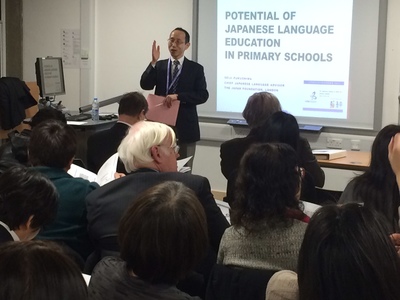
|
Dr Seiji Fukushima, the Chief Language Advisor for Japan Foundation London, has spent the last 4 years researching and teaching in London. For his final seminar in the UK, 58 attendees joined Dr Fukushima on the 20th of January 2015, to hear about the possibilities for Japanese language education in UK primary schools. The seminar included information about the current MFL policies in the UK, and how Dr Fukushima has worked on a scheme of work to encourage children to learn Japanese in a way that integrates cultural education, intercultural citizenship education and cross-curricular education. The scheme of work was trialled at a primary school in West London. Dr Fukushima told participants about how he encouraged children to keep learning and to create positive attitudes towards learning itself, which is crucial for citizens in a knowledge-based society. After the seminar Dr. Lid King, Director of the Languages Company, gave some comments about the seminar and then chaired a Q&A session. Attendees gave some fantastic feedback about the event. Peter Downes said that “The material provided is excellent and the philosophy underpinning it is valid and helpful.” Another attendee, Christopher Weadick said, “I found the children’s portfolios and media examples of work most useful as it gave a good comparison for work completed by my own group (aged 8-10). Attending this event has given me the confidence to continue club activities in future.” If you would like to download a copy of the Japanese Scheme of Work for primary schools please click here.
10/12/2014
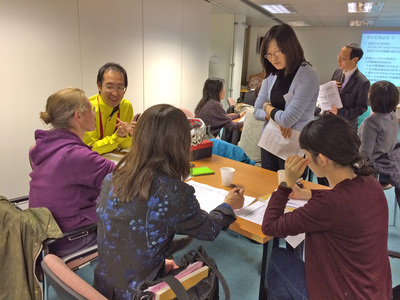
|
On 29th November 2014, the Japan Foundation London in conjunction with the British Association for Teaching Japanese as a foreign language (BATJ) held a seminar on using JF Standard as an assessment tool in Japanese language education. This was led by Mayumi Mitsuya, Japanese Language Senior Specialist at Japanese Cultural Institute, the Japan Foundation Rome, and was attended by approximately 20 teachers.
In the first part of the seminar, Mitsuya-sensei and the participants looked at different tests for assessing competence in accomplishing tasks, and examined what should assessed and by what criteria. This was followed by a workshop in which participants considered simple exam questions for measuring competence in accomplishing tasks and created a rubric to assess them. Participants also discussed what kinds of assessment can be used in their own classes and what form this assessment can take.
All the participants found the seminar helpful to their teaching strategies. Some of their comments included:
「現在『まるごと』を使って教えていて、評価作成も今後必要なので非常に勉強になりました。すぐに使えるアイデアもたくさんいただきました。」
(“I’m currently teaching with the Marugoto textbooks and needed to establish a form of assessment so this workshop was really useful. There were plenty of ideas that I feel I could use straight away.”)
「実はJFスタンダードについてあまりよく知らなかったのですがよくわかり大変勉強になりました。」
(“I didn’t actually know much about JF Standard previously but now I feel that I really understand it. “)
「実際の学習者の産出を見ながら言語活動と言語能力の評価の違いをディスカッションできたのは参考になった」
(“It was really useful to be able to discuss the difference between language activities and assessing language competence based on examples of actual students’ work.”)
We would like to thank Mitsuya-sensei for her enlightening talk, and all our participants for coming and their enthusiastic contribution to the discussions.
09/12/2014
The Japan Foundation, London will be moving from our current office at Russell Square House to new premises in Holborn as of 15 December, 2014. This will be a temporary arrangement until we move into a new office in central London in FY2016. We would like to thank you all for your continued support of our activities and we apologise in advance for any inconvenience caused by the relocation.
Please see below for full details of our relocation plans:
Close of business at Russell Square House: 12 December, 2014
Open for business at temporary office: 15 December, 2014
Temporary office address
Lion Court,
25 Procter Street,
London,
WC1V 6NY (3min walk from Holborn tube station)
T: 020 3102 5021 F: 020 3102 5022
The Japan Foundation Library
As of November, 2014 all operations related to the Library were suspended. Upon moving to our temporary office in Holborn, some operations including a limited borrowing service (postal only) may be resumed. Any resumption in services will be announced in advance via our website.
Events/language classes
Please note that while we will continue to hold our regular programme of events and Japanese language classes after relocating to Holborn the venue for each event may be different. Please see our website for full details of event times/venues.
28/11/2014
Ofsted have reacted very positively after observing a Japanese language class at Madley Primary school in Herefordshire. The school received the following comments in their Ofsted report:
“Pupils explore various religions and cultures, and have direct links with a range of schools around the world. This was typified by a lesson where pupils were being taught Japanese. Not only were they learning the language, but also aspects of Japanese customs and traditions. Such opportunities have resulted in pupils’ spiritual, moral, social and cultural development being a strength of the school.“
Madley Primary school started teaching Japanese this year after the headteacher, Lee Batstone, attended and was inspired by the Japan Conference for Schools, held at the Embassy of Japan in March 2014. The school started teaching a Japanese club and has maintained a link with a school in Japan for over a year. More recently Japanese has been linked into the curricular themes, and Japanese lessons have been introduced across Years 4 and 5. Mr Batstone also took part in the Japan Foundation’s recent Japan Group Tour Programme for UK Head Teachers, which he described as a “phenomenal experience,” that “really cemented why I think Japanese is a good language to teach”.
26/11/2014
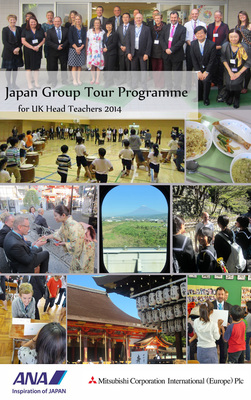
|
As part of the Japan Foundation’s Primary Japanese Campaign to support and encourage primary schools teaching Japanese language, we took 19 headteachers to Japan from October 25th to November 1st 2014 to give them the chance to learn more about Japan and the Japanese education system.
The programme included a whole range of Japanese cultural experiences to help deepen the headteachers’ understanding of Japan. They saw Japan’s modern side with a visit to the National Museum of Emerging Science and Innovation (known as Miraikan), spent some time near the giant robot-like gundam in Diver City, Tokyo and rode on Japan’s fastest train, the shinkansen. In Kyoto, they were able to experience Japan’s more traditional side, as they explored the areas around Kiyomizudera temple and Yasaka shrine on the East side of Kyoto.
The headteachers also spoke to the Deputy Assistant Vice-Minister, Mr Ken Okaniwa, at the Ministry of Foreign Affairs. They also visited the British Council in Tokyo. Lastly, they enjoyed inspiring seminars from Lori Henderson MBE, Executive Director of British Chamber of Commerce who spoke about business in Japan, as well as Professor Mark Langager of the International Christian University, who spoke about the Japanese education system.
The highlights of the programme were the visits to two Japanese schools, Fujimi Elementary School in Tokyo and Ooyake Elementary School in Kyoto. The UK headteachers had the chance to observe the Japanese education system first-hand, as they took part in English classes, observed a whole range of lessons, and spoke to the Japanese teachers. One headteacher said the following; “the two school visits were inspirational and it was delightful to meet such lovely staff. I now am keen to develop the project further to have a link school in Japan that we can work with.”
So far we have had fantastic feedback from the schools involved in this programme. One participant told us “I had some experiences which I will never forget and will talk about for years to come!” While another mentioned that was an “amazing experience, thank you!”
The Japan Foundation would like to thank all the headteachers for joining us, as well as ANA (All Nippon Airways Co. Ltd) and Mitsubishi Corporation International (Europe) Plc for their generous support for this Programme. If you would like to see some further photos from this trip, they are available on the Japan Foundation’s facebook page here.
18/11/2014
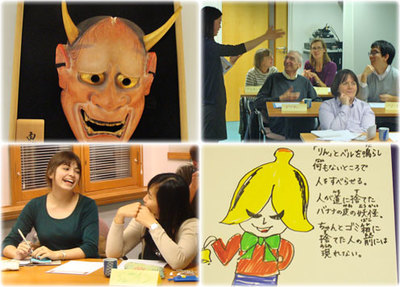
|
What exactly are yokai, the monsters and ghouls of Japanese folklore? How were they thought of, and what purpose did the stories about them serve? And what might they look like if transplanted into a different cultural context, such as the modern-day UK? These were just some of the questions answered by this month’s Japanese Plus course for advanced Japanese learners, “Friend or Foe? Understanding Japanese Thought and Culture through Yokai”, which ran from the 4th to the 12th of November.
The course, attended by 39 participants in total over the course of two weeks, was led by the Japan Foundation’s Assistant Japanese Language Advisor, Mio Tsunematsu. In the first week, the etymology and history of Japanese yokai were elucidated, with numerous examples examined from both traditional folklore and modern sources such as anime and manga. Week 2 focused on the purpose served by yokai legends, as explanations for natural phenomena or vehicles for moral instruction. Participants were then invited to create and illustrate their own yokai, adapted to reflect life in modern Britain, with imaginative and often amusing results.
All participants responded very positively to the course, particularly to Tsunematsu-sensei’s teaching and the opportunity to come up with their own yokai. Darcy Perkins, a Japanese Plus veteran, commented, “I like the courses because I get to maintain my Japanese, learn new Japanese and also learn something new about traditional or modern Japan.”
We’d like to thank all participants for taking part in Japanese Plus, and we hope to see more people take part in our next course!
To learn more about Japanese Plus, please click here.
12/11/2014
Programme Officer – Position Vacant
The Japan Foundation London
Salary: £23k to £25k depending on experience and qualifications
Expected start date: Early January 2015
THE ORGANISATION
The Japan Foundation is Japan’s principal organisation for international cultural exchange. We work principally in the fields of Arts and Culture, in Japanese Language Education, and in Japanese Studies and Intellectual Exchange. The Foundation’s activities are coordinated through our headquarters in Tokyo as well as through our cultural centres in over 20 countries across the world. The Japan Foundation London coordinates all of the Foundation’s programmes within the UK.
THE ROLE
The Japan Foundation London is seeking to appoint a Programme Officer to carry out the general administration and programming of its work in the area of Japanese Studies and Intellectual Exchange.
This is a full-time, permanent position, based at our office in central London. Applicants must already be eligible to work in the UK.
Working for the Deputy Director, the post holder will manage all grants applications within this field from initial screening through to grant project completion, and will be responsible for organising and promoting public lecture events and academic seminars/workshops. They will also maintain the Foundation’s public relations portfolio including overseeing the office e-bulletin, website, and social media accounts. Other duties will include proof reading documents in English, liaising as appropriate with other UK based organisations, and acting as a resource for fellow Japanese staff on all matters relating to the UK, including assisting with all general office maintenance arrangements.
The successful appointee will be qualified to at least first-degree level. Practical knowledge of the UK higher education system would be an advantage as well as broad general knowledge of UK policy and practice of international cultural and intellectual exchange. Proven administrative skills, the ability to work effectively as a team player and excellent IT skills are all essential requirements. IT skills should include proficiency in all MS Office software and intermediate ability in Photoshop. The appointee must have excellent written and spoken communication skills in English (native speaker level or equivalent). Upper intermediate Japanese language ability (N2 or above of the Japanese Language Proficiency Test) would be desirable. Previous experience of organising and promoting events would be advantageous.
APPLICATIONS
The deadline for applications is Monday 1st December 2014. Interviews will likely be held between Thursday 4th and Thursday 11th December.
Please send your CV and covering letter by post to Yui Ishikawa, Deputy Director at the address below, outlining the reason for your application and your experience and suitability for the role. Applications will only be accepted by post. Should you be unable to apply by post, please contact us before applying.
Enquiries: Please contact Hal Parker on 020 7436 6695 or e-mail hal.parker@jpf.org.uk
To apply, please send your CV and covering letter to: Ms Yui Ishikawa, Deputy Director, Japan Foundation London, Russell Square House, 10-12 Russell Square, London, WC1B 5EH, UK
10/11/2014
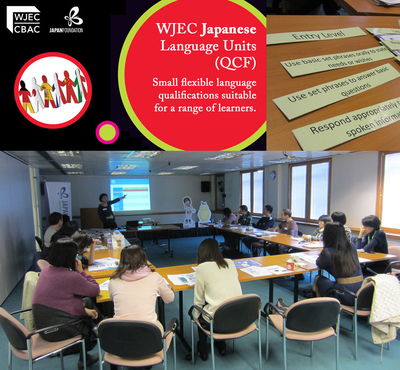
|
On the 22nd October 2014, 16 teachers of Japanese attended a seminar to learn more about WJEC’s Japanese Language Units. These qualifications can enhance Japanese language lessons by giving pupils the opportunity to gain formal recognition for their learning. The WJEC Language Units are small bite-sized QCF (Qualifications and Credit Framework) qualifications which enable learners to demonstrate their competence and progress by producing evidence in the classroom, rather than taking exams.
The workshop started with an overview about the support, funding and resources that are freely available for teachers of Japanese in the UK. This was followed by the introductory assessor training course from Claire Parry, the WJEC Vocational Qualifications Subject Officer. Claire spoke about the qualifications, and explained how to adapt the context and focus of the evidence to fit in with any school’s curriculum. Lastly Tadashi Sakai, a Japanese teacher from Wolverhampton High School for Girls, introduced the resources that he has been using to teach Japanese for these qualifications. These resources were created with Funding from the Japan Foundation’s Local Project Support Programme, and will soon be available (for free) from the WJEC website.
If you were unable to join us for this event, but you are interested in using these qualifications to accredit the Japanese language learning at your school, Claire Parry will be running other sessions to introduce these qualifications in Birmingham on 5th February 2015 and in Plymouth on 21st April 2015. You can find out more information here.
10/11/2014
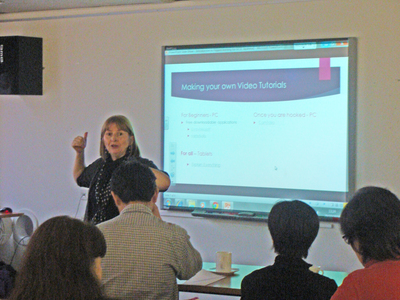
|
Forty teachers learned how to successfully combine technology with innovative teaching methods on October 29th 2014, at the Introduction to Flipped Learning for GCSE-level Japanese seminar held by Anne Rajakumar at the Japan Foundation London.
Head of Japanese at Hockerill Anglo-European College, Anne-sensei has used the Japan Foundation’s Japanese Language Local Project Support Programme funding to create a series of short video tutorials which she uses in conjunction with her self-created workbooks, “Everything you ever wanted to know about the GCSE-level Japanese course.” These videos are used to teach Japanese via the “flipped learning” method: Students learn vocabulary and grammatical patterns prior to using them in class through the videos, and can also consolidate their learning by watching the video after the relevant lesson. It is even possible for students to complete the Japanese GCSE course online if there is no specialist Japanese teacher available thanks to the videos.
In her presentation, Anne-sensei not only introduced her own videos and resources, but also explained how teachers can create their own multimedia resources for “flipped learning” and advised them on how best to use them with the students. She also demonstrated how effective the new “flipped learning” method has proved at her school, including video feedback from the students themselves.
Due to popular demand, Anne-sensei has created a website where her resources, including the videos, can be accessed for free: http://japanese4schools.co.uk
Anne-sensei’s presentation was followed by introductions to other resources and support services available through the Japan Foundation, including the new JFL Japanese Scheme of Work for primary schools and Japanese Taster Lesson Resource Activity Pack.
The seminar was well-received by all participants. Some of the comments made by participants at the end of the seminar include:
「わかりやすい説明で助かりました。」 (“The presentation was easy to understand and a great help”)
“Anne sensei’s generosity always impresses me & puts me to shame as I am not doing much”
「Flipped learningはGCSEだけではなく、他でも使いやすいと思います。勉強になりました。ありがとうございました。」
(“I think ‘flipped learning’ would be easy to apply to any teaching, not just for GCSE. Really useful – thank you very much!”)
We would like to thank Anne Rajakumar for giving such an inspiring presentation, as well as the staff and students of Hockerill Anglo-European School for supporting her activities, and of course all the participants who came to the Japan Foundation London for this event.
04/11/2014
The Institut Français, the Japan Foundation London and Network for Languages have created a new resource to support high-level language learning in the UK. This resource will help support students that study French at AS and A level in order to improve their oral communication in French while at the same time, widen students’ language skills to include basic Japanese. The resource can be used as part of a programme will include intensive day(s) dedicated to languages within the students’ curriculum.
We are now looking for schools that teach A-level French that might be interested in taking part in the programme. Their students will have the chance to improve their French, by using their French language skills as a tool to learn basic Japanese. Students will also be given the chance to explore both French and Japanese culture. Teachers do not need any proficiency in Japanese to take part in this project.
The resources are available to download below, or you can also find the on the culturetheque website from Institut français du Royaume-Uni. Please let us know what you think!
23/10/2014
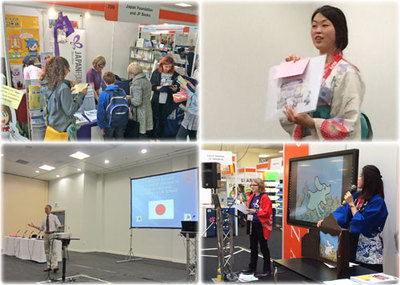
|
A big thank you to everyone who visited the Japan Foundation’s stand at the Language Show Live on the 17th, 18th and 19th October at Olympia.
Held once a year, the Language Show is the UK's biggest event for language learners, teachers, linguists and anyone with a passion for languages. The Japan Foundation’s stand gave visitors a chance to experience Japanese language and culture, including writing their name in Japanese.
On Friday, for the first time, the Japan Foundation held a presentation on kami-shibai (a traditional form of Japanese story-telling with pictures), and how this can be used effectively to teach not only Japanese, but any foreign language. This presentation used resources from the newly-developed Japanese Language Scheme of Work for Primary Schools, and Japanese Taster Lesson Sample Activity Pack.
On Saturday, we held a Japanese Language Taster session led by the Japan Foundation’s Assistant Japanese Language Advisor, Mio Tsunematsu. It was attended by enthusiastic language learners of all ages, who learned basic Japanese greetings and the writing system.
Finally, on Sunday, we were very lucky to be joined by Crispin Chambers, Head of Japanese at Tavistock College and winner of the Pearson National Teaching Award of Teacher of the Year in a Secondary School for his work in Japanese. He held a seminar on encouraging students to study languages by introducing them to less common, non-European languages (such as Japanese).
Additionally, we held a Japan Quiz, which approximately 700 people entered.
The answers to the quiz were as follows:
1. Japan is in which continent? a) Europe b) Asia c) Oceania
Answer: b) Asia. Japan is in East Asia.
2. What Hollywood film was inspired by Akira Kurosawa’s classic Japanese film ‘Seven Samurai’? a) The Magnificent Seven b) King Kong c) Jurassic Park
Answer: a) Seven Samurai. John Sturges’ 1960 movie The Magnificent Seven was inspired by Kurosawa’s 1954 movie, Shichinin no samurai, called “Seven Samurai” in English.
3. The kanji (Japanese character) 言means “words,” and the kanji 舌 means “tongue.” What do you think their combination, 話, means? a) To taste b) To read c) To speak
Answer: c) To speak. The Japanese word to speak is “hanasu” (話す).
4. What is Japan’s famous high-speed train, the Shinkansen, also known as? a) The Bullet-Train b) The Maglev c) The TGV
Answer: a) The Bullet-Train. The Maglev is the more recent “magnetic levitation” train, and the TGV is France’s high-speed rail service.
Out of those who answered the quiz correctly, we picked five at random to send our Japan Foundation Goody Bag. Congratulations to Luke O’Donovan, Michal Dzienio, Brigitte Barrett, David Bonnano and Honorata Radwanska who have all been sent Goody Bags!
We would like to thank Crispin Chambers and all our Japanese Taster for Schools volunteers who generously donated their time and expertise for the show. Domo arigato gozaimashita!
Japan Foundation will also be attending the Language Show in 2015, on October 16th, 17th and 18th at the Olympia, London. We hope to see you there!
21/10/2014
The Japan Foundation, London will be moving from our current office at Russell Square House to new premises in Holborn as of 15 December, 2014. This will be a temporary arrangement until we move into a new office in central London in FY2016. We would like to thank you all for your continued support of our activities and we apologise in advance for any inconvenience caused by the relocation.
Please see below for full details of our relocation plans:
Close of business at Russell Square House: 12 December, 2014
Open for business at temporary office: 15 December, 2014
Temporary office address
Lion Court,
25 Procter Street,
London,
WC1V 6NY (3min walk from Holborn tube station)
The Japan Foundation Library
As of November, 2014 all operations related to the Library were suspended. Upon moving to our temporary office in Holborn, some operations including a limited borrowing service (postal only) may be resumed. Any resumption in services will be announced in advance via our website.
Events/language classes
Please note that while we will continue to hold our regular programme of events and Japanese language classes after relocating to Holborn the venue for each event may be different. Please see our website for full details of event times/venues.
15/10/2014
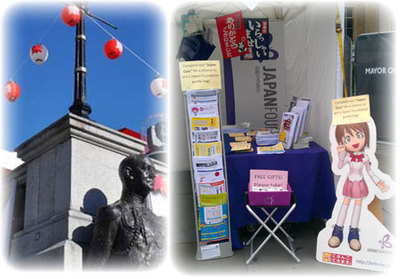
|
Japan Matsuri returned to Trafalgar Square in London on Saturday 27th September 2014. This popular annual festival brings members of the Japanese community and Londoners together to enjoy the many aspects of Japan with Japanese food, music, dance and other activities.
The Japan Foundation ran a stall at the festival providing information about studying Japanese in the UK, useful handouts about our support for schools and details about all of our upcoming events. In addition, we held a Japan Quiz, which over 600 people entered.
The answers to the quiz were as follows:
1. Japan is in which continent? a) Europe b) Asia c) Oceania
Answer: b) Asia. Japan is in East Asia.
2. What Hollywood film was inspired by Akira Kurosawa’s classic Japanese film ‘Seven Samurai’? a) The Magnificent Seven b) King Kong c) Jurassic Park
Answer: a) Seven Samurai. John Sturges’ 1960 movie The Magnificent Seven was inspired by Kurosawa’s 1954 movie, Shichinin no samurai, called “Seven Samurai” in English.
3. The kanji (Japanese character) 言means “words,” and the kanji 舌 means “tongue.” What do you think their combination, 話, means? a) To taste b) To read c) To speak
Answer: c) To speak. The Japanese word to speak is “hanasu” (話す).
4. What is Japan’s famous high-speed train, the Shinkansen, also known as? a) The Bullet-Train b) The Maglev c) The TGV
Answer: a) The Bullet-Train. The Maglev is the more recent “magnetic levitation” train, and the TGV is France’s high-speed rail service.
Out of those who answered the quiz correctly, we picked four at random to send our Japan Foundation Goody Bag. Congratulations to the four winners M.F Stringfellow from Brighton, , and Melissa Schuh, Samantha Junak and Ashaar Shaikh all from London, who have now been sent their good bags!
07/10/2014
The application forms for the Japanese Studies Fellowship Programme 2015 have now been released.
To receive an application form or to learn more about the programme contact Hal Parker or visit the programme list on our Tokyo site.
Application deadline: 1st December, 2014.
Please discuss your eligibility with the Japan Foundation before applying.
30/09/2014
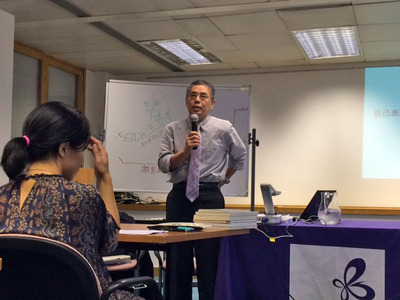
|
On Saturday September 20th 2014, 37 teachers of Japanese and other individuals in the field of Japanese language education came to the Japan Foundation London to take part in a seminar by Prof. Koichi Nishiguchi of the Center for International Education and Exchange, Osaka University. Prof. Nishiguchi has produced several well-known Japanese textbooks, including books in the Perfect Master Kanji and Minna no Nihongo series.
The seminar was co-organised by the Association of Japanese Language Teachers in Europe e.V.and Japan Foundation London as part of the JGap project to investigate articulation problems and possible measures within Japanese language education, using the UK as a model. It explored the theme “Self-Expressing Activities and Elementary Japanese Language Education.” In the first part of the seminar, Prof. Nishiguchi outlined the importance of social communication verses practical communication in terms of conveying one’s sense of “self.” This was followed by a workshop in which all participants discussed the issue and how they can effectively create their own self-expressing activities for their students within their classrooms.
Some of the feedback from participants included:
「とても勉強になりました!!」
(“It was really useful!!”)
「早速、使わせて頂きます。」
(“I’ll be using these ideas in the very near future.”)
「大変勉強になるセミナー、ワークショップを参加費無料で開催していただき、感謝しています。ありがとうございました。実践での活用、実際に使えそうなアイディアがたくさん盛りこまれていたのがよかったです。」
(“I’m so glad this really useful workshop and seminar was held for free – thank you. It was great that there were so many practical ideas that I can put to real-life use.”)
We would like to thank Prof. Nishiguchi and all the participants for contributing to such a lively and inspiring workshop.
25/09/2014
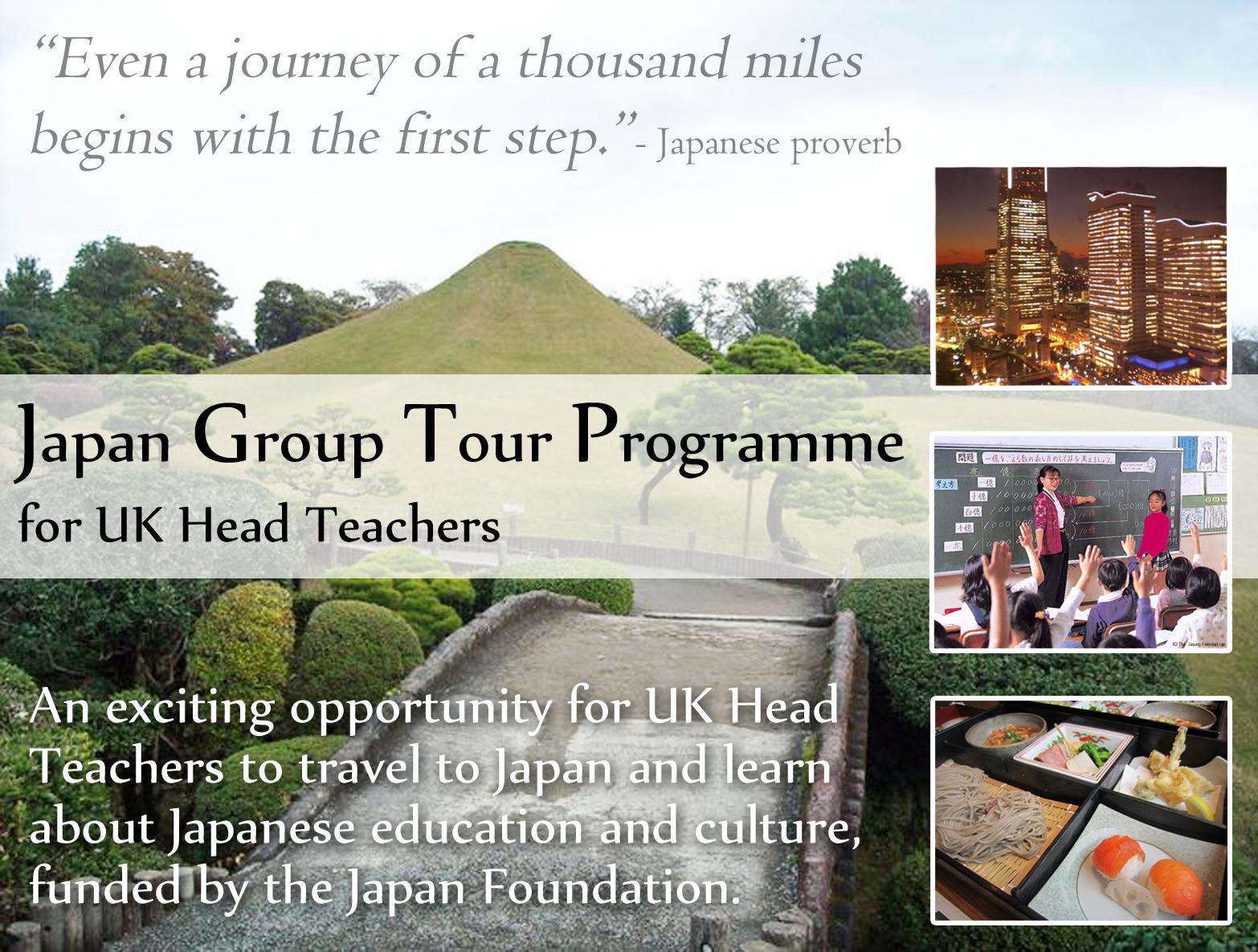
As part of the Japan Foundation’s Primary Japanese Campaign to support and encourage primary schools teaching Japanese language, we have invited 20 head teachers to take a study trip to Japan from the 25th October to 1st November on the Japan Group Tour Programme for UK Head Teachers. We are delighted to announce the names of the teachers that will be joining us:
Bowhill Primary School, Devon - Lynda Brooks, Headteacher
Brixham Church of England Primary School, Devon - Melody Easter, Headteacher
Charlton Manor Primary School, London - Timothy Baker, Headteacher
Coteford Junior School, Middlesex - Joanna Martin, Headteacher
Edwinstree Middle School, Hertfordshire - Julie Michael, Headteacher
Elburton Primary School Academy, Devon - David Bradford, Headteacher
Escomb primary School, Durham - Wendy Gill, Headteacher
Great Malvern Primary School, Worcestershire - Robert Bothma, Assistant Headteacher
Grimley and Holt CofE Primary, Worcestershire - Helen Hoarle, Headteacher
Madley Primary School, Herefordshire - Lee Batstone, Headteacher Netherthong Primary School, West Yorkshire - Catherine Jubbs, Headteacher
Prince Rock Primary School, Devon - Simon Spry, Headteacher
Southfield Primary School, London - Simon Prebble, Headteacher
St Andrew's Primary School, Bath - Susan East, Headteacher
St Marks CE Primary, Kent - Christopher Hollands, Deputy Headteacher
St Mary's School for Girls, Essex - Hilary Vipond, Principal
St Saviours Infants, Bath - Edward Harker, Headteacher
Tenbury C.E.Primary School, Worcestershire - Jill Grant, Headteacher
The Octagon AP Academy, London - Angela Tempany, Head of School
Tollgate Primary School, Suffolk - Alison Earl, Headteacher
The programme will include Japanese cultural experiences to help deepen their understanding of Japan, as well as a visits to Japanese schools in Tokyo and Kyoto to observe the Japanese education system first-hand. It will also provide an excellent opportunity to network with teachers in Japan, as well as with other head teachers in the UK whose schools are enthusiastic about Japanese.
23/09/2014
|
On September 12th 2014, 20 current and prospective volunteers attended a Training Day for the Japan Foundation’s Japanese Taster for Schools (JTS) Programme, in which native and fluent Japanese speakers conduct free Japanese taster sessions in UK schools.
After an overview for new volunteers about the Japan Foundation and the JTS programme itself, the participants heard a report from a volunteer who had held a recent Japanese language taster at the Charter School, a secondary school in London. This taster had proved to be challenging yet rewarding, and the participants found it really useful to hear about the volunteer’s real-life experiences.
This was followed by workshops by Hiroko Tanaka (Japanese Language Advisor and co-ordinator of JTS at the Japan Foundation), who introduced a number of enjoyable activities that volunteers could use in their own taster sessions. These included using the “Hiragana Rap” to learn the basic sounds of the Japanese language, playing matching pairs and board games to learn vocabulary, and the highly energetic game “Fruit Basket,” similar to “Musical Chairs” but great for practicing new Japanese words. Several of the activities introduced came from Japan Foundation’s own online resources, including Ready Steady NihonGO! , JFL Japanese Scheme of Work for primary schools and the draft version of the Japanese Taster Lesson Resource Activity Pack.
All the volunteers enjoyed the training day and said that they found it useful. Shraddha Payyapilly, who was attending the training day for the first time, said, “I have learnt about so many simple, easy and extremely effective techniques about teaching Japanese. I am extremely grateful and happy to be allowed as a part of this training day. Special thanks to Tanaka sensei. She is very motivating and kind.”
We would like to thank all participants for coming, especially our guest speaker!
If you are interested in taking part in the JTS programme as a volunteer, please click here for more information.
29/08/2014
The Japan Foundation is now accepting proposals for projects to receive Performing Arts Japan Programme for Europe (PAJ Europe) Touring and Collaboration grants for the 2015-2016 fiscal year. To apply for the programme, please read the information on the Performing Arts Funding page carefully and contact the relevant Japan Foundation office in Europe to discuss eligibility. The deadline for projects taking place between 1 April 2015 and 30 June 2016, is 30 October 2014.
Overview
Performing Arts Japan Programme for Europe (PAJ Europe) was started by the Japan Foundation in 2006 to revitalise and facilitate the exchange between leading artists in Europe and Japan. The main feature of this scheme is that this grant will be made available to those organisers based in Europe who are planning to organise Japan-related performing arts projects in European regions. The applications will be screened by an annually appointed panel of advisors who are specialists in the area of performing arts in Europe. Successful applicants will receive grants towards part of the cost of implementing their project.
To date, PAJ Europe has funded 109 projects (including 62 touring and 47 collaboration projects) of Japanese performing arts in both traditional and contemporary art forms. In the 2014-2015 fiscal year, 12 projects (7 touring and 5 collaboration projects) were selected under the programme, for a total amount of 142,000 euros.
28/08/2014
|
From August 18th – 20th 2014, 13 intermediate and advanced speakers of Japanese came to the annual Japanese Refresher Course for Teachers to refresh their Japanese before the start of the new school year. This year’s attendees were non-native Japanese language teachers from a wide range of teaching backgrounds, from private tutors to secondary school teachers.
This year’s theme was 「学ぼう!教室活動のネタ」- "Tips for class activities." The aim of the course was to explore various classroom activities and ideas for teaching Japanese, while at the same time brushing up on the teachers’ own Japanese language ability. Lead by the Japan Foundation’s Japanese Language Advisors, Dr Seiji Fukushima, Ms Hiroko Tanaka and Ms Mio Tsunematsu, the course gave participants the opportunity to explore all different kinds of teaching methods.
The course began with a look at some of the useful resources available for teaching Japanese – Reading Tutor and OJAD – followed by an introduction to teaching Japanese onomatopoeia using manga. This was followed by sessions on teaching Japanese using kinaesthetic learning; employing movement, dance and songs in order to re-enforce learning. Finally, participants presented their own tips for teaching Japanese
All participants enjoyed not only exploring teaching methods, but also the opportunity to network and practice their Japanese with fellow Japanese teachers. Some of the comments we received from participants included:
“Very useful practice. Excellent tips from JF staff, especially on grammar and very resourceful participants.”
(Olga Saburova, Rochester Grammar School)
“Very good balance of activities: song/dance/manga/grammar etc, targeting a wide range of age groups and abilities.” (Forum Mithani, Westminster Kingsway College)
“Overall, this was an excellent course. I would recommend it to all teachers of Japanese.” (Robert Fox, Aston University)
We would like to thank all participants for coming to the Refresher Course, and really hope to see them again at future events. お疲れ様でした!
You can download files from the Refresher Course below
26/08/2014
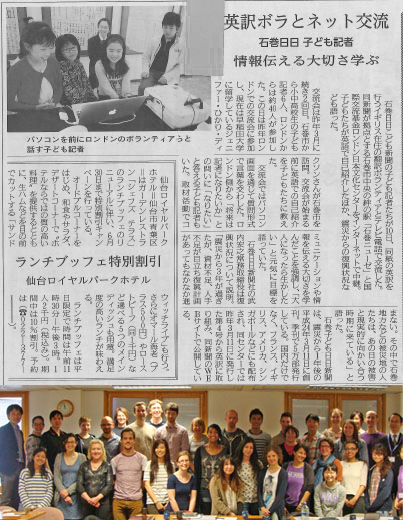
Ishinomaki is a city in Japan’s Miyagi Prefecture, and is one of the areas that suffered severe damage due to the Great East Japan earthquake and tsunami on March 11, 2011. As they began to rebuild, the children of Ishinomaki published Ishinomaki Hibi Kodomo Shinbun; a newspaper created by the children that reports the current activities in their city.
On May 10th 2014, the Japan Foundation London held a second translation event with the Ishinomaki Hibi Kodomo Shinbun; a newspaper created by Japanese schoolchildren that reports the current activities in their city. Ishinomaki is a city in Japan’s Miyagi Prefecture, and is one of the areas that suffered severe damage due to the Great East Japan earthquake and tsunami on March 11, 2011. The children created their newspaper one year after the disaster, and now, three years on from the tsunami, the children aim to tell Ishinomaki’s story to people all over the world. To bring this goal to fruition, 32 volunteers spent their Saturday morning translating articles from the newspaper into English. You can read a little more about the event here.
Now, the children are ready to tell Ishinomaki’s story to people all over the world. All the translated articles are available on the Ishinomaki Kodomo Shinbun website (click here to read more in English, or here for the Japanese website.) They also have a twitter feed, which you can follow here. We hope you will enjoy their articles in English. The Japanese versions of these article are not published online, however if you are interested in reading the latest copy of the Ishinomaki Hibi Kodomo Shinbun, there are still some copies available at the Japan Foundation London, just outside the library.
We would like once again to thank all volunteers for giving up their time on this project, and to the organisers and children at Ishinomaki for their very genki participation!
21/08/2014

|
A big thank you to the 2,000 visitors who came to the Japan Foundation’s stand at Hyper Japan on the 25th, 26th and 27th July 2014.
HYPER JAPAN is the UK's biggest celebration of Japanese culture, Japanese cuisine, and Japanese cool. The Japan Foundation London’s stand gave visitors a chance to find out more about Japanese arts and culture, and studying Japanese language.
One of the highlights of our stand was our Japan Quiz, which around 1,300 people entered.
The answers to the quiz were as follows:
1. Japan is in which continent? a) Europe b) Asia c) Oceania
Answer: b) Asia. Japan is in East Asia.
2. What Hollywood film was inspired by Akira Kurosawa’s classic Japanese film ‘Seven Samurai’? a) The Magnificent Seven b) King Kong c) Jurassic Park
Answer: a) Seven Samurai. John Sturges’ 1960 movie The Magnificent Seven was inspired by Kurosawa’s 1954 movie, Shichinin no samurai, called “Seven Samurai” in English.
3. The kanji (Japanese character) 言means “words,” and the kanji 舌 means “tongue.” What do you think their combination, 話, means? a) To taste b) To read c) To speak
Answer: c) To speak. The Japanese word to speak is “hanasu” (話す).
4. What is Japan’s famous high-speed train, the Shinkansen, also known as? a) The Bullet-Train b) The Maglev c) The TGV
Answer: a) The Bullet-Train. The Maglev is the more recent “magnetic levitation” train, and the TGV is France’s high-speed rail service.
Out of those who answered the quiz correctly, only five people could win the Japan Foundation goody bag. The lucky five were Simon, Kristian and Edward from London, Roshni from Middlesex and Lynn from Essex. Well done to them!
Don’t forget that the Japan Foundation will be at Alcon (Anime League’s Anime & Gaming convention at De Montford University) on September 6th and 7th, and at Japan Matsuri at Trafalgar Square on September 27th. We hope to see you there!
07/08/2014

On the 1st of August 2014, 12 primary teachers joined Japan Foundation staff for an introduction to both the Japan Foundation’s new Japanese Scheme of Work for Key Stage 2, and easy to follow resources that can be used alongside the Scheme of work. These teaching materials have been created by the Japan Foundation’s Chief Language Advisor Dr Seiji Fukushima, and have been tested with two classes of Year 3 pupils at Southfield Primary School. Participants were each given exclusive draft versions of the resources, and Dr Fukushima gave explanations about how he taught his class, and how his resources might be adapted for other primary Japanese classes. The resources themselves include worksheets, plans, activities, games etc.
Dr Fukushima explained the structure of the new Scheme of work, introduced the kind of activities he had tried at Southfield Primary School, and showed examples of student’s work, including a video with the children acting out animal-related vocabulary using the story of Ookii Kabu (The Enormous Turnip).
This was followed by an introduction of the Japan Foundation’s new taster package by Hiroko Tanaka, the Japan Foundation’s Japanese language advisor. This package includes lessons on some basic Japanese vocabulary, games and several culturally-related activities (which can be chosen depending on the time of year). Ms Tanaka demonstrated activities such as “fruit basket” (where students have to switch chairs depending on what vocabulary is called) and “tama-ire” (where participants have to throw balls into a basket, and then count how many they have managed to acquire.) Lastly attendees were told about the vast range of support, training and networking opportunities available to schools that teach Japanese.
One teacher, Laura Parfitt, told us that “It has been so useful to have the SOW and resources ready-made and with such clear lesson plans.” After the event, Catherine Rodrigues mentioned “I feel very motivated to go back to school and start teaching Japanese. Thank you for organising today!”
We hope this event gave the attendees everything they need to start teaching primary level Japanese from September. If you could not attend the event, but are interested in the new resources and taster package, they will be available to download from the Japan Foundation website soon.
31/07/2014

How to write a CV and job application in Japanese, appropriate language to use in job interviews, and even how to effectively present oneself to ensure success – these were just a few of the topics covered in July’s “Japanese for Jobs” Japanese Plus course for advanced Japanese learners, which ended on 29th July.
The course, which was attended by 42 participants in total and ran for 4 weeks, was led by Hiroko Tanaka, Japanese Language Advisor at the Japan Foundation London. In the first week, the Japanese job-hunting process was examined, and vocabulary related to this process was provided and defined. Week 2 involved instruction on how to fill out a CV and job application form in Japanese, with learners assigned to complete their own resumes as a practical exercise. In Week 3, Tanaka-sensei delved into the interview process for Japanese jobs, offering instruction on the appropriate keigo (respectful language) to use in this situation. Finally, Week 4 saw participants taking part in mock interviews, before receiving evaluation feedback from Tanaka-sensei as well as the Deputy Director Mr Akazawa, who previously worked in HR, recruiting people for the Japan Foundation’s Head office.
All participants responded very positively to the course, and to Tanaka-sensei’s teaching. One participant commented that they “really enjoyed the course- wasn’t too strenuous for a weekday night either which is good! Rare to find such good quality, inexpensive Japanese classes.” Ian Brenkley also offered the following praise: “Thank you for another great course! They are always incredibly well thought out, structured and delivered.”
We’d like to thank all participants for taking part in Japanese Plus, and we hope to see more people take part in our next course!
To learn more about Japanese Plus, please click here.
29/07/2014
Yokohama Triennale 2014, the fifth edition of the Yokohama Triennale, will open from 1 August to 3 November 2014, and welcomes the artist Yasumasa Morimura as its artistic director. This year's exhibition “ART Fahrenheit 451: Sailing into the sea of oblivion”, which takes its title from Ray Bradbury's science fiction novel Farenheit 451, aims to explore the sea of “oblivion” by means of a ship called “art,” in a voyage along with all those who believe in the possibility of artistic adventure and those who seek out a bold view of the world.
For full details, please visit the Yokohama Triennale 2014 website.
29/07/2014

On July 3rd 2014, the Japan Foundation London Library was delighted to welcome 22 pupils and two teachers from Newstead Wood School. The pupils were all Year 8 students and are studying Japanese language.
The Library and Resources Officer, Miho Takamura, introduced the library to the pupils using simple Japanese words. Pupils were then invited to play a hiragana card game and then they explored the library themselves. The manga section proved particularly popular! Pupils also enjoyed making their own purikura mini photos, using the purikura activity on Japan Foundation’s Erin’s Challenge! I Can Speak Japanese website. Some students enjoyed playing the Japanese traditional board game of Go.
Others tried on Japanese school uniform and Kimono and took selfies.
The library is open to all members of the public who wish to use its resources for Japanese language study. For further details on how to join and the types of membership available, please click here. The library will be open as usual throughout the school summer holidays, so please come and visit!
Finally, we’d like to thank the teachers and pupils of Newstead Wood School for visiting us –
ありがとうございました!
If you are interested in organising a library tour for your pupils, please contact the Japan Foundation Library at library@jpf.org.uk for more information.
24/07/2014
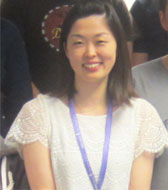 The Japanese Language Department are delighted to be joined by a new Assistant Language Advisor, Mio Tsunematsu:
「はじめまして、国際交流基金ロンドン日本文化センターに日本語指導助手として参りました、常松未央と申します。私は、タイで1年、その後は日本で日本語教師をしてまいりました。ロンドンへは観光で一度来たことがありますが、住むのは初めてですのでこれからの生活が楽しみです。」
"My name is Mio Tsunematsu and I am an Assistant Japanese Language Advisor at the Japan Foundation, London. I taught Japanese language in Thailand for one year and then I taught in Japan. I have visited London before as a tourist but it’s my first time to live here, so I’m looking forward to experiencing London life."
We'd like to offer Tsunematsu-sensei our warmest yookoso (welcome!)
24/07/2014

The Japan Foundation London held its second exclusive beginners’ Japanese class for participants of the Japan Exchange and Teaching (JET) Programme, in which graduates from English-speaking countries go to Japan to teach English and promote cultural exchange.
The course took place over July 19th and 20th, and 17 JET participants in total took part. Led by the Japan Foundation’s new Assistant Japanese Language Advisor, Mio Tsunematsu, the course was based on Japan Foundation’s coursebook Marugoto: Japanese language and culture, in addition to material from the accompanying MARUGOTO+ website and Erin’s Challenge! I Can Speak Japanese. The Marugoto coursebook, which is based on JF Standard for Japanese Language Education and emphasises learning Japanese for practical communication and cultural understanding, was very appropriate to the JET participants, who will soon find themselves in situations where they will need Japanese in order to accomplish basic tasks such as ordering food, meeting new people, and teaching Japanese school pupils. To keep the course effective and enjoyable, Tsunematsu-sensei incorporated many different activities into the lessons, including role-play, games and videos of Japanese life.
We were also very fortunate to be joined by fluent Japanese-speaking volunteers, who gave participants the opportunity to practice their newly-acquired Japanese and ask questions about Japanese language and culture.
Some of the feedback from participants included:
“Very useful, and good value. Having volunteers to speak to was really good as we could explore related vocab and phrases and learn more about Japan.”
“Practising with native speakers was very useful. It was also enjoyable to hear about the culture first-hand.”
“Very good, very happy, inexpensive and met some lovely Japanese people. Very happy!”
The participants will all be travelling out to Japan in August, and we wish them all the best of luck – ganbatte kudasai!
A big thank you to all the participants for coming, and an especially big thank you to the Japanese-speaking volunteers - ARIGATOU GOZAIMASHITA!
16/07/2014
The Japan Foundation, London is inviting travel agents based in the UK to submit bids for the service of coordinating an organised group study tour to Japan in this autumn. The necessary procedures and specifications can be downloaded below.
Please be advised that all the relevant documents concerning this project are provided in Japanese as, due to the nature of the tour, we will require the successful travel agent to be able to communicate comfortably in Japanese.
*Please note, the deadline for applications has now passed.*
08/07/2014
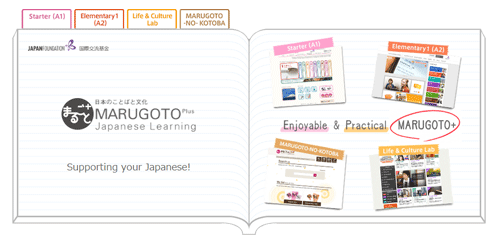
There’s been some exciting new changes to the structure of the Marugoto supplementary webpages which now means you can easily find the relevant Marugoto websites all in one place!
Marugoto Plus (https://marugotoweb.jp/) used to only feature content about the Starter (A1) course, but it is now the Global Homepage, with links to all the other Marugoto sub-sites, including:
- Starter (A1) - http://a1.marugotoweb.jp
- Elementary (A2) - http://a2.marugotoweb.jp
- Life & Culture Lab - http://a2.marugotoweb.jp/en/life_and_culture/
- Marugoto no Kotoba - http://words.marugotoweb.jp
Enjoy using Marugoto Plus!
01/07/2014

The Nihongo Cup Japanese Speech Contest for secondary school students was held at the Embassy of Japan in London on June 21st 2014.
The 18 finalists, who had been selected from 205 applicants from 25 different schools across the UK, all demonstrated great creativity, thoughtfulness and outstanding ability in Japanese in performing their speeches – not to mention extraordinary courage to present their ideas in a foreign language to an audience of 130 people!
Between each of the three categories of speeches, the audience had the opportunity to watch videos and presentations from the Federation of Abbey Schools and Netherton Junior and Infant School, two primary schools which teach Japanese language and culture. It was the first time primary schools have been involved in the Nihongo Cup and it was inspiring to see primary-level children show such enthusiasm for Japan at such a young age.
Due to the extremely high level of Japanese and the thought-provoking content of the speeches delivered by all finalists, the judges had extremely difficult decisions to make when choosing the final winners of the 204 Nihongo Cup. In the end, Rianna Shah (Key Stage 4 and 5 Post-GCSE), Aisha Mariam (Key Stage 4 and 5 Pre-GCSE) and Hana Khan (Key Stage 3) were awarded first prize in each of their categories.
We asked some of the winners and other attendees about their thoughts and feelings about learning Japanese. 1st prize winner Aisha Mariam commented, “Japanese is a language I hold dear...Learning the language is something I really enjoy doing and would definitely recommend to everyone. I can’t stress enough how brilliant and exciting it is! It may seem strange to study right now, but with the growing influence of Japan around the world, in all ways, I can see it being a MFL in every school in England.”
Theodore Nze, 2nd prize winner of the Key Stage 3 category, said, ““I studied Japanese as it geared me up to more possibilities, and it makes it easier to communicate to other people. It has changed my life, how I act, how I speak, everything. I can safely say it’s the best thing that’s happened to me.”
Many congratulations and a big thank-you to everyone who came together to make the day such a success. The full results of the contest are as follows:
Key Stage 4 and 5 Post-GCSE Category
Winner: Rianna Shah (North London Collegiate School)
Speech title: “Food for Thought: Inspired by India”
2nd Prize: Dominic Oben (Whitgift School)
Speech title: “Let’s Study Kanji”
3rd Prize: Ridwana Uddin (Presdales School)
Speech title: “What I felt on the 5th”
Other finalists:
Kirsten Bergfors (St Helen’s School)
Jane Liu (Wycliffe College)
William Sweetman (King Edward VII School)
Key Stage 4 and 5 Pre-GCSE Category
Winner: Aisha Mariam (King Edward VII School)
Speech title: “Relating Pakistan and Japan”
2nd Prize: Cynthia Dewi (Tile Hill Wood School)
Speech title: “My Experience in England”
3rd Prize: Thomas William Davies (Writhlington School)
Speech title: “Let’s Learn Foreign Languages”
Other finalists:
Yuting Feng (Wolfreton School)
Lucy Hawksley (Bexley Grammar School)
Byung Sup Song (Whitgift School)
Key Stage 3 Category (Speech theme: “My Dream”)
Winner: Hana Khan (Haberdashers’ Aske’s School for Girls)
2nd Prize: Theodore Nze (Aylesbury Grammar School)
3rd Prize: Taranpreet Kalra (Greenford High School)
Other finalists:
Joshua Anthony (Dartford Grammar School)
Mark Potts (Campion School)
Symran Wedge (Queen Mary’s High School)
The event was organised by the Japanese Language Committee of the Association for Language Learning, in association with the Japan Foundation London and Embassy of Japan in the UK. We are very grateful to Japan Centre, JOBA, JSA (the Japanese Speech Awards), JP Books, Lingualift, Oxford Brookes University, Ricoh UK Ltd, and Toshiba of Europe Limited for sponsoring the event and donating prizes, and also to Sumisho Computer Systems for their generous sponsorship, to the Embassy of Japan for hosting the event, and to Soho Japan for contributing to the evening reception.
Finally, don’t forget that schools teaching Japanese or doing any kind of Japan-related activities can enter our Japan Webpage Contest for Schools – click here for further details.
30/06/2014

On June 26th 2014, 18 current and prospective volunteers attended a Training Day for theJapan Foundation’s Japanese Taster for Schools (JTS) Programme, in which native and fluent Japanese speakers conduct free Japanese taster sessions in UK schools.
After an overview for new volunteers about the Japan Foundation and the JTS programme itself, the participants heard reports by two volunteers who had held recent Japanese language tasters. The first presenter talked about her experience teaching with one other volunteer at Whyteleafe Primary School in Surrey, and introduced lots of very interesting and new ideas for teaching Japanese language. The other presented her report on her taster with three other volunteers at Walthamstow School for Girls in Waltham Forest, and demonstrated the beautiful PowerPoint presentation they had created in order to teach the pupils about Japan.
This was followed by workshops by Hiroko Tanaka (Japanese Language Advisor and co-ordinator of JTS at the Japan Foundation), who introduced a number of enjoyable activities that volunteers could use in their own taster sessions. These included teaching Japanese greetings and bowing using finger puppets, introducing the Japanese Tanabata “Star Festival” with a kami-shibai picture story and hanging wishes on a bamboo stem, and playing a variation of janken(Rock, Paper, Scissors) incorporating origami samurai helmets! Several of the activities introduced came from Japan Foundation’s own online resources, including Ready Steady NihonGO!
All the volunteers enjoyed the training day and said that they found it useful. Mei Grant, who was attending the training day for the first time, commented:
「とても良かった、いろいろを勉強になりました。参考になりました。」
(“It was very good and I learned a lot of things that will come in handy.”)
Dimple Singh, another newcomer to the JTS Training Day, said, “I really enjoyed today, I think that it is very important that these kinds of training courses are held in order to introduce more people to the Japanese language and culture.”
We would like to thank all participants for coming, especially our two fantastic guest speakers!
More photos from the event can be viewed at the Japan Foundation London Facebook page here.
Our next JTS Training Day is scheduled for September 2014, and bookings will be open in due course.
If you are interested in taking part in the JTS programme as a volunteer, please click here for more information.
26/06/2014
The Japan Foundation is delighted to announce that artist Chiharu Shiota will represent Japan at the 56th International Art Exhibition – la Biennale di Venezia, to be held from 9 May to 22 November 2015. Shiota will present the exhibition entitled 'The Key in the Hand', curated by Hitoshi Nakano, Curator of the Kanagawa Arts Foundation. Through her work Shiota, who gave an artist talk at the Japan Foundation, London in 2013, explores questions such as "What does it mean to be alive?" and "What is existence?" in large-scale installations that make use of a variety of media including sculptural elements, photography, and video.
For more information about the exhibition, please visit: http://2015.veneziabiennale-japanpavilion.jp/ (Japanese)
26/06/2014
The Japan Foundation has organised Japan's national participation at the 14th International Architecture Exhibition of the Venice Biennale, which will be held from 7 June through to 23 November 2014. This year, for the very first time, all of the national pavilions at the biennale have been invited to adopt and explore the same theme; 'Absorbing Modernity: 1914‐2014'. The Japan Pavilion which has been commissioned by Kayoko Ota, Exhibition Organiser and Editor, will convey the strength and historical depth of Japanese architecture, telling the story of the architectural development of Japan over a hundred years.
For more information about the Architectural Biennale, please visit: http://www.labiennale.org/en/architecture/
29/05/2014
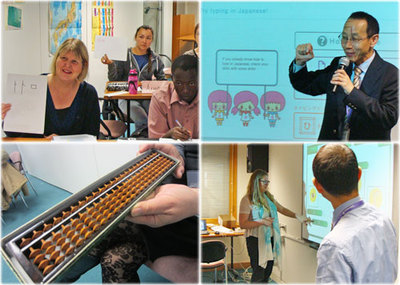
|
On Tuesday 27th and Wednesday 28th May 2014, the Japan Foundation ran Learn & Teach Primary Japanese, a course for primary school teachers looking to teach Japanese to their pupils. This forms part of the Japan Foundation’s Primary Japanese Campaign, which aims to bring Japanese language learning to primary school children across the country.
Twelve primary level teachers gathered at the Japan Foundation for the two-day course, which uses our own Japanese Scheme of Work for Primary Schools to provide lesson plans and ideas for teachers. The participants, who had little or no prior knowledge of Japanese, experienced model Japanese lessons led by Chief Japanese Language Adviser Dr Seiji Fukushima. Over the course’s duration, the participants received instruction on how to teach hiragana and katakana, greetings and self-introductions, and how to say colours and body parts in Japanese.
Throughout the course, the focus was on teaching methods that would be fun and engaging for primary school students. The lessons made use of videos of Japanese media, internet resources, colourful anime-style characters, active participation and games aimed at allowing pupils to memorise vocabulary in an enjoyable way. Many of the teachers praised the wide variety of teaching tools demonstrated, and enjoyed taking part in the games and activities themselves.
At the conclusion of the course, each teacher was given a CD-ROM with copies of the presentations, teaching materials, and links to resources used during the course. They were also provided with information on securing funding for Japanese classes at their respective schools, institutions in the UK which teach Japanese, and more. It is the Japan Foundation’s hope that all the educators who attended the course will make use of our Scheme of Work and its associated resources to create engaging, enjoyable lessons which will make their students enthusiastic about learning Japanese.
Here are just a few of their comments on the course:
“Teacher was fantastic! Very charismatic, informative, fun. The course moved at a good pace.” (Aiya Abe)
“Loved the activities and how Sensei made everything easy to understand. The teacher was brilliant and the course was well prepared and delivered.” (Rishi Gohil)
“I loved the writing aspect- this really helped to clarify the different alphabets and their uses.” (Kimberley Devonshire)
We would like to thank all the teachers who took part in the course, and to wish them the best of luck with teaching Japanese in the future.
27/05/2014
Last month, we said sayounara to Yuko Murata, Deputy Director of the Japan Foundation London and head of the Languages department for over five years, who has been transferred to the Japan Foundation headquarters in Tokyo.
In her place, we are delighted to welcome Tomoki Akazawa, who was formerly a student at the University of Warwick.
Here are some messages from Yuko Murata and Tomoki Akazawa:
.jpg) From Yuko Murata: “First of all, I would like to say a big “thank you” to all of you who warmly supported and shared pleasant times with me for these years.
From Yuko Murata: “First of all, I would like to say a big “thank you” to all of you who warmly supported and shared pleasant times with me for these years.
I remember I was very nervous when I arrived in the UK five years ago as it was the first time for me to work at the Japan Foundation’s overseas office. To my surprise, my anxiety soon became a hopeful outlook for the future and it actually was the brightest time in my life.
During my entire period in London, I had been involved in Japanese language education as well as office management. Although this was tough and challenging, everyone and everything I have met and encountered was enthusiastic and impressive and it was definitely a fruitful time for me.
I have just taken a new position at the Asia Centre within the Japan Foundation Head Office. Thought I will be mainly involved in projects with Asian countries for the next couple of years, the UK will be always in my heart and I hope we cross paths again in the future.”
.jpg) From Tomoki Akazawa: "I would like to offer my greetings as Deputy Director of the Japan Foundation, London, succeeding Ms. Yuko Murata. As I had spent a year at the University of Warwick back in 2000-2001, this is my second opportunity to live and work in the UK, and also my second stint abroad (the last time was at the Japan Foundation’s Center for Global Partnership in New York, 2005-2010.)
From Tomoki Akazawa: "I would like to offer my greetings as Deputy Director of the Japan Foundation, London, succeeding Ms. Yuko Murata. As I had spent a year at the University of Warwick back in 2000-2001, this is my second opportunity to live and work in the UK, and also my second stint abroad (the last time was at the Japan Foundation’s Center for Global Partnership in New York, 2005-2010.)
I am mainly responsible for our Japanese language programs and resources. I would really appreciate it if you could continuously come and join our events as well as to keep on with the incredible support that my predecessors had enjoyed. For those who are new to the Japan Foundation, please don’t be shy to contact us. Your curiosity could change someone’s life, which might lead to a huge leap from where we are.
I am looking forward to working with you closely down the road."
15/05/2014
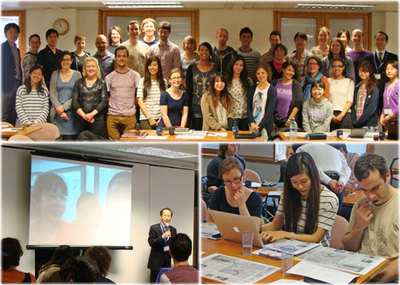
|
On May 10th 2014, the Japan Foundation London held a second translation event with the Ishinomaki Hibi Kodomo Shinbun; a newspaper created by Japanese schoolchildren that reports the current activities in their city. Ishinomaki is a city in Japan’s Miyagi Prefecture, and is one of the areas that suffered severe damage due to the Great East Japan earthquake and tsunami on March 11, 2011. The children created their newspaper one year after the disaster, and now, three years on from the tsunami, the children aim to tell Ishinomaki’s story to people all over the world. To bring this goal to fruition, 32 volunteers spent their Saturday morning translating articles from the newspaper into English.
The event began with a screening of the DVD “Ishinomaki to shinsai- sono ato” (about the quake-hit Ishinomaki) and an explanation about the project by Hiroyuki Takeuchi, Executive Administrator of Ishinomaki Hibi Shinbun and director of Ishinomaki NEWSée, via Skype. This was followed by a talk about the newspaper by some of its young journalists, including Momoka Saito (2nd year at Sendai Ikuei Gakuen High School), Hiroki Matsubayashi (1st year at Hebita Junior High School), and Riko Sakai (6th year at Kadonowaki Elementary school). All were fantastic speakers, overcoming their nerves to ask and answer questions from participants on the other side of the world, and even showed off their English language skills for us.
Lastly, the volunteer translators broke into groups and translated several of the newspaper’s articles from Japanese into English. If you would like to find out more about the Ishinomaki Hibi Kodomo Shinbun, you can visit their website here (in Japanese). English translations of articles from last year’s event can be found here; this year’s translations will be available soon.
Almost all the participants mentioned that they really enjoyed interacting with the organisers and with the children themselves. As participant Robert Henderson states, “It was great to be able to have the live conversation over Skype with the children in Ishinomaki.” At the end of the event, the Japan Foundation collected some messages for the children of Ishinomaki. Here are just a few of them:
“I hope the children of Ishinomaki can fulfil their dreams and become stronger from their experiences. がんばって!(Keep at it!)” – Charlie Marshall
“I really enjoyed talking to you about the tsunami and life afterwards. It was also great to hear about your impressions of the UK. Good luck to you in all your future endeavours.”- Edward Scourfield
“We learned a lot through our article about things we never considered before, such as how the salt water has affected the vegetation after the tsunami. Keep up the good work!”- Claire Thompson
「夜遅い時間に、遠いイギリスの私たちのために、こういう機会を設けてくれてありがとうございます。皆さんのおはなしを、これからも新聞を通して聞けることを楽しみにしています。ありがとう」(“Thank you for giving us this opportunity to speak to you from far away in England, even though it was late at night for you. I look forward to hearing all of your stories through the newspaper. Thanks!”) - Miki Kojima
We would like to thank all volunteers for giving up their time on this project, and to the organisers and children at Ishinomaki for their very genki participation!
Photos from the event can be viewed on our Facebook page here.
08/05/2014
As a new financial year begins, funding (up to £1,500) is once again available in the area of Japanese Studies/Intellectual Exchange for projects that help to promote a greater awareness of Japan, as well as travel grants (up to £600) for applicants who are planning to visit Japan for research.
:: Click here for more information
28/04/2014
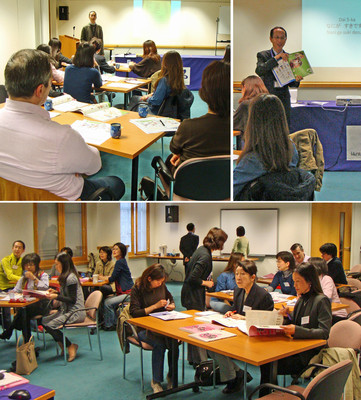
|
On the Tuesday 22nd April, 19 participants came to the Japan Foundation for a seminar to learn about how Japanese language teachers can use the new Japan Foundation textbook Marugoto: Japanese Language and Culture (Starter A1- KATSUDOO & RIKAI). Marugoto is designed so that users learn competence in accomplishing tasks using their language alongside learning competence in intercultural understanding.
The event began with an introduction to Marugoto as modelled on the JF Standard for Japanese Language Education by the Japan Foundation’s language advisor, Hiroko Tanaka. This was followed by an explanation of how teachers can use the Marugoto textbook by the Japan Foundation’s Chief language advisor, Dr Seiji Fukushima. Lastly, one of the Japanese teachers from SOAS Language Centre, Shinichiro Okajima, spoke about his experiences using the textbook as part of his language teaching for the Japan Foundation & SOAS Language and Culture Course. He mentioned the benefits he had found from utilising this methodology, which was very interesting and challenging.
The event was helpful for the teachers that attended. One of the teachers commented「まるごとを使ったクラスを教えてみたいと思いますね。」(I would like to try teaching a class using Marugoto)after joining us for this event.
26/03/2014
|
On the 22nd March 2014, the Japan Foundation London, in conjunction with BATJ, held a seminar titled ‘Designing a reading activity based on the JF Standard.’ The instructor at the event was Ms Sono Habuto, a Japanese Language Educational Advisor at the Japanese Cultural Institute, Japan Foundation Cologne, and the seminar was attended by 19 Japanese language teachers.
In the first session, Ms Habuto focused on the act of “reading” and what it comprises. She illustrated this with a discussion of ‘schema’, which states that comprehension of text involves pre-existing knowledge on the part of the reader regarding the context in which the written material is presented. Other strategies also used in reading comprehension were also covered. This was followed with some example tasks. In the second session, the participants used various authentic reading materials to create and present their own reading activities, based on the ideas presented in the first session. These activities were divided up into “pre-task activity”, “main- task activity”, “post-task activity” and “recap” sections.
Comments from participants included:
「とてもよかったです。分かりやすく、授業に使えそうな情報が多かったです。」
("This was very good. It was easy to understand and there was plenty of information that I felt I could use in my lessons.")
「先生のお話を聞いたあとで、実際にグループでアクティビティーを考えることができ、大変役に立ちました。」
("It was really useful to be able to discuss our thoughts in groups after hearing the lecture.")
We would like to thank all attendees and Ms Habuto for coming!
05/03/2014
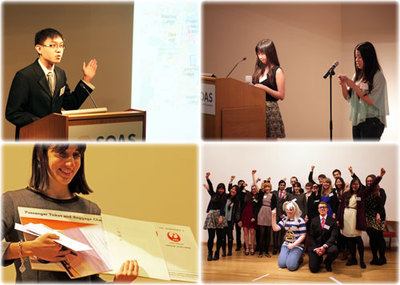
|
The UK space industry, vampire folklore, and the arcades of Japan as a meritocracy were among the many fascinating topics presented at the Finals Day of the 9th Japanese Speech Contest for University Students, which was held on March 1st at SOAS, University of London.
Co-organised by the British Association for Teaching Japanese as a Foreign Language (BATJ) and the Japan Foundation London, the main purpose of this annual contest is to improve the speaking and presentation skills of students studying Japanese as a foreign language. It also aims to promote Japanese language learning at higher education level in the UK and Ireland. There are approximately 60 universities in the UK and Ireland offering Japanese as either a degree or elective course, and all undergraduate students enrolled in a university Japanese course are eligible to take part.
This year’s contest saw a total of 117 students from 18 different universities apply for the contest, meaning that the competition for the 15 places in the finals was exceptionally high. Approximately 200 spectators attended the Finals Day, including representatives from companies sponsoring the contest.
The contest began with the new Individual Presentation Category, in which post-beginner learners of Japanese speak about their topic with the aid of a PowerPoint presentation. The winner of this category was Gen Nen Ho, a 3rd year student of Medicine at King's College London, for his very animated and intriguing presentation on The Mythical Cambridge. “Despite being a medical student, I spend much of my time learning Japanese,” said Gen Nen after the contest. “When the opportunity to take part in a speech contest came to me, I took it without hesitation. I believe it would be a great chance to test my proficiency in Japanese and of course, to meet people who share the same interest in Japanese.”
This was followed by the Speech Category, the most challenging category of the contest, in which finalists may not use PowerPoint. After much deliberation, the judges awarded the first prize to Giulia Surace, a 4th year student of Japanese and Politics at SOAS University of London, for demonstrating excellent Japanese language and presentation skills through her thought-provoking speech on Political Indifference in Japanese Youth. She won a return air ticket to Japan, a Japan Rail Pass and £700 for her outstanding performance. “Being able to take part in such a challenging competition was the greatest reward after studying Japanese for four years,” commented Giulia. “My Japanese teacher encouraged me to apply, as I had already taken part in the Group Presentation Category during my first year. I remember watching the Speech Category participants and thinking that it would be amazing to be able to do it someday.”
Elliot Harvey, a runner up in the Speech Category, also enjoyed the experience. "It was absolutely thrilling," he commented. "Meeting the other contestants was a really lovely opportunity and by the end of the day I felt as though I had made some new friends rather than entered the terrifying speech contest that I was expecting."
Special prizes were also given to four groups selected to perform in the Group Presentation Category, aimed at beginner level students of Japanese. Liisa Veerus, a finalist in the Group Presentation Category from Imperial College London who talked about her home country of Estonia, commented, “I really enjoyed talking in Japanese about Estonia. I was really glad to receive a lot of questions about Estonia afterwards.” Her team mate, Michael Florea, also commented, "At the finals, I could hear other people close to my age speak Japanese a lot better than I did, which really gave a very good understanding of the great level one can reach with work. This really become a strong motivator ever since, and unlike before, I am now certain I will pursue Japanese to a professional level."
We would like to thank all participants, their teachers and supporters, the judges, audience members and BATJ for making the contest such a success. In addition, special thanks must go to the generous sponsors: Baker & McKenzie LLP, Bloomberg L.P., Central Japan Railway Company, Gendai Travel Limited, The Great Britain Sasakawa Foundation, Japan Airlines, Japan Centre, JP BOOKS, Mitsubishi Electric Europe B.V., SOAS University of London, Ricoh UK Ltd, and Toshiba of Europe Ltd.
The 10th Japanese Speech Contest for University Students will take place in February 2015, and will be open for applications from autumn this year. We hope even more university students will apply!
Don't forget that applications are still being accepted for the Nihongo Cup, the Japanese Speech Contest for Secondary Students. The deadline to apply is March 31st - click here for more information and to apply!
You can download the full results of the contest below.
04/03/2014
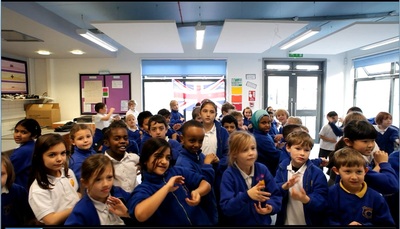
|
On 20th January, Japan Foundation London visited the pupils of Year 3 from Southfield Primary School, to take part in the Japan Foundation's "恋するフォーチュンクッキー" (Fortune Cookie in Love) Dance Video. We chose this primary school because they have been working with Dr Seiji Fukushima, the Japan Foundation London's Cheif Language advisor, to try out the Japan Foundation London's Japanese Scheme of Work for Key Stage 2.
This was part of an effort by the Japan Foundation to bring Japanese language learners from around the world to come together to have fun making a Japanese pop music video. The song chosen is by the popular Japanese girl band AKB48. The music video for the song has had a massive impact online, similar to that achieved by the Korean music video “Gangnam Style”, with many people uploading their own versions of the dance craze onto sites such as Youtube. The Japan Foundation thought that making a dance video was a great way to introduce a bit of Japanese pop culture, learn a few words and phrases, and have fun. The pupils of Year 3, from Southfield Primary School, who are learning Japanese, represented the U.K. and enjoyed practising the dance moves, such as the onigiri dance – a dance that imitates the making of rice balls. In total, groups from around 20 countries took part, and the video is available to watch on the Japan Foundation's head quarters website here or in you tube here.
When you watch the video, look out for Southfield Primary School at 0:46 and 2:40. If you would like to try to learn the dance, you can learn the moves by clicking here.
26/02/2014
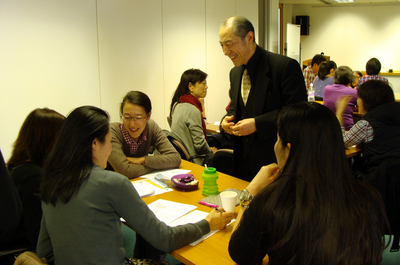
|
On 22nd February 2014, the Japan Foundation London and the Association of Japanese Language Teachers in Europe invited Waseda University Professor Yoshikazu Kawaguchi to conduct a Japanese Teacher Training workshop titled ‘Teaching contextualisation and personalisation of elementary grammar within GCSE Japanese’. Around 40 participants attended the workshop.
The theories of ‘contextualisation’ and ‘personalisation’ were presented, along with examples from Professor Kawaguchi’s classroom experiences. Afterwards, using GCSE-level syntax such as ‘koto ga aru’, and ‘~ni~ga aru’, the participants were invited to make a presentation utilising the concepts of contextualisation and personalisation, and were later given feedback from Professor Kawaguchi. By discussing these ideas with each other at the workshop, the participants got a better understanding of these two theories.
You can watch a video of the first part of the workshop lecture via the web address below.
http://www.ustream.tv/channel/japan-foundation-london-language
Materials used at the workshop can also be downloaded below.

26/02/2014
|
On February 21st 2014, twenty current and prospective volunteers attended a Training Day for the Japan Foundation’s Japanese Taster for Schools (JTS) Programme, in which native and fluent Japanese speakers conduct free Japanese taster sessions in UK schools.
After an overview for new volunteers about the Japan Foundation and the JTS programme itself, the participants heard reports by two volunteers who had held recent Japanese language tasters. The first presenter talked about her experience teaching with three other volunteers at Harwell Primary School in Oxfordshire, while the other presented her report on her taster at a languages club at Westminster Kingsway College, a further education college in London. It was a good opportunity to hear about two quite different JTS experiences.
This was followed by workshops by Hiroko Tanaka (Japanese Language Advisor and co-ordinator of JTS at the Japan Foundation), who introduced a number of enjoyable activities. These included teaching body parts through the song “Atama, kata, hiza, ashi” (Heads, shoulders, knees and toes), introducing Japanese colours and directions using both paper-based games and games using an Interactive Whiteboard, and a wonderful way to teach animal-related vocabulary using a simple PowerPoint-based kamishibai (picture story) of Ookii Kabu (“The Enormous Turnip”), which is part of the JFL Japanese Scheme of Work for Key Stage 2.
All the volunteers enjoyed the training day and said that they found it useful. Takako Higgs, a new JTS volunteer, commented:
「いろいろなアイディアを見ることができて良かったです。」
(“It was good to see so many different ideas.”)
Kinue Snookes, another newcomer to the JTS Training Day, said:
「ボランティアによる訪問報告がすごくためになった。また、本当にこれから、自分も訪問するんだなと実感できた。」
(“The visit reports by JTS volunteers were extremely useful. Additionally, I really felt that visiting a school myself is something I can really do now.”)
We would like to thank all participants for coming, especially our two fantastic guest speakers!
Our next JTS Training Day is scheduled for June 2014, and bookings will be open in due course.
If you are interested in taking part in the JTS programme as a volunteer, please click here for more information.
26/02/2014
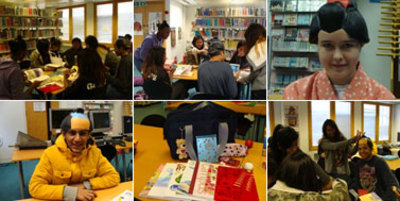
|
The Japan Foundation London Library had a ‘Let’s visit the Library this half term’ campaign to encourage school students who are interested in Japanese language and culture to visit the library during half term between 17th -21st February.
During this period, the library had 100 visitors including students from secondary schools and 6th form colleges, as well as their teachers and families. The students were very keen to try practice questions for GCSE/AS/A2/IB/JLPT exams and most of them got very high marks and received a Japan Foundation sticker as a reward (these can be downloaded here). Some of them tried Edo period style wigs for town girls and samurai.
Others even enjoyed the Japanese board games Go and Shogi.
Comments from participants included:
“It is really fun and a lovely place. The campaign is awesome, too”- a year 8 secondary student
“The help with learning Japanese was excellent as I was given many worksheets to help me to improve. There were also many textbooks and study books.” - a year 7 secondary student
“The variety of resources was very convenient and helpful. The campaign should raise awareness so more students can benefit from the library. “- 6th form student.
“It brought different students of Japanese together to share interests and encourage each other. “- 6th form student
“It was interesting and the staff was very kind and helpful. I think the campaign is great for students like myself and I would like to visit again.” - 6th form student
“Very helpful and provided us with lots of information and allowed us to play ‘Go’ – very fun!” - 6th form student
We’d like to thank all participants for taking part in this campaign and teachers who kindly forwarded the invitation to their students. We really hope to see even more participants at our next ‘visit the library campaign’!
20/02/2014
|
Advanced Japanese language learners were given the opportunity to discover the secrets behind the success of some of Japan’s most popular computer game characters in a special two-day Japanese Plus course at the Japan Foundation on February 11th and 12th 2014.
The course was run by Tomohiro Sasaki, a theatre director and former video game planner / scenario writer, with particular expertise in character design. Conducting the course entirely in Japanese, Sasaki-sensei introduced the basics behind creating an appealing character, including their external appearance and personality, and the many different kinds of characters one may encounter in game scenarios. His lectures also gave lots of insight into traditional and modern Japanese culture, and key words in Japanese associated with character creation. Participants particularly enjoyed the chance to display their linguistic skills, artistic talents and creativity by creating their own characters and presenting them to the class!
“It was very interesting,” commented Andrew Niewiarowski, a regular attendee of Japanese Plus. “The level of Japanese was pitched very well – not too easy, not too difficult.”
Another participant commented, “Even though I know nothing about games/anime, it was interesting to learn about that part of Japanese culture. It was fun to design our own characters.”
Sasaki-sensei’s book about character design, 『ゲームシナリオの書き方』, is available to loan from the Japan Foundation London Library.
We’d like to thank all participants for taking part in Japanese Plus, and Sasaki-sensei for his fascinating and highly entertaining lectures. We really hope to see even more participants at our next Japanese Plus course!
To learn more about Japanese Plus, please click here.
17/02/2014
(日本語)
The Japan Foundation London Library has launched a campaign to encourage school students who are interested in Japanese to visit our library during half term between 17th – 21st of February.
- Secondary school, sixth form and college students: The first 70 students to visit the library will receive a limited edition present.
- We will also be giving out (free) practice questions for GCSE/A-LEVEL/IB/JLPT exams. If you get over 60% of the answers correct, we have some cute stickers to give you as a prize.
- If you fill out one of our questionnaires, you will be put into a draw to win a fantastic prize.
The Japan Foundation London library has lots of Japanese books, manga and magazines.
During the half term period we will also have an exhibition of things such as a Japanese high school quiz and Edo period style wigs for town girls and samurai. You can even try on the wigs and take a photo.
You can also have a go at the Japanese games of Go and Shogi (Japanese chess)
So this half term, please do come and visit the Japan Foundation London Library. We’re really looking forward to seeing you.
Library opening hours:
- Mondays, Wednesdays, Thursdays and Fridays: 10am to 1pm and 2pm to 5pm
- Tuesdays: 2pm to 7pm
(日本語)
17/02/2014
Thursday 6th February saw the return of our annual Post-Graduate Workshop, organised in collaboration with the British Association of Japanese Studies (BAJS). Despite the Tube strike and poor weather, over 40 post-graduate students from across the country attended.
This year’s workshop kicked off with parallel presentation sessions in which 6 PhD students presented their research and received feedback from fellow post-graduate students and senior colleagues. The presenters were: Fabiana Marinaro (University of Manchester), Hui-Ying Kerr (Royal College of Art and Design/The Victoria and Albert Museum), Lynley Aldridge (University of Leeds), Forum Mithani (SOAS), Sylvia Simpson (SOAS), and Jane Wallace (University of Leeds).
The afternoon featured practical workshop sessions on ‘Conducting Research in Japan’, given by Dr Irena Hayter (University of Leeds) and Dr Jamie Coates (University of Sheffield), and ‘Navigating Open-Access and Getting your Research Published’, given by Professor Caroline Rose (University of Leeds).
The workshop finished with a session on ‘Funding your Research’ with presentations from Rory Steele (Great Britain Sasakawa Foundation), Mitsuko Ando (Japan Society for the Promotion of Science), Susan Meehan (Daiwa Anglo-Japanese Foundation), and Hal Parker (Japan Foundation).
We would like to thank all participants for coming along and making the day such a great success. We hope to see you all again next year!
17/02/2014
|
The Japan Foundation recently invited the sociologist and rising star of Japanese academia Hiroshi Kainuma (University of Tokyo/Fukushima University) to the UK to give a mini lecture series on his latest research.
Lecture 1: ‘Voices from Fukushima - sketching a future beyond the pro/anti-nuclear debate’ (Held at the Japan Foundation, London, and the University of Sheffield on 20th and 22nd January respectively)
In his first lecture, Fukushima-native Kainuma explored the historical background and development of the nuclear power industry in Fukushima, before moving on to discuss the experiences and opinions of those whose lives have been directly affected by the ongoing nuclear crisis. He ended his talk by offering new directions for future debates that move beyond a simple pro/anti-nuclear dichotomy. Following Kainuma’s presentation, Dr Peter Wynn Kirby (University of Oxford) introduced his research into radioactive citizenship in Fukushima and Japan more broadly, before joining Kainuma in discussion.
Lecture 2: ‘On the Margins in Japan - Voices from the Underclass, Sex Industry, Far-right and New Left’ (Held at The University of Edinburgh, and the Japan Foundation, London on 21st and 23rd January respectively)
In his second lecture, Kainuma revealed another side to modern Japan through a series of case studies examining those people/groups living on the fringes of Japanese society. Kainuma’s talk was followed by an incisive commentary from discussant Dr Tuukka Toivonen (Goldsmiths, University of London/Nissan Institute of Japanese Studies, University of Oxford) and a lively Q&A session with questions directed at both speakers.
We would like to thank Mr Kainuma for making the long trip to the UK to give such a fascinating and thought-provoking series of lectures, and we very much hope to see him in the UK again soon. We would also like to express our gratitude to the University of Edinburgh and University of Sheffield for kindly agreeing to co-host the regional seminars.
**If you would like to receive Mr Kainuma’s PowerPoint presentations, please contact Hal Parker at the following address: hal.parker@jpf.org.uk
27/01/2014
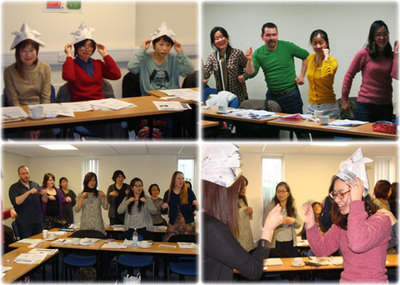
|
On January 21st 2014, the Japan Foundation London held a training day for current and prospective volunteers of the Japanese Taster for Schools (JTS) Programme at Newcastle University for the first time. JTS volunteers are fluent Japanese speakers who deliver Japanese language taster sessions at UK primary and secondary schools, in order to inspire pupils to learn more about Japanese language and culture, and to encourage schools to start Japanese classes.
A total of 29 people attended the training day, which began with an overview of the Japan Foundation and the JTS Programme. This was followed by a workshop by Hiroko Tanaka (Japanese Language Advisor and co-ordinator of JTS at the Japan Foundation), who introduced a variety of games and enjoyable activities to teach Japanese in an effective and engaging manner. These included songs to teach Japanese greetings, gestures for learning the numbers 1-10 in Japanese, and “Samurai Rock, Paper, Scissors” which involves making and wearing origami samurai helmets!
The workshop was very well received by all participants. One participant, Kimie Tanaka, commented:「短期間のセッションなのに内容も充実していて面白かったです」
(“Although it was a short session, it was fun and managed to pack everything in.”)
Another participant, Sophie Kerr, said, “Activity suggestions were really interesting and useful. Demonstrations of songs and games were also useful. And fun!”
The Japan Foundation would like to thank all attendees for coming, as well as Kumi Casey and all the other staff at the School of Modern Languages for supporting this event.
Our next JTS Training Day will take place in London on February 21st – click here for more information and to book your place.
If you would like to find out more about the JTS Programme and how to become a member, please click here.
18/12/2013
|
The latest Japanese from Scratch event took place on the 5th of December 2013. The theme for this event was ramen, a Japanese dish in which noodles are served in broth, which has recently experienced a surge of popularity in the UK. 47 people came to the Japan Foundation London to learn about these noodles, to learn about their history and how to get the most out of their ramen-eating experience.
The event started with a talk from Dr Barak Kushner, the author of “Slurp! A Social and Culinary History of Ramen - Japan's Favorite Noodle Soup,” who gave a really interesting introduction to the history of ramen in Japan and its special place in Japanese culture. This was followed by a session about ramen culture and an introduction to the types of ramen available in London by the Japan Foundation’s unofficial ramen enthusiast, Josephine Audigier. Next the Japan Foundation’s Chief Japanese language Advisor, Dr Seiji Fukushima, led an interactive Japanese language session focussing on the vocabulary and expressions relating to ramen.
All this talk (and photos) of ramen made most people hungry by the end of the event, but luckily we had already planned to take some participants to try authentic ramen at nearby restaurants in central London. Eight participants visited the nearby Seto restaurant in Camden, while another 14 participants walked over to the new CoCoRo ramen restaurant behind the British Museum. They all had a chance to use their newly-learnt Japanese to order ramen, and taste it for themselves. If you would like to explore some of the various ramen options available in London, please download the ramen map below.
One participant mentioned that “It was very fun – made me hungry. It was my first time attending something like this so I was nervous, but everyone was really friendly. Thank you!”
Another attendee told us the following:
“The first part was very interesting, providing knowledge about the history and culture of Japan in just an hour. Very good speaker. I found the info on the places to eat ramen very useful. Also, the language teacher was very good at interpreting the words and I liked the fact that it was an interactive speech.”
We would like to thank all participants for coming – arigatou gozaimashita.
If you have never studied Japanese before and are interested in learning, or have only just begun to study Japanese, please click here to sign up to our monthly e-bulletin to receive notifications of this and other Japan Foundation events. Click here to read more about Japanese from Scratch and view reports of previous workshops.
11/12/2013
|
The Institut Français, Japan Foundation and Network for Languages formally signed a partnership agreement in October 2013 to come together to support high-level language learning in the UK.
They have come together for the purpose of supporting students that study French at AS and A level in order to improve their oral communication in French and to widen students’ language skills to include basic Japanese. The support will include the development of specific resources and training for French and Japanese along with school partnerships between the three countries. The programme will include intensive day(s) dedicated to languages within the students’ curriculum. Our aim is to inspire students to keep on studying languages at university.
We are now looking for schools that teach A-level French that might be interested in taking part in the programme. Their students will have the chance to improve their French, by using their French language skills as a tool to learn basic Japanese. Students will also be given the chance to explore both French and Japanese culture. Teachers do not need any proficiency in Japanese to take part in this project.
Roles of each partner
- The Institut Français du Royaume-Uni will provide French resources for teachers during the year and native speakers, as far as possible, for the intensive day(s). It will also help to create partnerships with French schools.
- The Japan Foundation will provide resources for Japanese taster sessions and native level speakers of Japanese, as far as possible, for the intensive day(s). It will also help to create partnerships with Japanese schools.
- Network for Languages help to create partnerships with schools which teach French for A-level and which do not currently teach Japanese. It will also be in charge of the teachers training.
Please see the attached press relase for contact details of each organisation.
11/12/2013
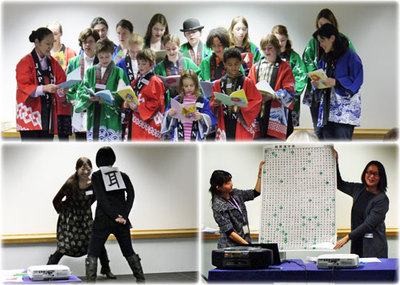
|
On November 29th 2013, 37 people including special guests from the Academy of Home Educators attended the fourth and final training day of 2013 for the Japan Foundation’s Japanese Taster for Schools (JTS) Programme, in which native and fluent Japanese speakers conduct free Japanese taster sessions in UK schools.
After an overview for new volunteers about the Japan Foundation and the JTS programme itself, the participants heard reports by two volunteers who had held recent Japanese language tasters. One presenter talked about her experience teaching with three other volunteers at Langley Grammar School in Slough, while the other presented her report on her visit to Boxgrove Primary School in London. It was a good opportunity to hear about two quite different JTS experiences.
This was followed by workshops by Hiroko Tanaka (Japanese Language Advisor and co-ordinator of JTS at the Japan Foundation), who introduced how to teach Japanese writing – one of the most challenging aspects of Japanese for UK learners. However, Tanaka-sensei demonstrated that despite the difficulties involved, learning Japanese hiragana, katakana and kanji can be made very enjoyable for students through games and activities such as “kanji sumo” and the “Hiragana rap!” Finally, Tanaka-sensei showed some activities suitable for winter and Christmas incorporating Japanese language and culture.
Several of the materials used came from Japan Foundation’s own resources, including Ready Steady NihonGO.
To close the Training Day, we had a very special performance by the children of the Academy of Home Educators. Ever since having a Japanese language taster organised through JTS in March 2012 (which you can read about in-depth here on page 6), the pupils have been learning Japanese regularly from two of our JTS members. Their amazing performance of Japanese songs demonstrated how far their Japanese language abilities are progressing.
All the volunteers enjoyed the training day and said that they found it useful. Midori Case-Leng, who has now completed her full course of 4 JTS Training Days, commented:
「いつも通り、ボランティアの皆さんのお話、そして博子先生のお話、興味深く聞かせていただきました。特に今日はThe Academy of Home Educators の皆さんのパフォーマンスも見ることができてラッキーでした!」
(“As always, it was really interesting to hear what the other volunteers and Hiroko Tanaka had to say. I feel particularly lucky to have been able to see the performance by the Academy of Home Educators!”)
Eri Matsuoka, a new JTS volunteer said:
「すごく勉強になりました。ボランティア経験をしている方の説明と、アクティビティのインフォメーションは使ってみたいです。」
(“It was really useful. I want to try and use the information I learned from the volunteers’ report of their experiences and the activities.”)
We would like to thank all participants for coming, especially our two fantastic guest speakers and all the pupils, parents and staff from the Academy of Home Educators!
Our next JTS Training Day is scheduled for January 21st, which will be held at Newcastle University for the first time – good news for our volunteers in the north! We are now open for applications.
If you are interested in taking part in the JTS programme as a volunteer, please click here for more information.
04/12/2013
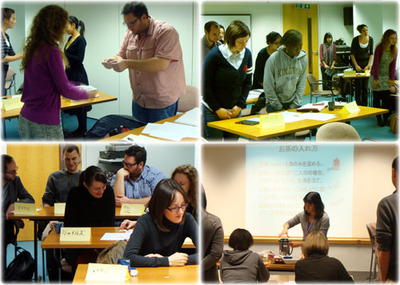
|
How to exchange business cards correctly, the elegant way to serve tea and even the correct order for sitting in a car according to hierarchy were among the vast range of dos and don’ts in Japanese etiquette outlined in November’s Japanese Plus course for advanced Japanese learners, which ended on November 25th.
The course, which was attended by 48 participants in total and ran for 4 weeks, was led by Hiroko Tanaka, Japanese Language Advisor at the Japan Foundation London. In the first week, the participants looked at the typical hierarchical structure of a Japanese company and revised keigo (polite Japanese language). The theme of business Japanese language and etiquette continued in Week 2, in which Tanaka-sensei demonstrated the correct attire for a Japanese business, the right way to introduce one’s self in a business situation, and how to handle guests coming to one’s company. Week 3 looked at sending business emails in Japanese, using the correct expressions. Finally, in Week 4, Tanaka-sensei taught dining etiquette and explained how to avoid some of the pitfalls that can occur when selecting appropriate presents for certain occasions.
All participants responded very positively to the course. Emma Gallagher, a Japanese Plus regular, commented, “It was a useful refresher of language & cultural etiquette I knew once many years ago, as well as an introduction to new vocab/aspects of Japanese culture I was less familiar with.”
Another regular participant, Brigitte Cann, said, “Great course, you learn things you would never learn anywhere else.”
We’d like to thank all participants for taking part in Japanese Plus, and really hope to see even more participants at our next course!
To learn more about Japanese Plus, please click here.
28/11/2013

|
Japanese has been identified as one of the “most vital” languages to the UK over the next 20 years in the British Council’s Languages for the Future report, published on November 20th 2013.
The list of 10 languages featured in the report were chosen based on economic, geopolitical, cultural and educational factors including the needs of UK businesses, the UK’s overseas trade targets, diplomatic and security priorities, and prevalence on the internet.
One of the reasons for the importance of Japanese to the UK given in the report is that Japan is the world’s third largest economy and a significant contributor to UK prosperity. The UK is by far the biggest destination for Japanese investment in Europe, with 1,400 Japanese companies located here. Japan’s roles in science, technology and development assistance were also highlighted in the report.
Despite this, currently only 1% of the UK's adult population report that they speak Japanese well enough to hold a conversation. There is therefore a clear need continue developing Japanese language provisions in the UK at all levels, including schools, universities and colleges.
There are many ways in which you can help to support Japanese language education in the UK:
- If you wish to learn Japanese yourself, take a look at our information for potential learners here, as well as the range of courses we have on offer. We also have a wealth of free online resources for independent learners, as well as around 10,000 books and other materials in our library. Lists of primary schools, secondary schools and universities that teach Japanese can be found here.
- If you are interested in becoming a Japanese teacher, you can find out more information here. You can also register with us as a Private Tutor, or as a Japanese Tasters for Schools (JTS) Volunteer.
- If you are a school or other educational institution looking to start Japanese classes, take a look at our information here. Our many support services for schools starting Japanese include funding, resources, training and Japanese taster sessions. Institutions looking to start Japanese are encouraged to get in direct contact with the Japan Foundation as soon as possible for full details on how we can help you.
- Anyone interested in supporting Japanese at primary level can register with our Primary Japanese Campaign – click here for more details.
26/11/2013
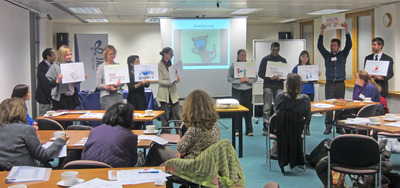
|
On the 21st of November, during the British Council’s International Education Week, 20 teachers of Japanese and primary class teachers came to the Japan Foundation, London for a chance to learn about support and resources for Japanese language classes in primary schools. This event was part of the Japan Foundation, London’s series of workshops and events for our Primary Japanese Campaign 2014, to help prepare primary teachers who would like to teach Japanese from September 2014.
The seminar started with an overview of the wide range of support (including resources and funding) for primary schools in the UK, with plenty of time for questions. Teachers then had a chance to explore the Japan Foundation library and have a look at possible teaching materials for Key Stage 2. Lastly, Dr Seiji Fukushima, the Chief Language Advisor for the Japan Foundation London, introduced some resources in detail, and explained how he is currently using them in a West London primary school. He showed how he is adapting our Key Stage 2 scheme of work, and using it along with Ready Steady NihonGo, Eirin’s challenge and videos of Japan from JNTO.
Most attendees mentioned that the information about resources was very helpful Thierry Maillard mentioned that it was “Great for videos and ideas, even for MFL in general.” Another teacher commented that is was good to “see resources and websites in action.” Quite a few participants mentioned that they were interested in a longer version of the seminar that could include some basic Japanese language training. We will try to provide another basic Japanese course for teachers in the future, so please sign up to our e-bulletin or Primary Japanese Campaign to ensure you receive the latest information.
Click below for the full presentation about support and resources.
15/11/2013
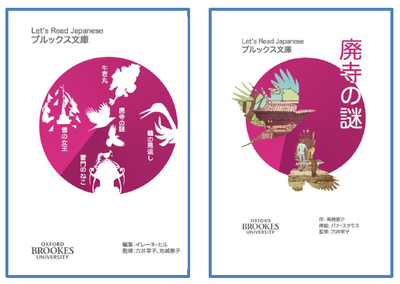
|
Two years ago, Oxford Brookes University used the Japan Foundation’s Japanese Local Project Support programme funding to set up a Tadoku (Extensive Reading) Project. This project introduced extensive reading as an approach to students of Japanese as well as the wider Japanese education community. Since then, the university can expanded the project to create their own fantastic reading materials, which you can see at this book launch.
‘Let’s Read Japanese’ is a series of graded readers for learners of Japanese. Texts are graded, i.e. vocabulary and grammar are controlled, in accordance with the Common European Framework of Reference for languages (CEFR). Born out of feedback from students saying they wanted accessible yet interesting materials for adult learners reading for pleasure. The books are also designed to introduce them to Japanese culture through legends, classic tales and poems, as well as new stories and original illustration.
The Let’s Read Japanese series supplements any textbooks as it complements Japanese learning.
In this special book launch, the series’ Japanese supervisors Suzuko Anai and Keiko Ikeshiro, from Oxford Brookes University, will introduce the concept of the Let’s Read Japanese and making of the first publication of A2-1 stories, and explain how Let’s Read Japanese could be used in the classroom.
There will be a small reception after the talk and an opportunity to see the books. Oxford Brookes University will also bring a limited number of copies that will be available to purchase at a special price.
Date: Thu 28th November 6:30pm
Venue: The Japan Foundation, London
Booking: This event is free but please reserve a place by contacting letsreadjapanese@brookes.ac.uk with your name, details and those of any guests.
28/10/2013
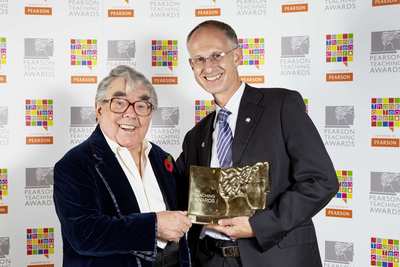
|
The Japan Foundation is delighted to confirm that Crispin Chambers, who teaches Japanese at Tavistock College in Devon, has won the award for Teacher of the Year in a Secondary School at the Pearson National Teaching awards ceremony held in London. His large group of supporters cheered loudly and even shouted “konnichiwa sensei” in unison as he collected his award.
Crispin learnt to speak Japanese when he took part in the Japan Exchange and Teaching (JET) Programme, teaching English on Awaji Island for 2 years and then became JET programme co-ordinator for a year for the Japanese government at in Tokyo. After returning to the UK, Crispin gained an MA in Japanese at Sheffield University followed by a PGCE at Nottingham University. He has been teaching Japanese and French at Tavistock since 1996, and has trained several other teachers of Japanese. His lessons are inspiring and fun, and were described by the Teaching Awards judges as "a joy to watch".
As he collected his award, Crispin was asked why he thought his students do so well learning Japanese. He responded with several reasons:
- Japanese has a strong visual impact, so those students that like art are good at Japanese
- It is one of the most simple languages to study from a grammatical point of view, so students that like maths and science are normally good at Japanese
- It is good to see pupils with various learning disabilities succeed in Japanese, and his dyslexic pupils have done well
Crispin finished by saying that Japanese was his passion and that he is just happy to be able to share it with the thousands of pupils that he has taught.
You can see Crispin receive his award on Britain’s Classroom Heroes here. The programme will be available on the BBC iplayer until the 3rd of November 2013. You can learn more about Crispin’s fantastic Japanese lessons in our case study about the school click here or here to read it.
27/10/2013
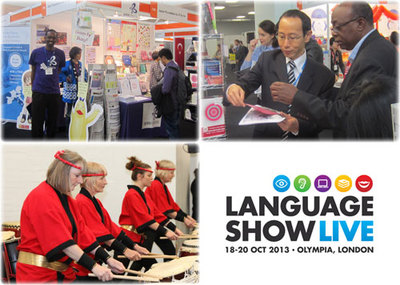
|
A big thank you to everyone who visited the Japan Foundation’s stand at the Language Show Live on the 18th, 19th and 20th October at Olympia.
Held once a year, the Language Show is the UK's biggest event for language learners, teachers, linguists and anyone with a passion for languages. The Japan Foundation’s stand gave visitors a chance to experience Japanese language and culture, including writing their name in Japanese and taking a purikura-style photo using Japan Foundation’s Erin’s Challenge! I Can Speak Japanese website (you can find the purikura game here).
On Friday morning, for the first time, the Japan Foundation held a seminar on Non-European languages in Primary and Secondary education: A case study of Japanese. Using Japanese as an example, the seminar aimed to give ideas to teachers of less well taught languages about how to go about introducing them into schools, and what support is available.
On Sunday morning, we held a Japanese Language Taster session led by the Japan Foundation’s Japanese Language Advisor, Hiroko Tanaka. It was attended by enthusiastic language learners of all ages, who learned basic Japanese greetings and the writing system.
At the close of the show on Sunday afternoon, Japan Foundation were delighted to welcome back Tamashii Daiko for a performance Japanese taiko drumming and a taiko workshop. Tamashii’s exhilarating drumming drew an enormous crowd, and many audience members were delighted to get the change to try taiko themselves.
Additionally, we held a Japan Quiz, which approximately 700 people entered. Out of those who answered the quiz correctly, we picked five at random to send our Japan Foundation Goody Bag. Congratulations to Maysoun Cesarato-Adel from London, Caroline Moses from London, Jeanette Shipp from Surrey, Kristin Barrett from Essex and John Parry from Shropshire, who have all been sent Goody Bags!
The answers to the quiz were as follows:
1. Japan is often known as “The Land of the Rising...”a) Sun b) Moon c) Ninjas
Answer: a) Sun. The Japanese word for Japan, Nihon (日本), means “sun’s origin.”
2. Japan’s tallest mountain was recently awarded UNESCO World Heritage status. But what is this mountain’s name? a) Mount Kilimanjaro b) Mount Everest c) Mount Fuji
Answer: c) Mount Fuji. Kilimanjaro is in Tanzania, and Everest is in the Himalayas.
3. Which of these kanji (Japanese characters) means “tree”? (Hint – look at the shape!) a) 日b) 山c) 木
Answer: c) 木(ki). 日(hi) means “sun” or “day,” while 山 (yama) means “mountain.”
4. Which of the following is a traditional Japanese performing art? a) Belly Dance b) Kabuki c) Peking Opera
Answer: b) Kabuki. Belly dance is from the Middle East, and Peking Opera is from China.
We would like to thank Tamashii Daiko and all our Japanese Taster for Schools volunteers who generously donated their time and expertise for the show. Domo arigato gozaimashita!
If you missed us, you will also have the opportunity to see the Japan Foundation exhibit and present seminars at Experience Japan Exhibition 2013 on November 16th.
Japan Foundation will also be attending the Language Show in 2014, on October 17th, 18th and 19th at the Olympia, London. We hope to see you there!
24/10/2013
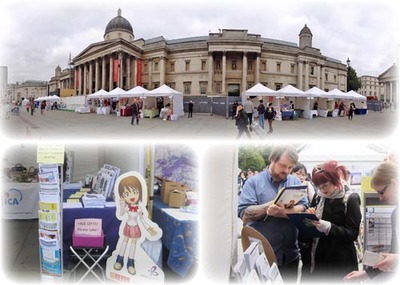
|
The Japan Matsuri returned to Trafalgar Square in London on Saturday 5th October 2013. This popular annual festival brings members of the Japanese community and Londoners together to enjoy the many aspects of Japan with Japanese food, music, dance and other activities.
The Japan Foundation ran a stall at the festival providing information about studying Japanese in the UK, useful handouts about our support for schools and details about all of our upcoming events. In addition, we held a Japan Quiz, which 600 people entered.
The answers to the quiz were as follows:
1. Japan is often known as “The Land of the Rising...”a) Sun b) Moon c) Ninjas
Answer: a) Sun. The Japanese word for Japan, Nihon (日本), means “sun’s origin.”
2. Japan’s tallest mountain was recently awarded UNESCO World Heritage status. But what is this mountain’s name? a) Mount Kilimanjaro b) Mount Everest c) Mount Fuji
Answer: c) Mount Fuji. Kilimanjaro is in Tanzania, and Everest is in the Himalayas.
3. Which of these kanji (Japanese characters) means “tree”? (Hint – look at the shape!) a) 日 b) 山c) 木
Answer: c) 木(ki). 日(hi) means “sun” or “day,” while 山 (yama) means “mountain.”
4. Which of the following is a traditional Japanese performing art? a) Belly Dance b) Kabuki c) Peking Opera
Answer: b) Kabuki. Belly dance is from the Middle East, and Peking Opera is from China.
Out of those who answered the quiz correctly, we picked five at random to send our Japan Foundation Goody Bag. Congratulations to the five winners Karen Mason from London, Cathy Stroemer from Orpington, Guendalina De Luigi from London, Daniel Tilbey from Essex and Kiki Chiv from London, all of whom have been sent goody bags!
The Japan Foundation will also be at the Experience Japan Exhibition 2013 on November 16th. We hope to see you there!
30/09/2013
There has been a change in personnel here at the Japan Foundation, London Office with Tsuyoshi Takahashi returning to Tokyo and Kenichi Yanagisawa assuming the role of Director-General. Please click here to read a farewell message from Takahashi-san and a welcome message from Yanagisawa-san.
26/09/2013
|
Speak to the Future has just launched a campaign calling for everyone to learn 1,000 words of a foreign language - a level that will allow them to hold simple conversations in another tongue. The project is funded by the British Academy and Routes into Languages, and is backed by a broad coalition of organisations including the British Council and the Japan Foundation, London. We hope that lots of people will try to learn their first 1000 words in Japanese!
How to get started for individuals:
A good way to get started is to have a look at the fantastic resources on the Japan Foundation’s portal website Nihongo iina (including various Japanese language application’s for Android or iOS.) or you can try the new Language and culture course website, Marugoto Plus.
We will continue to hold Japanese from Scratch events, that allow people to dip their toes into Japanese language learning, as well as our Language and Culture Course for Beginners. We will be giving out hiragana and katakana charts along with plenty of useful Japanese language learning advice at the upcoming Japan Matsuri and Language Show Live, so come and visit us at these events. Please subscribe to our ebulletin or check out our What's On page to see what other events are coming up.
How to get started for teachers:
Teachers that would like to take their first steps in learning Japanese can attend our free Basic Japanese Language and Culture Course for teachers during the upcoming autumn half term. We also have a free Japanese for primary schools event in November to demonstrate how to introduce Japanese language classes into primary schools (and have a go at learning Japanese yourself!) For teachers that already know basic Japanese, we have the J-Basic Online course that would like to build up their language skills, to get you closer to your first 1000 words.
How to get started for schools:
If your school would like to introduce Japanese, we have a huge range of support to help you get started. We have a network of volunteers who can visit your school to give a free Japanese language taster. We have a funding programme, a large selection of free online resources and a fantastic library (including a loan-by-post service) with approximately 10,000 items to help you teach Japanese language and culture.
日本語のことば1000語に挑戦!
Let’s get learning at least 1000 words in Japanese!
24/09/2013
The application forms for the Japanese Studies Fellowship Programme 2014 have now been released.
To receive an application form or to learn more about the programme contact Hal Parker or visit the programme list on our Tokyo site.
Application deadline: 2nd December, 2013.
Please discuss your eligibility with the Japan Foundation before applying.
24/09/2013
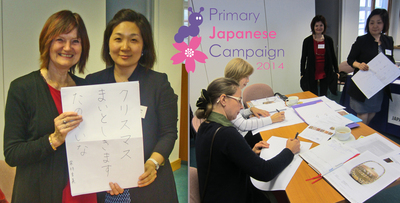
|
From September 2014 it will be compulsory for all maintained primary schools in England to teach at least one foreign language from Key Stage 2. In response to this, the Japan Foundation, London is planning a series of workshops and events for our Primary Japanese Campaign 2014, to help prepare primary teachers who would like to teach Japanese. The first of these events took place on the 10th of September 2013, when 15 teachers of Japanese and primary class teachers came to the Japan Foundation, London for an exclusive opportunity to learn from the Language Consultants from Japan Foundation Sydney.
In Australia Japanese is the most widely taught language in primary schools, so Australian schools have a wealth of advice and resources that could also be used in the United Kingdom. The specialist language consultants from the Japan Foundation Sydney, Cathy Jonak and Hyogyung Kim, introduced some of the tried and tested ways Japanese has been taught in Australian schools.
The seminar started with an overview of the wide range of support (including resources and funding) for primary schools in the UK. This was followed by information about Intercultural Language Learning (ILL), an approach which integrates language and culture learning in a holistic way. ILL forms the basis of the languages curriculum for Australian school education. Lastly, participants looked at various classroom activities based on this approach using the resource Art Speaks Japanese-日本の美術, and the anime 『千と千尋の神隠し』(Spirited Away).
One teacher mentioned that this event “inspired me to use more cultural (traditional and anime) resources” while another commented that “it was useful to learn about the Intercultural Language Learning approach especially using Miyazaki films and Art Speaks Japanese.” If you are interested in the Art Speaks Japanese resource, we have six copies available to borrow in the Japan Foundation Library.
12/09/2013
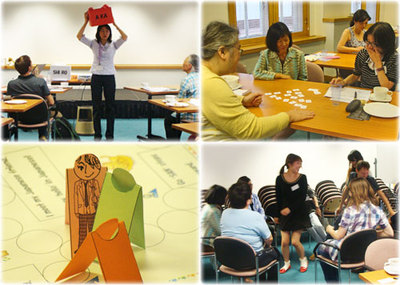
|
On September 6th 2013, 16 volunteers attended the third training day of 2013 for the Japan Foundation’s Japanese Taster for Schools (JTS) Programme, in which native and fluent Japanese speakers conduct free Japanese taster sessions in UK schools.
After an overview for new volunteers about the Japan Foundation and the JTS programme itself, the participants heard reports by two volunteers who had held recent Japanese language tasters. One presenter was a native Japanese speaker who had visited Wayfield Primary School in Medway, Kent, while the other was a non-native speaker who held a taster at Sandgate Primary School in Folkestone (also in Kent). It was a good opportunity to hear about two quite different JTS experiences.
Next, the Japan Foundation’s Japanese Language Advisor, Hiroko Tanaka, held workshops on how to introduce Japanese language effectively in a Japanese taster, focussing on the teaching of Japanese numbers. Tanaka-sensei demonstrated that numbers can be made easier to remember through the use of pictures and gestures. She also introduced methods of practicing Japanese numbers, including the use of fun games (including Bingo and a boardgame), and cultural activities like “tama-ire,” in which teams have to throw balls into a basket held by another member. Several of the materials used came from Japan Foundation’s own resources, including Ready Steady NihonGO.
Finally, as many volunteers who attended past Training Days had said that they would like to see a real-life Japanese language class, all participants had the opportunity to watch videos of Japanese teachers and beginner-level students.
Thanks to the enthusiasm of all volunteers, the training day was filled with energy and a lot of fun for all involved. Aki Adams, a veteran member, commented:
「沢山のアイディア(ティーチング)があり、とても参考になりました。ゲーム等が特によかったです。」
(“It was really useful because there were so many teaching ideas. The games and other activities were particularly good.”)
Isabelle Demaude, another veteran JTS member, said, ““Good fun, some great ideas for new games to play with students.”
We would like to thank all participants for coming, especially our two fantastic guest speakers!
Our next JTS Training Day is scheduled for November, when we hope to have some very special guests coming.... pupils from the Academy of Home Educators who have been learning Japanese for several months from a veteran JTS volunteer. Applications for this training day will open soon, so look out!
If you are interested in taking part in the JTS programme as a volunteer, please click here for more information.
02/09/2013
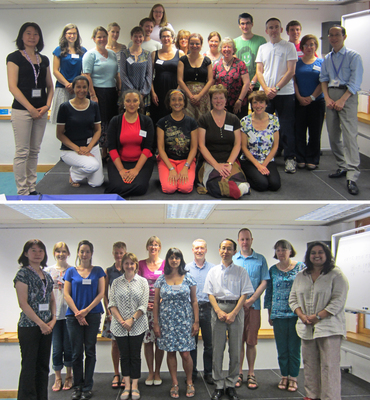
|
From the 19th to the 23rd of August, 22 intermediate and 15 advanced speakers of Japanese joined the Japan Foundation’s language advisors to refresh their Japanese before the start of the new school year. This year’s attendees were non-native Japanese language teachers from a wide range of teaching backgrounds, from primary schools to university-level.
This year’s theme was 「話すことを教える」- Teaching Spoken Japanese. The aim of the course was for teachers to study Japanese teaching methods while at the same time brush-up their own Japanese ability by trying out teaching activities. Lead by Seiji Fukushima and Hiroko Tanaka, the Japan Foundation’s Japanese Language Advisors, the course gave participants the opportunity to explore how to teach Japanese conversation, including pronunciation, looking at both pedagogy and practical teaching ideas.
Participants looked at the JF Standard for language education and had time to practice speaking in Japanese by creating role plays. They also learnt about spoken Japanese in terms of timing, rhythm and intonation and tips to improve pronunciation, such as shadowing. On the final day of each course, the participants gave speeches or self-introductions in Japanese. These were excellent and demonstrated the exceptional talent and passion that Japanese language teachers in the UK possess. Catherine Stead commented that she “liked the balance of activities that challenged us to use Japanese and that concerned discussion of teaching Japanese.”
All participants enjoyed not only exploring teaching methods, but also the opportunity to network and practice their Japanese with fellow Japanese teachers. One participant, Beth Smith summed this up by saying, “I really enjoyed the challenge – and I would recommend to anyone teaching Japanese or running a Japanese club. I learned so much that I thought I had forgotten.”
We would like to thank all participants for coming to the Refresher Course, and really hope to see them again at future events. お疲れ様でした!
You can download the data from the Refresher Course below.
30/08/2013
The National Curriculum reforms mean that from September 2014, it will be compulsory for primary schools maintained in England to teach a foreign language of their choosing to Key Stage 2 pupils. In response to this, the Japan Foundation have launched the Primary Japanese Campaign 2014, in order to support primary schools and teachers offering, or aspiring to offer, Japanese language lessons for their pupils.
Some of the activities that the Japan Foundation will be holding as part of this campaign will include:
- Events for primary schools and teachers about teaching primary Japanese
- Developing specialist resources for teaching primary Japanese
- Holding Japanese language courses and workshops especially for primary teachers
- Providing funding for primary schools to launch their own Japanese classes
- Distributing practical information and advice to schools about teaching Japanese
 Upcoming events and activities taking place within the campaign:
- October 31st - November 1st 2013: Basic Japanese Language & Culture Course for Teachers
- November 21st 2013: Japanese for Primary Schools: Support, Resources & Taster
- September 2013 – July 2014: Looking for a partner school to develop primary Scheme of Work and supplementary resources
Join in!
YOU can be a part of this campaign! Register with us in order to receive the latest information on upcoming activities within the campaign. Primary school teachers, senior managers, language co-ordinators, private tutors and anyone else interested in primary Japanese language education is welcome to join.
< If you register, you can even opt to receive free, exclusive Primary Japanese Campaign reward stickers for your school!
> Click here to register for the Primary Japanese Campaign 2014
28/08/2013
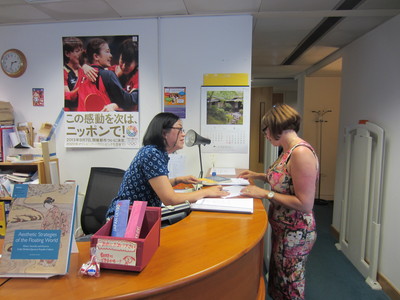
|
We are delighted to announce that from 1 September 2013, the library regulations will be changed to make it even easier for a greater number of people to benefit from our Japanese language education collection.
Please click here to view the details of these changes (in Japanese and English) and click here to view our updated library leaflet.
27/08/2013
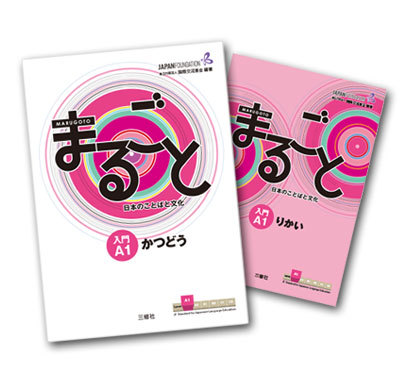
|
We are delighted to announce that Marugoto Starter (A1), a brand new coursebook created by the Japan Foundation using the JF Standard for Japanese Language Education, are available in the UK from September.
Marugoto Starter (A1) is designed in such a way that Japanese language and culture can be studied together. It aims to increase communicative skill and responds to the needs of learners who desire to become able to speak in Japanese in as short a time as possible. Through useful topics, audio learning materials and full-colour photographs and illustrations that let you get a glimpse of Japanese life and culture, it’s possible to rapidly deepen learners’ interest in Japan and Japanese language. This book allows learners around the world to feel the joy of using Japanese and steadily increasing what they can do in the language.
Some of the features of Marugoto include:
- Levels: Based on the JF Standard (JFS) which is derived from the CEFR. CEFR is an abbreviation of the 'Common European Framework of Reference for Languages: Learning, Teaching, Assessment' which provides a shared framework in the field of language education and learning in Europe.
- Tasks: Learning goals for each chapter are designed with reference to JFS's "Can-do" statements. The emphasis is on communicative tasks.
- Intercultural Understanding: In order to deepen their understanding, learners can find out about Japanese life and culture and consider similarities and differences with their own.
- Portfolio: Learners use a portfolio to keep records of their Japanese language learning and cultural experiences. This makes the learning process and achievements gained more visible.
More information about Marugoto and supplementary materials can be found at the following websites:
- Introduction to Marugoto on the Japan Foundation Headquarters Website (Japanese language only)
- Official Marugoto website of Sanshusha Publishing
- MARUGOTO + (official supplementary website)
- Marugoto no kotoba – Reference and activity site for vocabulary and expressions used in Marugoto
- Marugoto on the JF Standard website
If you are interested in learning Japanese through Marugoto, you may be interested in the Japan Foundation & SOAS Language and Culture Course which uses this textbook – click here for more information.
If you are a teacher of Japanese and are interested in teaching with Marugoto, we are planning to hold seminars on teaching with this resource. Please click here to subscribe to our monthly e-bulletin, JF News, to receive news on upcoming Marugoto events.
01/08/2013

Japanese language in primary education:
The National Curriculum reforms mean that from September 2014, it will be compulsory for primary schools maintained in England to teach a foreign language of their choosing. In response to this, the Japan Foundation are developing a Japanese language education Scheme of Work and supporting materials for primary schools. We are now looking for a London-based primary school that would like to participate in the development of these resources, by working in partnership with us to test our draft Scheme of Work with a class of Year 3 pupils.
The selected partner school will be supplied an expert Japanese language teacher from the Japan Foundation London, who will plan and deliver an entire course of Japanese lessons completely free of charge. Should your school wish to receive further advice and support in continuing the Japanese lessons after the trial period has ended, the Japan Foundation will be more than happy to assist.
This is a very exciting and unique opportunity for the partner school to take an active role in creating a Scheme of Work and supporting resources that will be available to schools nationwide, as well as to develop their own Japanese language programme for their school and to give their pupils the rare chance to learn Japanese language.
Scheme of Work development project: Japanese language education for primary education
Aim: To develop a Scheme of Work (SoW) and supporting materials for KS2 (Year 3) by September 2014. Additionally, to develop teaching methods for Japanese classes incorporating Japanese culture such as anime (Japanese cartoons).
Target Class: We would like to test the draft curriculum with the following two types of model classes:
1. General Japanese Class (Year 3)
- Target: Year 3 pupils
- Period: September 2013 – July 2014 (We can discuss the duration at the end of each school term)
- Time: 45 minutes once a week, for a total of 36 sessions (provisional schedule)
- Content: Japanese class based on the new curriculum
- Instructor: Dr Seiji Fukushima (Chief Japanese Language Advisor at the Japan Foundation London)
2. Short-Term Japanese/Anime Course
- Target: Year 3 pupils
- Period: Approximately one month (as appropriate) between September 2013 – July 2014
- Time: 45 minutes once a week, for a total of 4 sessions
- Content: Japanese language and culture class using anime (Japanese cartoons).
- Instructor: Dr Seiji Fukushima (Chief Japanese Language Advisor at the Japan Foundation London)
The partner primary schools should:
- Be interested in holding a Japanese class and a Japanese club for Year 3 pupils (Preferably held on different days)
- Be willing to permit the Japan Foundation to use its facilities and equipment to be used for the purpose of running a Japanese class and club, including class room, PC, projector etc.
- Be willing to provide an advisor for the instructor. The Japanese class will be run by a Japanese language advisor from the Japan Foundation London, but we would also like a class teacher from the partner school to attend the classes and provide appropriate advice from the point of view of a primary level educator.
Other points:
- Both schools that are currently teaching Japanese, and those not currently teaching Japanese, are welcome to apply
- The Japan Foundation will cover all expenses, including personnel expenses, travel expenses etc. incurred by the Japanese language advisor.
- Priority will be given to schools with particular enthusiasm for introducing language education.
- Priority will be given to maintained primary schools
If you are interested in getting involved in the project, please contact Josephine Audigier josephine.audigier@jpf.org.uk or 020 7436 6698.
31/07/2013

|
A big thank you to the 2,000+ visitors who came to the Japan Foundation’s stand at the Hyper Japan on the 26th, 27th and 28th July 2013.
HYPER JAPAN is the UK's biggest celebration of Japanese culture, Japanese cuisine, and Japanese cool. The Japan Foundation London’s stand gave visitors a chance to find out more about Japanese arts and culture, and studying Japanese language.
One of the highlights of our stand was our Japan Quiz, which around 1,300 people entered.
The answers to the quiz were as follows:
1. Japan is often known as “The Land of the Rising...”a) Sun b) Moon c) Ninjas
Answer: a) Sun. The Japanese word for Japan, Nihon (日本), means “sun’s origin.”
2. Japan’s tallest mountain was recently awarded UNESCO World Heritage status. But what is this mountain’s name? a) Mount Kilimanjaro b) Mount Everest c) Mount Fuji
Answer: c) Mount Fuji. Kilimanjaro is in Tanzania, and Everest is in the Himalayas.
3. Which lovable Japanese animal character made its first appearance in 1974 before taking the world by storm? a) Hello Kitty b) Kermit the Frog c) Pikachu
Answer: a) Hello Kitty. Pikachu is Japanese, but made his first appearance in 1996. Jim Henson (American) created Kermit the Frog in 1955.
4. Which of these kanji (Japanese characters) means “tree”? (Hint – look at the shape!) a) 日 b) 山c) 木
Answer: c) 木(ki). 日(hi) means “sun” or “day,” while 山 (yama) means “mountain.”
5. Which of the following is a traditional Japanese performing art? a) Belly Dance b) Kabuki c) Peking Opera
Answer: b) Kabuki. Belly dance is from the Middle East, and Peking Opera is from China.
Out of those who answered the quiz correctly, only five people could win the Japan Foundation goody bag. The lucky five were Jayson Arago from Surrey, Alan Lok from Hertfordshire, Jen Kenny from Northampton, Daniel Pina from London and Antonio Ruiz from Essex. Well done to them!
We are scheduled to be at Hyper Japan again in 25th – 27th July 2014, and hope to see even more Japan fans there!
29/07/2013
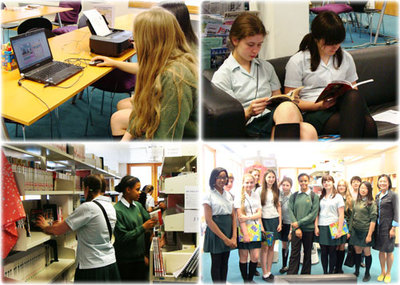
|
On July 4th 2013, the Japan Foundation London Library was delighted to welcome ten pupils and two teachers from Newstead Wood School. The pupils were all in Year 9 and studying Japanese language.
The Library and Resources Officer, Miho Takamura, told the pupils all about the library, using simple Japanese words such as hon (book) and shinbun (newspaper). Pupils were then invited to explore the library themselves. The manga section proved particularly popular! Pupils also enjoyed making their own purikura mini photos, using the purikura activity on Japan Foundation’s Erin’s Challenge! I Can Speak Japanese website.
The library is open to all members of the public who wish to use its resources for Japanese language study. For further details on how to join and the types of membership available, please click here. The library will be open as usual throughout the school summer holidays, so please come and visit!
Finally, we’d like to thank the teachers and pupils of Newstead Wood School for visiting us – arigatou gozaimashita!
If you are interested in organising a library tour for your pupils, please contact the Japan Foundation Library at library@jpf.org.uk for more information.
23/07/2013
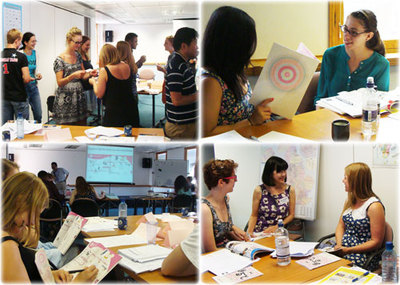
|
For the very first time, the Japan Foundation London has held an exclusive beginners’ Japanese class for participants of the Japan Exchange and Teaching (JET) Programme, in which graduates from English-speaking countries go to Japan to teach English and promote cultural exchange.
The course took place over July 20th and 21st, and twenty JET participants in total took part. Led by the Japan Foundation’s Chief Japanese Language Advisor, Dr Seiji Fukushima, the course was based on Japan Foundation’s brand new coursebook Marugoto: Japanese language and culture, in addition to material from the accompanying MARUGOTO+ website and Erin’s Challenge! I Can Speak Japanese. The Marugoto coursebook, which is based on JF Standard for Japanese Language Education and emphasises learning Japanese for practical communication and cultural understanding, was very appropriate to the JET participants, who will soon find themselves in situations where they will need Japanese in order to accomplish basic tasks such as ordering food, meeting new people, and teaching Japanese school pupils. To keep the course effective and enjoyable, Fukushima-sensei incorporated many different activities into the lessons, including role-play, games and videos of Japanese life.
We were also very fortunate to be joined by fluent Japanese-speaking volunteers, who gave participants the opportunity to practice their newly-acquired Japanese and ask questions about Japanese language and culture.
Some of the feedback from participants included:
“Situation learning’ meant the Japanese study felt a more natural way to learn and my interest was held. The event was enjoyable!”
“Really liked the course handbook & textbook. The sensei was excellent – very enthusiastic which helped keep me focussed. The additional help from the volunteers was very helpful.”
“I liked the contrast between group discussion and teaching and it was nice to get to know other JETs from the U.K. before going whilst learning some useful phrases.”
The participants will all be travelling out to Japan in August, and we wish them all the best of luck – ganbatte kudasai!
A big thank you to all the participants for coming, and an especially big thank you to the Japanese-speaking volunteers - ARIGATOU GOZAIMASHITA!
22/07/2013
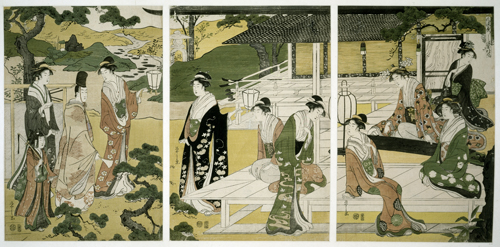
The Japan Foundation was delighted to present this book launch and talk on the highly-regarded new publication, Aesthetic Strategies of the Floating World. We were joined by the book’s author, Afred Haft (British Museum), who examined how the Floating World responded to the authority of Japan’s classical tradition, and made ukiyo-e (popular woodblock prints) an agent in the social and cultural politics of their time. Following Haft’s talk, Tim Clark (British Museum) and Dr Christine Guth (Royal College of Art) gave incisive and thought-provoking commentaries on the book, before the panel took questions from the audience in what was a lively and interesting Q&A session.
We had a full house for this event and the Japan Foundation would like to thank all those that came along and helped to make this such a successful evening.
Image: Fûryû yatsushi Genji: Matsuzake Chôbunsai Eishi circa 1790, collection of the British Museum
19/07/2013
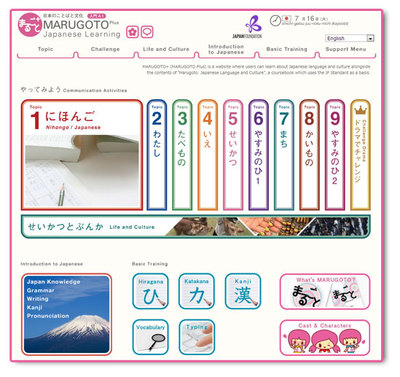
|
The Japan Foundation are delighted to announce the launch of a new website especially for beginners of Japanese language, called MARUGOTO+.
Free and very easy to use, MARUGOTO+ (MARUGOTO Plus) enables users to learn about Japanese language and culture through nine separate topics. The emphasis on the website is to learn Japanese for practical communicative tasks, as well as deepen understanding of Japanese culture. There are a large number of videos of life in Japan for listening and speaking practice, which also help deepen your understanding of actual everyday situations. The website also features basic training in Japanese grammar, writing and pronunciation, including animations for writing kanji.
The website is designed to be used alongside the contents of Marugoto: Japanese language and culture, a coursebook developed by the Japan Foundation which uses the JF Standard for Japanese Language Education as a basis. This coursebook will be published later in the year.
To start using MARUGOTO+ straight away (no registration is required), please go to http://marugotoweb.jp.
We hope beginners of Japanese will enjoy using this fun website to enhance their studies!
09/07/2013
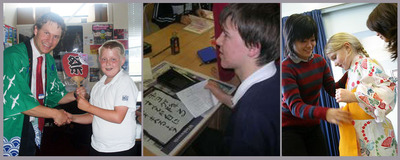
|
The Japan Foundation delighted to report that the UK government published a new draft national curriculum on 8th of July 2013 that includes several amendments that are beneficial to teachers and students of Japanese as it gives schools a free choice of which language to teach. The national curriculum applies to all state maintained schools in England, but does not have to apply to academies, free schools or independent schools. There will be one last consultation on this draft, which is due to be introduced in schools from September 2014.
We would like to thank all of the teachers, pupils, businesses, organisations and individuals who responded to the various government consultations over the last year. The latest report from the Department for Education specifically mentions that a large number of respondents mentioned Japanese, and argued against the prescriptive list of seven languages. We have outlined a brief overview of how the changes affect Japanese language education below. You can see the full report here and the new framework document here.
Key Stage 2 (pupils aged 7 – 11)
The Department for Education has removed the proposed list of languages from the key stage 2 programme of study for foreign languages to give schools a free choice over which modern or ancient language pupils should study over the four years of key stage 2. This is fantastic news for primary schools that already teach Japanese, and for schools that would like to introduce Japanese in the future.
The Japan Foundation London is keen to support primary schools that would like to start Japanese. We have funding, resources and a whole range of courses and events for teachers; we hope many more primary schools will use our support to introduce Japanese classes at this level.
Key Stage 3 (pupils aged 11 – 14)
There is also good news for the many secondary schools where pupils begin to study Japanese at key stage 3. “Teaching may be of any modern foreign language and should build on the foundations of language learning laid at key stage 2, whether pupils continue with the same language or take up a new one.” This means that even if feeder primary schools are unable to teach Japanese, it should not affect the ability of secondary schools to maintain their current Japanese classes.
As some primary schools do already teach Japanese, the Japan Foundation London is keen to work with schools to bridge the gap between key stages 2 and 3 to ensure pupils will be able to progress smoothly into secondary school and continue to study Japanese at higher levels.
Key Stage 4 (GSCE level 14 – 16)
Modern foreign languages are not compulsory national curriculum subjects after the age of 14, but all pupils in maintained schools have a statutory entitlement to be able to study them. This means that schools must provide access to at least one language course at key stage 4 level, which leads to a formal qualification.
The government is also running a consultation about GCSE accreditation. You can read the subject content and assessment objectives here, and can respond to this consultation here.
04/07/2013
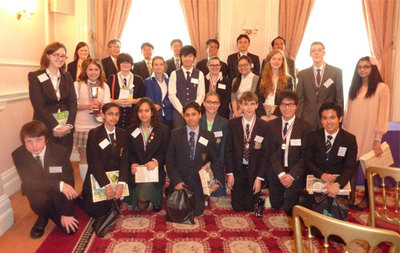
|
The Nihongo Cup Japanese Speech Contest for secondary school students was held at the Embassy of Japan in London on June 29th 2013.
The 18 finalists, who had been selected from 203 applicants from 22 different schools across the UK, all demonstrated great creativity, thoughtfulness and outstanding ability in Japanese in performing their speeches – not to mention extraordinary courage to present their ideas in a foreign language to an audience of 130 people!
Between each of the three categories of speeches, the audience was entertained by Japanese children’s stories told to the musical accompaniment of Motoki Hirai, and an interactive performance of the traditional “tankobushi” Japanese coal miner’s dance by two members of the Japanese Language Committee.
Due to the extremely high level of Japanese and the thought-provoking content of the speeches delivered by all finalists, the judges had extremely difficult decisions to make when choosing the final winners of the 2013 Nihongo Cup. In the end, Ji-Han Choi (Key Stage 4and 5 Post-GCSE), Lusha Zharova (Key Stage 4 and 5 Pre-GCSE) and Anna Whitehead (Key Stage 3) were awarded first prize in each of their categories.
There were many young Japanese language learners in the audience studying Japanese, and we asked them to share their experiences with us. Christina Vivian, a student at Greenford High School, said: “I chose to study Japanese because I’m really interested in the culture and language so pursued to learn it... It has made my school life a lot more interesting!”
Anna Whitehead, winner of the Key Stage 3 category, said, “Japanese is a fun and interesting language to learn. Japanese culture is exciting and unique, and the food is delicious! I recommend Japanese, it is very special and you won’t regret it!”
Many congratulations and a big thank-you to everyone who came together to make the day such a success. The full results of the contest are as follows:
Key Stage 4 and 5 Post-GCSE Category
Winner: Ji-Han Choi (Hampton School)
Speech title: “Meeting with Code Geass”
2nd Prize: Bozena Odobasic (Gresham’s)
Speech title: “School Uniform”
3rd Prize: Rachel Lawson (Wolfreton School and Sixth Form College)
Speech title: “My Writing”
Other finalists:
Clifford Chung (Hockerill Anglo-European College)
Yu Yeen Fung (St. Helen’s School)
Alvin Lei (Wycliffe College)
Key Stage 4 and 5 Pre-GCSE Category
Winner: Lusha Zharova (Sevenoaks School)
Speech title: “Anjin”
2nd Prize: Benny Dörnyei (The South Wolds Academy and Sixth Form)
Speech title: “Japan and Hungary”
3rd Prize: Mia Sutton (Aldercar Community Language College & Post Sixteen Centre)
Speech title: “Visiting Japan”
Other finalists:
Maisey Hodges (Campion School Language College)
Ruth Ladani (Greenford High School)
Anna Spivack (Hockerill Anglo-European College)
Key Stage 3 Category (Speech theme: “My favourite thing”)
Winner: Anna Whitehead (Haberdashers’ Aske’s School for Girls)
2nd Prize: Chris Grimwood (Aylesbury Grammar School)
3rd Prize: Setareh Rafahtalab (Queen Mary’s High School)
Other finalists:
Elan Gadit (Whitgift School)
Taranpreet Kalra (Greenford High School)
Kai Dunlop (Campion School Language College)
The event was organised by the Japanese Language Committee of the Association for Language Learning, in association with the Japan Foundation London and Embassy of Japan in the UK. We are very grateful to Toshiba of Europe Ltd, JSA (the Japanese Speech Awards), Ricoh UK Ltd, JP-Books (JPT Europe Ltd), Japan Centre and Lingualift for sponsoring the event and donating prizes, and also to Sumisho Computer Systems for their generous sponsorship and to Soho Japan for contributing to the evening reception.
28/06/2013
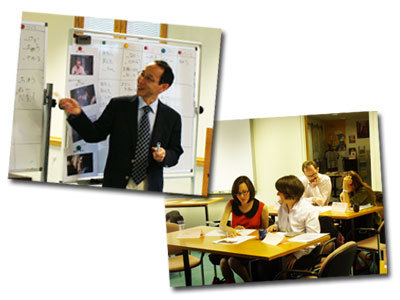
|
How to speak Japanese like a young girl, an old man or a bossy mother were some of the topics covered in the summer course of the Japan Foundation’s Japanese Plus course for advanced Japanese learners, which ended on June 26th.
Running for four weeks and attended by 30 participants, the course used the Japanese movie Happy Family Plan as a learning tool to introduce the various styles in which Japanese is spoken. While following the story of the trials and tribulations of life in a Japanese family, participants learned about how Japanese can reflect one’s personality, age, social status and gender, according to the vocabulary and manner used in speech. The course was lead by the Japan Foundation’s Chief Language Advisor, Dr. Seiji Fukushima, who guided participants in analysing and interpreting the speech of the characters in the movie. All participants also received a copy of the Happy Family Plan DVD to keep and enjoy.
One of the participants, Cheryl, commented, “Excellent course – very enjoyable.”
Another participant said:
“I really like the format of learning from a film. Analysing the characters and their spoken Japanese is really useful and something I can hopefully continue on my own after the course.”
We’d like to thank all participants for taking part in Japanese Plus, and really hope to see even more participants at our next course!
To learn more about Japanese Plus, please click here.
24/06/2013

The Japan Foundation, in collaboration with the Royal Mint Museum, was delighted to present this special public seminar (held on 13th June) exploring the rich history of exchange between Japan and the UK in the area of mint. Yoshiake Shinhara, President of the Japan Mint, gave a detailed and informative talk focussing on the UK's contribution to the establishment of the Japan Mint and the close ties that developed between Japan and the UK in the area of mint in the late 19th century. Shinhara was joined by Graham Dyer OBE FSA of the Royal Mint Museum who provided a British perspective on these ties, and Dr Helen Wang (Curator of East Asian Coins, British Museum) who wrapped things up with an engaging presentation in which she introduced some of the coins that were in circulation in Japan and the UK around the time of the Japan Mint's inception.
18/06/2013
|
Ishinomaki is a city in Japan’s Miyagi Prefecture, and is one of the areas that suffered severe damage due to the Great East Japan earthquake and tsunami on March 11, 2011. Exactly one year later, the children of Ishinomaki published Ishinomaki Hibi Kodomo Shinbun; a newspaper created by the children that reports the current activities in their city.
On the 10th of March 2013, over 40 intermediate to advanced speakers of Japanese, and Japanese people living in the UK, gathered at the Japan Foundation London to speak directly to the people of Ishinomaki over the internet. Attendees learnt more about how Ishinomaki was affected by the March 11 disaster, its current effort towards recovery, and the activities of the young journalists. After speaking to Ishinomaki’s children, attendees worked together in groups to translate selected articles into English. You can read a little more about the event here.
Now, the children are ready to tell Ishinomaki’s story to people all over the world. All the translated articles are available on the Ishinomaki Kodomo Shinbun website (click here to read more in English, or here for the Japanese website.) They also have a twitter feed, which you can follow here. We hope you will enjoy their articles in English. The Japanese versions of these article are not published online, however if you are interested in reading the latest copy of the Ishinomaki Hibi Kodomo Shinbun, there are some copies available at the Japan Foundation London, just outside the library.
11/06/2013
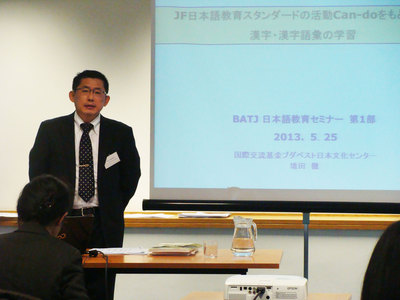
|
On May 25th 2013, approximately 40 people attended a seminar on Kanji and Kanji Vocabulary Learning based on JF Standard’s Can-do Statements, jointly run by the Japan Foundation London and the Association for Teaching Japanese as a Foreign Language (BATJ). This seminar was run by Toru Sakaida, Senior Japanese Language Advisor at the Japan Foundation Budapest, at the Japan Foundation London.
Part 1 of the seminar was entitled Kanji / Kanji Vocabulary Learning Based on Can-do Statements for Communicative Language Activities in JF Standard for Japanese-Language Education (JF Standard). In this seminar, participants deepened their understanding of the relationship between JF Standard’s Can-do statements and kanji teaching, by exploring the kanji and vocabulary needed by Japanese language students when confronting reading and writing tasks. As languages that use kanji have not been considered in the Can-do statements in the Common European Framework of Reference for Languages (CEFR), this proved to be a good opportunity to consider the relationship between reading and writing activities and script.
Part 2, entitled Excel 3 Steps for Kanji vocabulary – Training method for the accurate understanding of Kanji vocabulary with typing by using Excel, introduced study methods for kanji vocabulary using the rubi function in Microsoft Excel. This “Excel 3 Step” aims to get learners familiar with kanji forms and readings by using a computer to type Japanese. In today’s modern world in which typing with a PC has become the norm, “writing” kanji involves recognising the possible kanji that appear when converting from romaji to characters, and selecting the correct one. The “Excel 3 Step” method is a modern practice technique that increases learners’ kanji vocabulary by repeating this process.
Some of the feedback given from participants of the seminar included:
「今回のセミナーでJF Can-doの使い方が以前より理解できた気がします。とても濃い内容でとても勉強になりました。」
(“Thanks to this seminar I think I have a better understanding of how to use Japan Foundation’s Can-do statements than before. The content was very informative and useful.”)
「漢字学習を作文のタイプ打ち以外どのように練習できるか、長い間課題になっていました。良い例を頂きました。」
(“How to practice kanji other than typing compositions has long been a subject of discussion. This seminar gave some good examples.”)
「実践的なセミナーでとても役に立ちました。さっそくエクセルシートで漢字ワークシートを作りたいと思います。」
(“This practical seminar was really useful. I now want to make a kanji worksheet using Excel straight away.”)
22/05/2013
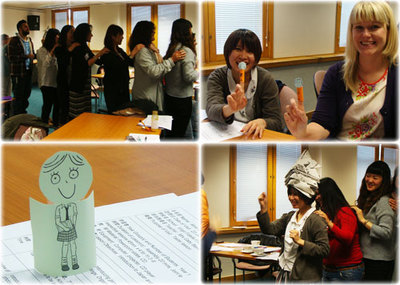
|
On May 17th 2013, 28 volunteers attended the second training day of 2013 for the Japan Foundation’s Japanese Taster for Schools (JTS) Programme, in which native and fluent Japanese speakers conduct free Japanese taster sessions in UK schools.
After an overview for new volunteers about the Japan Foundation and the JTS programme itself, the participants heard reports by two volunteers who had held recent Japanese language tasters. One presenter was a native Japanese speaker who had visited Woodridge Primary School in Barnet, while the other was a non-native speaker who held a taster at Virgo Fidelis Preparatory School in Croydon. It was a good opportunity to hear about two quite different JTS experiences.
Next, the Japan Foundation’s Japanese Language Advisor, Hiroko Tanaka, held workshops on how to introduce Japanese language effectively in a Japanese taster, including Japanese greetings using songs, bowing finger puppets and “jan ken” (Rock Paper Scissors). Several of the materials used came from Japan Foundation’s own resources, including Ready Steady NihonGO.
Finally, Tanaka-sensei demonstrated how Japanese culture can be integrated into language tasters. Taking the theme of summer, she introduced origami koi-nobori (carp streamers), a kamishibai (picture story) about the Tanabata star festival, and a game involving origami kabuto (samurai hats)!
Thanks to the enthusiasm of all volunteers, the training day was filled with energy and a lot of fun for all involved. Kazue Ono, a new volunteer, commented:
「興味はあるけど最初の一歩を踏み出すのはためらってしまうところがあったが、勇気がわいて楽しみになってきた。」
(“I was interested in the programme but I was hesitant to make the first step. But now, I feel confident and look forward to taking part.”)
Emma Gallagher, a veteran JTS member, said, “Another excellent session. Although I’d heard some of the ideas before, it’s still good to have a refresher. And I always meet new faces which is great. Looking forward to my next lesson now!”
We would like to thank all participants for coming, especially our two fantastic guest speakers!
Our next JTS Training Day is scheduled for September, when we hope to have some very special guests coming.... pupils from the Academy of Home Educators who have been learning Japanese for several months from a veteran JTS volunteer.
If you are interested in taking part in the JTS programme as a volunteer, please click here for more information.
24/04/2013

|
The Hakuho foundation is now accepting applications their Japan Experience Program for Overseas Children. This fantastic programme consists of three parts, training in Japan, followed by hosting Japanese school visit and culminating in a trip for some of your students to Japan!
The programme consists of three parts (chronologically):
- One teacher of Japanese from your school will need to take part in preparatory training (two weeks in October/November 2013) . Return airfares to Japan, accommodation, meals and activities, including training and travel expenses are covered by Hakuho.
- One or two schools that take part in the programme will be selected to host a group of Japanese students in late April, early May 2014. Hakuho will provide expenses, including travel for expenses associated with receiving the Japanese schools.
- A maximum of 15 schools will have the chance to send 4 students and an accompanying teacher to Japan in July 2014. Return airfares to Japan, accommodation, meals and activities, including travel expenses are covered by Hakuho.
Application deadline: May 15th 2013
Eligibility
Schools:
- School must be recognised as a formal educational institution by a government authority
- School must be teaching students aged 13-15 in formal Japanese lessons in a school setting
- School undersatands that participation in this programme runs across two calendar years, and must be able to participate continuously until the end of the programme
- School is able to send a non-native teacher of Japanese to participate in both the training programme, and the Japan experience for overseas children.
- School must be able to send students studying Japanese (aged 12-16) to Japan to participate in the programme
- School must be able to actively and cooperatively prepare and implement the programme training
- School must be able to obtain any permissions required from their government or any governmental body for participation in the programme and training.
Teachers:
- Must be teaching students aged 13-15 in formal Japanese classes in a formal setting (however ages 12 and 16 will be considered)
- Must have a teaching licence or equivalent qualification
- Have Japanese ability of at least N4 (previous Level 3) in the Japanese language Proficiency test at time of application.
- Nationality other than Japanese
- Must be able to guarantee continuous participation (including training) from selection until the end of the programme the following calendar year
- Able to stay physically and mentally healthy from selection until the end if the programme the following year.
* Note that teachers who are unable to continue their participation for their own reasons and those who are ineligible to participate in the foundation’s international traveller’s insurance scheme (including due to pregnancy or childbirth) may be asked to withdraw.
For further information, or to download an application form, please visit the Hakuho Website.
The Application Form and Application Guides in English and Japanese can also be downloaded below.
22/03/2013
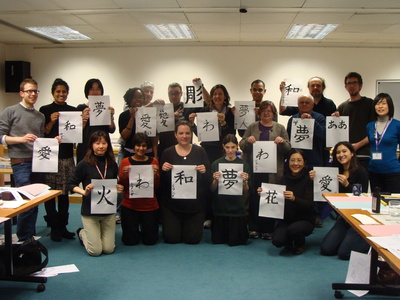
|
Participants who had never before studied Japanese learned how to write beautiful Japanese characters such as 「夢」(yume, “dream”) 「和」(wa, “harmony”) and「愛」(ai, “love”) at our latest “Japanese from Scratch” workshop for beginners in Japanese language studies. The workshop, which focused on the art of shodō (Japanese calligraphy), was held on March 13th at the Japan Foundation London, and 17 people braved the snowy weather to come along and take part.
The workshop was led by Hiroko Tanaka, Japanese Language Advisor at the Japan Foundation London and experienced shodō practitioner. The workshop started with a quiz about Japan, followed by an introduction to some useful Japanese words and phrases. Tanaka-sensei then introduced the Japanese writing systems – hiragana, katakana and kanji – explaining their history, origins and how to use them. This was followed by an introduction to calligraphy tools and techniques, after which the participants practised using water and special Japanese “mizu-shuuji” paper.
Finally, when everyone had got to grips with the basics of shodō, the participants created their own shodō pieces with real Japanese paper and ink. Although most participants had never studied Japanese before, they all created fabulous pieces of work demonstrating their skill and determination. All staff at the Japan Foundation were very impressed!
After the workshop, one participant said, “The teacher was excellent and really structured the workshop well. I liked how she talked about the meaning and symbolism behind words.” Another commented, “Enjoyed the workshop – learnt so much about the history and types of characters as well as the actual art of calligraphy.”
We would like to thank all participants for coming and for their hard work – arigatou gozaimashita.
If you have never studied Japanese before and are interested in learning, or have only just begun to study Japanese, please click here to sign up to our monthly e-bulletin to receive notifications of this and other Japan Foundation events. Click here to read more about Japanese from Scratch and view reports of previous workshops.
15/03/2013
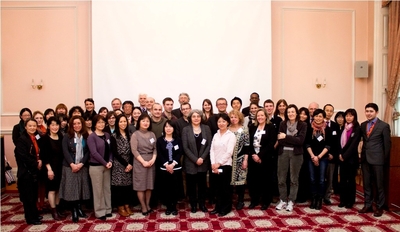
|
On 8th March 2013, 65 participants joined the Japan Conference for Schools, held at the Embassy of Japan in London. Co-organised by the Embassy of Japan, the Japan Foundation and the Japan Society, the event was an excellent opportunity for attendees to hear about how the new National Curriculum might affect Japanese language education in the UK, as well as network and share practical ideas about projects for introducing Japanese into their schools or to enhance their existing Japan-related activities.
Participants were welcomed to the Embassy by the cultural attaché, Eiji Watanabe. This was followed by very useful talk by the Director of Languages First at the University of Cambridge, Bernardette Holmes, who spoke about the changes to the new National Curriculum, and how this might affect Japanese language education in the UK. Bernadette spoke of several ideas for how teachers of Japanese might want to respond to the upcoming Department for Education consultation about the new national curriculum. You can find more about the consultation here.
This fantastic key note speech was followed by a panel discussion, where Martin Clayton from Netherthong primary school and Dan Thompson from Tile Hill Wood School joined Bernardette Holmes to speak about continuity between primary and secondary schools, as well as how this might change with the introduction of the new curriculum. One of the attendees, Darren Jones, mentioned that “The keynote speech was highly informative and thought-provoking. The panel discussion served to answer many questions and offered many ideas for Japanese provision in schools.”
After lunch, Heidi Potter, Chief Executive of the Japan Society, gave a short presentation about the Tohoku area two years after the Earthquake and Tsunami. This was followed by two sessions of small panel discussions, where attendees could join groups and learn more on the topic they were most interested in. This year the topics were things such as cross curricular Japanese for Primary schools, how to run an effective exchange without visiting Japan, practical teaching ideas as well as information about support and resources available. Joseph Bull said that “the group discussions were very useful – great to see practical teaching ideas and resources. I’ll be back in school full of ideas!” while Dan Thorn said he had found “excellent information sharing all round, thank you!”
The event was closed with a few words from the Director General of the Japan Foundation London, Tsuyoshi Takahashi. This year the conference had a good mix of both primary and secondary schools, and was also a mix of schools that teach Japanese already, schools that are hoping to start as well as schools that run Japan related activities as clubs or as cross-curricular activities.
Thank you to all the participants, speakers and the other organisers for making the conference such a success. We hope to see you again next year!
15/03/2013
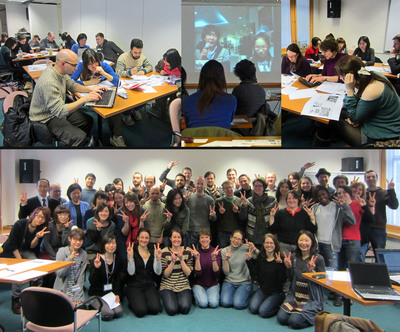
|
On March 10th 2013 41 speakers of Japanese gave up their Sunday to come to the Japan Foundation London and help translate newspaper articles from the Ishinomaki Hibi Kodomo Shinbun; a newspaper created by the children that reports the current activities in their city. Ishinomaki is a city in Japan’s Miyagi Prefecture, and is one of the areas that suffered severe damage due to the Great East Japan earthquake and tsunami on March 11, 2011. The children created their newspaper one year after the disaster, and now, on the second anniversary since the tsunami, the children aim to tell Ishinomaki’s story to people all over the world.
The event began with a screening of DVD “Ishinomaki to shinsai” (about the quake-hit Ishinomaki) and an explanation about the project by Hiroyuki Takeuchi, Executive Administrator of Ishinomaki Hibi Shinbun and director of Ishinomaki NEWSée, via video conferencing software. This was followed with an introduction about the newspaper by two of the young journalists, Takuto Chiba (2nd Year at Higashi Matsushima High School) and Momoka Saito (3rd Year at Hebita Junior High School). Takuto and Momoka were fantastic speakers and overcame their nerves to speak and ask questions to participants on the other side of the world.
Lastly, the volunteer translators broke into groups and translated several articles from Japanese into English. If you would like to find out more about the Ishinomaki Hibi Kodomo Shinbun,you can visit their website here (in Japanese). We hope to publish English versions of the articles soon.
Almost all the participants mentioned that they really enjoyed interacting with the organisers and with the children themselves. One participant, Judith Reynolds mentioned that “the Skype link-up with Ishinomaki was fantastic; it gives a real personal link and is great motivation!” At the end of the event, the Japan foundation collected some messages for the children of Ishinomaki. Here is a selection of these messages:
- “I am so impressed with your newspaper project! It was a pleasure talking with you and helping you to convey your articles to speakers of English. Keep working hard and maintain your positive attitude. Good luck!” - Kevin Squibb
- “Thank you for this chance to work together. I pray that the newspaper will encourage many people and help with the rebuilding of Japan. またよろしくね (I look forward to seeing you again)” - Levi Booth
- “世界の人々が石巻のことにまだ興味があると思います。新聞を読むのを楽しみにしています。” (I think that the people of the world will be interested to hear about Ishinomaki. I am looking forward to reading your articles.) - Kerry Williams
- “Your activities are very inspiring. I wish you all at the Ishinomaki Children’s Newspaper the very best for the future.”- Jennifer Hikari Dixon
14/03/2013
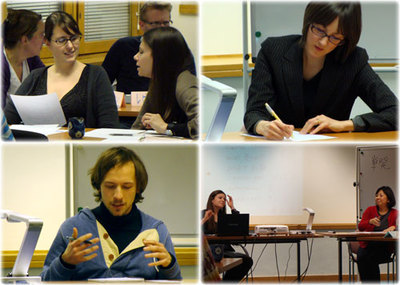
|
From February 12th – March 6th 2013, a total of 36 advanced Japanese language learners experienced a taste of professional Japanese interpreting, as part of the Japan Foundation’s Japanese Plus course.
The course was led by Yoshiko Shimizu, a professional Japanese interpreter and translator, and former Course Director at the University of Bath. After introducing the basics of interpreting, including technique, and types of interpreting, Shimizu-sensei taught liaison interpreting, in which the interpreter translates both English to Japanese and Japanese to English for two speakers. This was followed by a lesson on note-taking in preparation for performing consecutive interpreting, in which the interpreter translates a single speaker’s speech from English into Japanese, or Japanese into English. All participants had the opportunity to attempt both kinds of interpreting, and demonstrated real skill both as Japanese language learners and as budding interpreters.
All participants seemed to find the course challenging, but rewarding. Simon Grisdale, a newcomer to Japanese Plus, said, it was a “nice introduction into interpreting – realise how much more work is needed!” Kath Lawrence, another new participant, commented, “Careful preparation and vocab for liaison interpreting conversations was just the right level.”
We would like to thank all participants and Shimizu-sensei for their hard work throughout this course – otsukaresama deshita!
If you are Japanese learner of approximately JLPT Level 2/N2 or above and are interested in taking part in the next Japanese Plus, please click here to sign up to our monthly e-bulletin to receive notifications of this and other Japan Foundation events. Click here to read more about Japanese Plus and view reports of previous workshops.
14/03/2013
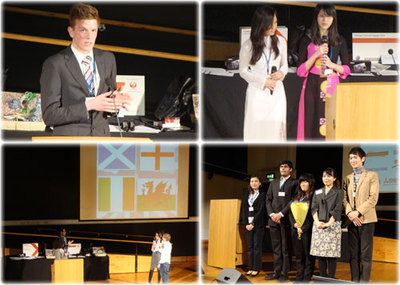
|
On March 2nd 2013, the Finals Day of the Eighth Japanese Speech Contest for University Students was held at Regent’s College London, showcasing ten individual speeches, along with five group presentations, by UK university students.
The day began with the Category 2 finalists, all of whom are studying Japanese as an elective or optional course. The speeches were all of a very high standard and it was very difficult for the judges to decide the winner. However, the first prize eventually went to Junehwan Sung, a second year student from the University College London, for his fascinating speech on “The Hidden Treasure – Dialects.” In second place was Scarlett Wong, a 2nd year at Imperial College London, for her thought-provoking speech entitled “Even adults should watch anime.”
Category 2 was followed by speeches by the Category 1 finalists, who are studying Japanese as their main degree subject. All five finalists demonstrated not only exceptional Japanese ability, but also a great degree of insight and knowledge of their chosen subjects. After much deliberation, first prize was awarded to Tim Joris Laméris, a 4th year student at the School of Oriental and African Studies (SOAS), University of London, for his enlightening speech on “Japan: Dancing Prohibited.” The second prize was awarded to Paulina Wilczynska, in her 4th year at SOAS, for her insightful speech on the theme of “The apology culture of Japan.”
This year’s Group Category gave beginner-level students the chance to give presentations on a topic of their choice. The four outstanding groups that made it through to Saturday’s finals were chosen from an initial 19 applications, and represented Imperial College London, King's College London, University of Warwick and University of Wolverhampton. They gave talks on “Vietnam,” “Introduction to the Mythological Creatures of Great Britain,” “Chinese Food Culture”, “Stratford-Upon-Avon “ and “Stereotypes of British people.” These groups were not placed individually, but instead received special prizes based on their chosen topics.
The full results and details of other entrants can be downloaded below.
We would like to thank all participants, their teachers and supporters, the judges, audience members and BATJ for making the contest such a success. In addition, special thanks must go to the generous sponsors: Baker & McKenzie LLP, Bloomberg L.P., Central Japan Railway Company, Eikoku News Digest, Gendai Travel Limited, The Great Britain Sasakawa Foundation, Japan Airlines, Japan Centre, JP-Books (JPT Europe Ltd.), Mitsubishi Electric Europe, European Business School (Regent’s College London), Ricoh UK Ltd and Toshiba of Europe Ltd
We would like to encourage as many undergraduate students of Japanese language as possible to apply for next year’s contest.
If you are a secondary school teacher or student, you may be interested in the 2013 Nihongo Cup Japanese Speech Contest for Secondary Schools.

14/03/2013
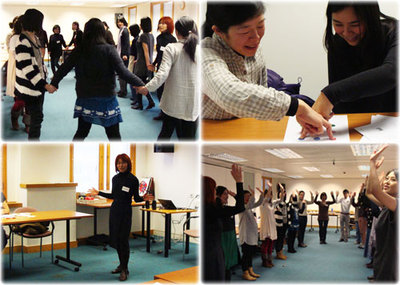
|
On February 22nd 2013, 19 volunteers attended the first training day of 2013 for the Japan Foundation’s Japanese Taster for Schools (JTS) Programme, in which native and fluent Japanese speakers conduct free Japanese taster sessions in UK schools.
After an overview for new volunteers about the programme itself, the participants heard reports by two volunteers who had held recent Japanese language tasters. One presenter was a native Japanese speaker who had visited the London-based Rosendale Primary School with three other volunteers, while the other was a non-native speaker who held a taster at Sale Grammar School in Cheshire by herself. It was a good opportunity to hear about two very different JTS experiences. Several of the materials used for the tasters came from Japan Foundation’s own resources, including Ready Steady NihonGO.
These presentations were followed by a very special session by Kayoko Fujii – one of JTS’s most experienced members, having visited 20 schools during her time with JTS. As Ms Fujii is now returning to Japan, this was a final chance for volunteers to get some valuable teaching ideas from a veteran member. Ms Fujii introduced various songs and dances to make learning Japanese as enjoyable as possible for students.
Finally, Japan Foundation’s Japanese Language Advisor Hiroko Tanaka held workshops on how to introduce Japanese language and culture effectively in a Japanese taster, including fun games for teaching Japanese colours such as “finger twister!”
All participants seemed to enjoy the Training Day. Sachiko Toda commented, 「初めての参加でしたので、全く楽しく興味深かったです。実際の活動の紹介がとてもよかったです。次回も是非参加したいと思っています。」
(“It was my first time to attend, and it was all really enjoyable and interesting. The introduction to practical activities was very good. I definitely want to attend again next time.”)
Karolina Nalaskowska, a veteran JTS member, said, “The session was very entertaining and as always gave me lots of new great ideas for the next JTS.”
We would like to thank all participants for coming, especially our three guest speakers, and wish Kayoko Fujii the best of luck when she returns to Japan!
14/03/2013
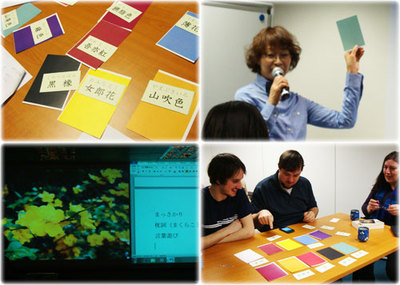
|
Twenty-two participants came to the Japan Foundation London on February 14th for a very special, one-off Japanese Plus workshop on wa no iro – the colours of Japan – hosted by Yuko Hayasaka, editor-in-chief at the Visual Design Institute. The workshop not only gave participants an insight into Japanese colours, but also the opportunity to practice advanced Japanese with help from Hiroko Tanaka, Japanese Language Advisor at the Japan Foundation London.
The workshop began with a game to match colours with their names in Japanese; a challenging task, as it was hard to imagine what colours with names such as 「縁色」(yukari-iro, “the colour of affinity”) and 「薄花色」(usuhana-iro, “light flower colour”) could be like. After matching the colours, the participants practiced their Japanese by expressing what meanings each colour could have, and what feelings they evoked.
Hayasaka-sensei then went on to explain the history and meanings of the colours, taking examples from classical Japanese poems (written in the original classical Japanese). In keeping with Valentine’s Day, the participants discovered that many of the colours had very romantic associations.
We would like to thank all the participants for coming, and Hayasaka-sensei for her unique insight into the world of Japanese colours.
If you are Japanese learner of approximately JLPT Level 2/N2 or above and are interested in taking part in future Japanese Plus courses and workshops, please click here to sign up to our monthly e-bulletin to receive notifications of this and other Japan Foundation events. Click here to read more about Japanese Plus and view reports of previous workshops.
07/03/2013
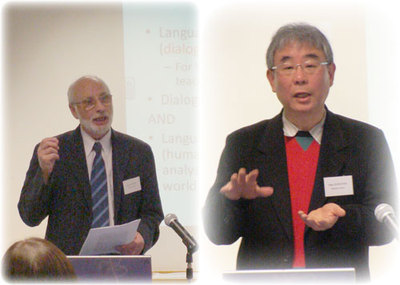
|
On Saturday 23rd February 2013, Professor Michael Byram of Durham University and Professor Hideo Hosokawa of Waseda University held a lecture on Mediation, Interculturality & Citizenship Education: The significance and potential of Japanese Language Education at the Japan Foundation London, in association with British Association for Teaching Japanese as a Foreign Language (BATJ).
Prof. Byram started the lecture by discussing and demonstrating how foreign language teaching in Higher Education should and can be related to liberal educational aims of developing ‘criticality’ in learners and how this can be done through linking language teaching with ‘education for citizenship’. The lecture focused on the theory behind how the aims and objectives of the cultural dimension of language teaching correspond to this of criticality and citizenship, as well as examples from advanced language learners and beginners’ courses.
The theme of mediation, interculturality and citizenship continued in Prof. Hosokawa’s lecture, which explored the relationship between individuals and society and the boundaries between language and culture. To illustrate how mediation relates to interculturality and citizenship education in Japanese language education, Prof. Hosokawa gave examples of the experiences of Japanese language students who participated in his research.
The lecture was not only attended in person by approximately 40 people, but also had a total of 193 views (including 74 unique views) from across the world thanks to a live broadcast on Ustream. Some of the comments from participants included:
「以前から興味のあったトピックでしたが、実際にレクチャーを聞いたりする機会がなかったので、とても良い経験になりました。」
(“I’ve had an interest in this topic for a while, but I hadn’t had a chance to hear a lecture by these researchers so this was a really good experience for me.”)
「実際の研究や具体例を交えながらで、深く理解しながら拝聴することができました。『日本語教育とは、教育とはこうあるべきだ』という考えを根本から問いかける内容で非常に興味深かったです。」
(“Combining real research with actual examples meant I could get a deep understanding of this topic. It was really interesting to explore the concept of what Japanese language education and education in general should be like.”)
「市民性教育についてお聞きしたかったので、言語教育と市民性教育のつながりを聞けたのは、とても新しい発見だったと考えています。」
(“I wanted to find out more about citizenship education, and I think it was a really new discovery to explore the connection between language education and citizenship education.”)
We would like to thank Professor Byram, Professor Hosokawa and all attendees for their enthusiastic participation in this lecture.
This lecture was recorded on Ustream and can be viewed here:
http://www.ustream.tv/channel/japan-foundation-london-language
We have also included the presentation files from the two lecturers below.
25/02/2013

In December 2012 the Department for Education conducted public consultations about language education at Key Stage 2 (Primary Schools, Year 3-6, children aged 7 to 11) and about Key Stage 4 (Secondary Schools Year 10-11, pupils aged 14-16). We would like to thank everyone who participated in these consultations and submitted their opinions.
Recently, the Department for Education has published reports about the results of these consultations, as well as information about the newly-revised draft National Curriculum for England. We have included a summary of the consultation reports, links to the original reports and a link to the new draft National Curriculum below. There is a further consultation from the Department for Education about the draft National Curriculum, with a deadline of Tuesday 16th April 2013. We have also included a link for this below.
In the consultation regarding language education in Key Stage 2, it was found that 61% of respondents were not in favour of a restrictive list of 7 languages, including 13% of respondents who specifically mentioned that Japanese language education should be included at this level. However despite these findings, the draft National Curriculum retains the original list of foreign languages (French, German, Italian, Chinese, Spanish, Latin and Ancient Greek). Japanese has not been included on this list and we are concerned that this will be an obstacle to Japanese language learning in primary education in the UK. In our response to the Department for Education, we will once again request that the restrictive list of seven languages is removed, or if that is not possible, we will request that Japanese be included on the list.
On top of this, the draft National Curriculum for Key Stage 3 (Year 7-9, pupils aged 11-14) states that language learning should build on the foundations laid at Key Stage 2. As the meaning of ‘foundation’ is not very clear, the implications of this could be that many schools will choose languages for Key Stage 3 that are on the approved list of languages for Key Stage 2 (French, German, Italian, Chinese, Spanish, Latin and Ancient Greek). For this reason too we are concerned that that the number of institutions that teach Japanese may diminish. In our response to the Department for Education, we will ask for a clarification that Language learning at Key Stage 3 should “build on the foundation of language learning in KS2, but not necessarily in the same language.”
At the Japan Foundation, London, one of the ways we encourage mutual understanding between Japan and the UK is by promoting Japanese language education. As an organisation dedicated to supporting Japanese language teaching, we are therefore submitting our opinion to the Department for Education’s consultation.
We are concerned that the new draft National Curriculum places too much emphasis on linguistic competence. Teaching Japanese as a modern foreign language should not be limited to studying language. It should also be an opportunity to use language as a vehicle, to get students to understand Japan’s world view and to show Japanese values. One example would be to look at behavioural patterns after the Great East Japan Earthquake in 2011, or to look at the work ethic that supports Japanese technology and the economy. We feel that there are many aspects of Japanese culture that could help children in their development as citizens of the UK and the world. We are concerned that a decline in the diverse range of languages offered to children, leaving out languages such as Japanese, could lead to a lessening in appreciation and tolerance towards the rich cultural diversity of British society.
We would like to encourage everyone who is interested in Japanese language education, Japanese studies, Japan/UK cultural exchange, Japan/UK related businesses and all other Japan-UK related organisations to respond to this consultation with your support for the continuation of Japanese language education.
○ Click here for a link to the Consultation on reform of the National Curriculum in England and the response forms. The deadline for responses is April 16th 2013.
You can download the Word file to respond to the consultation, (from the link above). To submit your response, either e-mail your word file to NationalCurriculum.CONSULTATION@education.gsi.gov.uk or upload it to here.
You can read all of the above information in Japanese by clicking on the document below.
14/02/2013
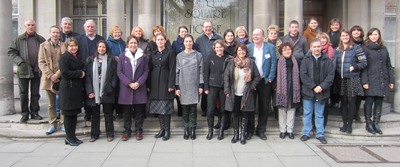
|
The Japan Foundation welcomed people from all over Europe on 6th-8th February 2013 as we hosted a meeting for a new European Commission Funded project called Lingu@netWork.
This project aims to build on the fantastic work of the Lingu@net World Wide website, which is a multilingual portal website for language learning, that links to over 4,900 quality assured resources in 32 different languages. Teachers and language learners can access the current website in 32 different languages including Japanese. There are currently over 160 resources aimed for Japanese which teachers and learners of Japanese have used since its launch in 2011. Lingu@net World Wide was developed by 34 organisations from 25 European countries including the Japan Foundation London.
The new Ling@netWork project will be a new interactive resource, building on and linked to the existing website. The interface will be accessible through 10 different languages, and will give users a chance to interact with each other and rate their favorite resources. Please keep a look out for this fantastic website in the next year!
The Japan Foundation will continue to add new Japanese language resources to the Lingu@net World Wide website, so if you know of a high quality resources you think we should include, please click here (in English) or click here (in Japanese) to reccoment online resources.
14/02/2013
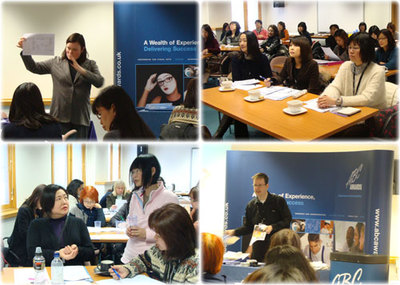
|
On the 21st of January 2013, 40 teachers of Japanese braved the snow to come to come and learn more about ABC Awards. This event, co-organised by the Association for Language Learning (ALL), ABC Awards and the Japan Foundation, introduced the ABC Awards and gave teachers an idea of how these qualifications could be used to accredit Japanese language learning in UK schools. This event was particularly timely as many schools need to find an alternative to the Asset Language Japanese qualification that is due to be scrapped at the end of 2013.
Josephine Audigier, Programme Officer at the Japan Foundation opened the event with information about Japanese Language Teaching in the UK and support available from the Japan Foundation. Daniel Moult, of ABC awards, then gave basic information about the structure of the ABC Awards and how these can be used in schools. Lydia Morey of ALL provided practical information about her schemes of work, assessments and how she has used the ABC awards to accredit her students’ Japanese language studies. Lydia gave teachers the chance to discuss how they could adapt these ideas to their own classrooms. Finally Noriko Williams from Richard Huish College gave practical examples of how she teaches Japanese using the ABC Awards.
We hope that the day proved useful for all the teachers who came. Once teacher commented that they “received very practical and useful information”. Another mentioned “I will recommend ABC to my colleagues as an alternative to Asset.”
We would like to thank the Sasakawa Foundation who generously provided funds to pay the travel expenses for attendees.
If you were unable to attend this event, but are still interested in finding out more about the ABC Awards, you can download the hand outs below.
21/01/2013

Thursday 10th January saw the return of our annual Post-Graduate Workshop, organised in collaboration with the British Association of Japanese Studies (BAJS). Responding to feedback received following last year’s event, this year’s workshop gave participants the opportunity to present their research and receive feedback from fellow PhD students and senior colleagues. In all, six current PhD students presented their research - Alice Freeman (University of Oxford), Anna Seabourne (University of Manchester), Mark Donoghue (University of the Arts, London), Nicolas Garvizu (University of Sheffield), Robert Horn (University of Sheffield), and Takahiro Yamamoto (London School of Economics). Following these presentations, Prof Chris Hughes, President of BAJS, gave a training session on ‘looking for work, job applications and interviews’. The day finished with a session on ‘funding your research’ which featured presentations by Susan Meehan (Daiwa Anglo-Japanese Foundation), Stephen McEnally (Great Britain Sasakawa Foundation), Junichi Kumagai (Japan Society for the Promotion of Science) and Prof Ian Neary (Japan Foundation Endowment Committee). We would like to thank all participants for coming along and making the day a great success. We hope to see you all again next year!
13/12/2012
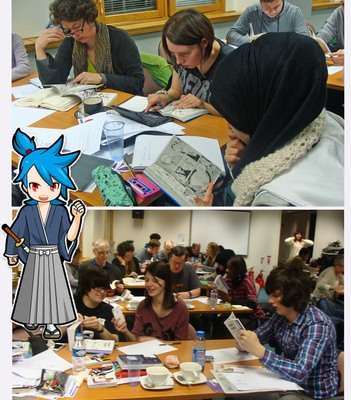
|
On Sunday December 9th, 34 manga fans came to the Japan Foundation for a workshop to learn new kinds of Japanese language by reading and watching the internationally-acclaimed manga, Bleach.
The Japan Foundation’s Chief Language Advisor, Dr Seiji Fukushima, introduced different styles of speech for several different types of manga characters before teaching attendees specific phrases and speech patterns for two of Bleach’s main characters, Ichigo and Ruika. Attendees then had the chance to read some of the manga and ask questions about the author’s use of Japanese, which was often very different to the Japanese traditionally taught in classrooms! One of the attendees, Stuart Eynon, said that he enjoyed “learning colloquialisms and how Japanese can actually be used in real life” while another participant, James Moore, liked “practising yarou speech” (speaking like a gangster).
All attendees went home with a copy of the original Japanese version of Bleach, and a deeper understanding of the Japanese used in anime and manga.
11/12/2012
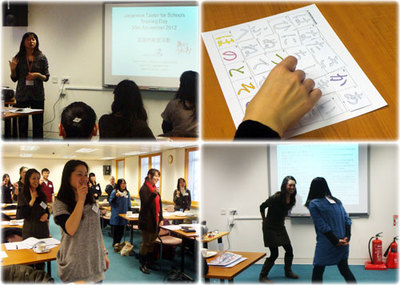
|
A total of 22 volunteers attended the November 30th Training Day of 2012 of volunteers of the Japan Foundation’s Japanese Taster for Schools (JTS) Programme, in which native and fluent Japanese speakers conduct free Japanese taster sessions in UK schools.
The day started with a basic outline of the JTS programme for new volunteers, followed by presentations from two volunteers (one native and one non-native Japanese speaker) who had visited several different kinds of primary and secondary schools through the programme. The first volunteer had visited a London-based primary school within a group of volunteers, while the second had visited a Lincolnshire secondary school on her own. It was good to hear about the two contrasting experiences!
This was followed by workshops by Hiroko Tanaka (Japanese Language Advisor and co-ordinator of JTS at the Japan Foundation), who introduced how to teach Japanese writing – one of the most challenging aspects of Japanese for UK learners. However, Tanaka-sensei demonstrated that despite the difficulties involved, learning Japanese hiragana, katakana and kanji can be made very enjoyable for students through games and activities such as “kanji sumo” and the “Hiragana rap!” Finally, Tanaka-sensei showed some activities suitable for winter and Christmas incorporating Japanese language and culture.
Several of these ideas and materials came from Japan Foundation’s own resources, including Ready Steady NihonGO.
The training day was well-received by all volunteers. Isabelle Demaude, a new JTS volunteer, commented, “Really interesting to see different approaches to teaching Japanese – will definitely be using some of the activities myself!”
Nobuko Boyd, a veteran JTS volunteer, commented, 「田中先生の教えてくださった、ひらがな・カタカナ・漢字の教え方・ゲームが大変参考になりました。」
(“The games and teaching methods for hiragana, katakana and kanji by Tanaka-sensei were really useful.”)
We would like to thank all volunteers for coming to the Training Day, and hope they will have the chance to hold a Japanese Taster Session at a school soon!
If you speak native level or fluent Japanese and are interested in becoming a JTS volunteer, please click here for more information.
If you are a school teacher and are interested in holding a Japanese language taster at your school, please click here to find out more.
11/12/2012
|
From November 12th – November 27th, a total of 50 advanced Japanese language learners experienced a taste of professional Japanese translation, as part of the Japan Foundation’s Japanese Plus course.
The course was led by Yoshiko Shimizu, a professional Japanese translator and interpreter, and former Course Director at the University of Bath. During the course, Shimizu-sensei taught participants some of the techniques and tricks used by translators in the field for a wide variety of different types of text, from legal contracts to product recall letters. Giving participants engaging exercises in both Japanese-to-English and English-to-Japanese translation, Shimizu-sensei demonstrated that translation requires a variety of different skills – not simply proficiency in a second language. She also gave an insight into the life of a professional translator, providing students with information and tips about how to succeed in the field. Finally, Shimizu-sensei gave some examples of amusing mistranslations in English and Japanese, some of which caused class-wide laughter!
Participants generally found the course quite a challenge, but enjoyable and useful to their Japanese studies. Emma Gallagher, a regular Japanese Plus participant commented, “This was an excellent course, really well taught. I picked up lots of tips.”
We would like to thank all participants and Shimizu-sensei for their hard work throughout this course – otsukaresama deshita!
If you are Japanese learner of approximately JLPT Level 2/N2 or above and are interested in taking part in the next Japanese Plus, please click here to sign up to our monthly e-bulletin to receive notifications of this and other Japan Foundation events. Click here to read more about Japanese Plus and view reports of previous workshops.
11/12/2012
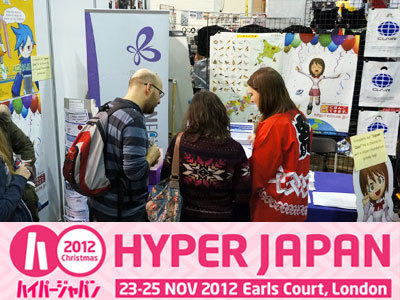
|
A big thank you to everyone who visited the Japan Foundation’s stand at the Hyper Japan 2012 on the 23rd, 24th and 25th November.
HYPER JAPAN is the UK's biggest celebration of Japanese culture, Japanese cuisine, and Japanese cool. The Japan Foundation London held a stand for the first time ever at this event, which gave visitors a chance to find out more about studying Japanese language.
One of the highlights of our stand was our Japan Quiz, which over 1,000 people entered.
The answers to the quiz were as follows:
1. What is the capital of Japan? a) Tokyo b) Seoul c) Beijing
Answer: a) Tokyo (Seoul is the capital of South Korea, and Beijing is the capital of China)
2. Which of these is NOT a Japanese martial art? a) Judo b) Karate c) Kung fu
Answer c) Kung Fu, which is from China.
3. What is “Hello” in Japanese? a) Konnichiwa! b) Sayonara! c) Wagamama!
Answer a) Konnichiwa is “hello” in Japanese (Sayonara means “goodbye,” andwagamama means “self-indulgence”)
4. Which of these kaomoji (Japanese emoticons/smileys) means, “I’m happy”?
a) (>_<) b) (^_^) c) (X_X)
Answer: b) (^_^) represents a smiling face. (>_<) is an angry face, and (X_X) is dizzy/confused!
5. What noise does a dog make in Japanese? a) Chu chu! b) Nya nya! c) Wan wan!
Answer: c) “Wan wan” is a dog’s bark in Japanese. “Chu chu” is a mouse’s squeak, and “nya nya” is a cat’s meow.
Out of those who answered the quiz correctly, we will soon pick five at random to send our Japan Foundation Goody Bag. Good luck to everyone who entered, and keep checking your emails to see if you were a winner!
03/12/2012

The Department for Education is currently running two consultations that may have a great impact on Japanese language education in the UK, especially in England.
Key Stage 4 consultation
The Department for Education is considering replacing the General Certificate of Secondary Education (GCSE) with a completely new qualification, the English Baccalaureate Certificate (EBC) in England for Key Stage 4 (Year 10 – Year 11 in secondary schools, age 14-16). They are holding a public consultation regarding this, with a deadline of December 10th 2012. One of the questions included in the consultation is, “Should all languages in which there is currently a GCSE be included in our competition?” There are currently 24 languages at GCSE level, including Japanese. It is possible that based on the results of this consultation, the GCSE level exam in Japanese (which has over a thousand entrants each year) will be discontinued.
Key Stage 2 consultation
This consultation is about the proposal to make foreign languages a statutory subject in primary schools from September 2014. The order suggests a requirement for primary schools to teach one or more of French, German, Italian, Mandarin, Spanish or a classical language (Latin or Ancient Greek) to pupils at Key Stage 2.
The Japan Foundation London believe that in today’s changing, increasingly globalized world it is very important to nurture young people’s ability to live together with people with different cultures who speak different languages. Language education is not simply about studying words and phrases; it also builds students’ intercultural understanding and teaches them to respect diversity. Narrowing the choice of languages at school level would not only deprive school studnets of the chance to learn about a wide range of languages and culture while they are at an impressionable age; it might also rob them of their natural enthusiasm to try to understand other cultures. With this in mind, we can say that Japanese language education greatly contributes to the UK’s linguistic and cultural diversity.
At the Japan Foundation, London, one of the ways we encourage mutual understanding between Japan and the UK is by promoting Japanese language education. As an organization dedicated to supporting Japanese language teaching, we are therefore submitting our opinion to the Department of Education’s consultation. Firstly, we think that Japanese should be included in the new English Baccalaureate Certificates (EBCs) if they replace the current GCSEs. Secondly, although we welcome the news that languages will be taught at primary level, we are strongly against any restrictive list that limits which languages may be taught.
Both of these consultation aims to reach a wide range of respondents, not only people involved in primary and secondary education, but also higher education institutions, the private sector, exam awarding organisations as well as the general public. Therefore we would like to encourage everyone who is interested in Japanese language education, Japanese studies, Japan/UK cultural exchange, Japan/UK related businesses and all other Japan-UK related organisations to respond to them with your support for the continuation of Japanese language education in secondary school, including Japanese language qualifications.
To see further information about this and to download the response forms, please click here for the Key Stage 4 consultation (deadline December 10th 2012) and click here for the Key Stage 2 consultation (deadline December 16th 2012). Please feel free to respond to the questions related to language education as well as any others you are interested in.
29/11/2012
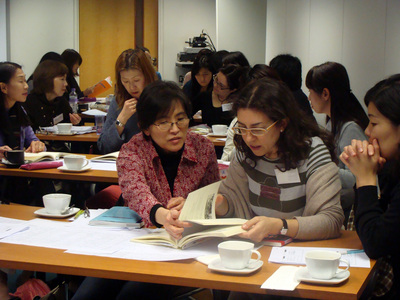
|
On November 27th 2012, 34 teachers attended the Japan Foundation’s November Japanese language teachers’ seminar, entitled Grammar for Good Writing: Ways of Thinking and Teaching (Applied to GCSE) /「うまく」書くための文法-考え方と教え方(GCSEを例にして).
This seminar, co-organised by the Association of Japanese Language Teachers in Europe (AJE) and the Association for Language Learning (ALL), re-examined the prominence of language knowledge placed on teaching grammar within Japanese language education and focused on how it can be put to practical use, in addition to considering ways of applying these teaching methods to KS4 writing tasks.
The day began with an introduction to AJE’s J-GAP (Japanese Global Articulation Project) by Suzuko Anai. J-GAP aims to ensure that learners progressing from a lower to higher level are taught in a way that builds upon their existing knowledge, resulting in a smooth transition from beginner to intermediate and intermediate to advanced levels.
This was followed by an introduction to Language Education in the UK and how it relates to the Common European Framework of Reference for languages (CEFR) /JF Standard for Japanese-Language Education, held by the Japan Foundation London’s Chief Japanese Language Advisor, Dr Seiji Fukushima. He explained that since the launch of CEFR in 2001, foreign languages are now being recognised as part of lifelong education, and that questions appearing in recent GCSE papers, which feature real-life situations, seem to reflect this trend.
Finally, Lydia Morey of ALL held a workshop on teaching methods for grammar and sentence patterns , as applied to KS4 compositions, and in doing so gave teachers the chance to discuss how they could apply these methods in their own classrooms.
We hope that the day proved useful for all the teachers who came. Once teacher commented, 「今後、教える時に活用させて頂きたいです。」(“I want to try and put [what I have learned] to use when I am teaching from now on.”)
19/11/2012
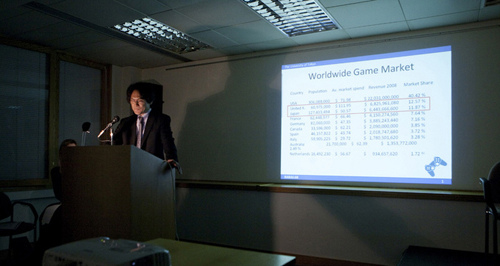
Prof Akira Baba delivering his lecture on the Japanese video game industry
Following his lecture on the current situation and problems of the Japanese video game industry held at the Japan Foundation last February, we are pleased to announce the publication of Prof Akira Baba's article 'Videogames - A Shared Culture Thriving in Japan and the United Kingdom'. Please click here to view this article.
29/10/2012
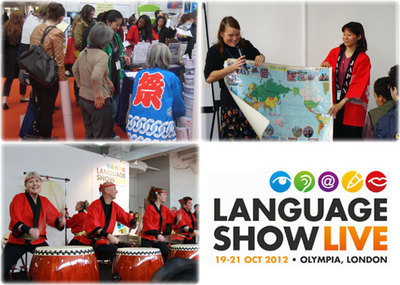
|
A big thank you to everyone who visited the Japan Foundation’s stand at the Language Show Live on the 19th, 20th and 21st October.
Held once a year, the Language Show is the UK's biggest event for language learners, teachers, linguists and anyone with a passion for languages. This year’s show, held in Olympia, was attended by over 9,000 people across the three days. The Japan Foundation’s stand gave visitors a chance to experience Japanese language and culture, including writing their name in Japanese and taking a purikura-style photo using Japan Foundation’s Erin’s Challenge! I Can Speak Japanese website (you can find the purikura game here).
On Saturday, for the first time, Japan Foundation presented a performance of Japanese taiko drumming and a taiko workshop at the Language Show’s “Cultural Arena,” performed by Tamashii Daiko. Tamashii’s exhilarating drumming drew an enormous crowd, and one Japanese member of the audience commented that the performance “...made me remember that I am Japanese.”
On Sunday, we held a Japanese Language Taster session led by award-winning Japanese language education professional Lydia Morey. It was attended by enthusiastic language learners of all ages, who learned basic Japanese greetings and the writing system.
Additionally, we held a Japan Quiz, which over 700 people entered. Out of those who answered the quiz correctly, we picked five at random to send our Japan Foundation Goody Bag.
We would like to thank Tamashii Daiko, Lydia-sensei and all our Japanese Taster for Schools volunteers who generously donated their time and expertise for the show. Domo arigato gozaimashita!
Japan Foundation will also be attending the Language Show in 2013, on October 18th, 19th and 20th at the Olympia 2, London.
Don’t forget that the Japan Foundation will next be appearing at Hyper Japan 2012 on November 23rd, 24th and 26th – click here for more details. We hope to see you there!
25/10/2012
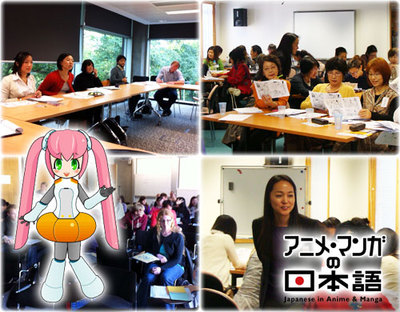
|
From October 4th to October 6th 2012, the Japan Foundation ran a series of seminars at the University of Edinburgh and the Japan Foundation London office to explore a form of Japanese study many learners and teachers may have already tried – studying through manga and anime! These workshops were led by Ms Nanae Kumano, Language Education Specialist at Japan Foundation Madrid and developer of the Japan Foundation’s Japanese in Anime & Manga website.
As Japanese anime & manga has become popular all over the world, so has the incentive to use such materials in Japanese language study. However, some words and phrases that are used in anime and manga might not always appear in a dictionary, causing headaches for the typical learner. The Japanese in Anime & Manga website has been designed by the Japan Foundation with these people in mind. Through fun games and quizzes, users can practice words and phrases suited to their level of Japanese and preference of genre.
These seminars gave teachers and learners of Japanese the opportunity to learn more about the website, and explore how it could be used to enhance Japanese language studies. Students were able to discuss what kind of manga and anime they liked as well as consider the differences in speech between each genre. In the teachers’ seminar, this was expanded to include how the website could be used effectively in order to help students have fun studying even when they have more specific learning goals.
The workshops were well received, with nearly 100 people attending in total across the three days. James Thornton, a Japanese language learner, said it was a “Very good event and the website looks amazing,” while one of the Japanese language teachers commented, “I always wanted to use manga in my lessons, but I never knew how. This event was very beneficial.”
We would like to thank all the dedicated Japanese language teachers and learners who came to the workshops, as well as Ms. Kumano for her very informative sessions. If you are interested in learning more about Japanese in Anime & Manga, you can visit the website at http://anime-manga.jp.
10/10/2012
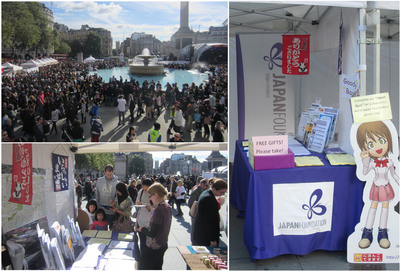
|
The Japan Matsuri returned to London on Saturday 6th October 2012. This year the Japan Matsuri was held in Trafalgar square and the organisers expected 70,000 visitors for one busy day! “Matsuri” means “festival” in Japanese and this event took the form of a large Japanese-style festival. There were numerous food and gift stalls, a variety of performances, nodo jiman (Japanese karaoke competition) and plenty of activities for families.
The Japan Foundation participated in the Japan Matsuri for the first time this year. We provided information about studying Japanese in the UK, useful handouts about our support for schools and details about all of our upcoming events. In addition, we held a Japan Quiz, which 500 people entered. Out of those who answered the quiz correctly, we picked five at random to send our Japan Foundation Goody Bag. Congratulations to the winners who were selected at random from all those who got all the answers right to win our goody bag!
The Japan Foundation will also be attending the Language Show Live 19th - 21st October 2012 at the Olympia, London as well as Hyper Japan on November 23rd - 25th 2012 at Brompton Hall, Earls Court. We hope to see you there!
28/09/2012
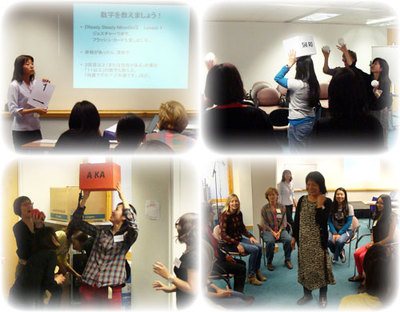
|
On September 21st 2012, 16 volunteers attended our Training Day for volunteers of the Japan Foundation’s Japanese Taster for Schools (JTS) Programme, in which native and fluent Japanese speakers conduct free Japanese taster sessions in UK schools.
The day started with a basic outline of the JTS programme for new volunteers, followed by presentations from two volunteers who had visited several different kinds of primary and secondary schools through the programme. This was followed by workshops by Hiroko Tanaka (Japanese Language Advisor and co-ordinator of JTS at the Japan Foundation), who introduced how to teach numbers in Japanese and games that students can play to help them learn number vocabulary, including “Fruit Basket” (a Japanese version of “musical chairs”). Finally, following the theme of Japanese sports, the day concluded with all volunteers playing “tamaire,” in which teams through soft balls into a box held up by one team member. The game not only demonstrated how to introduce Japanese culture to school children in an enjoyable way, but also served as a method to reinforce number counting; all teams counted their balls in the end using Japanese.
Several of these ideas and materials came from Japan Foundation’s own resources, including the JFL Japanese Scheme of Work for Key Stage 2 and Ready Steady NihonGO.
The training day was well-received by all volunteers. Maria Leanne Yu, a new JTS volunteer, commented, “The day was very well organised and we covered a lot of content. I especially enjoyed the talks from experienced volunteers because it gave me a good idea of what to expect.”
We would like to thank all volunteers for coming to the Training Day, and hope they will have the chance to hold a Japanese Taster Session at a school soon!
If you speak native level or fluent Japanese and are interested in becoming a JTS volunteer, please click here for more information.
If you are a school teacher and are interested in holding a Japanese language taster at your school, please click here to find out more.
12/09/2012
The Japan Foundation London is seeking to appoint a Programme Officer to carry out the general administration and programming of its work in the area of Japanese Studies and Intellectual Exchange.
This is a full-time, permanent position, based at our office in central London. Applicants must already be eligible to work in the UK.
Working for the Deputy Director, the post holder will manage all grants applications within this field from initial screening through to grant project completion, and will be responsible for organising and promoting public lecture events. They will also maintain the public relations portfolio including overseeing the office e-bulletin and website. Other duties will include proof reading documents in English, liaising as appropriate with other UK based organisations, and acting as a resource for fellow Japanese staff on all matters relating to the UK, including assisting with all general office maintenance arrangements.
The successful appointee will be qualified to at least first-degree level. Practical knowledge of the UK higher education system would be an advantage as well as broad general knowledge of UK policy and practice of international cultural and intellectual exchange. Proven administrative and organisational skills, the ability to work effectively as a team player and excellent IT skills are all essential requirements. IT skills should include proficiency in all MS Office programmes, and intermediate ability in Photoshop as well as experience and understanding of CMS and HTML would be desirable. The appointee must have excellent written and spoken communication skills in English (native speaker level or equivalent). Japanese Language ability to at least N3 (former Level 4) of the Japanese Language Proficiency Test (JLPT) would be advantageous.
The post is tenable from early November 2012.
Salary will be £23k to £25k depending on experience and qualifications
The deadline for applications is Tuesday 2nd October 2012 and interviews are likely to take place during the week starting from 8th October.
Please send your CV and covering letter by post to Noboru Futako, Deputy Director at the address below, outlining the reason for your application and your experience and suitability for the role. Applications will only be accepted by post. Should you be unable to apply by post, please contact us before applying.
Enquiries: Please contact Neil Cantwell on 020 7436 6695 or e-mail neil.cantwell@jpf.org.uk
To apply, please send your CV and covering letter to:
Mr Noboru Futako, Deputy Director, Japan Foundation London,
Russell Square House, 10 – 12 Russell Square, London, WC1B 5EH, UK
04/09/2012
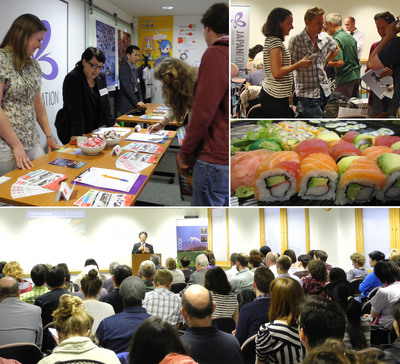
|
The second workshop from our “Japanese from Scratch” series for beginners in Japanese language studies took place on the 29th of August 2012 at the Japan Foundation in London. This event was co-organised by the Japan Foundation and Japan National Tourism Organisation (JNTO) and was designed to help people who are interested in travel to Japan.
The evening included useful tips and information about exploring Japan from Ms Yumi Takakubo from JNTO as well as presentations on three areas of Japan: Tokyo, Kyoto and Hakone. After a break where attendees could speak to experts from travel agencies specialising in Japan, we moved on to language learning. The Japan Foundation’s Chief Japanese Language Advisor, Dr Seiji Fukushima, presented a session that taught basic greetings, kanji and helpful phrases to help attendees on their future travels. There was plenty of information on delicious budget food options, so now everyone will be able to recognise signs for Japanese soba, udon and ramen and know the etiquette for eating these noodles.
After working up an appetite for delicious Japanese food, it was time for the participants to sample some sushi and sake. Participants had the chance to practice their skills with chopsticks, while trying out their newly acquired Japanese with the other participants and members of staff.
This event had a diverse group of participants, from grandparents who were keen to learn Japanese to communicate with their grandchildren to martial art enthusiasts and even honeymooners keen to explore Japan together. One participant summed up the event by saying it was “educational, entertaining and lovely food!” Several participants commented that they would like even more time spent on language learning, so please watch this space for our next workshop and a chance to learn more Japanese!
06/08/2012
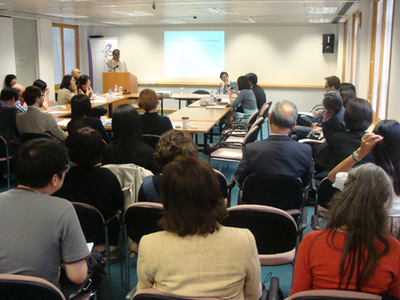
|
Please see the document below for a detailed report of our recent events looking at Creative Industries in East and Southeast Asia - an academic conference here at the Japan Foundation on Friday 29th June and a public symposium at Richmix Cinema on Saturday 30th June.
31/07/2012

|
| The panel at our 'COP 17 and Beyond' Event last November, with Prof Yamaguchi far right |
Following his key participation in our event on Climate Change ahead of the Durban COP 17 last November, we are pleased to be able to announce the publication of Climate Change Mitigation, edited by Professor Mitsutsune Yamaguchi. This volume provides perspectives on the Energy Outlook for Japan following the Nuclear Accident at Fukushima as well as considering the future of International Frameworks on Climate Change. Please click here for more information.
23/07/2012
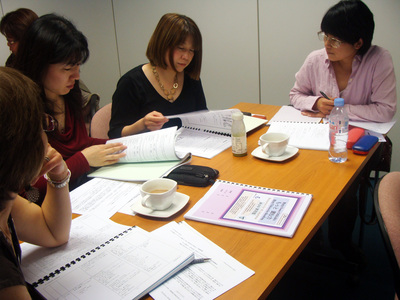
|
Over 30 teachers of Japanese language from across the UK attended the Japan Foundation’s most recent Japanese Language Teachers’ Seminar on Friday, July 13th, which focussed on Motto Yomu Chikara - a brand new resource designed to complement the Japan Foundation's successful Chikara resources for GCSE Japanese.
Now in its trial phase, Motto Yomu Chikara is funded by the Japan Foundation’s Japanese Language Local Project Support Programme and aims to help students bridge the gap between GCSE and AS level Japanese. The workshop, held at the Japan Foundation London, gave participants the chance not only to discuss the best way to utilise Motto Yomu Chikara in the classroom, but also to meet face-to-face with the authors of this resource: Michiyo Kato, Shoko Middleton and Sachiko Yamaguchi.
The workshop opened with an introduction to the original Chikara resource by Seiji Fukushima, Chief Language Advisor at the Japan Foundation London. This was followed by a series of presentations by the authors of Motto Yomu Chikara, explaining how the new resource works and how it can be used to improve the transition from GCSE to AS and A2 Japanese. This included demonstrations of practical and enjoyable activities to hold in the classroom to boost language learning. Finally, all the participants discussed in groups how they could best use Motto Yomu Chikara within their own teaching environment, and shared ideas for best teaching practice.
Overall, Motto Yomu Chikara was well received by all participants, and many attendees commented that they found the workshop very useful, both in terms of learning more about Motto Yomu Chikara and as a chance to exchange opinions and knowledge with fellow teachers of Japanese.
We would like to thank all teachers, including Kato-sensei, Middleton-sensei and Yamaguchi-sensei, who took the time out of their busy teaching schedules to attend and contribute their valuable insight to this workshop.
Click here to download the trial version of Motto Yomu Chikara from the Greenford High School website.
Click here to read more about our original Chikara series and download a free electronic version of the original Chikara.
18/07/2012
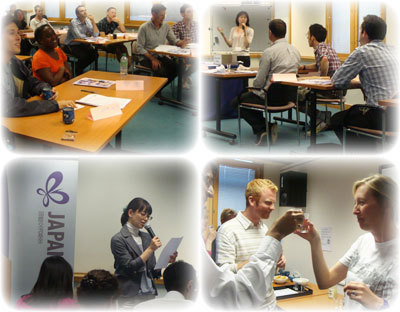
|
「明日テストがあるんやさかい、遊びに行ったらあかん!」
Participants of this term’s Japanese Plus course for advanced Japanese language learners will no doubt understand the above sentence, which means “You can’t go out because you have a test tomorrow” in Kansai-ben , the form of Japanese spoken in and around Osaka. Kansai-ben was one of many different variants of the Japanese language studied at Japanese Plus, which ran from June 8th – 29th 2012, and took the theme of hougen – Japanese dialects.
The course leader Hiroko Tanaka (Japanese language advisor at the Japan Foundation) introduced the different regions in Japan, their characteristics and their dialects. This included a detailed grammatical explanation of how standard Japanese changes in regional dialects. Using a variety of media, such as passages from famous Japanese novels, Japanese songs and manzai (Japanese double-act comedy), participants had the opportunity to speak, listen, read and write in different dialects. During the interval each week, samples of different kinds of sake (Japanese alcohol) from around Japan were served, giving participants a real “flavour” of each Japanese region!
In the final week, participants were treated to a special guest appearance from three Japanese nationals from different regions of Japan – Aichi, Tokushima and Saga. These guest speakers, from the Japan Local Government Centre (CLAIR London), not only gave participants the chance to hear Japanese regional dialects as spoken by their locals, but also to see more about these regions through the eyes of the inhabitants.
In total, 45 people attended the course across the four weeks, and all participants gave positive feedback. Andrew Niewiarowski, a Japanese Plus veteran, commented:
“Lectures were very well prepared. I learned a lot of new Japanese. Very good series! I enjoyed it very much. I appreciate the effort put into the classes. Learning about dialects made me enthusiastic to learn more Japanese!”
Emma Gallagher, a recent participant of Japanese Plus, said:
“Really enjoyed the course and can’t wait for the next! Thank you Tanaka-sensei, it was excellent. Thanks also for the sake – it was a nice way to learn about Japan – regional food and drinks is such an important part of the culture.”
We would like to thank the guest speakers and all participants for their hard work throughout this course, and look forward to seeing them again!
If you are Japanese learner of approximately JLPT Level 2/N2 or above and are interested in taking part in the next Japanese Plus, please click here to sign up to our monthly e-bulletin to receive notifications of this and other Japan Foundation events.
Click here to read more about Japanese Plus and view reports of previous workshops.
The Japanese Local Government Centre has also featured this event on their news page; click here to view (Japanese only).
30/06/2012

|
On Saturday June 30th 2012, the Japan Foundation and BATJ (the British Association for Teaching Japanese as a Second Language) co-hosted a seminar about developing intercultural competence through language education at the Japan Foundation, London. Around 35 people attended including teachers of Japanese from universities and schools around the UK.
The seminar started with an initial explanation of intercultural competence and how this relates to Japanese language education by Seiji Fukushima, the Chief Japanese Language Advisor at the Japan Foundation London.
The main seminar was divided into three sections. Firstly Yuichi Tomita, a Japanese language tutor at Manchester University spoke the role of teachers in facilitating the development of intercultural competence among their students and gave several concrete examples from his own experiences on how this can be achieved. Next was a section by Dr Lynne Parmenter, the Principal Lecturer in International Education at Manchester Metropolitan University, who explained how intercultural competence is embedded into the UK’s education system and how this links to trans-national policies such as the CEFR. Lynne went on to speak about an example of how to introduce these competences using the “Autobiography of Intercultural Encounters” which was developed by the Council of Europe (which can be downloaded from the file below). Finally, attendees discussed the ways in which teachers might incorporate intercultural learning into their own classroom practices.
The seminar received positive feedback from all attendees, many of whom discovered they already develop some aspects of intercultural competence within their Japanese lessons, but were glad to learn more about the theories behind this concept.
Click on the icon below to download the handouts and presentations used at the event.
20/06/2012
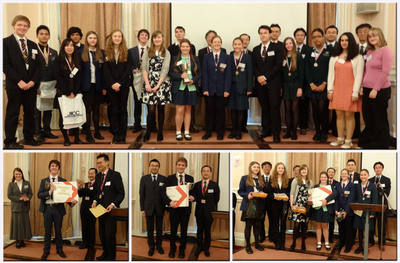
|
The Nihongo Cup Japanese Speech Contest for secondary school students was held at the Embassy of Japan in London on June 16th 2012.
The 18 finalists, who had been selected from 162 applicants from 21 different schools across the UK, all demonstrated great creativity, thoughtfulness and outstanding ability in Japanese in performing their speeches – not to mention extraordinary courage to present their ideas in a foreign language to an audience of 140 people!
Between each of the three categories of speeches, the audience was entertained by the beautiful sounds of Melissa Holding’s koto performance as well as the gorgeous voices of the choir from Greenford High school as they regaled the audience with songs in Japanese.
Due to the extremely high level of Japanese and the thought-provoking content of the speeches delivered by all finalists, the judges had extremely difficult decisions to make when choosing the final winners of the 2012 Nihongo Cup. In the end, Tom Rodriguez (Key Stage 4and 5 Post-GCSE), Nicholas Hendy (Key Stage 4 and 5 Pre-GCSE) and Samantha Nead (Key Stage 3) were awarded first prize in each of their categories. One member of the audience, Michelle Taylor, said the highlight was “seeing the finalists relax and really ‘get into’ their speeches.” Tyra Brown, who is a student from Greenford High school mentioned that “hearing the post GCSE students talk so fast was exceptionally breath-taking.” Several of the younger students also mentioned that they enjoyed listening to the post GCSE speeches; so we hope they will all continue to study hard and come back to try again next year.
Many congratulations and a big thank-you to everyone who came together to make the day such a success. The full results of the contest are as follows:
Key Stage 4 and 5 Post-GCSE Category
Winner: Tom Rodriguez (Aquinas College)
Speech title: “The importance of Foreign Languages”
2nd Prize: Vivian Truong (Bexley Grammar School)
Speech title: “My image of Japan”
3rd Prize: Omar Shah Hakim (Wycliffe College)
Speech title: “Male Jobs”
Other finalists:
Winnie Fan (Wycliffe College)
William Miller (Blythe Hall)
Azfar Rashman (Whitgift School)
Key Stage 4 and 5 Pre-GCSE Category
Winner: Nicholas Hendy (Aylesbury Grammer School)
Speech title: “My Future Dream”
2nd Prize: Kirsten Bergfors (St Helen’s School)
Speech title: “Story of Kappa”
3rd Prize: Jenny Robinson (Queen Mary’s High School)
Speech title: “Riding”
Other finalists:
Serena Coid (Queen’s College)
Eilis Hafey (Newstead Wood School)
Sorin Muraru (Hockerhill Anglo-European College)
Key Stage 3 Category (Speech theme: “Inspired by London 2012”)
Winner: Samantha Nead (Haberdashers’ Aske’s School for Girls)
2nd Prize: Kendra Rabbitts (South Wolds Community School and Sixth Form)
3rd Prize: Anna Whitehead (Haberdashers’ Aske’s School for Girls)
Other finalists:
Maisey Hodges (Campion School and Languages College)
Annie Moohan (King Edward VII School and Language College)
Emma Newman (South Wolds Community School and Sixth Form)
The event was organised by the Japanese Language Committee of the Association for Language Learning, in association with the Japan Foundation London and Embassy of Japan in the UK. We are very grateful to Toshiba of Europe Ltd, JSA (the Japanese Speech Awards), Ricoh UK Ltd, JP-Books (JPT Europe Ltd), the Japan Centre and Lingualift for sponsoring the event and donating prizes, and also to Sumisho Computer Systems for their generous sponsorship and to Soho Japan for contributing to the evening reception.
07/06/2012
The Japan Foundation is proud to announce that the artist Koki Tanaka will represent Japan for the Japan Pavilion at the 55th International Art Exhibition of the Venice Biennale. Based in Los Angeles, Tanaka’s diverse art practices spans many media, revealing the multiple contexts latent in the most simple of everyday acts, and his work has been widely shown both in and outside Japan. The curator representing Japan will be Mika Kuraya, Chief Curator of the Department of Fine Arts, The National Museum of Modern Art Tokyo.
01/06/2012
|
On May 27th 2012, Seiji Fukushima, the Chief language advisor at the Japan Foundation London presented an online seminar about learning Japanese in countries that do not have much contact with Japan. The seminar was made available via the Japan Foundation Cairo's Ustream page and allowed teaches of Japanese around the world to interact and ask questions if they watched it live.
Mr Fukushima has worked as a teacher of Japanese in Mexico, Uzbekistan, Russia and Hungary before coming to the UK to take up his current post early in 2011. He spoke about his experiences teaching in countries that do not have many Japanese residents or Japanese companies, where students of Japanese have limited chances to interact with Japanese culture or people.
34 people took part in the event in real time and a further hundred have viewed the seminar since it was first uploaded. You can see the whole seminar here.
This and previous seminars are now available through the Japan Foundation, Cairo's Ustream webpage.
Other seminars that might be interesting for teachers of Japanese:
25/05/2012
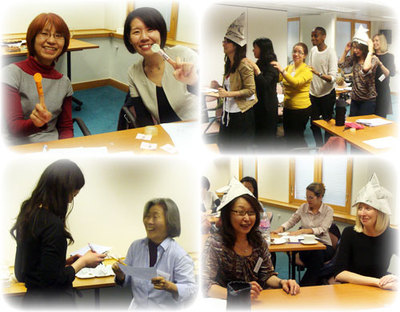
|
On May 18th 2012, 22 people attended our Training Day for volunteers of the Japan Foundation’s Japanese Taster for Schools (JTS) Programme, in which native and fluent Japanese speakers conduct free Japanese taster sessions in UK schools.
As well as providing new members with basic information about the programme, this month’s JTS Training Day featured reports from two volunteers who had performed taster sessions in two very different environments – one for a group of 30 primary school pupils, and the other for just two very enthusiastic secondary school students! This was followed by workshops by Hiroko Tanaka (Japanese Language Advisor and co-ordinator of JTS at the Japan Foundation), demonstrating enjoyable ways of introducing Japanese language through songs, arts & crafts, games and Japanese cultural activities. Several of these ideas and resources came from Japan Foundation’s own resources, including the JFL Japanese Scheme of Work for Key Stage 2 and Ready Steady NihonGO.
One of the volunteers, Hitomi Ito-Burton, commented:
「訪問報告が分かり易く、また考察として、こうすれば良かった等、現実味を帯びていて、これからの準備をするのに役立った。田中さんの外国語学習の視点も良く、どのツールを実際どこから使ったのかおっしゃって下さったので分かり易かったです。」
(“The school visit reports from volunteers were easy to follow and gave a good idea of what would work well during an actual taster; this will prove useful for my preparation for upcoming school visits. Ms. Tanaka’s insight into learning foreign languages really explained how to use what methods in which circumstances and was also very easy to understand.”)
We would like to thank all volunteers for coming to the Training Day, and hope they will have the chance to hold a Japanese Taster Session at a school soon!
If you speak native level or fluent Japanese and are interested in becoming a JTS volunteer, please click here for more information.
If you are a school teacher and are interested in holding a Japanese language taster at your school, please click here to find out more.
30/03/2012
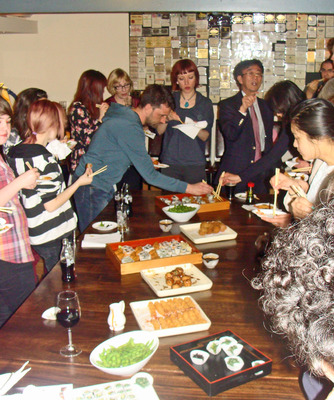
|
On the 28th of March, the first workshop from the “Japanese From Scratch” series for beginners in Japanese language studies was held by the Japan Foundation London. Titled “Let’s Eat Japanese food”, the workshop concentrated on Japanese cuisine, table manners and the expressions associated with food and restaurants in Japan.
The workshop was led by Chief Japanese Language Advisor, Seiji Fukushima, who introduced various kinds of Japanese food to the participants and demonstrated how to identify them by their correct Japanese name. The participants were then taught some simple greetings in Japanese and the use of these phrases with correct table manners and Japanese etiquette. Chopsticks have an important role in Japanese cuisine and the participants were also shown the correct way to hold and use them. After getting the hang of it, chopsticks skills were put to use by attempting to pick up wasabi peanuts from a bowl.
After working up an appetite for delicious Japanese food, it was time for the participants to go to a Japanese restaurant to not only try the food they were learning about, but also put their newly found Japanese skills to practice in a real restaurant scenario. Every participant got a chance to try different types of Japanese cuisine while mingling with the other participants and staff members.
The workshop had a high attendance and was a great success with all feedback being very positive. There was a great interest shown in beginner Japanese language from all ages and a demand for more workshops in the near future.
29/03/2012

|
「オープラ大統領?」(“Oprah Winfrey for President?”)
「私立学校 コオロギを給食に」(“Private School Includes Crickets on Lunch Menu”)
「ロンドン五輪高速折り紙デビュー?」(“High-Speed Origami to Debut in London Olympics?”)
These were just a few of the highly creative and amusing April Fools newspaper articles written by the talented participants of Japan Foundation’s first ever Japanese Plus course, a Japanese language and culture course for advanced learners.
This term’s theme was「新聞を読んで、新聞を作ろう」- “Read and Write Japanese Newspapers.” 39 people in total registered for the course, which ran every Thursday and Friday from February 23rd to March 23rd 2012. Run by Japan Foundation’s Japanese Language Advisor Hiroko Tanaka, the course began with an overview of Japanese newspapers and an examination of the style of writing used for newspaper articles. Participants then looked in depth at selected articles and discussed them in Japanese, in order to grasp how to construct an effective article while practicing reading, writing, speaking and listening in Japanese.
Finally, all participants formed groups and wrote their own “April Fools” joke articles, which were collected together and made into the Jプラス新聞 - the “J-Plus Paper.” Every participant received their own copy of the paper, which they enjoyed discussing in Japanese during the final session of Japanese Plus. With such stories as the creation of “Olympic bread,” the invention of “Health Waves” and the inclusion of “Quidditch” into the Olympics, the discussion frequently turned into roars of laughter!
The course received positive feedback from all participants. Michael Doherty, a newcomer to Japan Foundation’s language courses, commented : “I really enjoyed the classes. It was a great opportunity to set aside some time each week and enjoy 日本語 (Japanese)!”
Morgan Giles, also new to the Japan Foundation’s language courses, described the course as “excellent” and said that she “can’t wait for the next one.”
We also can’t wait to see all participants again at our next Japanese Plus course!
If you are Japanese learner of approximately JLPT Level 2/N2 or above and are interested in taking part in the next Japanese Plus, please click here to sign up to our monthly e-bulletin to receive notifications of this and other Japan Foundation events.
23/03/2012
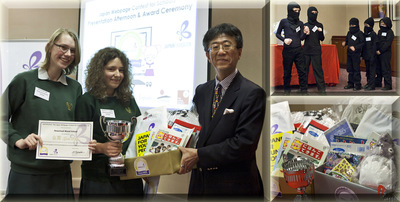
|
We are delighted to announce that Newstead Wood School in Kent has won £1000 worth of prizes for the Gold Award in the Japan Webpage Contest for Schools 2011-2012. All prizes were announced at an award ceremony and presentation afternoon, held on Saturday 17th March 2012 at the Hotel Russell in London.
Newstead Wood School captivated the judges with their fantastic website packed full information about their activities, trips and classes, as well as fantastic student work, photos, Japanese language resources and much, much more! The judges mentioned that the site is a bit like a treasure chest as they found more interesting nuggets of information each time they visited! This website also won the Public Vote Award, gaining an impressive 1042 votes out of 4363, almost 24% of the total votes.
The Silver Award was presented to Tenbury C of E Primary School for their website that is packed full of inspirational ideas for Japan related topics and lessons at Primary school level. You can take a peek at the Voki quizzes, play games to practice hiragana and katakana or spend hours watching the fantastic recordings of Kamishibai.
The Bronze award went to Heathfield House School for their brightly coloured, original and fun website. This website is great fun to look through as it is full of photographs of Japan related activities and has some thoughtful comments from the pupils themselves!
Finally, Luton Sixth Form won the Design Award as they impressed the judges with their stylish web design, and large range of content. The judges really liked the language section as well as the student work which showcases what fantastic group of artists they are!
The award ceremony was an excellent chance for pupils from each of these winning schools to display their webpages and tell the audience about their fantastic Japan–related projects. The ladies from Newstead High were delighted to win the top prize and Tenbury Primary school pupils wowed the audience by performing their Algorithm March. One parent, Hanna White mentioned that ‘The children’s presentations were wonderful. A great way to cement relations between our two countries!’ Another attendee, Cathy Darling, mentioned it was good to have ‘the opportunity to finally meet the creators of the competing websites we’d spent too many hours perusing.’ The final highlight for many of the children was the delicious range of sushi provided at the reception, which disappeared remarkably quickly!
You can see more information and links to all of the wonderful entries on the contest website here. Hopefully other schools will be inspired to start a similar webpages, and will join the Japan Webpage Contest for Schools in the future!
20/03/2012

|
We were very pleased to host this event considering the relationship between literature and disaster in Japanese history. Dr Stephen Dodd began the event with an overview of the experience of last year's earthquake and tsunami whilst considering the effects of the modern media in multiplying the experience around the world. He went on to discuss the historical example of the Great Kanto Earthquake and how it affected various writers at the time both in terms of the effect on the city they were living in and what was made possible for new types of literature by this event. Prof Izumi Ohmoto gave further insight into last year's events through recounting her experience and the stories of her students at Sendai University, before also commenting on the Great Kanto Earthquake, in particular examining the work of Ryunosuke Akutagawa. The event concluded with Karan Kurose giving an account of tanka written in the wake of last year's events, including detailed contextualisation of each poem as well as commenting upon the reception of each piece of work.
06/03/2012
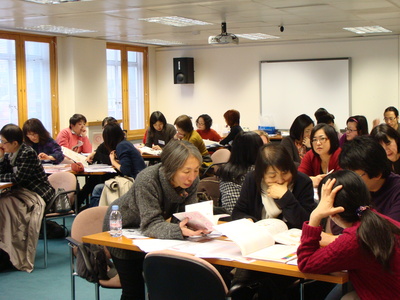
|
On the 4th of February 2012, a workshop using “Marugoto: Japanese Language and culture, a teaching resource based on the JF standard for Japanese-language education”, entitled Can-do and classroom activities was held. The event was attended by not only members of BATJ but also secondary school teachers (total attendance was 41 people), displaying a widespread interest in the text book.
“Marugoto” was developed under the principle of Japanese for mutual understanding and a trial version was published in May 2011. It therefore features a wide range of techniques, including Can-do target and level settings and portfolio assessment, designed to promote competence in accomplishing tasks (what a person can do by using Japanese) and competence in intercultural understanding (understanding and respecting other cultures by expanding one’s horizon through encounters with various cultures).
The JF standard for Japanese-language education was publicised in 2010 and the general idea of accomplishing tasks and intercultural understanding could be grasped from various training events. However the concern was how to use and tie in these abilities with everyday activities within the classroom. Using “Marugoto”, the training event this time round, examined the relationship between A-1 level Can-do and classroom activities.
There were subjects mentioned by the event participants in regards to the composition of the textbook, colourful pictures, the objective of each chapter in Can-do and also the amount of explanation of grammar within the activity book. However, secondary school teachers in charge of GCSE, ASSET and evening class teachers expressed interest in the possibility of purchasing the text book in the future and also thought that it has the ability to be widely used throughout the UK.
When “Marugoto” is published and becomes generally used, we would like to run training events tying together the principles of JF standard and practical classroom activities.
02/03/2012
There is a vacancy for the post of Assistant Programme and Administration Officer at the Japan Foundation London office.
The Assistant Programme and Administration Officer will assist the Director-General and his staff with administration. He or she is mainly expected to work closely with and under supervision of our Senior Arts Programme Officer by providing assistance towards the operation of the Foundation’s activities such as grant programmes and in-house projects such as talks and conferences, which normally take place in the evening, and other events organised by the Foundation. Duties will also include general administration work such as updating our website, maintaining our mailing database and general reception work.
The deadline for applications is Monday 19th March 2012.
Interviews will take place the week commencing 26th March 2012.
The post is tenable from mid April 2012.
Salary will be approximately £18-20k depending on experience and qualifications.
The appointment will be on a fixed term contract for one year in the first instance although there may be the opportunity to renew. Applicants must already be eligible to work in the UK.
Please download the attachment below for further information about the position and how to apply.
02/03/2012

|
Wednesday 29th February saw the fifth and final seminar in our Corporate Social Responsibility Seminar Series. Our first speaker was John Pepin, Founding Director of Aperio Group (Europe) Ltd, who gave a broad and entertaining introduction to the concept of social enterprise. He was followed by Karl Richter from the Euclid Network, and Founder of the JenLi Foundation, who expanded on John's introduction by exploring the terms social investment and social business.
You can download John's presentation below, and you can find Karl's presentation online by clicking this link.
28/02/2012
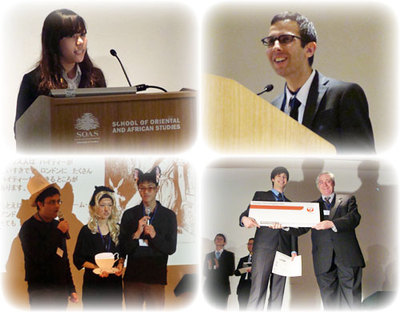
|
On 25th February, the finals of the Seventh Japanese Speech Contest for University Students were held in the Brunei Gallery of the School of Oriental and African Studies (SOAS), showcasing ten individual speeches along with four group presentations by UK university students.
The day began with the Category 2 finalists, all of whom are studying Japanese as an elective or optional course. The speeches were all of a very high standard and it was very difficult for the judges to decide the winner. However, the first prize eventually went to Yee Man Wong, a first year student from the University of Kent, for her extremely memorable speech on “The secret of the AKB48 Fever in Japan and overseas.” In second place was Yilin Wang, a 3rd year at the University of Hull, who spoke on the complex subject of “Problems faced by foreign tourists using Japanese communication technology.”
Category 2 was followed by speeches by the Category 1 finalists, who are studying Japanese as their main degree subject. All five finalists demonstrated not only exceptional Japanese ability, but also a great degree of insight and knowledge of their chosen subjects. After much deliberation, first prize was awarded to George Walker, a 4th year student at the University of Leeds, for his enlightening speech on “Job-hunting in Japan – Effects on studies and student life.” The second prize was awarded to Haider Muttaqi, in his 4th year at SOAS, for his passionate and informative speech entitled “Why should the Japanese government promote adoption?”
This year’s Group Category gave beginner-level students the chance to give presentations on a topic of their choice. The four outstanding groups that made it through to Saturday’s finals were chosen from an initial 22 applications, and represented SOAS, Imperial College London, King’s College London and the University of Warwick. They gave talks on “English Culture,” “Chinese New Year,” “English Literature” and “Coventry Cathedral.” These groups were not placed individually, but instead received special prizes based on their chosen topics.
We would like to thank all participants, their teachers and supporters, the judges, audience members and BATJ for making the contest such a success. In addition, special thanks must go to the generous sponsors: Baker & McKenzie LLP, Central Japan Railway Company, Eikoku News Digest, Gendai Travel Limited, The Great Britain Sasakawa Foundation, Japan Airlines, Japan Centre, JP-Books (JPT Europe Ltd.), Mitsubishi Electric Europe, Ricoh UK Ltd, School of Oriental and African Studies (SOAS), and Toshiba of Europe Ltd.
We would like to encourage as many undergraduate students of Japanese language as possible to apply for next year’s contest, which will be held at Regent’s College London.
If you are a secondary school teacher or student, you may be interested in the 2012 Nihongo Cup Japanese Speech Contest for Secondary Schools.
Click on the attachment below for the full results.

21/02/2012
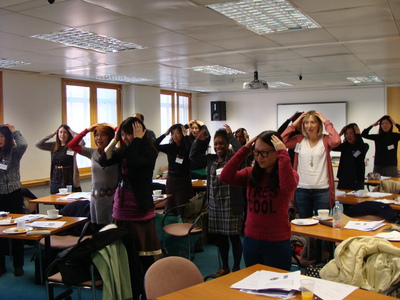
|
On February 10th 2012, 23 people attended our Training Day for volunteers of our Japanese Taster for Schools (JTS) Programme, in which native and fluent Japanese speakers conduct free Japanese taster sessions in UK schools.
As well as providing new members with basic information about the programme, this month’s JTS Training Day featured reports from two volunteers who had visited schools – one delivered in Japanese by a native Japanese speaker, and the other by a non-native Japanese speaker in English. This was followed by workshops by Hiroko Tanaka (Japanese Language Advisor and co-ordinator of JTS at the Japan Foundation), demonstrating enjoyable ways of introducing Japanese language and culture at taster sessions through songs, games and story-telling. Several of these ideas and resources came from Japan Foundation’s own resources, including our JFL Japanese Scheme of Work for Key Stage 2, Nihongo e-na and Ready Steady NihonGO.
Noriko Inman, a new member, commented:
「パワーポイント、動画、音楽、体操などを交えて、教材を紹介して下さって、驚くとともに特に楽しく勉強になりました。」
(“Combining the introduction of teaching resources with PowerPoint presentations, animation, songs and dance enabled me to learn new techniques in fun and surprising ways.”)
Another new volunteer, Emma Gallagher, said:
“It was useful to hear about the experiences of other volunteers. I picked up lots of hits and tips. It was good to have the opportunity to chat to other volunteers over lunch... Enjoyable and useful afternoon.”
We would like to thank all volunteers for coming to the Training Day, and hope they will have the chance to hold a Japanese Taster Session at a school soon!
If you speak native level or fluent Japanese and are interested in becoming a JTS volunteer, please click here for more information.
If you are a school teacher and are interested in holding a Japanese language taster at your school, please click here to find out more.
21/02/2012
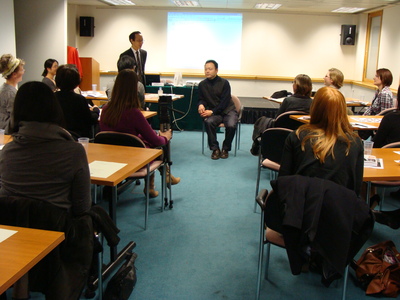
|
On the 15th of February 2012, 22 participants attended the Talking Contemporary Japan Special: Japanese discussion with Director Katsumi Sakaguchi.
Firstly, the participants were given the opportunity to view an exclusive screening of “かりんの家” (Karin no ie) in Japanese. This is one of Katsumi Sakaguchi’s most powerful documentaries, which addresses the topic of children, who for a variety of circumstances, cannot live with their parents. After viewing the film, the participants were then encouraged to discuss the content with not only themselves but with Mr Sakaguchi himself in Japanese. Sitting amongst the participants, Mr Sakaguchi answered questions from everyone and discussed the making of a documentary which explored such a serious social problem in contemporary Japan.
The event was very well received by all participants, who enjoyed the opportunity to practice advanced Japanese skills while exploring the field of documentary-making within Japanese society. Emma Gallagher, who attended the event, commented:
「とても楽しかったです。感動しました。ありがとうございました。」
(“It was really enjoyable and I was truly moved. Thank you very much.”)
Another participant, Rebecca Clegg, commented:
“It was a great opportunity to experience different points of Japanese culture.”
We would like to thank all the participants that came along to the Talking Contemporary Japan Special event and hope to see you again throughout the year.
NEW! Click here to view video clips from the event on YouTube.
17/02/2012
Please see below for details of upcoming charity events raising money to help the recovery effort in Japan following the earthquake and tsunami of March 11th.
------------------------------------------------------------------------------------------------------------
Name of Event: Exhibition of the series 'Haiku Prelude - Haiku Kami'
Organisation: Haringey Arts CIC
Date and time:
Sunday 11th March 2012 at 2:46pm - 6pm: Exhibition Opening and the book launch
Tuesday 13th March 2012 at 6:30pm - 8:30pm: Closing Party
Venue: 12 St. Alban's Grove, London, W8 5PM
Description: 'Haiku Prelude - Haiku Kami' series features twenty-seven paintings, inspired by traditional and contemporary Japanese and western haiku. The project aims to portray each haiku poem and embody its visual energy through the abstract painting. The project was conceived around the time of the natural and nuclear disasters in Japan in March 2011. In the light of these events Carolina Khouri dedicated the series to all victims there. During the 'Haiku Prelude - Haiku Kami' project's exhibition, on the day of the first anniversary of The Great East Tohoku Earthquake, a book will be launched. All proceeds from the book will be donated to Momo - Kaki Orphans Fund, which provides aid and encouragement for the children orphaned on this tragic day. The publication will also serve as an evolving memorial to those that suffered as a result of last March's tragedies in Japan.
Website: http://www.carolinakhouri.com
All funds to be donated to: Momo - Kaki Orphan Fund
------------------------------------------------------------------------------------------------------------
17/01/2012

|
Thursday 12th January saw us hosting a Post-Graduate Workshop in collaboration with the British Association of Japanese Studies. Prof Akihiro Kitada of the University of Tokyo, currently visiting the University of Leipzig, gave a keynote presentation on the topic of 'Globalisation and the Galapagos Effect of Knowledge?'. This was then followed by more practical training sessions by Prof Chris Hughes, President of BAJS, on the topic of journal publishing, and then Dr Thomas McAuley and Ms Luli Ishikawa-van der Does from the University of Sheffield gave an interactive presentation on how to present papers in Japanese. The day finished with presentations by Dr Brigitte Steger, representing the European Association of Japanese Studies, Jason James, Director-General of the Daiwa Anglo-Japanese Foundation, and Ryoko Kaga and Polly Watson from the Japan Society for the Promotion of Science. We are very grateful to all of our speakers as well as the Post-Graduate students who came from across the country to make the day a great success.
13/12/2011

|
The Japan Foundation has produced a documentary film about the ‘Light Up Nippon’ project – a series of firework displays that were held on August 11th this year by young Japanese volunteers as a requiem prayer for those who lost their lives in the devastated Tohoku region due to the Great East Japan Earthquake. Featuring music by Ryuichi Sakomoto, the film follows the process of the project and sends a message about Japanese people’s strong wish to recover from the disaster. For more information about the film please visit http://lightupnippon.jp/en.
The film will be broadcast in approximately 120 countries around the world via cable TV stations and satellite broadcasting networks, and will also be broadcast on the Internet. For viewers here in the UK, the film will be shown at the following times on Friday 16th December
00:30am, 04:30am, 08:30am, 12:30pm, 4:30pm and 8:30pm
It will be possible to watch the film in two ways:
- online via the following link to the live streaming page of the Japan International Broadcasting Inc website.
http://jibtv.com/program/?page=0
- on channels 507 or 518 for those with a BSkyB satellite service.
We have DVDs of the film available to hire free of charge for anyone who may be interested in organising a screening of the film - please contact info@jpf.org.uk for further information.
29/11/2011
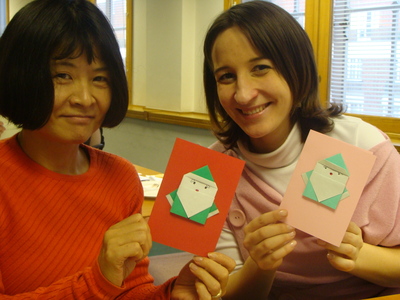
|
On November 25th 2011, 23 people attended our Training Day for volunteers of our Japanese Taster for Schools (JTS) Programme (formerly “StepOutNet”), in which native and fluent Japanese speakers conduct free Japanese taster sessions in UK schools.
As well as providing new members with basic information about the programme, this month’s JTS programme featured reports from two volunteers who had visited schools, as well as workshops by Hiroko Tanaka (Japanese Language Advisor and co-ordinator of JTS at the Japan Foundation) introducing ways to introduce Japanese writing into schools using games and the “Hiragana rap!” Finally, volunteers explored ways of incorporating seasonal themes into Japanese language tasters, such as making Japanese Christmas cards featuring an origami Father Christmas!
Aya Kamura Mirto, who has attended several training days, commented:
「日本語を教える際に楽しく学べるレッスンのアイデアをたくさん紹介して頂いて本当に参考になりました。実際に使ってみたいものが多かったです。」
(“It was really useful to learn so many enjoyable ideas for Japanese lessons. There were a lot of things that I now want to try out for real.”)
A new volunteer, Karolina Nalaskowska, said:
“It was my first time to attend the training, I really didn’t know what to expect, but I really enjoyed it and I think it was excellent. I could get lots of good ideas and feel even more excited about doing tasters for schools.”
We would like to thank all volunteers for coming to the Training Day, and hope they will have the chance to hold a Japanese Taster Session at a school soon!
If you speak native level or fluent Japanese and are interested in becoming a JTS volunteer, please click here for more information.
If you are a school teacher and are interested in holding a Japanese language taster at your school, please click here to find out more.
29/11/2011
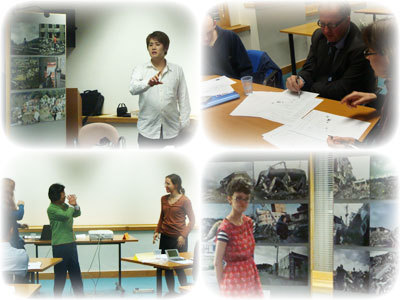
|
Japanese speakers from all walks of life enjoyed learning how to better understand and communicate with one another on both a cultural and individual level during November’s Talking Contemporary Japan, the Japan Foundation’s seminar series for advanced Japanese learners.
Spanning four weeks from October 31st – November 22nd, participants used their Japanese skills to explore the communication barriers that arise due to cultural difference, and how to overcome them. Hiroko Tanaka, Japanese Language Advisor at the Japan Foundation, lead the course and guided participants using role-play, quizzes and 頭を柔らかくする (“Mind-broadening”) puzzles. Naturally, the course focused largely on Japanese culture, giving participants to deepen their understanding of Japanese customs and ways of thinking in comparison to other world cultures.
On the final session, participants listened to a brief talk in Japanese by Mr. Satoshi Ueda, a photographer whose hometown Rikuzen-takata was devastated by the earthquake of March 11th. As well has hearing Mr Ueda’s very personal and moving account of the tragedy and viewing his photos taken of the destruction and subsequent restoration of his hometown, participants also had the opportunity to use their Japanese and ask questions to Mr. Ueda regarding his work.
The course received very positive feedback. Tim Bentham, a first-time Talking Contemporary Japan participant, commented, “I’m not confident with spoken Japanese, but these lessons were relaxed and well-paced so I didn’t feel stressed.”
For more information about Talking Contemporary Japan, please click here.
29/11/2011
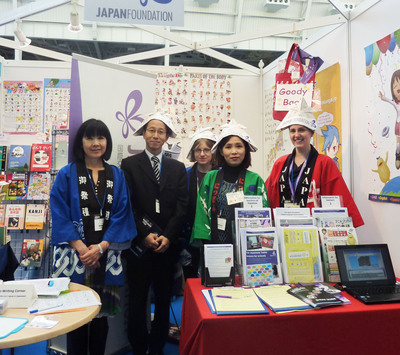
|
A big thank you to everyone who visited the Japan Foundation’s stand at the Language Show Live on the 21st, 22nd and 23rd October.
Held once a year, the Language Show is the UK's biggest event for language learners, teachers, linguists and anyone with a passion for languages. This year’s show, held in Olympia, was attended by over 9,000 people across the three days.
The Japan Foundation’s stand gave visitors a chance to experience Japanese language and culture, including writing their name in Japanese, trying Japanese alphabet jigsaw, and making an origami samurai hat!
Our Japanese Language Taster sessions, held by Japan Foundation’s Japanese Language Advisor, Hiroko Tanaka, was attended by a huge crowd of enthusiastic language learners of all ages,
We would also like to thank all our Japanese Taster for Schools volunteers who generously donated their time and Japanese language expertise to help at the stand. Domo arigato gozaimashita!
Additionally, we held a Japan Quiz, which over 500 people entered. Out of those who answered the quiz correctly, we picked five at random to send our Japan Foundation Goody Bag.
The answers to the quiz were as follows:
1. Which of these activities is the most widely practiced in Japan?
a) Tea ceremony
b) Golf
c) Karaoke
Answer = c) Karaoke is considered to be the most widely practiced cultural activity in Japan.
2. Which of these is most commonly recognised as the national flower of Japan?
a) Lotus
b) Wisteria
c) Cherry blossom
Answer = c) The cherry blossom is commonly recognised as Japan’s national flower (as well as the chrysanthemum).
3. Japan’s geography consists mainly of...
a) Cities
b) Mountains
c) Rice fields
Answer = b) Mountains cover over 70% of Japan’s terrain!
4. The character 日 means “sun” and the character 青 means “blue.” What do you think their combination, 晴, means?
a) Clear skies
b) Moon
c) Sadness
Answer = a) The character 晴, which is pronounced “hare” or “sei,” means clear skies or sunny weather.
5. Which of these cartoon characters does NOT originate from Japan?
a) Hello Kitty
b) The Powerpuff Girls
c) Super Mario
Answer b) = While Hello Kitty were created by Japanese companies (Sanrio and Nintendo, respectively), the Powerpuff Girls were made by American animators. Their style, however, imitates popular animation styles from Japan.
Congratulations to Selvi Saroinsong, Jonathan Collins, Rebecca Patterson, Franchon Wright and Sara Lounes who were selected at random from all those who got all the answers right to win our goody bag!
Japan Foundation will also be attending the Language Show in 2012, on October 19th , 20th and 21st at the Olympia, London. We hope to see you there!
24/11/2011
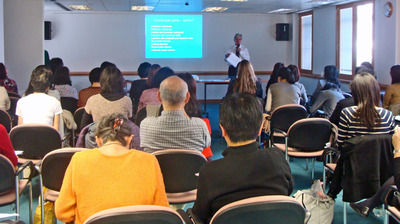
|
On Saturday October 29th 2011, the Japan Foundation and BATJ (the British Association for Teaching Japanese as a Second Language) co-hosted a seminar about Language Education policies at the Japan Foundation, London. Over 40 people attended including teachers of Japanese from universities and schools around the UK.
The seminar started with an overview of the National Curriculum and its history by Seiji Fukushima, the Chief Japanese Language Advisor at the Japan Foundation London. Next was a section by Lydia Morey, Chair of the ALL Japanese Language Committee and teacher of Japanese, who explained the variety of styles of Japanese language education within secondary schools. This was followed by the main speaker, Stephen Fawkes who is a Trustee and Membership Officer at the Association for Language Learning, with a long history in language education. Stephen described the history of language education strategies and also mentioned some of the developments we can expect in future education policies.
The seminar received positive feedback from all attendees, many of whom were glad to learn more about the way languages are taught at primary and secondary schools in the UK.
10/11/2011

|
Lingu@net is a multilingual website for teachers and learners of languages – in fact for anyone interested in languages.
It has been developed by an international consortium of experts – major organisations working in languages, technology and information science. Lingu@net World Wide has received support from the European Commission and has been recognised as a leader in its field, winning two prestigious prizes for its work, in 2007 it was awarded the MERLOT prize for being ‘exemplary online learning material for all disciplines’ (www.merlot.org) and in 2008 Lingu@net was awarded the European Commission’s Gold prize in the ‘European Lifelong Learning Awards for quality in mobility’.
Lingu@net World Wide provides teachers, trainers and curriculum writers with access to quality assured online resources for teaching and learning languages, from beginner to advanced levels. It currently includes over 5,000 resources in over 40 languages, including over 150 Japanese language resources.
For learners it offers guidance and information on learning a new language, as well as access to learning materials and authentic online texts.
Both learners and teachers can use Lingu@net World Wide to communicate with others.
Since May of this year Lingu@net World Wide can be accessed by native speakers of 32 languages, including most European languages, Japanese, Chinese, Hindi and Arabic.
Japanese speakers can now access this rich and world renowned site –
- To find out about learning other languages (e.g. English, French, German, Spanish, Arabic, whatever you choose)
- To find online resources to help teach or learn that language
- To communicate with other Japanese speakers interested in languages
Teachers of Japanese to foreigners can use the site to promote the Japanese language and to help learners find new and exciting material for their studies.
So please get online and visit Lingu@net World Wide now. Tell us what you think of the new site here. Suggest new resources for learning Japanese, or new ideas about language learning.
27/10/2011
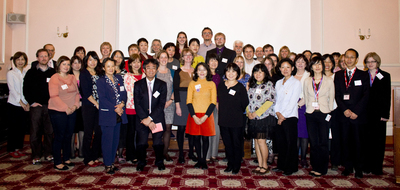
|
On 14th October 2011, over 50 teachers and local authority advisors attended the Japan Conference for Schools, held at the Embassy of Japan in London. Co-organised by the Embassy of Japan, the Japan Foundation and the Japan Society, the event was a fantastic chance for attendees to network and share practical ideas about projects for introducing Japanese into their schools or to enhance their existing Japan-related activities.
Participants were welcomed to the Embassy by Minister Hiroshi Suzuki, the director of the Japan Information and Culture Centre. This was followed by a poignant talk by Lynne Parmenter from Manchester Metropolitan University’s Institute of Education about the ‘Voices from Fukushima’ project. This project, funded by the Japan Foundation London, aims to develop and pilot a resource pack for teaching about Japan at Key Stage 2. It is a collaboration with teachers and children in Fukushima to present their experiences of the earthquake, tsunami and nuclear disaster, their relocation and recovery, their everyday lives and their dreams for the future. The idea is to go beyond the negative images of disaster to show children a more balanced picture of recovery, resilience and ordinary life in post-disaster regions.
Regarding the presentation, Bernedette Fellowes-Prynne from Chopwell Primary School said:‘The presentation by Lynne Parmenter was so inspiring and reinforced my feelings that children need to go back to learning about the wider Japanese culture and not focus on the recent events in the north.’
Following this, participants separated into small discussion groups and could choose between ten topics such as ‘Cross Curricular Japanese,’ ‘Practical Teaching Ideas’ or ‘Primary Focus.’ Throughout the day, all attendees had the chance to visit four of these sessions to find out about the topics that were most useful for their schools or their own personal development.
Alan Greaves from The Wavell School commented that:‘It was great to have discussions in smaller groups. Four workshops with four different leaders with contrasting styles led to very productive sessions and a chance to ask questions in a relaxed, informal setting.’
After a delicious bento lunch box, attendees viewed a video created by Christopher Purvis from the Japan Society on his recent trip to Japan’s Tohoku region, which was devastated by the Great Eastern Japan Earthquake and resulting tsunami six months ago. This was followed by an inspiring talk from Liz Gil about Wearhead Primary School’s award winning partnership with Amanuma School in Japan, which they have visited twice.
All in all, it was a fantastic day. Mary Hunt from St Mary’s RC Primary School observed that it was a ‘wonderful chance to find out what everyone else is doing… I enjoyed all the sessions I attended.’
Thank you to all the participants, speakers and the other organisers for making the conference such a success. We hope to see you again next year!
24/10/2011
These sessions aimed to give candidates and teachers information about the new Japanese Language Proficiency Test (JLPT). Over 90 people attended in London on September 14th, and around 40 came to the session in Edinburgh on September 21st 2011. Participants were given the chance to try sample questions and ask about the exam.
The event included:
- A General overview about the new JLPT exam
- Information about the differences to the old-style JLPT
- Introduction of example questions
- Introduction of possible study resources
- Current statistics about the JLPT in the UK and across the world based on official JLPT data.
- Guidance for applicants who plan to take the JLPT in the UK
- Q&A
One participant commented that they were ‘really pleased that none of the items were hurried and it was a very accessible event.’ Another mentioned ‘I enjoyed the session. It was very informative and I look forward to studying for and passing the JLPT; first N3 then N2 and eventually N1.’ We hope that it was useful and that it will encourage people to take the plunge and apply to take the test in the UK.
At the end of the evening Japan Foundation Staff gave away copies of the New Japanese-Language Proficiency Test Guidbooks. However if you missed out but would still like to find out more, you download resources from the JLPT website here.
If there is sufficient demand, we will run a similar event in 2012. So watch out for more information on the Japan Foundation website and e-bulletin.
18/10/2011
The Director-General of the Japan Foundation London office, Takashi Ishida, will shortly be leaving to take up a new position as Executive Director of our Toronto office. Please open the attachment below to read a farewell message from Ishida-san. The Japan Foundation welcomes his successor, Mr Tsuyoshi Takahashi.
03/10/2011
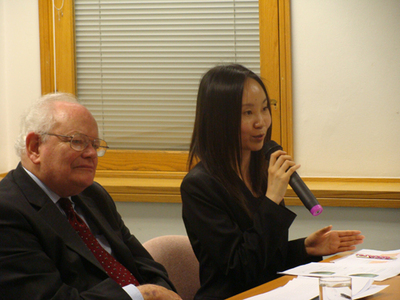
|
| Simon Webley and Arisa Kishigami |
Thursday 29th September saw the second event in our Corporate Social Responsibility Seminar Series, with the title 'Shining the Light on Corporate Behaviour - codifying and measuring Business Ethics'. Our first speaker was Simon Webley, Research Director at the Institute of Business Ethics, who gave a broad introduction to the application of ethical values to business behaviour. He was followed by Arisa Kishigami, Executive in Responsible Investment at FTSE, who talked about the various indexes she is involved with which try to provide a basis for measuring the ethical behaviour of companies.
You can download Simon Webley's Powerpoint Presentation below, and please click the following links for more information about the FTSE4Good Index Series and the FTSE4Good ESG Ratings.
03/10/2011

Date: 27 July 2011 - 11 September 2011
Exhibition: The Art of Connecting at Ikon Gallery
Date: 27 July 2011
The Art of Connecting: Curator Talk by Mizuho Kato & Jonathan Watkins at the Japan Foundation
Date: 9 September 2011
Atsuko Tanaka and Japanese Women Artists in the Context of Conceptualism: Curator Talk by Yuko Hasegawa at the Japan Foundation
The 11th September saw the close of the Atsuko Tanaka retrospective The Art of Connecting, after a very successful run at Ikon Gallery in Birmingham. The result of a long-running collaboration between the Japan Foundation, Ikon Gallery, Espai d’art contemporani de Castelló and the Museum of Contemporary Art Tokyo, The Art of Connecting was arguably the most comprehensive survey to date of work by Atsuko Tanaka.
As well as the exhibition, the Japan Foundation and Ikon gallery co-organised two events, to mark both the opening and the closing of the exhibition at Ikon Gallery. For the first of these, curator Mizuho Kato came to London, as well as Jonathan Watkins, Director of Ikon Gallery, and together they introduced the life and work of the artist. Providing a background to the comprehensive retrospective offered by the exhibition, they went on to discuss too the continued relevance of her work today. The format of this event was particularly well received, with one audience member commenting “Because it was a conversation, we could learn things otherwise hidden in formal vehicles […] - in this case, aspects of the relationship between Jiro Yoshihara [founder of the Gutai] and Atsuko Tanaka.”
The closing of the exhibition was marked by a visit to the Japan Foundation from another member of the curatorial team, Yuko Hasegawa, also Chief Curator of the Museum of Contemporary Art Tokyo. Concerned not only with Atsuko Tanaka, Hasegawa discussed other female artists of the period, and in particular how their activities can be regarded in the context of conceptualism. The audience then proceeded to offer Hasegawa a number of insightful questions, giving her the opportunity to expand on her talk, and share more of her extensive specialist knowledge.
The exhibition now moves to the Espai d’art contemporani de Castelló in Spain, where it shall remain until its return to the Museum of Contemporary Art Tokyo, early next year.
Pictured LR: Yuko Hasegawa, Jonathan Watkins, Mizuho Kato
03/10/2011

|
The Japan Foundation’s “StepOutNet” Programme, which creates links between Japanese-speaking volunteers and UK primary and secondary schools, has been renamed the Japanese Taster for Schools (JTS) programme.
The name change, which more accurately reflects the nature of the programme, was unveiled at the September 16th Training Day for Volunteers, which was attended by 29 people.

After the announcement, the Training Day continued as usual with reports from volunteers who had visited schools, and demonstrations of activities for teaching Japanese language and culture by Japan Foundation’s Japanese Language Advisor, Hiroko Tanaka.
The Training Day proved to be a success once again. Mrs. Kazuyo Ishii, a volunteer who has been involved with the programme for over a year, commented:
「今までのところ毎回参加させて頂いておりますが、大変楽しく皆さんのお話を伺っております。」
(“Even though I have attended every Training Day, I still really enjoy hearing everyone’s presentations.”)
We would like to thank all volunteers for coming to the Training Day, and hope they will have the chance to hold a Japanese Taster Session at a school soon!
If you speak native level or fluent Japanese and are interested in becoming a JTS volunteer, please click here for more information.
28/08/2011
08/08/2011

Old favourites among kanji teaching resources were revisited and brand new teaching methods shared at the 2011 Intermediate and Advanced Japanese Refresher Courses for Teachers, which were held at the Japan Foundation London from July 26th – August 5th.
This year’s course took the theme 「漢字は楽しい!!」- Kanji is fun – and was attended by a total of 26 non-native Japanese language teachers from a wide range of teaching backgrounds from primary school to university. Lead by Seiji Fukushima and Hiroko Tanaka, the Japan Foundation’s Japanese Language Advisors, the course gave participants the opportunity to deepen their kanji knowledge, examine kanji teaching resources and share their findings, and brush up on listening, speaking, reading and writing in Japanese.
On the final day of each course, the participants were able to put teaching methodology into practice by delivering a lesson in Japanese on various kanji. These lessons, which featured creative and enjoyable activities devised by the participants themselves, demonstrated the exceptional talent and passion that Japanese language teachers in the UK possess.
All participants enjoyed not only exploring kanji teaching methods, but also the opportunity to network and practice their Japanese with fellow Japanese teachers. Advanced Course participant Nimali de Silva, Japanese teacher at Katharine Lady Berkeley's School, commented, “There are so few opportunities to consider Japanese language teaching in particular, so this course is invaluable.” Regarding the Intermediate Course, Danielle Fenton of Heathfield House school said, “I am now desperate to teach more Japanese at my school and I feel a lot more confident in my ability.”
We would like to thank all participants for coming to the Refresher Course, and really hope to see them again at future events. お疲れ様でした!
27/07/2011
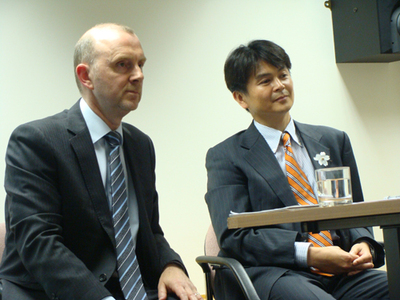
|
| Ian Blythe and Takeshi Shimotaya |
On Tuesday 19th July we were delighted to launch our new Corporate Social Responsibility Seminar Series organised in partnership with Phillida Purvis of Links Japan. This first event took the topic of From Philanthropy to Essential Business Investment - the evolution of CSR in the UK. Following Phillida's introduction, our first speaker, Takeshi Shimotaya, Managing Director of SustainaVision Ltd, gave a broad outline of the concept of CSR including the differences between approaches in the UK and Japan. Then our second speaker, Ian Blythe, Head of CSR for Boots UK, built upon this background by giving an account of the development of CSR within the historical story of the Boots company before looking at how these priorities are put into practice today. These lectures were followed by an engaging Q&A session and then a drinks reception throughout which these discussions continued.
You can download the Powerpoint Presentations of the two speakers via the links to the attachments below.
This series is also supported by the Embassy of Japan, the Japanese Chamber of Commerce and Industry (JCCI) in the UK, the Japan External Trade Organisation (JETRO, London and the Japan Europe Entrepreneurs Forum. Further details will be available soon about the next event in the series at the end of September.
22/07/2011
The Japan Foundation is pleased to support the participation of 21 students and teachers from 6 senior high schools from amongst the prefectures of Miyagi, Fukushima and Ibaraki affected by the recent Great East Japan earthquake and tsunami disaster. From 24th July, they will participate in joint Japan-UK group workshops on various scientific subjects taught by Cambridge University Professors, as well as visiting the Royal Society, the Royal Institution and University College in London. Dr Eric Albone of the Clifton Scientific Trust, who is organizing the weeklong event, says
“We are delighted to welcome to Cambridge students and teachers from schools in Japan which have suffered so much from the effects of the March 11th tsunami and earthquake to attend the 2011 UK-Japan Young Scientist Workshop at the University of Cambridge this summer. As a result of the generosity of many organisations, we are able to cover all of the schools' costs in Cambridge and also their airfares from Japan. We and all the British students and teachers look forward very much to welcoming them to England as our special guests. We are sure that, by living and working together in small teams with Cambridge scientists and engineers, not only will their understanding of science deepen but also they will see their futures in a global context and form international friendships which will last for many years ”
Please download the attachment below for a press release in Japanese.
01/07/2011
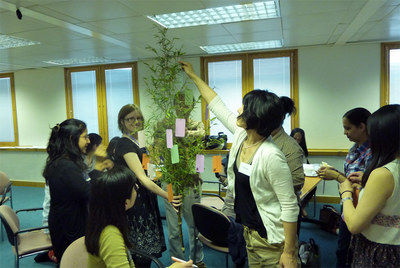
|
A record number of volunteers (32) attended our June 29th Training Day for members of our StepOutNet Programme, which holds volunteer Japanese taster sessions in primary and secondary school.
After new volunteers were introduced to the basics of the programme, all participants had an opportunity to hear reports from two volunteers who had visited schools recently. This was followed by an introduction of classroom activities that can be used to introduce Japanese in primary and secondary schools, led by Japan Foundation’s Japanese Language Advisor, Hiroko Tanaka. These included making finger puppets to demonstrate Japanese greetings with bowing, singing Japanese songs and using the Japan Foundation’s Ready, Steady Nihongo and Erin’s Challenge resources. Finally, all volunteers were shown how to introduce both Japanese language and culture by hanging wishes on bamboo to celebrate the Tanabata Star Festival.
One of the volunteers commented:
「私は日本語授業の経験はありますが、色々と変わった案や豊富な資料を御紹介頂いて勉強になりました。」
(“Although I have experience running a Japanese class, it was useful to be introduced to lots of different ideas and an abundance of resources.”)
We would like to thank all volunteers for coming to the Training Day, and hope they will have the chance to hold a Japanese Taster Session at a school soon!
If you speak native level or fluent Japanese and are interested in becoming a StepOutNet volunteer, please click here for more information.
01/07/2011
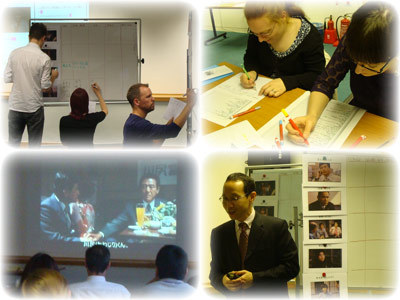
|
| Movie still Shochiku Co.,Ltd |
How to speak Japanese like a young girl, an old man or a bossy mother were some of the topics covered in the summer course of the Japan Foundation’s Talking Contemporary Japan course for advanced Japanese learners, which ended on June 23rd.
Running twice a week for four weeks, the course used the Japanese movie Happy Family Plan as a learning tool to introduce the various styles in which Japanese is spoken. While following the story of the trials and tribulations of life in a Japanese family, participants learned about how Japanese can reflect one’s personality, age, social status and gender, according to the vocabulary and manner used in speech. The course was lead by the Japan Foundation’s Chief Language Advisor, Seiji Fukushima, who guided participants in analysing and interpreting the speech of the characters in the movie.
One of our regular participants, Darcy, commented:
“I enjoy these courses and always learn something about Japanese language usage and culture that often isn’t explained in textbooks.”
We’d like to thank all participants for taking part in Talking Contemporary Japan, really hope to see even more participants at our next course!
To learn more about Talking Contemporary Japan, please click here.
30/06/2011
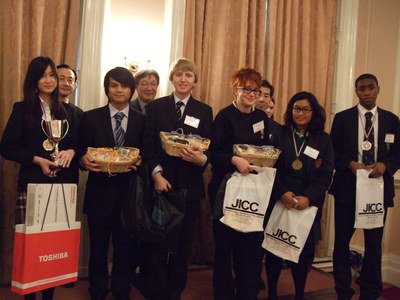
|
On June 18th the 2011 Nihongo Cup Japanese Speech Contest for secondary school students was held at the Embassy of Japan in London.
The 18 finalists, who had been selected from 279 applicants from 19 different schools across the UK, all demonstrated great creativity, thoughtfulness and outstanding ability in Japanese in performing their speeches – not to mention extraordinary courage to present their ideas in a foreign language to an audience of 150 people!
Between each of the three categories of speeches, the audience was entertained by the haunting singing of the Japanese choir Green Chorus, and also had the opportunity to participate in Japanese culture while offering their support for victims of the Tohoku Pacific earthquake and tsunami by writing messages on cranes and tanabata (Star Festival) paper slips.
Due to the extremely high level of Japanese and the wonderful content of the speeches delivered by all finalists, the judges found deciding on the final winners of the 2011 Nihongo Cup harder than ever. But eventually, Joe Littler (Key Stage 4and 5 Post-GCSE), Winnie Fan (Key Stage 4 and 5 Pre-GCSE) and Rebecca Young (Key Stage 3) were awarded first prize in each of their categories. After the prize giving ceremony, many of the finalists commented on how glad they were to have had this experience, and that they want to enter again next year!
Many congratulations and a big thank you to everyone who came together to make the day such a success. The full results of the contest are as follows:
Key Stage 4 and 5 Post-GCSE Category
Winner: Joe Littler (King Edward VII School)
Speech title: “Making a Japanese Sword”
2nd Prize: Lauren du Plessis (Aylesbury High School)
Speech title: “The Culture of the Geisha”
3rd Prize: Jisu Lee (St. Helen’s School)
Speech title: “Hiroshima”
Other finalists:
Kashif Akhtar (Greenford High School)
Stuart Burrell (South Wolds Community School)
Tanya Naumenko (Wycliffe College)
Key Stage 4 and 5 Pre-GCSE Category
Winner: Winnie Fan (Wycliffe College)
Speech title: “A Trip to Bath”
2nd Prize: Fabian Fatodu (Whitgift School)
Speech title: “Japanese Music”
3rd Prize: Kristine Gante (Queen Mary’s High School)
Speech title: “My Interest in the World”
Other finalists:
Bethany Allum (Tile Hill Wood School)
Philip Bentley (Dartford Grammar School)
Areekul Bunprakob (Havering College)
Key Stage 3 Category (Speech theme: “My Favourite Place”)
Winner: Rebecca Young (South Wolds Community School
2nd Prize: Carine Valarche (Wren Academy)
3rd Prize: Angel Catacutan (Greenford High School)
Other finalists:
Harjivan Chhokar (Campion School)
Yu Yeen Fung (St. Helen’s School)
Wesley Gaunt (Covenant Christian School)
The event was organised by the Japanese Language Committee of the Association for Language Learning, in association with the Japan Foundation London and Embassy of Japan in the UK. We are very grateful to Toshiba of Europe Ltd, JSA (the Japanese Speech Awards), Ricoh UK Ltd, JP-Books (JPT Europe Ltd) and the Japan Centre for sponsoring the event and donating prizes, and also to Sumisho Computer Systems for their generous sponsorship and to Soho Japan for contributing to the evening reception.
21/06/2011

|
The Japan Cultural Institute in Paris (The Japan Foundation Paris) has published a collection of summaries of the "CEFR - JF Standard for Japanese Language Education" seminars held in 2010, with the support of the Centre Européen d'Etudes Japonaises d'Alsace (SEEJA). It brings together the reports of participants in the seminar on the application of new pedagogy based on the Japanese CEFR (Common European Framework of Reference for Languages) in their educational institutions.
The report can be viewed here (in Japanese).
24/05/2011

|
| Tabaimo, teleco-soup still image 2011 video installation(527 loop) Tabaimo / Courtesy of Gallery Koyanagi and James Cohan Gallery |
The Japan Foundation is proud to announce the artist Tabaimo’s representation of Japan at the 54th International Art Exhibition – la Biennale di Venezia. Recognised as one of the country’s leading young artists, Tabaimo first received critical acclaim for her multimedia installation Japanese Kitchen (1999), which combined surreal, hand-drawn animations with architectural elements in an unblinking examination of contemporary Japanese society.
Commissioned by Yuka Uematsu, Curator, National Museum of Art, Osaka, TABAIMO: teleco-soup will continue that trajectory through an immersive multimedia environment that incorporates the unique characteristics of the Japan Pavilion in the Giardini.
20/05/2011
There will be a special event on Monday 23rd May to celebrate the launch of a global partnership between SOAS and Ritsumeikan University. Please click here for more information.
11/05/2011
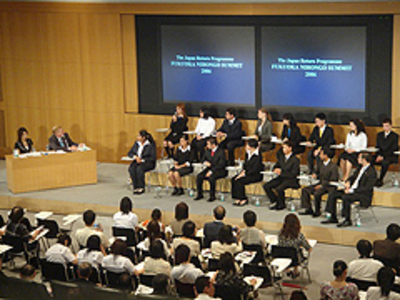
|
The Japan Return Programme (JRP), NPO organises the Nihongo Summit by selecting and inviting panellists from among the foreign youth throughout the world who have studied Japanese. During a 35 day stay in Japan, they will present their opinions in Japanese concerning what they can do for world peace through panel discussions at the NihongoSummit, in addition to various programmes including interchanges with Japanese students, homestays, and experience of Japanese traditional culture.
The theme for the Summit in 2012 is “Peace - Kizuna for One World”. JRP strongly encourages enthusiastic young people who are willing to discuss global issues and peace in Japanese, while sharing experiences with youth of the same generation for 35 days, to apply as panellists of the Nihongo Summit.
Please click here for further information in English.
Please click here for further information in Japanese.
For application forms, please click here.
JRP's website is www.nihongo.or.jp
10/05/2011
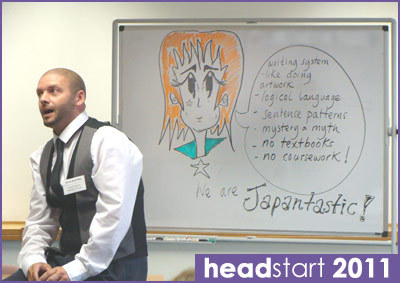
|
On May 5th 2011, Japan Foundation held out annual one-day Head Start course for head teachers, curriculum planners and MFL leaders interested in introducing Japanese language at their school.
The day began with an overview of the current picture of Japanese language education in the UK, in addition to the support available for Japanese teaching from the Japan Foundation. This was followed by an introduction to Japanese language and culture by the Japan Foundation language advisors, who introduced basic Japanese language and information about Japan with chanting, quizzes and games! These sessions were not only useful to teachers who had limited experience of Japanese culture, but also those who had been to Japan before; as one participant said, “Despite already being aware of Japanese language and culture, these sessions gave me ideas on communicating them in a classroom setting, and teaching the language.”
After a Japanese bento (lunchbox) lunch, the day progressed with presentations by teachers at schools currently teaching Japanese. Kevin McKellar, Head Teacher at Hendon School, gave an inspirational speech about how Japanese at his school has captured the enthusiasm of pupils across all ranges of ability, emphasising that “without Japanese, Hendon would not be where we are now.” Teresa Phillipson, Head of Modern Foreign Languages at Lutterworth College, gave a highly informative account of how Japanese Asset Languages is taught as an enrichment course at her school, and that pupils are so enthusiastic about Japanese that they will choose to study it even though it means less free periods!
Finally, the day closed with a tour of the Japan Foundation library, which now has 8,500 books and other Japanese language education resources, and a Q&A session. Overall, the day was a great success; some of the feedback received included:
“Really inspirational / motivational day. Lots of great, practical advice which will really help.” (Sally Daniells, Assistant Vice Principal at Skinners Kent Academy)
“Fantastic! A very inspiring day!” (Aeryn Hamilton, Exchange Teacher, Purbrook Junior School)
“An excellent and very useful day.” (Joan Nix, Curriculum Area Manager, Sandhill View School)
We would like to thank all Head Start attendees for coming, and hope we see you again soon!
If you would like more information about getting Japanese started at your school, please email info.language@jpf.org.uk.
28/04/2011

|
The Hakuho foundation is now accepting applications from non-native Japanese teachers in the UK that would like to take part in their teacher training programme. The programme is free of change for participants, and is an excellent chance for non-native teachers of Japanese to improve their Japanese language skills and learn new teaching methods while increasing their knowledge of Japanese culture through experiences in Japan.
- Study Japanese along with teaching methods
- Chance to network with teachers of Japanese from all over the world
- Learn more about traditional Japanese culture
- Visit Japan
- Use your experiences to improve Japanese language lessons in your school
For further information, or to download an application form, please visit the Hakuho Webite.
28/04/2011
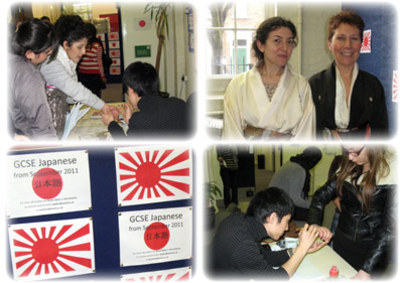
|
| \ |
The Japan Foundation is pleased to report that the William Morris Sixth Form in London will be starting a Japanese GCSE course from this September.
It will be the eighth language to be offered at this school, alongside Arabic, Chinese, French, Italian, Persian, Portuguese and Spanish.
The course will be lead by Ana Acitores, who also teaches Spanish. The school have described the introduction of Japanese as “...an excellent opportunity to learn a fascinating language spoken by 125 million people in the world.”
To read more about William Morris Sixth Form’s Japanese programme, please click here to visit their website.
If your school is considering launching a Japanese course or club and would like to know how the Japan Foundation can assist you, please send us an email at info.language@jpf.org.uk .
19/04/2011

|
| Akiko Fukai speaking at the Japan Foundation, London |
Following her visit to London to speak at the Japan Foundation event Japan / Fashion - A Talk by Akiko Fukai, you can now read an interview with Akiko Fukai on the Dazed Digital website here.
14/04/2011
On April 1st 2011, three of Japan Foundation’s StepOutNet Programme volunteers visited Sandgate Primary School in Folkestone as part of the school’s International Day of Languages.
During each 30 minute session, the volunteers first told the pupils all about Japan, and then taught them numbers in Japanese with gestures and pictures to help them remember. They then played games using numbers and jan ken pon (rock, scissors, paper). The pupils also learned basic Japanese greetings from ohayo gozaimasu to sayonara. Finally, the older pupils learned about Japanese kanji, while younger pupils heard the Japanese fairy tale “Kaguya Hime.”
Both the volunteers and the pupils really enjoyed the day, and one Year 4 pupil commented, “The Japanese language lesson was awesome. The actions helped me to remember everything and the teachers were kind, helpful and really made it fun."
A report of the event by the school, including photos of the StepOutNet volunteers in action, can be found on the school website here.
We would like to thank our volunteers and the staff of Sandgate Primary School for all their hard work in preparing the taster session!
If you would like to arrange a StepOutNet taster session for your school, please click here.
If you are a fluent Japanese speaker and would like to become a StepOutNet volunteer, please click here.
12/04/2011

|
On April 6th 2011, eighteen StepOutNet volunteers came to the Japan Foundation London office for the final StepOutNet Training Day in our five-course series.
After listening to detailed and interesting reports from two of our volunteers’ visits to Heathside Preparatory School and Sandgate Primary School, the volunteers took part in workshops by Mr. Seiji Fukushima, Chief Japanese Language Advisor at the Japan Foundation. These workshops demonstrated how Japanese language and culture can be taught in fun and effective ways during StepOutNet sessions, and activities included teaching how to bow, simple self-introduction games and the Origami Samurai Helmet Game!
One of our new volunteers commented, “I thought three hours would be a long time, but in fact it was really useful and worthwhile. It was great to be able to hear about the experiences of other volunteers.” (「3時間は長いかなと思ってたのですが、すごく有意義だったので、あっという間だった。今まで、ボランティアをした人の経験がきけてすごくよかった。」).
We would like to thank all our volunteers for taking part, and hope that they can join us again for the first StepOutNet Training Day of our 2011 course this summer.
If you are interested in becoming a member of StepOutNet, our volunteer programme for offering Japanese taster sessions at UK schools, please click here for more information.
07/04/2011

|
The Japan Foundation London office is pleased to support Play for Japan - an initiative set up in response to the earthquake and tsunami of March 11th. Play for Japan is working to help raise the profile of events created by groups or individuals in order to raise funds in support of the relief effort in Japan, as well as raising awareness of the challenges being faced by people in Japan whilst creating links between communities in the affected regions and the UK.
Please visit their website www.playforjapan.com to find out more information.
06/04/2011
We are delighted to pass on news of the announcement of the Yakult Lectureship for Japanese Language Studies at the University of East Anglia. The School of Language and Communication Studies at UEA is now inviting applications for this position, so please click here or view the attachment below to find out more information about this exciting development and opportunity.
05/04/2011
|
Are the Olympics a waste of money?
Do CCTV cameras prevent crime?
Should we stop adding katakana words to Japanese?
Which is the ideal pet – a dog or a cat?
These were hotly-contested themes of the exciting final evening of Talking Contemporary Japan, the Japan Foundation’s four week course for advanced Japanese learners. The March course took the theme of “Debating Time,” and explored how to engage in effective, persuasive and enjoyable debates in Japanese.
In each lesson, Hiroko Tanaka, the Japan Foundation’s Japanese Language Advisor, guided participants in the rules and techniques of debating in Japanese, and encouraged them to explore and discuss aspects of debating while using Japanese language in groups. On the final lesson, participants were divided into teams and held a real life debate – which was judged by the participants themselves!
Although a challenging, and at times nerve-wracking experience, participants enjoyed being able to use their Japanese in such an engaging and lively manner. Richard Witts, a newcomer to Talking Contemporary Japan, commented in the final lesson that the course was “...excellently organised, excellently structured. Even in these few hours I feel my Japanese has improved!”
We would like to thank all Talking Contemporary Japan participants for the hard work they put in every week, and congratulate them on their impressive, professional debating skills!
For more information about Talking Contemporary Japan, please click here.
22/03/2011
The Great Britain Sasakawa Foundation has set up a special grant programme under which it will consider applications for small grants for projects (including seed money to get a fund-raising event going) related to the aftermath of the earthquake and tsunami. See their website for details.http://www.gbsf.org.uk/
18/03/2011
For those who may be without news of their relatives as a result of the earthquake and tsunami in Japan on March 11th, the International Committee of the Red Cross has set up a Family Links web-page to help restore contact between family members. Please click here to visit this web site.
15/03/2011
As you will be aware, following the earthquake and tsunami in Japan on 11 March, many people are now struggling to cope with the aftermath.
The Japan Foundation would like to thank all those who have sent messages of condolence and sympathy for the people of Japan.
Please click here to read a statement from the Japan Foundation Head Office in Tokyo.
If you would like to make a contribution to help the recovery effort in Japan, several charities are now fundraising on behalf of this cause, including the following;
The Japan Society Tohoku Earthquake Relief Fund
www.japansociety.org.uk/earthquake
Embassy of Japan in the UK
www.uk.emb-japan.go.jp/en/visa/Donations_earthquake160311.html
The British Red Cross Japan Tsunami Appeal
www.redcross.org.uk
Japanese Red Cross Society
http://www.jrc.or.jp/english/index.html
The Japan Foundation, London
28/02/2011
We've been saying a lot of sayonaras and konnichiwas at the Japan Foundation Language Centre, with two members leaving, and two new members arriving!
Yoko Udagawa, Chief Japanese Language Advisor, has been succeeded by Seiji Fukushima.
Kim Woodruff, Programme Officer, has been succeeded by Josephine Audigier.
 Leaving message from Yoko Udagawa:
"It’s been three years since I started working at the Japan Foundation London and it’s time to go. I would like to take this opportunity to thank you for your support, encouragement and help. It has been great pleasure to meet and work with you all.
My tasks here in the UK were mainly supporting Japanese language education and promoting Japanese language learning in the UK. I do hope I was able to contribute to both areas.
I really enjoyed living in London. There are so many things that I will miss a lot, for example, walking and jogging in Hampstead Heath, going to see performing arts and museums, having a pint (or two) in a historical pub, etc…. I also enjoyed travelling all over the UK very much even though there are still many places I would like to go.
Thank you again and I hope to see you again somewhere in the world."
 Leaving message from Kim Woodruff
"I have had a fantastic 3 and a half years working at the Japan Foundation, and it’s been a pleasure to get to know so many enthusiastic and inspiring teachers of Japanese, and to have played a small part in supporting the fantastic work that you do. My new position is still within the field of education, and I’m very much hoping to keep up my Japanese and to attend lots of Japan-related events, so I do hope our paths may cross again. In particular, I may see you at this year’s Nihongo Cup when I hope to be in the audience!
Best wishes, and good luck with your Japanese teaching!
これからもどうぞ宜しくお願い致します。"
 Greetings from Seiji Fukushima
My name is Seiji Fukushima, the new Chief Japanese Language Advisor at the Japan Foundation London.
I started my career as a Japanese teacher in Mexico in1994. After that I worked at Tashkent State Institute of Oriental Studies in Uzbekistan(1997-2000), Novosibirsk State University in Russia(2000-2001), the Uzbekistan-Japan Center for Human Development(2003-2006), the Japan Foundation Budapest in Hungary(2007-2010).
I have been very happy that I could meet a lot of people, from children to elderly people, learning Japanese in every country. And now I am very excited to be working in London and looking forward to seeing you soon. よろしくおねがいいたします。
 Greetings from Josephine Audigier
"Hajimemashite!
My name is Josephine Audigier and I have recently taken over from Kim Woodruff as Programme Officer at the Japan Foundation London Language Centre. I started to learn Japanese at sixth form as part of my International Baccalaureate, then continued to study Japanese and History at SOAS. After Graduating, I spent two years as a Coordinator for International Relations in the beautiful ancient city of Nara. Since returning to London, I have worked in several roles at a wide range of companies, including Pokémon UK, Nikkei Europe and EThames Graduate School.
Deciding to study Japanese has been one of the best decisions I ever made. It allowed me to get to know some lovely people, travel around Japan and Asia, learn about a new culture, and also encouraged me to think about my own language and culture.
I am delighted to have joined the Japan Foundation and look forward to supporting teachers and students of Japanese, so that more students will have the chance of personal enrichment and growth through learning Japanese. Douzo yoroshiku onegaishimasu!"
26/02/2011
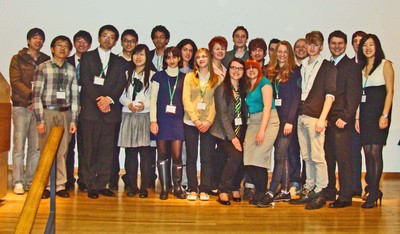
|
| All 22 speech contest finalists for 2011 |
On 26th February, the finals of the Sixth Japanese Speech Contest for University Students were held in the Brunei Gallery, SOAS, showcasing ten individual speeches along with four group presentations by UK university students.
The day got off to a brilliant start with the Category 2 competition, featuring speeches by students studying Japanese as an elective or optional course. Such was their high level of Japanese; it was hard to believe these finalists were not studying Japanese as their main degree subject. In a closely fought contest, the top place was awarded to Edwin Goh, a 3rd year at Imperial College London with his enthusiastic speech about fan translation of light novels. Second place was awarded to Shuran Dong from the University of Bristol for her speech on Japan’s traditional theatres.
After a short interval, the audience was treated to the Category 1 speeches, by students studying Japanese as their main degree subject. All five entries were very impressive; well researched, presented with confidence and followed by thoughtful answers to the searching questions of the interlocutors. The judges must have had a difficult decision, but in the end they awarded first prize to Andrew Lyttle, 4th year at the School of Oriental and African Studies (SOAS) for his exceptional speech about Rehabilitation facilities for Parolees in Japan. Second place was awarded to James Ball from the University of Leeds for his speech about the Senkakushoto territorial dispute.
This years Group Category gave beginner-level students the chance to give presentations about an issue of interest to them. The four outstanding groups that made it through to Saturday’s finals were chosen from an initial 19 applications, and represented the University of Sheffield, Newcastle University, Imperial College London, and SOAS. They gave talks on The Gunpowder Plot, Local Cuisine, Experiencing the ‘Pimlico Connection’ and Secrets of London. These groups were not placed individually, but instead received special prizes based on their chosen topics.
We would like to thank all participants, their teachers and supporters, the judges, audience members and BATJ for making the contest such a success. In addition, special thanks must go to the generous sponsors: Baker & McKenzie LLP, Central Japan Railway Company, Eikoku News Digest, Gendai Travel Limited, The Great Britain Sasakawa Foundation, Japan Airlines, Japan Centre, JP-Books (JPT Europe Ltd.), Mitsubishi Electric Europe, Ricoh UK Ltd, School of Oriental and African Studies (SOAS), and Toshiba of Europe Ltd.
Click on the attachment below for the full results.
28/01/2011
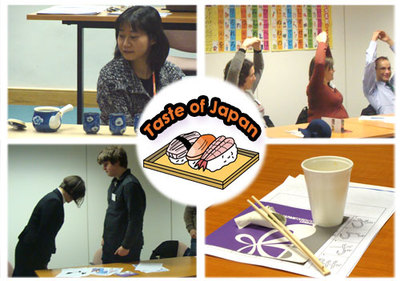
|
Green tea, sushi and bowing were enjoyed by all at Japan Foundation’s first ever beginner’s Japanese language event Taste of Japan, which was held on January 26th 2011 by the Japan Foundation London Language Centre.
After warming up with a Japan quiz, participants were taught by the Japan Foundation’s Chief Japanese Language Advisor, Yoko Udagawa, essential expressions for survival in Japan. The session also covered Japanese etiquette including the different kinds of bow and how to use chopsticks with style. Hiroko Tanaka, a Japan Foundation Language Advisor, also demonstrated how to serve ocha (green tea) with grace and elegance. Finally, participants had a chance to practice their language and cultural skills for real as everyone tucked into a sushi dinner.
One of the participants described the event as “very warm and welcoming. Very informative in a fun and inclusive way. It is very good to learn words and phrases but also extremely important to learn the customs at the same time. I am definitely going to continue learning Japanese language and culture.”
We would like to give all our participants a huge thank you for coming. Dōmo arigatō gozaimashita!
This was also Udagawa-sensei’s final event as a Japan Foundation UK Language Advisor. Udagawa-sensei, o-tsukare-sama deshita!
20/01/2011
Following her recent lecture at the Japan Foundation, Dr Inge Daniels has curated an exhibition 'At Home in Japan - beyond the minimal house' for the Geffrye Museum, which will be on display from 22nd March until 29th August 2011. Please click here for more information.
20/01/2011
Please follow this link to read a report from the conference 'Japan: increasing its global role?', which was held at Wilton Park last November and supported by a Japan Foundation Intellectual Exchange Conference Grant.
06/12/2010
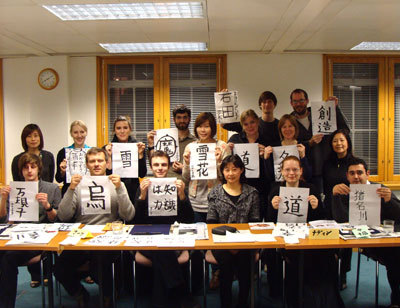
|
Over 40 participants attended our November-December Taking Contemporary Japan course for advanced Japanese learners, which ended on December 3rd.
Taking the theme of kokugo – Japanese language that Japanese people learn – participants had a chance to read classic Japanese stories and poetry, try riddles and kanji puzzles, and learn about the Japanese language as school children in Japan would do. In the final session, the students were even able to try shuji or Japanese calligraphy, under the guidance of Japan Foundation’s language advisor and calligraphy specialist Tanaka-sensei.
Simona Lombardi, a first-time participant of Talking Contemporary Japan, said:
“I think that this course is a great opportunity for all the people interested and in love with the Japanese language culture to keep practising and learning in a very friendly and relaxed way while having fun and meeting new people...It is good to see that there are other people like you that may not be using the Japanese language on a daily basis anymore but that are bounded to this country and share your same passion. This course gave me the right motivation to get back to study and look for new activities and courses in my part time to keep deeding my passion and interest for the Japanese language and culture.”
The next Talking Contemporary Japan course will take place in March 2011. Please look out for details in the What’s On section of this website and in JF-News.
15/11/2010
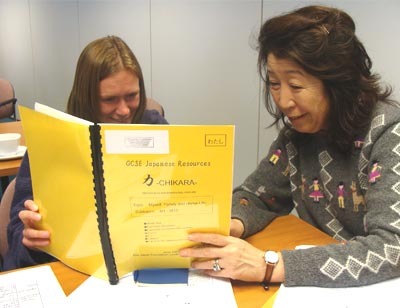
|
Our Autumn 2010 CHIKARA update workshop was held on 27th October and 8th November and was attended by 42 teachers of Japanese.
This workshop focused on developing students’ speaking/oral skills. Participants had the chance to discuss this in relation to the CHIKARA resource and also to take part in real-life examples of teaching activities.
If you are interested in participating in any our events for Japanese teachers in the future, you can join our e-bulletin JF News to receive the latest information about all upcoming Japan Foundation events.
05/10/2010
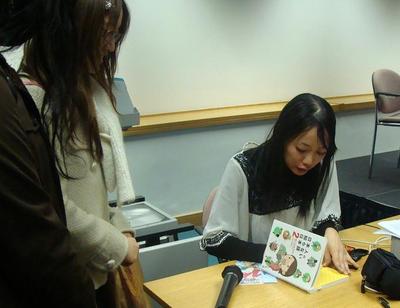
|
| Hebizo-sensei signing autographs |
Over 100 guests visited the Japan Foundation on 30th September to hear a talk in Japanese with the authors of the best-selling manga essay series, ‘Nihonjin no Shiranai Nihongo’ (‘Japanese that Japanese People Don’t Know’).
Japanese teacher and writer, Nagiko Umino, was inspired to write the book by her experiences of teaching Japanese as a foreign language, and the difficult questions her students asked her. She was encouraged by and collaborated with illustrator and manga artist, Hebizo, and since last year, their two books have sold over 1.4 million copies and even been turned into a TV drama.
Umino and Hebizo spoke about their collaboration, their desire to write a visually appealing and fun manga book rather than a dry textbook, and the responses they have had to their books. The authors also revealed some of their favourite anecdotes from the classroom, such as the student who, asked to describe the word ‘tenshi’ (‘angel’), said “a person with ‘teba’ (chicken wings) on their back”.
To conclude the talk, Hebizo demonstrated how to draw manga and inspired the audience by revealing that she had only decided to become a professional manga artist in her mid-30s.
“The authors were fantastic speakers!” said one learner of Japanese who attended the event. “Both of them had great presence and were able to relate very interesting stories verbally. I really enjoyed the opportunity to listen to natural Japanese in a lecture style.”
05/10/2010
The Japan Foundation is pleased to announce a call for proposals for Intellectual Exchange Conferences on topics related to the state of regional integration and collective identity in Europe and Asia. Examples of specific conference themes, from a comparative perspective between Europe and Asia, could include (but are not limited to):
- International migration and regional identity
- Regional integration, economic nationalism, and cultural identity
- Regional identity and peace and security
- The roles of sub- and supra-state institutions and their impacts on identity politics
This special grant program provides grants to partially cover expenses for implementing international intellectual collaborative projects that involve Japanese participation. The program is designed to deepen mutual understanding and establish closer relations between Japan and other countries while promoting global intellectual exchange.
Projects should be implemented and completed between December 1st 2010 and March 31st 2011. There will be between 5-10 grants available. The deadline for applications is the 4th November.
For other specific terms and conditions of grants, please refer to the attached application form. Please feel free to contact Neil Cantwell with any further enquiries.
05/10/2010
The Japan Foundation London office is currently updating our 2007 Survey of Japanese Studies at Higher Education Institutions in the UK. We have also taken this opportunity to seek out the opinions of Japanese Studies students, which you can read in this preliminary report. Please feel free to share with us any comments you may have by e-mail to Neil Cantwell.
26/08/2010

|
Professor John Holden has provided us with a very enjoyable report from his recent visit to Japan as part of the Japan Foundation Cultural Individual Invitation Programme. Please click on the attachment below in order to read it.
Prof Holden will be launching a new publication for Counterpoint, the think-tank of the British Council, entitled Class and Culture at an event on the 7th September. Please click here to find out more information about this event and the publication.
To read a report from Prof Holden's lecture in Tokyo, please follow this link.
John Holden - Values Without Borders:'Cultural Diplomacy' Starts At Home
19/08/2010
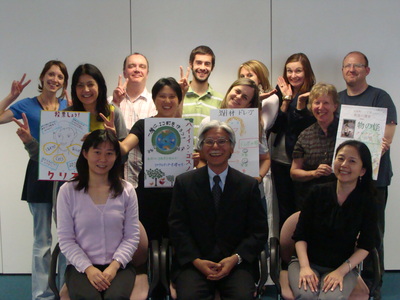
|
From 21st – 30th July, 25 participants took part in the Japanese Language Refresher Courses for Teachers. They visited the Japan Foundation to brush up on their language skills and network with other teachers of Japanese. An advanced course was held in the first week and an intermediate course was held in the second week, in an attempt to cater to as many different levels as possible.
The advanced course focused primarily on keigo and manners/taboos in a typical Japanese workplace. The participants were able to hone their skills through role-plays, quizzes and written activities before finally interviewing a series of mystery guests and reporting their findings back to their classmates.
In the intermediate course the class revised various language points, while also talking about recycling issues and any new ideas they had for tackling the world’s environmental problems. Finally, in small groups, they laid out their manifestos for why they should be elected as ‘mayor’ and had the chance to vote for whoever they considered to be the best candidate.
“I really enjoyed the course”, said Helen Turner, a lecturer at Hertford Regional College. “It was a wonderful opportunity to submerge in Japanese and to meet people in the same situation.”
Christopher Byrne agreed, saying, “It was a very well structured course with two excellent teachers. It featured very clear explanations and use of target language, with enjoyable and engaging activities.”
Thank you very much to everyone who made this year’s courses so successful.
02/08/2010
There are more people learning Japanese in the UK than in any other country in Europe, according to the results of the Japan Foundation’s latest worldwide survey.
The survey found a total of over 19,600 learners of Japanese, with France in second place with just over 16,000. The number of learners in the UK has also increased by 32% since the last survey, carried out in 2006.
Globally, the number of learners outside of Japan has now reached 3.65 million (an increase of 22% since 2006), with the biggest rise seen in Indonesia. The country with the highest number of learners is Korea, followed by China.
“We are delighted to see this rise in learners of Japanese in the UK,” said Takashi Ishida, Director General of the Japan Foundation London. “We would like to thank all teachers and institutions involved for their great success in inspiring and motivating students to learn Japanese. Given this encouraging trend, I am hopeful that even more learners will rise to the challenge of the Japanese Language Proficiency Test, which is now available at five levels.”
Thank you very much to everyone who completed the survey. We will be sending you some teaching aids (e.g. picture cards sent by email) in the autumn, together with a summary report of the survey. This summary will also be posted on the Japan Foundation Head Office’s website.
02/08/2010

|
The 2010 Japanese Language Proficiency Test (JLPT) will be held in the UK at SOAS, University of London, on Sunday 5th December 2010. The exam will also be held on the same day at Dublin City University in Ireland.
This is the first time that candidates will sit the new JLPT, and be able to choose from five levels, instead of four. The new levels N1, N2, N4 and N5 will be roughly equivalent in difficulty to the old levels 1-kyu, 2-kyu, 3-kyu and 4-kyu, respectively. The new N3 level will bridge the gap between 3-kyu and 2-kyu.
The new exam will focus more on communication skills, and give a better picture of what a candidate can do in Japanese. The sections within each level have also changed slightly. In addition, past exam questions will no longer be made public. Sample questions and profiles of the new levels will be published instead. Full details of the new exam are given on the official JLPT website in Japanese. (An English version is expected later in August 2010.)
Applications will be open from 12th August 2010 until 6pm on Thursday 7th October 2010. For all enquiries about taking the JLPT in the UK, please contact SOAS.
07/07/2010
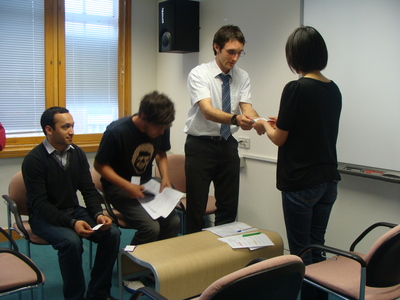
|
This course provided a chance for advanced learners of the Japanese Language to finally discover what Japanese people really think about various topics. The participants spent some time learning about formal ways of speaking and also worked together in small groups to think of questions to ask the special mystery guests. Questions topics ranged from the position of women in the Japanese workplace to the acceptability of tattoos in public baths! Each group also had the chance to present their findings to their classmates and compare conclusions.
The next Talking Contemporary Japan course will take place in November. Please look out for details in the What’s On section of this website and in JF-News.
25/06/2010

|
| Nihongo Cup finalists and sponsors |
On 19th June the finals of the Nihongo Cup were held at the Embassy of Japan in London. Despite the rival event of Japan vs Holland taking place at exactly the same time – clearly an oversight on the part of the World Cup schedulers – the auditorium was full to capacity, as the audience settled down to listen to the speeches. Without a vuvuzela in sight, the finalists showcased their considerable talents, competing in three separate categories in an attempt to impress the judges and win an array of fantastic prizes.
The 18 finalists had done extremely well to reach this stage of the competition, with this year’s number of applications totalling 268 pupils from 22 different schools. Speech topics ranged from the traditional way of the Japanese samurai to Seattle saxophonists and all participants had clearly put a great deal of time and effort into their preparation for the contest.
In between the speeches there were also excellent performances by the pupils of Knorton Knatchbull School and the Kakehashi Koto Ensemble to keep everyone entertained. On top of this, the audience was treated to a dance and language lesson by the pupils of Greenford High School and the Japanese Language Committee, demonstrating that clubbing and Japanese-language learning can actually be combined very easily!
Competition was extremely high but eventually the judges were able to agree on the winners, awarding first prize in each category to Ollie Capehorn (post-GCSE), Tanya Naumenko (pre-GCSE) and Jonah Allen (Key Stage 3), who later remarked that “This was probably the best moment of my life to date!”
Many congratulations and a big thank-you to everyone who came together to make the day such a success. The full results of the contest are as follows:
Key Stage 4 and 5 Post-GCSE:
Winner – Ollie Capehorn, Wycliffe College
Speech Title: Why not take up a foreign language?
2nd Place – Shyam Patel, Whitgift School
Speech Title: Japanese Religions
3rd Place – Lawson Lancaster, Greenford High School
Speech Title: Takoyaki and Fried Potatoes
Other Finalists:
Jisu Lee, St. Helen’s School
Joe Littler, King Edward VII School
Dorota Malec, South Wolds School
Key Stage 4 and 5 Pre-GCSE:
Winner – Tanya Naumenko, Wycliffe College
Speech Title: Hokusai
2nd Place – Sean Bullock, Dame Alice Owen’s School
Speech Title: Studying Foreign Languages
3rd Place – Hannah Dobb, Campion School
Speech Title: My 2010
Other Finalists:
Areekul Bunprakob, Brittons School & Technology College
Jessica Leeson, Weald of Kent Grammar School
Amelia Underwood, Stratford upon Avon Grammar School for Girls
Key Stage 3 (all speeches entitled ‘My Favourite Person’):
Winner – Jonah Allen, Aylesbury Grammar School
2nd Place – Nketia Obed-Arthur, Whitgift School
3rd Place – Phoebe Ball, South Wolds School
Other Finalists:
Kirsten Bergfors, St. Helen’s School
Ellie Oaten, Tavistock College
Jenny Robinson, Queen Mary’s High School
The event was organised by the Japanese Language Committee of the Association for Language Learning, in association with the Japan Foundation London and Embassy of Japan in the UK. We are very grateful to Toshiba of Europe Ltd, JSA (the Japanese Speech Awards), Ricoh UK Ltd, JP-Books (JPT Europe Ltd) and the Japan Centre for sponsoring the event and donating prizes, and also to Sumisho Computer Systems for their generous sponsorship and to Soho Japan for contributing to the evening reception.
23/06/2010
The Japan Foundation in Tokyo runs the Performing Arts Network; a comprehensive resource for information on performing arts related happenings in Japan, featuring interviews, reviews and articles in both Japanese and English. The website has recently been updated and new articles include:
- The unique appeal of old playhouses. Links to Edo Period theater culture.
- CINARS, over a quarter of a century. The vision and accomplishments of founder Alain Pare.
- Play of the Month, Irairasuru Otona no Ehon (Frustrating Picture Book for Adults) by Tanino Kuro.
To read the articles, please click here.
21/06/2010
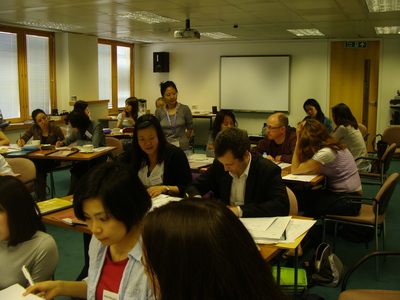
|
Part 4 of the CHIKARA update workshop was held on 24th May and 4th June and was attended by 43 teachers of Japanese.
The workshop focused in particular on the use of particles in GCSE Japanese. Participants had the chance to discuss this in relation to the CHIKARA resource and also to work on resources of their own.
18/06/2010
Centre Europeen d'Etudes Japonsaises d'Alsace (CEEJA) and the Japan FOundation (JF) are inviting applications to participate in the Japanese Study Seminar - Meiji II, scheduled to take place on 24 and 25 September 2010 at CEEJA in Kinetzheim, France.
This Japanese Study Seminar aims to encourage networking among young researchers on Japan in Europe and deepen further promotion of Japanese Studies in Europe.
Participants will join a two-day intensive workshop in the cosy and intimate atmosphere of CEEJS's facility in Kientzheim and present and discuss their current research projects amongst each other, as well as with a guest Mentor from Japan.
Following last year, the subject of this year's seminar will be "Meiji" We are calling for young researchers in Europe who specialise in politics, history, society, literature, arts, language, thoughts, economy, city and architecture, religions etc. of this unique juncture of Japanese modern history.
Please download the attachment below for further information.
17/06/2010
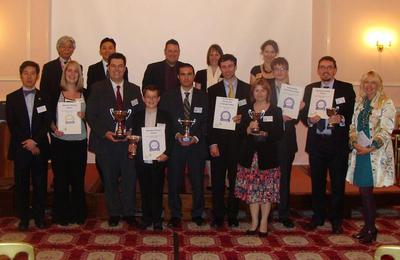
|
On 14th June, representatives from four schools travelled from across the UK to the Embassy of Japan in London, to celebrate their successes in the Japan Webpage Contest for Schools.
As well as receiving their prizes and trophies from the contest judges, each school gave a demonstration of their website before an audience of around 80, including many representatives from educational and Japanese organisations.
We were honoured to be joined by four teachers from the Overall Winner, Ballyclare Primary School, who travelled all the way from Northern Ireland to attend the event. Karen Irwin and Simon McLean, coordinators of Ballyclare’s entry, presented their inspiring website and partnership with Tomei Primary School in Japan.
"We were very pleased to have been shortlisted, and totally delighted to have won the overall first prize," said Ballyclare Primary School Principal, Kim Cowden. "We are very fortunate to have a lot of ICT experience and the two teachers involved were able to do all the web designing and create the finished link with input from some very talented pupils. We are very proud of this achievement and commend our two staff, Mrs Irwin and Mr McLean for their outstanding work. The award will give us great satisfaction and will build enthusiasm in the future for our Japanese link. We have lots of plans to develop this and we hope this will be of interest to our neighbouring schools in Northern Ireland and also those in the UK as a whole. We thank the Japan Foundation for their generosity and to our partners in the school link, the Daiwa Foundation and the British Council. Without all of their support, we would be unable to sustain such a meaningful and exciting project for our school community."
South Wolds Community School, one of the joint Runners-Up, was represented by Japanese teacher Anne Rajakumar and Year 11 student James Forsythe. James gave a wonderful demonstration of the school’s extensive Japanese website, including year group pages, a video-tour of the school in Japanese by Year 10 students, and Japanese language resources and games. James also spoke about how much he had enjoyed the school’s trips to Japan.
Class teacher Athole McLauchlan and Primary 6 pupil Adam Stanley travelled down from Glasgow to collect their Runner-Up prize and Public Vote Award on behalf of Bearsden Primary School. Adam eloquently demonstrated his class’s site, Godzilla’s Den, and said “The website was exciting and interesting to make and everyone in the class did at least something for it. I really liked making the block prints on Hokusai’s Great Wave, and the other artwork like manga and anime”.
Japanese teacher Dan Thomson and IT technician Jamie Lee collected the Design Prize Award on behalf of Tile Hill Wood School and Language College, for their stylish website. Jamie explained that the scrolling carousel navigation had been inspired by conveyor belt sushi restaurants! Dan spoke about the school’s projects with Japanese pop star Suga Shikao and even gave the audience a sneak preview of their latest collaboration.
The audience was also thoroughly entertained by two thank you videos showing pupils from Ballyclare and Bearsden celebrating their awards and even speaking in Japanese. Although these pupils couldn’t be at the event in person, their presence and their contributions to the websites were felt very strongly, and made the evening even more special.
After an enlightening question and answer session, all school representatives and guests enjoyed a reception in the Embassy’s wonderful ballroom, and the chance to make new contacts and take a closer look at all the webpages.
Takashi Ishida, Director General of the Japan Foundation London said “We were delighted to receive 32 entries to the contest, and deeply impressed at the range and quality of the webpages, many of which did not exist before the contest began. I would like to congratulate and thank all of the schools that participated.”
Thank you to the Embassy of Japan for hosting and co-organising the Presentation Evening and Award Ceremony, and to all of our contest partner organisations, judges, school representatives and guests.
Click here to see all webpage entries and gain inspiration for Japan-related projects that you can try!
To stay in touch with news about any similar projects, please sign up for our e-bulletin.
24/05/2010
Under our Cultural Individual Invitation Programme, last year The Japan Foundation London Office invited Prof John Holden, former Head of Culture at the independent think-tank Demos, on a two-week visit to Japan. As part of his activites in Japan, he delivered a lecture in Tokyo on the topic "Values Without Borders: 'Cultural Diplomacy' Starts At Home". You can read a report and view a video of this lecture by following this link below.
John Holden - Values Without Borders:'Cultural Diplomacy' Starts At Home
24/05/2010

|
Ballyclare Primary School in Northern Ireland has won £1000 worth of prizes in the Japan Webpage Contest for Schools, a new contest organised by the Japan Foundation London.
Ballyclare wowed the judges with its entertaining and inspiring website, which was set up to showcase projects with its Japanese partner school. You can read about the school’s ongoing attempt to walk the distance to Japan, which kicked off with an event where pupils walked to school in their pyjamas. You can also watch narrated videos of stories about an Evil Germ, a Grumpy Tiger, a Super Penguin (and more!) written collaboratively by children in both schools.
Other prize-winners were Bearsden Primary School in Glasgow, South Wolds Community School in Nottinghamshire, and Tile Hill Wood School and Language College in Coventry.
Bearsden’s entry was designed and created by the class of P6B, who did an 8-week topic on Japan, and claimed both a Runner-Up Prize and also the Public Vote Award. You can find out how to make kokeshi dolls out of yoghurt pots, read news stories about Godzilla attacking Tokyo, learn about the latest video games created by P6B, and be amazed by hi-speed origami and tangrams. South Wolds also won Runner-Up Prize, for its extensive website with contributions from 100 students. You can read about how South Wolds is making the most of the 2012 Olympics through its original ‘Musubi’ project, download many excellent teaching resources, and watch videos of students giving a guided tour of the school in Japanese or performing their Japanese self-introduction raps. Finally, Tile Hill Wood impressed the judges with its stylish web design, useful learning resources for students, and inspirational project with pop star Suga Shikao. Students have been using Suga-san’s music to help them in their Japanese lessons, and – thanks to their video – were even able to meet him in person and welcome him to their school!
Six other schools were shortlisted for their excellent Japan-related webpages: Altrincham Grammar School for Girls, Dame Bradbury’s School, Gartree Community School, James Allen’s Girls’ School, St Paul’s School, and Swavesey Village College.
You can see all 32 webpage entries and read about Japan-related activities in UK schools here.
A Presentation Evening and Award Ceremony will be held on Monday 14th June at the Embassy of Japan, to celebrate the achievements of all schools taking part in the contest. The event is open to all and free to attend but booking is essential. Please click here for more information.
12/05/2010
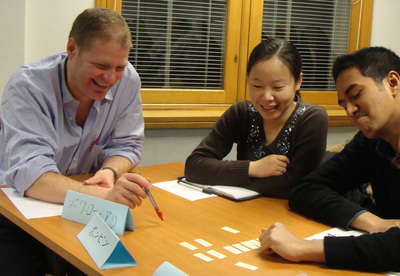
|
Do you know the correct etiquette for serving Japanese tea? Or where each person should sit in a business meeting? How about the hierarchy of sitting in a taxi? Writing work e-mails? Or even just standing in a lift?
All these questions and more were answered in the latest Talking Contemporary Japan class, Getting down to Business! – Language and Etiquette in Japanese Society. The course ran throughout March and gave participants the chance to get to grips with business language, etiquette and taboos in Japanese society. The classes provided a wide variety of information and activities, and this was reflected in the positive evaluation that was received. “The Classes were a nice balance of group work, lecture and participation”, said Jamie McLaughlin at the end of the course. Josy Audigier was also very enthusiastic, saying “Tanaka sensei is awesome! I loved this class!”
The next Talking Contemporary Japan course will take place in June. Please click here for further information and an application form.
30/04/2010
Arts & Culture
Film Festivals Abroad Support Programme 2010-11
Cinemagic International Children’s Film Festival
Applicant: Cinemagic
Scotland Loves Animation
Applicant: Scotland Loves Animation
Onedotzero – adventures in motion 2010
Applicant: Onedotzero
Encounters International Short Film Festival
Applicant: Encounters Festival Ltd.
Zipangu Fest
Applicant: Midnight Eye Screening
Exhibition Abroad Support Program 2010-2011
Grants will be awarded towards the following exhibitions:
New work by Rinko Kawauuchi for the Brighton Biennial 2010
Applicant: Photoworks
Unearthed: figure-making and figure-breaking in ancient Japan and the Balkans
Applicant: Sainsbury Institute for Visual Arts
Tatsumi Orimoto
Applicant: A Foundation
Tabaimo
Applicant: Parasol Unit for Contemporary Art
Portraits of the Hibakusha
Applicant: Kingston University
Performing Arts for Europe 2010-11
Shun-kin
Applicant: Theatre de complicite
Japanese Studies
Fellowship Programme 2010-11
Long-Term Scholars and Researchers
Dr Mara Patessio, University of Manchester - Topic of Research: Hasegawa Shigure and Japanese Women’s Modern History
Dr Andrea Germer, University of Newcastle – Topic of Research: Visual Propaganda in Wartime Japan and Germany: Culture, Race and Gender in Comparative Perspective
Short-Term Scholars and Researchers
Dr Roman Matousek, London Metropolitan University – Topic of Research: Banks Efficiency and Monetary Policy Stance in Japan: Lessons for Europe
Prof Fran Lloyd, Kingston University – Topic of Research: Dumb Type: An Art of Intervention
Ms Alice Maude-Roxby, Kingston University – Topic of Research: Bigakko – investigating the impact of radical Japanese artist-teachers since 1969
Intellectual Exchange Conferences 2010-11
Wilton Park – a grant towards the conference: Japan: Increasing its International Role?
University of Oxford – a grant towards the conference: The 20th Japanese/Korean Linguistics Conference
Other Support for Conferences:
British Association for Japanese Studies (BAJS)
A grant towards: BAJS Conference 2010
Organisations in Japanese Studies 2010-11
Staff Expansion – University of Edinburgh, SOAS (ongoing)
Language Centre
Short-Term Training Programme for Foreign Teachers of the Japanese Language (Summer Course) 2010-11
Roberta Ignirri
Sophie Lane
Japanese-Language Programme for Specialists (Specialists in Cultural and Academic Fields) 2010-11
Paul O'Shea
Amy Walker
SAKURA Core Project 2010-11
The British Association for Teaching Japanese as a Foreign Language (BATJ)
23/04/2010
We are delighted to report that through the generous donation of his recent Japan Foundation Prize, Professor Arthur Stockwin has made possible the creation of a new Scholarship for MPhil students in Modern Japanese Studies at St Antony's College, Oxford University. Please download the attachment below for further details.
20/04/2010
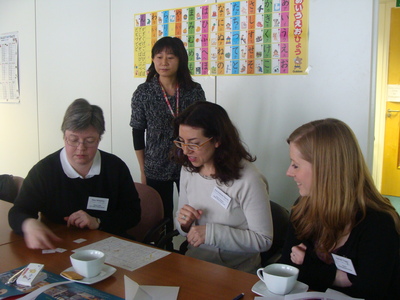
|
On 17th March the Japan Foundation’s annual ‘Head Start’ event was held, offering advice to curriculum planners and language teachers about how they can introduce Japanese language classes and cultural activities in their schools.
Workshops were held on resources, accreditation and support available from various organisations. There was also a tour of the Japan Foundation library, an introduction to the Japanese language and culture and another session providing a taster Japanese language class for the delegates to experience.
Participants were also treated to presentations from Helen Gilhooly, Senior Director of Aldercar Community Language College, Nottingham, and Garry Ratcliffe, Executive Headteacher of Oakfield Community Primary School, Kent. They spoke about how Japanese had been introduced at their own schools and the challenges and benefits it had brought with it.
If you would like more information about the support available for schools wishing to introduce Japanese then please don’t hesitate to contact us, or alternatively go to our FAQs page.
20/04/2010

|
The Japan Foundation has recently launched four new websites for teachers and learners of the Japanese language. Please click on the titles below in order to visit the sites.
This site focusses on expressions specific to Anime and Manga (see news article below for more details).
JF Standard for Japanese-Language Education
This site provides a framework for Japanese language education.
This site provides a series of video clips following the experiences of an exchange student in a Japanese high school. The English version of this site should be ready by the end of April. A site dedicated to introducing all kinds of websites and online tools useful for studying Japanese.
A site dedicated to introducing all kinds of websites and online tools useful for studying Japanese.
01/03/2010
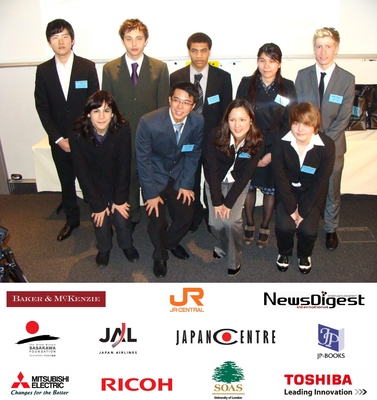
|
| Category 1 and 2 finalists |
On 27th February, the finals of the Fifth Japanese Speech Contest for University Students were held at SOAS, showcasing nine individual speeches and four group presentations by UK university students.
The day got off to a fantastic start with the Category 2 competition, featuring speeches by students studying Japanese as an elective or optional course. Such was their high level of Japanese, it was hard to believe these finalists were not studying Japanese as their main degree subject. In a closely fought contest, the two top places went to students at Imperial College London: William Kwang Won Kim emerged victorious with his speech about patent, followed closely in second place by Anthony Chow, for his speech on Shinto.
After a short interval to catch their breath, the audience was treated to the Category 1 speeches, by students studying Japanese as their main degree subject. It was clear the judges would have a tough decision, as each finalist not only impressed the audience with their interesting and well-presented opinions, but also skilfully fielded the searching questions of the interlocutors. The suspense was intense, but finally the judges awarded second prize to Harriet Mary Jones from the University of Cambridge for her speech on tōrima incidents, and first prize to Antoni Slodkowski from SOAS, for his outstanding speech on the political and social implications of the ODA policy.
"It was a brilliant feeling to win first prize!” said Antoni. “After winning 2nd prize in the speech contest two years ago, I wanted to come back this year and show the progress that I'd made. I also wanted to use my experiences from my year abroad, and talk about something that would interest both Japanese and non-Japanese people. I hope I achieved this. I've been overwhelmed by the number of people who supported me, including a researcher at a Japanese university who helped me with my speech, my teachers at SOAS, and my friends - some of whom came today even though they don't speak Japanese, and I'm really grateful to them all."
This year there was also a new category in which groups of beginner-level students gave presentations about an issue of interest to them. The four excellent groups that made it through to Saturday’s finals were selected from an initial 51 applications, and represented the University of Leeds, Imperial College London, SOAS and the University of Birmingham. They gave talks on Strange British Festivals, London’s Olympic 2012, The Otley Pub Run and Big Brother. These groups were not placed individually, but instead received special prizes based on their chosen topics.
We would like to thank all participants, their teachers and supporters, the judges, audience members and BATJ for making the contest such a success. In addition, special thanks must go to the generous sponsors: Baker & McKenzie LLP, Central Japan Railway Company, Eikoku News Digest, The Great Britain Sasakawa Foundation, Japan Airlines, Japan Centre, JP-Books (JPT Europe Ltd.), Mitsubishi Electric Europe, Ricoh UK Ltd, School of Oriental and African Studies (SOAS), University of London, and Toshiba of Europe Ltd.
Click on the attachment below for the full results.
25/02/2010
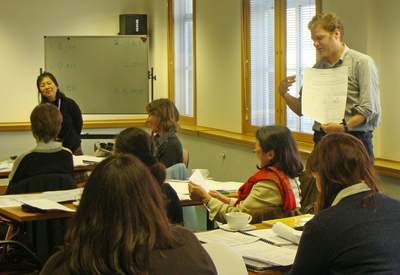
|
Part 3 in the series of CHIKARA update workshops took place on 18th and 19th February and was attended by 40 teachers of Japanese.
This series of workshops provided advice and activities to help teachers improve their skill in making new resources, and also provided an insight into how the GCSE in Japanese is changing.
If you would like more information about the CHIKARA GCSE resources, please click here.
27/11/2009
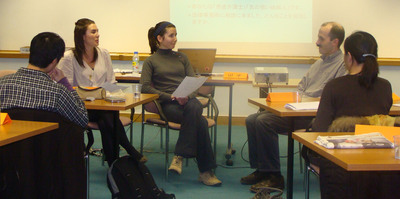
|
| Role-play during the class |
In the latest set of Talking Contemporary Japan classes, participants delved into the world of Japanese comedy-drama. The course usually comprises just one set of four classes but, such was its popularity, we were forced to offer a second course in order to satisfy demand. During the sessions, participants watched and talked about an episode from a Japanese TV comedy-drama series. They discussed the characters and storylines and compared them to similar situations in their own countries. Topics of conversation ranged from garbage disposal to ways of exacting revenge, so there was certainly something for everyone! The classes also focussed on the language points that emerged from watching the drama unfold. In particular, participants looked at the use of slang and colloquial expressions, in order to help their own use of Japanese become more natural. On top of this there were a number of games and role-plays in which the members of the class were able to impress their peers, and also win some prizes. Feedback from the class was very positive. Ian Brenkley commented that: "Overall the teaching was excellent and it was certainly an interesting way to learn a little more about modern Japan." Another participant also said: "The teacher was really great and showed interest in everybody’s opinions. The classes were well-planned and thought out. The course was original and generated some very interesting and amusing discussions!" The next set of Talking Contemporary Japan classes will start in March 2010. These sessions are an excellent opportunity for advanced learners of Japanese to brush up on their language skills and learn about new elements of Japanese life and society. Please keep an eye on our website or subscribe to our monthly E-bulletin if you would like to be kept up-to-date with the latest Japan Foundation events.
06/11/2009
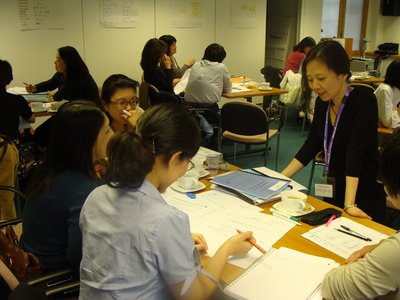
|
| Participants talking with Udagawa-sensei |
At the end of October over 40 Japanese teachers came to the Japan Foundation to learn about the CHIKARA resource for GCSE Japanese. Workshops were held on both the 27th and 28th of the month and were conducted by Yoko Udagawa, Chief Japanese Language Advisor at the Japan Foundation London Language Centre. Participants worked in small groups, making resources, and also learned about how the GCSE in Japanese is changing.
The next workshop in the series will be held in spring 2010. Please look out for further information on this website.
The CHIKARA resources for GCSE Japanese were created by the Japan Foundation in 2008, with generous support from the Great Britain Sasakawa Foundation. They can be downloaded from the Japan Foundation website and are also available in CD and hard copy format.
06/11/2009
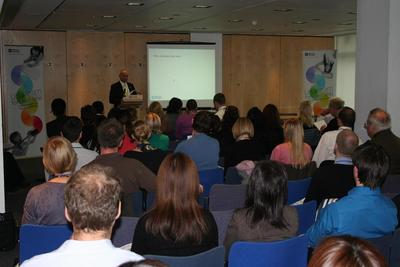
|
| The Conference |
On 16th October, over 80 teachers and local authority advisors attended the Japan Conference for Schools. Co-organised by the British Council, the Embassy of Japan, the Japan Foundation and the Japan Society, the event offered ideas for activities and projects that teachers can use to introduce Japan and Japanese into their schools.
The day began with an excellent talk by James Laming of Frederick Gough School, Scunthorpe, about his Joint Curriculum Project: Recycling in Nagoya. James and a number of his students had a very successful trip to Japan in which they spent time at a partner school and with members of the local community.
Following this, participants separated into small groups for workshop sessions on the themes of A Geographers Japan, Japanese Language, Japan in the Primary Classroom and Japan and Art. Speakers came from all over the UK and gave very enthusiastic presentations about how they have used Japan and Japanese in their schools.
Participants were also able to take advantage of one-to-one advisory sessions with members of the four organising institutions. There is an enormous amount of free support available, and this was an opportunity for the teachers to find out how best to make use of it.
The event will be held again in 2010 so look out for information about it on this website. You can also gain advance notice of Japan Foundation events by signing up for our monthly e-bulletin.
06/10/2009
The new programme guidelines and application forms for grants to be made in the financial year 2010-11 have recently been added to our Head Office website here. Please don't hesitate to contact this office with any enquiries you may have about your eligibility for our grant programmes.
16/09/2009
This annual grant programme is available to those organising performing arts projects in the UK and other European countries. We are currently inviting applications for projects that will take place between 1 April 2010 and 30 June 2011. The deadline for applications is Friday 16 October 2009. For more information please click here. All those considering making an application should first contact Junko Takekawa to confirm their eligibility.
10/08/2009

|
| Professor Arthur Stockwin |
The Japan Foundation London is delighted to announce that Professor Arthur Stockwin will be awarded the Japan Foundation Award for Japanese Studies and Intellectual Exchange for the year 2009. The award ceremony will take place on the 6th of October in Tokyo, Japan. For other awards to be made this year, please see here As the founding Director of the Nissan Institute for Japanese Studies and Fellow of St Antony’s College at Oxford University, Professor Stockwin has made a great contribution to the field of Japanese Studies in this country, through his writing on modern Japanese politics and promotion of intellectual exchange between the UK and Japan. Professor Stockwin comments: “In accepting this award, I do so as a representative of those who have been involved in Japanese Studies at Oxford and indeed at other universities in the United Kingdom. Over the past two or three decades we have worked to promote the study of Japan in the UK. Interest in Japan, Japanese people, language, history, culture and institutions (formal and informal) remains strong, despite fluctuations that occur from time to time. For me it has been a fascinating experience to take part in the efforts to keep Japan lodged firmly within the consciousness of people in my country.” Professor Stockwin, this year awarded an OBE, has also previously been the recipient of The Order of the Rising Sun, Gold Rays with Neck Ribbons from the Japanese Government.
04/08/2009
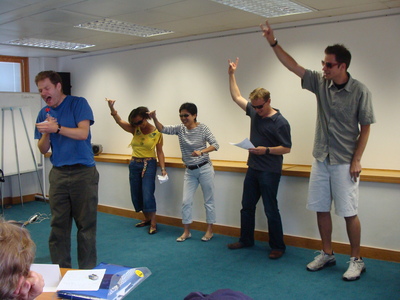
|
| The new SMAP? |
At the end of July, 32 teachers from UK primary and secondary schools came to the Japan Foundation to attend some Japanese Language Refresher Courses. A three-day advanced course and a five-day intermediate course gave non-native teachers of Japanese the opportunity to brush up on their language skills and network with other teachers.
In the advanced course the participants studied authentic media such as novels, newspapers, manga and anime, while also focussing on common areas of difficulty such as the use of keigo. There was also plenty of opportunity for speaking, through discussions, role-plays and games.
The intermediate course gave the participants a chance to consolidate their knowledge of Japanese grammar and put it into practice in a series of real-life situations. Later in the week they focussed on natural conversation, looking in detail at the phrases and grammar often used in anime and manga.
All through the week the members of the intermediate course also worked on projects in which they played the role of travel agents advertising places of interest to the rest of the class. All the groups put a lot of effort into their final speeches and posters and many congratulations must go to the Kew Gardens team which was awarded the top prize.
Participants of both courses also tried their hand at J-Pop, learning the Smap song 'Sekai ni Hitotsu Dake no Hana'. They performed the song in small groups, incorporating Japanese sign language into the chorus, along with their favourite dance moves as well!
Thank you to everyone who attended, together with Udagawa-sensei and Tanaka-sensei for organising such excellent classes. Feedback was extremely positive and here are a few comments from attendees:
"A really enjoyable and well-balanced course. Thank you for all your efforts and work." - Paul Cross, Hainford Primary Partnership School.
This is the 4th time I've attended the Refresher Course and it just gets better and better! - Hai Ying Gosnall, Summerhill School.
Challenging but not out of reach. Educational and enjoyable! - Cameron Fehr, Swavesey Village College.
Thank you for a wonderful 3 days. You have put so much time and effort into the course and I have learnt so much. I have even been dreaming in Japanese! Helen Langsam, Hendon School.
Click on the PDF below for more pictures from the two courses.
30/06/2009
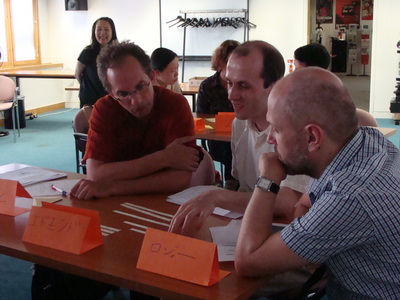
|
| The class in action |
June saw the latest instalment in our Talking Contemporary Japan series; this time entitled 'Japan's Past Meets the Present'. Every Thursday, advanced Japanese language learners were transported back through the centuries, taking in aspects of Nara, Heian and Edo period Japan and investigating the links between those eras and the present day.
Their journey began in Heian Japan with 'Iroha' - the old Japanese alphabet. Through the study of this writing system, participants were able to translate old Japanese proverbs, some of which are over 1,000 years old. They were also interested to discover the similarities between UK and Japanese proverbs, for example, the Japanese equivalent of "Water off a duck's back" being "Water on a frog's face!"
The second week focussed on the story of 'Urashima Taro', which was shown in Kamishibai style (story-telling through a series of pictures). This old Japanese folk story is very well known in Japan, in the same way that stories such as Cinderella and Snow White form part of the upbringing of children in the UK. Knowledge of traditional stories such as this allowed the participants to gain a greater understanding of popular Japanese culture.
In the third and fourth weeks the main topic was the Tale of Genji, a classic work of Japanese literature. By reading the story and studying its background, participants were able to discuss the tale and how the issues relate to the present day.
In addition, the use of games, quizzes, discussion, group reading, manga and ghost stories made for a very interesting four weeks. Joachim Kolb, one of the course participants, stated that:
"The course has been a pleasure to attend; educational, informative and well-taught. I am looking forward to the next series!"
Thank you to everyone involved for making these classes such a success. Please look out for information on the website regarding the next free course which will be held later in the year.
30/06/2009
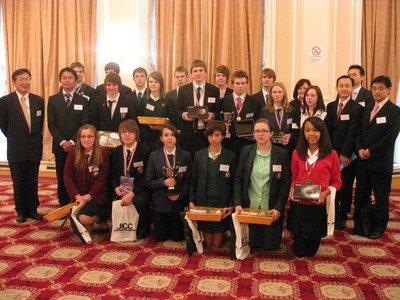
|
| Finalists and sponsors |
Time travel, an African safari and Antarctic exploration were just some of the exciting topics dreamed up by participants at this year's Nihongo Cup. Nineteen UK secondary school students gathered together at the Japanese Embassy to deliver their speeches, entirely in Japanese, to the attentive audience.
The finalists had already come a long way, having been selected from an initial 124 applicants from 19 different schools. Creativity, poise and accuracy were all needed in equal measure as students battled it out in three different categories, depending on their Key Stage, in an attempt to win an array of fantastic prizes.
The judges had an extremely difficult decision and after much deliberation awarded first prize in each category to Rhiannon Griffiths, Edmund Rhind-Tutt and Harriet Smailes. Many congratulations must go to those three students, and indeed to all the other finalists, for contributing to such an excellent competition.
Attendees were not only treated to nineteen impressive speeches, but also entertainment in the form of a koto performance, judo demonstration and a very unusual and inventive 'exercise dance' for everyone to try. As the routine began, the performers were greeted with looks of surprise and confusion, and yet, in the space of just a few minutes, the entire auditorium was having fun twisting, crouching and gesticulating in time with their movements!
The full results are as follows:
Key Stage 5:
Winner - Rhiannon Griffiths, King Edward VII School
Speech title: For the Sake of Beauty
2nd Place - Ollie Capehorn, Wycliffe College
Speech title: Technology
3rd Place - Lawson Lancaster, Greenford High School
Speech title: My Study of Japanese
Other Finalists:
Rory Faulkner, Campion School
Tom Kilford, Whitgift School
Joshua Scott-Fawcett, Gresham's School
James Spencer, Whitgift School
Key Stage 4: (all speeches entitled 'My Perfect Journey')
Winner - Edmund Rhind-Tutt, Millfield School
2nd Place - Rowland Goodbody, St. Gregory's Catholic College
3rd Place - Jenny Mulvihill, South Wolds School
Other Finalists:
Charlotte Handford, Stratford upon Avon Grammar School for Girls
Katherine Miller, Queen Mary's High School
Matthew Oldroyd, Christ College, Cheltenham
Key Stage 3: (all speeches entitled 'My Perfect Journey')
Winner - Harriet Smailes, South Wolds School
2nd Place - Paulina Ogar, Dame Alice Owen's School
3rd Place - Luke Austin, Tavistock College
Other Finalists:
Emma Curati-Alasonatti, Haberdashers' Aske's School for Girls
Layke Smith, Katharine Lady Berkeley's School
Roshana Wickremasinghe, Haberdashers' Aske's School for Girls
The event was organised by the Japanese Language Committee of the Association for Language Learning, in association with the Japan Foundation London Language Centre and Embassy of Japan in the UK. We are very grateful to Toshiba of Europe Ltd, JSA (the Japanese Speech Awards), Ricoh UK Ltd, JP-Books (JPT Europe Ltd) and the Japan Centre for sponsoring the event and donating prizes, and also to JRI Europe Ltd for their generous sponsorship and to Soho Japan for contributing to the evening reception.
29/06/2009
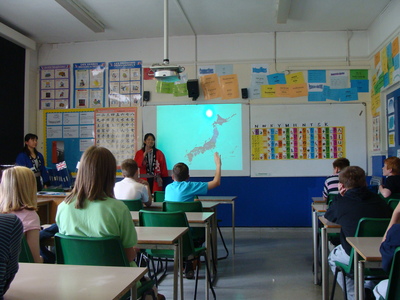
|
| Students learning about Japan |
On 12th June a StepOutNet visit was held at Roding Valley High School, Essex. Memi Kato, a Japanese-speaking volunteer, and Hiroko Tanaka, Language Advisor at the Japan Foundation, went to the school to give the students an introduction to the Japanese language and culture.
They introduced many aspects of life in Japan, including its arts, sports and food, together with its different styles of housing and clothing. They also taught the students about Japanese greetings, counting and the Japanese alphabet.
The students were excited to find out about schools in Japan, particularly the fact that Japanese students eat together in their classrooms and have to clean the school every day!
If you would like to organise a similar visit for your own school, or to register as a volunteer, please see the StepOutNet section of our website or contact info.language@jpf.org.uk
03/06/2009
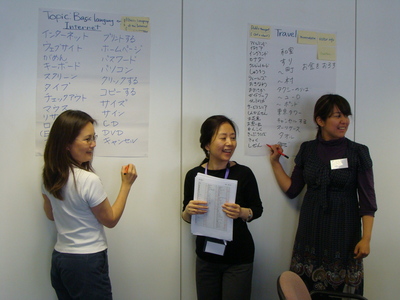
|
| Participants working with Udagawa-sensei |
On 28th and 29th May, seventeen Japanese-language teachers visited the Japan Foundation to take part in the first CHIKARA Update Workshop.
CHIKARA is a set of resources for GCSE Japanese which were created by the Japan Foundation and Great Britain Sasakawa Foundation in 2008.
The workshop aimed to give the teachers some insight into the changes in the new GCSE syllabus and how CHIKARA can be used in relation to this. Participants looked in detail at the sentence structures, vocabulary, topics and kanji required for GCSE and the support that the CHIKARA resources can provide. Participants made their own plans using the topic, 'basic weather', and shared their ideas as a group.
Further workshops will be held in 2009-10 so please look out for information in the teaching events section of this website.
02/06/2009
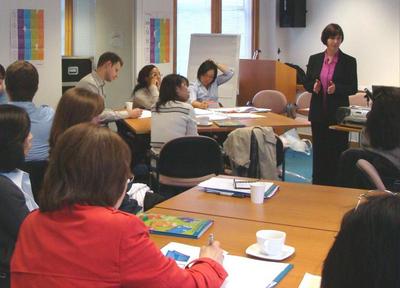
|
| Delegates listening to Hilly Day speak about Asset Languages |
On 8th May, 27 delegates attended a one-day course, "Asset Languages Day for Teachers of Japanese". The course was organised by the Japan Foundation London Language Centre and Asset Languages.
In the morning session, Asset Languages trainer Hilly Day gave an extensive overview of the Asset Languages scheme, assisted by Qualifications Manager Jemma East. In the afternoon session, Mary-Grace Browning, another Asset trainer and an experienced teacher of Japanese, spoke about issues specific to Japanese. Delegates also had the chance to look at teacher assessment packs in Japanese, try some sample tasks, and ask questions about the qualifications.
Frederique Midroit, a teacher at King Edward VI Grammar School in Chelmsford, said "Thank you again for the brilliant session on Asset. It was very informative, and it was good to meet again with some of the teachers I had met a few years ago in your training sessions."
Asset Languages is an assessment scheme which is currently available in 25 languages, including Japanese. It is designed to reward language skills for learners of all ages and abilities, from primary to adult, by measuring them against the DCSF Languages Ladder of proficiency. Click here for an overview of Asset Languages qualifications in Japanese from our website. Click here for the official Asset Languages website.
14/05/2009
We are delighted to announce the recipients of our Japanese language grant programmes in 2009-10:
Programme for the Donation of Japanese Language Teaching Materials:
Campion School
Cardiff University, Cardiff Japanese Studies Centre
Elthorne Park High School
Manchester Metropolitan University
Norton Knatchbull School
Old Palace of John Whitgift School
Oxford Brookes University
The Sixth Form College Colchester
University of Central Lancashire
University of Edinburgh, Institute of Applied Language Studies
Wolfreton School
Grant Programme for Japanese Language Courses Abroad:
Manchester Metropolitan University
Grant Program for Developing Networks of Japanese-Language Teachers and Institutions:
British Association for Teaching Japanese as a Foreign Language (BATJ)
Advanced Training Programme for Teachers of the Japanese Language:
Masakazu Kudara, Cardiff University (2 month programme)
Click here for more information about our language-related grant programmes.
Click here for older news articles from the Mado newsletter.
14/05/2009
The results of our Annual Grant Programmes for 2009-10 have now been announced. Please follow the links below to view the respective programmes within each department. Arts and Culture Films Festivals Abroad Support Programme Performing Arts Japan Programme for Europe Exhibitions Abroad Support Programme Japanese Studies and Intellectual Exchange Japanese Studies Fellowship Programme Grant Program for Intellectual Exchange Conferences Support for Japanese Studies Organisations
08/05/2009
Hosei University are now receiving applications to their Foreign Scholars Fellowship Programme for 2010-11. Please click here for more information about this opportunity to conduct research for one year in Tokyo.
24/03/2009
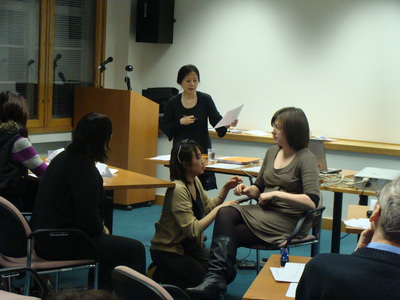
|
| Participants acting out one of the mysteries |
An air of mystery and suspense descended upon the Japan Foundation during February and March. In the latest set of Talking Contemporary Japan classes, 20 amateur sleuths gathered together to investigate Japanese mystery stories and to find the answer to the ultimate question - "whodunit!?"
Each session, designed for advanced learners of Japanese and conducted entirely in Japanese by Yoko Udagawa, Chief Japanese Language Advisor at the Japan Foundation London Language Centre, focussed on a particular story. Participants read the stories, discussed them and sometimes even acted them out. They also examined the different speech styles used to portray individual characters and gave presentations on their own favourite mysteries.
Feedback was very positive. One of the participants, Henrietta Martin-Fisher said:
"Thank you very much for a very good course. It was really well-planned and enjoyable - I look forward to the next one!"
Another participant commented:
"This was the best course ever and very funny too. I learnt so much from it."
Talking Contemporary Japan courses are free of charge and take place at various times throughout the year. Details of future courses at the Japan Foundation London Language Centre will be announced on the website when they are available.
19/03/2009
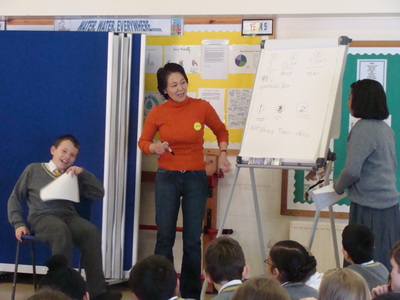
|
| Marina teaching the students Japanese |
At the beginning of March, the pupils of Staines Preparatory School became the latest to receive a Japanese language taster courtesy of the Japan Foundation's StepOutNet programme. Marina Ishido-Kidd, a StepOutNet volunteer, visited the school and had a lot of fun teaching the Year 6 students Japanese greetings and numbers. She also told them about Japanese culture and, in return, the pupils were excited to talk to her about their own experiences with judo and karate.
After the visit, Claire Eastaugh, Head of Languages at the school said:
"She inspired me and the children to learn more Japanese and to learn more languages in general."
Thank you to Marina and the staff and students of Staines Preparatory School for helping to make the visit such a success.
If your school is interested in arranging a similar visit, please e-mail info.language@jpf.org.uk for more details.
02/03/2009
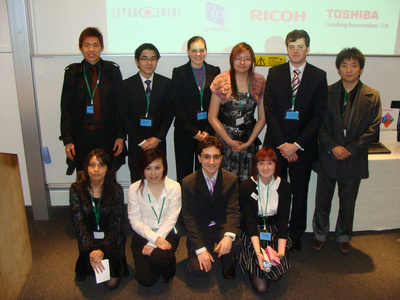
|
| The finalists |
Great speeches live long in the memory. Throughout history they have served to inform, persuade and move us to action. From the orators of the Roman Forum to battle-weary generals on the big screen, the power of words can never be underestimated. Following in this grand tradition, on Saturday 21st February, were ten students, hopeful that their offering could also stand the test of time. Thus began the Fourth Japanese Speech Contest for University Students.
Yet in many ways, theirs was a more demanding prospect. Passion and content were naturally key elements, but they also had to deliver their words in a foreign language and in front of an audience largely comprising native Japanese speakers, before facing the searching questions of the judges - again in Japanese.
The event, co-organised by BATJ and the Japan Foundation, saw an extremely high standard, which was reflected by the excellent prizes on offer. As well as the full programme of speeches, the audience was also treated to a raffle, with the chance to win many great prizes, and watched an informative video about Nishijin textiles and one man's attempt to create a cloth depicting the Tale of Genji.
The day began with the Category 2 finalists, who study Japanese as an elective course. Such was their confidence and proficiency, it is difficult to believe that these students do not study Japanese full-time. Bryan Woon took first place with his speech on Japanese salarymen, and he was closely followed by Chang Liu, giving her views on school violence.
Category 1 came next, in which students who study Japanese as their main degree subject were able to showcase their talents. Competition was fierce, with speeches about Japanese language education, the bathhouses of Japan, one man's robotic dream, and the education of the deaf all pitted against each other. However, it was Jonathan King who earned the plaudits of the judging panel, receiving first prize thanks to his speech examining the new lay judge system in Japan.
Looking back on his victory, Jonathan remarked:
"Taking part in the speech contest has been a really good experience and also a great networking opportunity. As for what I'm going to do with the prize money and trip to Japan, my tea collection has just run out so I'm looking forward to going back to Japan to buy some more and visit my favourite tea shops!"
Min Park, one of the Category 1 finalists, also said:
"It was a fantastic event and I learnt so many things. I couldn't win this time, but I will try again next year!"
Many congratulations to the participants and also a big thank you to all the organisers. We would also like to extend our appreciation to the generous sponsors: Baker & McKenzie LLP, Eikoku News Digest, The Great Britain Sasakawa Foundation, Japan Airlines, Japan Centre, JP-Books (JPT EUROPE LTD), Ricoh UK Ltd and Toshiba of Europe Ltd. どうもありがとうございました!
The Results:
Category 1:
Winner - Jonathan King, University of Edinburgh - A new lay judge system for the benefit of whom? - 誰のための裁判員制度?
2nd Place - Alison Sinead Evans, University of Oxford - Sign language and the Education of the Deaf - 手話と聴覚障害教育
Finalists:
Luke Happle, School of Oriental and African Studies
Phillippa Harvey, University of Leeds
Min Park, University College London
Category 2:
Winner - Brian Woon, University of Warwick - Is the Japanese salaryman fast becoming a relic of the past? - 変わり行く日本の中でサラリーマンは生き残れるのか
2nd Place - Chang Liu, Imperial College London - School Violence in Japan, China and the United Kingdom - 校内暴力――日、中、英国間の違いと解決方法
Finalists:
I-Ting Li, University of Hull
Hock Boon Ong, Imperial College London
Yi Zhang, University of Exeter
Please click 'Download Attachment' for a summary of the winners' speeches and a report by Brian Woon on his Speech Contest experience, as well as more photos from the day itself.
02/03/2009
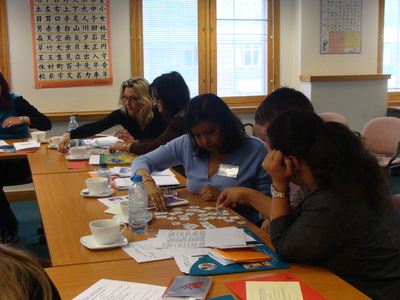
|
| Teachers enjoying an introduction to the Japanese language |
On Monday, 23rd February the Japan Foundation London Language Centre hosted the 2009 Head Start Course. Head Start is a one-day course offering curriculum planners, language teachers and coordinators from UK primary and secondary schools the opportunity to get to grips with some of the issues specific to the teaching of Japanese.
A total of 14 teachers attended the course, coming from as far away as Teesside and Devon. They took part in sessions on Japanese language teaching in the UK, support available, Japanese culture and language, accreditation, a tour of the Japan Foundation library, and even a Japanese language taster. We were also lucky enough to have two excellent presentations by Helen Langsam, Head of Japanese at Hendon School, and Zoe Griffiths, Global Education Coordinator at Hampton Hill Junior School, who spoke about the success of teaching Japanese at their own schools.
Feedback from the participants was very positive. Emilie Darabasz, an MFL teacher and Head of Year at Roding Valley High School, Essex, said:
"It really helped me, inspired me and guided me where I should start with Japanese in my school."
Caren Brooks, Deputy Head at Brixham Church of England Primary School, described the course as:
"A really useful and comprehensive introduction to all the Japan Foundation has to offer - thank you!"
Head Start is a yearly course. If you are interested in attending next year then please contact us at info.language@jpf.org.uk or keep an eye on the website for future updates.
10/02/2009

|
| Students studying at Wren Academy |
One year ago, Wren Academy, a London secondary school, attended the Japan Foundation's Head Start Course. Now, Japanese language classes are thriving at the school. Please see below for an interview with Jamie Barnes, Head of Modern Foreign Languages at Wren Academy.
Please tell us about yourself.
My name is Jamie Barnes. I am Head of Modern Foreign Languages at Wren Academy, a brand new Academy in North Finchley. Wren opened its doors to our first intake of students in September 2008. In my role as Head of Faculty, I have also been studying Japanese in classes with the students, as it is part of the Academy vision that staff should be seen as life-long learners.
Did your school teach any Japanese classes before Head Start 2008?
Obviously, as a new school, we were building a language faculty from scratch. Nevertheless, we were committed to offering Japanese learning to our students from a very early stage as it would build wider social cohesion of the Academy with a large Japanese community nearby.
What did you gain from Head Start 2008?
As I was not yet in post, another member of the Academy attended the Head Start course, who made the following comments:
"I found the day very informative and of real benefit in helping us start Japanese from scratch. The advice from schools which already offer Japanese was invaluable and inspired me to integrate Japanese into the curriculum at Wren and give our students the opportunity to gain qualifications in due course. The sample Japanese lesson was very interesting and the food was very much appreciated."
What is the current situation regarding Japanese at your school?
At Wren Academy, all students take part in three hours of enrichment activities every week. Japanese is available as part of our enrichment programme and at a weekly Japanese breakfast club. We currently have 40 year 7 students studying Japanese once a week (two groups of 20).
What have they been studying?
The students (and myself) have studied a wide range of topics, and can recognise the Japanese words for numbers, countries, nationalities, colours, animals, adjectives and much more. Further to this we have been learning to write Hiragana and basic Kanji. Although we still have some way to go before we can write freely, we are getting quicker and more accurate in our Japanese writing.
Do your students sit any exams?
As we are in our first year, we are not planning to enter any students for exams this year. Nevertheless, we are currently looking into a number of Japanese qualifications, including Asset languages and GCSEs, and look forward to students' future successes in these qualifications.
What do your students enjoy most about Japanese classes?
Students have responded exceptionally well to the challenge of learning a new language. As an Academy, we have trained students about how to become effective learners, and they regularly demonstrate this in Japanese class by sticking at their learning, and by working together. We were keen that our Japanese provision would widen our students' horizons, and therefore students have also studied aspects of Japanese culture. Origami, sumo wrestling, manga and sushi have really captured our students' imagination.
How did you find a Japanese teacher?
We advertised on the Japan Foundation London Language Centre website.
How does your teacher find resources?
Our Japanese teacher finds most of her resources from the Japan Foundation library. In particular, she uses websites such as Minna no Kyozai as suggested by the Japan Foundation. She also finds the 'JLE-UK' email discussion group valuable.
Have you had any difficulties introducing Japanese?
We have not experienced major difficulties but clearly we are keen to build on the success of our first year. We are currently looking at how we can increase teaching time, and work towards a specific qualification, which will accelerate our students' language learning.
Do you have any advice for other schools that are thinking about introducing Japanese?
I believe that the key to our success this year has been the formalised contact time built into our enrichment programme. Motivating students is obviously key to their success, so we seek to engage them with ranging activities and a broader study of Japanese culture. Our Japanese teacher and I have also visited a nearby school, where Japanese is taught very successfully, to pick up ideas on how to develop our programme. We plan to make further visits throughout this year.
If you would like more information about the Japan Foundation's 2009 Head Start Course, please contact Christopher Shone on 020 7436 6698 or send an e-mail to info.language@jpf.org.uk
04/02/2009
|
| Students of Wearhead School giving a presentation |
On Monday 26th January, the worlds of Japanese language and cultural exchange combined to form the Japan Conference for Schools. About 120 teachers and local authority advisors from the UK and Japan gathered together at the British Council in London to share practical ideas about introducing Japan and Japanese in schools. The conference - a joint project for the fourth year running, between the British Council, the Embassy of Japan, the Japan Foundation, the Japan Society, and funded by the Department for Children, Schools and Families - included workshops led by teachers on the themes of Environmental Education, Food and Fitness, Science, Japanese Language Education for All and Joint Curriculum Projects. Participants were also able to take advantage of one-on-one sessions with specialists about funding, Japanese activity days, resources, exchange between the UK and Japan and much more.
The day started in fine style with a presentation by the teachers and students of Wearhead School, County Durham. Having woken up at 2:30am to begin their journey to London, they spoke about their partnership with Amanuma School in Japan, which they visited last year. Pupils from the two schools have been very busy with exchange projects and have written a science fiction story, with each school taking it in turns to write a page. Members of the audience were thrilled by the excellent presentation, and very impressed to hear that Wearhead School has just 24 students. It goes to show that anything is possible when combined with the right drive and support!
The day ran very smoothly and there was a lot of positive feedback. Steve Fletcher, Head of Geography at Roding Valley High School said:
"The conference is a great day, with stimulating workshops that vary every year. As a geography teacher, it's the one course of the year where I can mix with and talk to teachers with varied subject backgrounds, yet all pursuing a common aim. Through the conference and the contacts I have made, I have organised language, art, music, dance and flower arranging (ikebana) workshops, games like Shogi (Japanese chess) and Go, all with Japanese workshop leaders. I always leave feeling enthusiastic about continuing developing Japanese studies in school because I feel part of a wider network where we are all trying new ideas to enrich pupils' experiences."
Tomomi Masumoto from Eton College stated that:
"As a teacher of the Japanese language, I found it particularly useful to hear about the speakers' teaching experience, as well as to exchange ideas with teachers from other schools. There was plenty of opportunity to receive advice and practical information from Japan-related organisations. I was also intrigued that the study of Japan could be applied in a wider scope, and that some British schools adopted Japanese schools' lunchtime and cleaning customs for a certain period of time, which raised the students' awareness of environmental issues such as waste."
Delegates were also lucky enough to enjoy a taiko drumming performance by the children of Heritage House School, Buckinghamshire. The performers, who in 2006 studied in Japan with a leading taiko master, wowed the audience with their exhilarating rhythms and sheer enthusiasm for the music. The audience could not help but cheer and clap along!
Thank you to all the participants, speakers and the other organisers for making the conference such a success. See you again next year!
28/11/2008
|
| Participants watching an example of Japanese comedy |
November saw the latest instalment in our Talking Contemporary Japan series, in which 17 participants sought to throw off the winter blues by learning about Japanese comedy. There were four two-hour sessions, all conducted entirely in Japanese, and enthusiastically led by Keiko Kelly, a teacher of Japanese at SOAS.
The first session aimed to introduce the participants to traditional culture originating in the Edo era and the following weeks saw classes on Rakugo, Haiku and Senryuu, before finishing with comedy in contemporary Japan. The sessions included history, information about the various art forms, discussions and practice. The members of the group often found themselves transformed into professional comedians, entertaining the rest of the group with rakugo skits and haiku poems - even dressing-up in traditional costume!
The sessions were all warmly received and very positive feedback was given by the participants. One member of the class commented, "These courses are such a great idea - Thank you!!" and another wrote "Keiko-san is a great teacher!"
Please look out for updates on our website regarding future Talking Contemporary Japan sessions and other exciting events!
15/10/2008
Guidelines and Application Forms for The Japan Foundation Annual Grant Programmes for FY 2009-10 have now been released. Guidelines can be obtained from this office or downloaded from our Head Office website.
Please contact this office to discuss your application before applying.
The deadline will be 1st December for all programmes, apart from the Audio-Visual and Publication Exchange Programmes, which will close on 20th November.
Click here for further information about our funding.
16/09/2008
The 2008 Yokohama Triennale opened on Saturday 13 September and will run until 30 November. The theme of this years exhibition is Time Crevasse. The Triennale exhibition comprises works by 74 artists from 25 different countries, featuring large scale installations, film and videos, photography, sculpture and live performances.
For more information about the 2008 Yokohama Triennale, please click here.
13/08/2008
Japanese architect, Junya Ishigamis exhibit Extreme Nature: Landscape of Ambiguous Spaces will be on show from 14th September to 23rd November as one of the exhibits in the 11th International Architecture Exhibition 2008, part of the 2008 Venice Biennale.
For more information on the 11th International Architecture Exhibition please click here.
05/08/2008
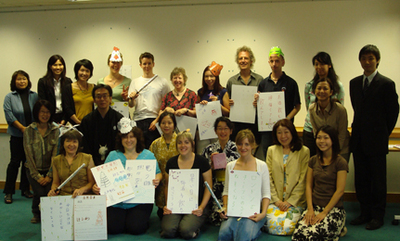
|
| Refresher Course participants with StepOutNet members and Japan Foundation staff |
From 21st to 25th July 2008, 14 teachers came to the Japan Foundation London Language Centre to attend this year's Japanese Language Refresher Course. The course aims to submerse Japanese-language teachers in Japanese for a week, so they can brush up and improve their language skills.
Each morning the group came together for some warm up activities, which included Japanese dancing (Bon-odori) and singing (Hotaru no hikari).
The teachers were then split into two groups depending on their self-assessed level of Japanese, and had language sessions throughout the day, delivered by the JFLLC's Japanese-language advisors, and Japanese teachers from SOAS. As part of the language sessions the participants worked on writing their own haiku, and the participants in the higher-level group worked on their own production of a Japanese ninja drama.
In the morning of Wednesday 23rd July (the third day of the course) participants visited the British Museum, and were given a tour of the Japanese exhibits. They then chose their favourite exhibits, and the lower-level group used these as inspiration for their haiku. The higher-level group later made posters on their chosen artefacts. Following the British Museum, all participants joined teachers for a lunch at a Japanese Restaurant.
Following each afternoon's language sessions, participants were offered resources sessions including a tour of the Japan Foundation library and introductions to various resources produced by the Japan Foundation (Erin's Challenge, Ready Steady NihonGO!, and Minna no Kyozai).
On the final day of the Refresher Course, Japan Foundation staff and StepOutNet members were invited to watch as participants presented their haiku and gave their Japanese drama performance. The participants were then presented with certificates by JFLLC director Harufumi Murata.
The participants' comments below reflect the popularity of this year's course:
Super language teaching which had helped secure some of my dodgy understanding of grammar! ... Thank you all so much for your hard work and kindness (Meredith Bryer, primary school teacher)
I received many useful teaching materials and I am so impressed with the facilities that the JFLLC has to offer teachers of Japanese. I feel thoroughly supported and can't wait to try out some of the materials in September. I found the teachers inspiring and well-prepared and very professional (London secondary school teacher)
I enjoyed the variety of the course and opportunity to learn more about Japanese culture as well as the language. I loved doing the [play]! I feel a lot more confident about doing creative things in my lessons and can see how valuable drama is in learning a language. All the teachers were excellent and this made the whole course very enjoyable and stimulating (Mairi Smart, Audenshaw School, Manchester)
The Japan Foundation would like to thank the participants for their hard work and success during the course.
23/07/2008
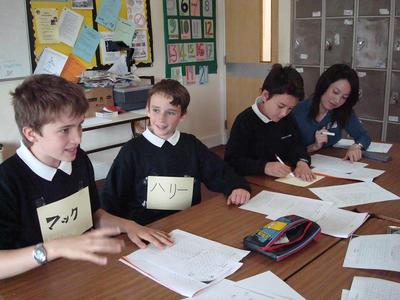
|
| Year 7 students at Priory School trying Japanese with StepOutNet volunteer Asami Harada |
Priory School, a secondary school in East Sussex specialising in language, arts and science, has been introducing Japanese in 2007-8 and is planning on taking it further. Japanese is the sixth foreign language the school has been offering recently, in addition to French, German, Spanish, Mandarin and a short course in Greek.
The school's interest in Japanese started when Sarah Timlin, now Assistant Headteacher with responsibility for Modern Foreign Languages, attended the one-day Head Start Course at the Japan Foundation London Language Centre in March 2008. "As a language college we are always open to seeing how we can increase number of languages offered and the number of students studying a language," said Sarah.
Sarah was so enthused by the Japanese language taster at Head Start that she got her school's backing to set up an after-school club for Year 9s as a pilot project, to give her students an introduction to Japan and Japanese. Having picked up the basics of Japanese, Sarah used the Ready Steady NihonGO! resources and video clips of everyday life in Japan from the Tobu CD to introduce some simple aspects of the language.
Sarah was keen that her colleagues in the language department also became familiar with the language, especially given the school's long-term plan to develop Japanese further. She therefore asked our Language Advisor, Shoko Middleton, to run a half-day language course in basic Japanese for ten of the school's language teachers. Shoko said "I was very impressed with the teachers' enthusiasm, quickness to learn, and the way they used their experience of other languages to help them with Japanese."
The teachers put their knowledge of Japanese to use at the school's International Day on 18th July 2008. Here, they worked with two StepOutNet volunteers, Asami Harada and Riko Sherratt, to give Japanese language tasters to 250 students across Year 7 to Year 10. The students tried many activities, including writing their names in Japanese, Japanese numbers and actions, and learning animal names and noises. They also tried aspects of Japanese culture such as taiko drumming and origami, and even had the chance to make their own samurai costume. The Japanese activities were partly funded by the Japan Society.
In 2008-9, Priory School is planning on offering Japanese as an extra-curricular subject taught by a Japanese-speaking teacher, and also hopes to offer accreditation for this. The school also plans to offer Japanese as one of a carousel of languages to mainstream students with SEN (Special Educational Needs) in Years 7, 8 and 9.
If your school would like to follow the example of Priory School, please contact Kim Woodruff (kim.woodruff@jpf.org.uk) at the Japan Foundation London Language Centre for more information.
28/06/2008
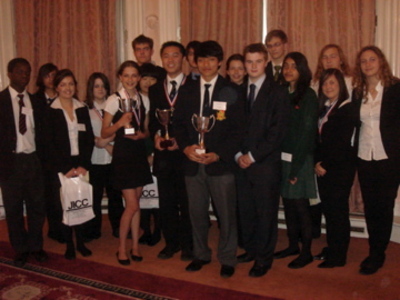
|
| Finalists at the 2008 Nihongo Cup |
The 2008 Nihongo Cup Japanese Speech Contest for Secondary Schools took place on 28th June at the Embassy of Japan in London.
A record-breaking 248 students from 21 schools across the country applied for the contest. Seventeen finalists made their speeches in the grand setting of the embassy ballroom, and impressed an audience of over 100 people with their original ideas and Japanese language skills. William Wan won first prize in the Key Stage 5 category for his speech about the novel Yukiguni (Snow Country). "It's one of those experiences in life I will never forget," said William. "I feel really confident now about doing public speaking and I was very much the opposite beforehand".
Ebo Dadey, one of the Key Stage 3 finalists, also spoke positively about his experience of the Nihongo Cup: "It helps you extend your vocabulary and go to new areas of the Japanese language, and increases your confidence in talking in front of other people"
The prize-winners in each category were as follows. However, we would like to congratulate all the finalists for your excellent speeches at the embassy, and all the applicants for recording a speech in Japanese.
Key Stage 3
1st prize - Holly Harrison, Tavistock College
Awarded the Japan Foundation Nihongo Cup trophy and gold medal, and an iPod touch from ALL.
2nd prize - Jenny Eden, Tavistock College
Awarded the Japan Foundation silver medal and a digital camera from Ricoh UK Ltd.
3rd prize - Lauren Leete, Aldercar Community Language College
Awarded the Japan Foundation bronze medal and an electronic dictionary from JP-Books (UK) Ltd.
All other Key Stage 3 finalists received an obento set from the Japan Centre.
Key Stage 4
1st prize - Zain Ahmad Riza, Wycliffe College
Awarded the Japanese Ambassador's Nihongo Cup and gold medal, and an iPod touch from ALL.
2nd prize - Jisu Lee, St Helen's School
Awarded the Japanese Ambassador's silver medal and a digital camera from Ricoh UK Ltd.
3rd prize - Samantha Day, Aldercar Community Language College
Awarded the Japanese Ambassador's bronze medal and an electronic dictionary from JP-Books (UK) Ltd.
All other Key Stage 4 finalists received an obento set from the Japan Centre.
Key Stage 5
1st prize - William Wan, Whitgift School
Awarded the ALL Nihongo Cup and gold medal, an iPod touch from ALL, and the chance to participate in the Japanese Speech Awards (JSA) in Tokyo.
2nd prize - Alex Karmazyn, South Wolds School
Awarded the ALL silver medal and a digital camera from Ricoh UK Ltd.
3rd prize - Stephanie Tress, Wellington College
Awarded the ALL bronze medal and an electronic dictionary from JP-Books (UK) Ltd.
All other Key Stage 5 finalists received a tea set from the Japan Centre.
All finalists in all Key Stages also received goody bags from the Embassy of Japan, and all Key Stage 5 finalists received goody bags from JP-Books (UK) Ltd.
The event was organised by the Japanese Language Committee of ALL, in association with the Embassy of Japan in the UK and the Japan Foundation London Language Centre. We are very grateful to the Japan Centre, JP Books UK Ltd, JSA (the Japanese Speech Awards) and Ricoh UK Ltd, for sponsoring the event and donating the above prizes, and also to JRI Europe Ltd, and Soho Japan for their generous sponsorship too.
26/06/2008
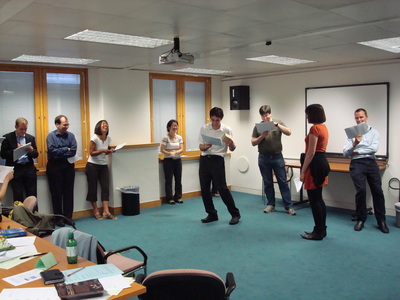
|
| Talking Contemporary Japan participants acting out scenes from short stories, watched by course leader Shoko Middleton |
June's 'Talking Contemporary Japan' course saw 20 advanced adult learners of Japanese spend four 2-hour sessions focussing on short stories written by popular Japanese authors. In the first session participants studied "真っ赤な芥子" (Makkana Keshi) by Haruki Murakami, before moving on to "肩の上の秘書" (Kata no ue no Hisho) by Shinichi Hoshi in the second session. In the third week they studied a short story from "つめたいよるに" (Tsumetai yoru ni) by Kaori Ekuni. In the final session participants studied a short story from "夢十夜" (Yumejyuya) by Soseki Natsume.
In each class there were activities such as voice projection, vocabulary and kanji pair work, small discussions using words from the stories, reading aloud, acting out scenes and discussion of interpretations. In the last session the participants creatively acted out scenes from 'The Fourth Night' by Soseki.
The course proved very popular with all participants, like Rachel Yokoo-Laurence, who had the following comments:
"The course was excellent. Middleton-sensei is a great teacher - very engaging and friendly".
Course leader Shoko Middleton also enjoyed the course, saying:
"Thanks to the enthusiastic and highly-motivated participants. I learnt a lot through the course and it was most fulfilling for me".
Click here for more information about Talking Contemporary Japan on the Japan Foundation London Language Centre website, including information on past courses.
24/06/2008
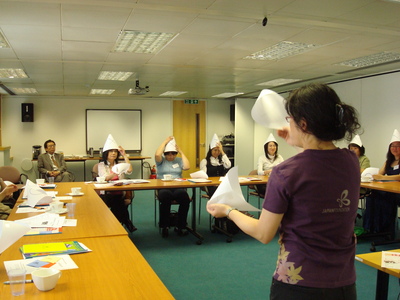
|
| StepOutNet members wearing true and false hats as part of a quiz |
The Japan Foundation London Language Centre has been successfully running the StepOutNet programme since 2006, and now has 80 members who carry out Japanese language taster sessions at schools throughout the UK. On Tuesday 24th June, 14 StepOutNet members came to the Japan Foundation for a training day. The day was designed to help StepOutNet members plan their Japanese language tasters, with the aim of ensuring all arrangements for the tasters run smoothly, and the taster sessions themselves are a success. After a complimentary light lunch, participants saw a presentation by assistant programme officer Alastair Warner on the organisation of taster sessions, and a report on the recent day of tasters at Silverdale Primary School in East Sussex (click here for more information on that visit). The next presentation by Japanese language advisor Shoko Middleton introduced some practical classroom ideas for tasters, and finally chief Japanese language advisor Yoko Udagawa gave the first of a planned series of presentations on Japanese grammar.
If you are a teacher interested in having a StepOutNet Japanese language taster at your school, please click here for more information. Fluent Japanese speakers please click here if you would like to become a StepOutNet volunteer.
18/06/2008
The website publishing the results of the 2007 Japan Foundation Japanese Studies Survey is now online. The survey was carried out in 2007 to look at the state of Japanese Studies in the UK. Many thanks to all the universities who responded to the survey. To access the website, please click here. If you have any questions about the Japan Foundation Japanese Studies Survey, please contact info@jpf.org.uk.
11/06/2008

|
| Pupils at Silverdale Primary School enjoying a kanji card game |
When Silverdale Primary School in East Sussex were planning their international week, teacher Angela Crouch contacted the Japan Foundation London Language Centre to enquire about the possibility of having StepOutNet Japanese language tasters as part of the activities. On Wednesday 11th June 2008 Eriko Suzuki and Mari Sato travelled to St. Leonards-on-Sea to carry out a full day of tasters at Silverdale School. They delivered 12 x 20 minute sessions to all the pupils in key stage 2 (years 3-6, ages 7-11). In the sessions they covered Japanese greetings, which they practiced with the pupils. They also introduced Japanese vocabulary like animals and body parts, and the kanji for these words. The pupils were very enthusiastic about learning kanji, and enjoyed playing a competitive kanji card game in groups. Overall this was a very successful day and we were especially pleased with Angela's positive feedback:
"I think it all went very well. Mari and Eriko were lovely and I think they enjoyed their day, too. The children certainly did."
If you are a teacher interested in having a StepOutNet Japanese language taster at your school, please click here for more information. Fluent Japanese speakers please click here if you would like to become a StepOutNet volunteer.
04/06/2008

|
The Movers and Shapers: Japan - UK Relations Seminar series gets underway on 11 June 2008 with a seminar entitled Nagasaki and "Madame Butterfly": Historical Background and Implications of the Famous Opera.
The seminar series will run from June 2008 - December 2009.
For more information about the Movers and Shapers series, download the attachment.
03/06/2008
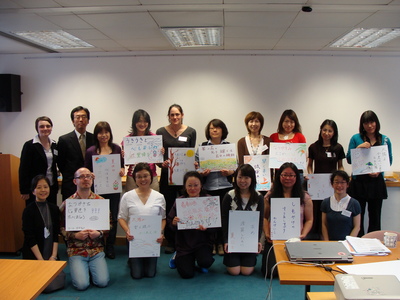
|
| Participants in the CPD course with their haiku and Japan Foundation staff. |
CPD Course
From Wednesday 28th to Friday 30th May 2008 the Japan Foundation London Language Centre held a training course in continuing professional development for teachers of Japanese. The course aimed to extend participants' knowledge and skills of Japanese teaching, develop their Japanese language ability and deepen their understanding of Japanese culture. 19 teachers from around the UK attended on at least one of the three days, with 10 teachers coming on all three days. The courses were led by Japan Foundation Chief Japanese Language Advisor Yoko Udagawa, and Japanese Language Advisor Shoko Middleton.
Each day started with warm up activities, and on the first day this was followed by a training session on Japanese teaching resources developed by the Japan Foundation. First participants studied the complete CHIKARA resources including the new Reading section, and then the new DVD resource "Erin's Challenge". On Wednesday afternoon there were two further sessions on Japanese textbooks and resources published in Japan, Australia and the United States, introduced by Udagawa-sensei from her experience of Japanese language teaching with the Japan Foundation overseas (click here to read Udagawa-sensei's welcome message with more information on her past Japan Foundation placements). Participants expressed interest in these resources, which many of them were looking at in depth for the first time. The resources are available in the Japan Foundation library, which participants were given the option of touring on Wednesday afternoon.
Thursday started with a session linking museum studies with Japanese language and was followed by a visit to the British Museum, where participants joined a tour of the Japanese galleries and then attempted to design their own worksheets. In the afternoon participants worked at developing Japanese language activities following their museum visit, and then shared their worksheets and activities with each other.
On the final day, following a session concentrating on CHIKARA for Reading, participants wrote and presented their own haiku. In the afternoon there was a session on useful expressions and instructions for the Japanese language classroom, and the day closed with a discussion on the issues and challenges facing the Japanese language teacher.
Overall the course was a great success, with the British Museum visit being particularly popular, along with the haiku sessions and the final discussion. See below for some comments from participants:
I am taking my students to the British Museum next month, so it was great to have this preliminary visit. With the haiku writing, even Japanese people find this hard, so it was great to feel that I could make this a simple, fun and achievable activity for my secondary class. (Sachiko Yamaguchi, King Edward VII School and Language College, Sheffield)
I met many new people and was able to exchange information with them, so it was a valuable experience. I was very happy with the course content and I learnt a lot. I'm looking forward to the next course. (Tomomi Masumoto, Eton College, Windsor)
08/05/2008
The Japan Foundations Local Project Support Programme for Japanese Studies has recently been expanded to make provisions for organisations involved with Japanese Studies in the Republic of Ireland. The Local Project Support Programme will now provide grant assistance to organisations that are planning Japan related projects in Japanese Studies and Intellectual Exchange. Not only has the Local Project Support Programme for Japanese Studies been extended to include the Republic of Ireland, but we are also pleased to announce that the grant may now be used to cover the costs of Library Resources.
For more information, please click here.
25/02/2008
The Japan Foundation is now inviting applications for the 2008 Japan Foundation Group Study Tour to Japan for Secondary Teachers in June. This is a fully-funded two-week tour of Japan offering an introduction to Japans society, culture and education system. The Study Tour is for full-time secondary school teachers who teach about Japan and Administrators involved in curriculum development. For further information click here.
04/02/2008
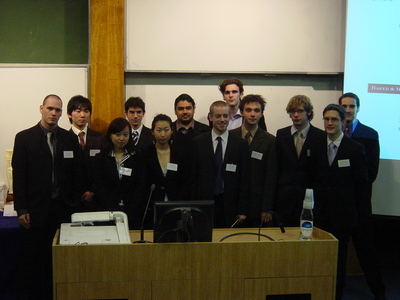
|
| Finalists of the Third University Speech Contest |
On Saturday 2nd February, the Third Japanese Speech Contest for University Students final was held at Imperial College. The event, co-organised by BATJ and the Japan Foundation, saw finalists in two categories battle it out for some fantastic prizes.
In category 1, for students studying Japanese as a main degree subject, the six finalists were competing for the first prize of a return ticket to Japan, a Japan rail pass and 1000. Michael Downey, a 3rd year student from the University of Leeds, took the prize for his speech entitled 'The unique Japanese approach to showing consideration for others and its disappearance from modern society'. Second place went to Antoni Slodkowski, a 2nd year student at SOAS, who spoke on 'Living in a Japanese teahouse - cultural experience in Kyoto'. Antoni won a digital camera and 500.
The six category 2 finalists all study Japanese as an elective or optional course. The first prize of a notebook PC went to Handoo Seo, a 2nd year student at Imperial College, for his speech 'Life's magic'. In second place, Faizal Farokh asked 'Do video games have a bad influence on youths?' Faizal, a 4th year student at Imperial College, won a digital camera and 500.
The standard of all the speeches was very high, and all finalists took home goody bags from JP-Books and tea sets from the Japan Centre. There were also prizes for audience members who took part in a raffle, as well as enjoying a Japan Quiz, and a J-pop singalong.
Please click 'download attachment' below to read a summary of the winners' speeches.
The Japan Foundation would like to thank Baker & McKenzie LLP, The Great Britain Sasakawa Foundation, Japan Airlines, the Japan Centre, JP-Books, Ricoh UK Ltd and Toshiba of Europe Ltd for their generous support.
04/02/2008

Progression has been made in the preparations for the 2008 Yokohama Triennale. To download the latest press release, please click here.
09/01/2008
Award winning young architect, Junya Ishigami, has been selected to exhibit at the Japan Pavilion at the 11th International Architecture Exhibition at the 2008 Venice Biennale. The project, Extreme Nature Small Pavilions, will see him design a group of small pavilions inside and outside the permanent Japanese Pavilion examining the question What is architecture?. The pavilions proposed are a new type of greenhouse and with the help of botanist Hideaki Ohba, Ishigami will produce environments that are just subtly different from their surroundings, suited to plant life that is potentially disruptive to the local habitat of Venice.
23/11/2007
On Wednesday 14th November, assistant programme officer Alastair Warner travelled to Alfriston in East Sussex to attend the East Sussex Primary Languages Conference called 'A Love for Languages'. Primary schools in East Sussex must introduce a language onto the curriculum by 2008, so representatives from a number of organisations were present to give advice and support on introducing different languages into their schools.
The Japan Foundation presented to the whole group, and kicked off with a wonderful Japanese language taster by one of our StepOutNet volunteers. She introduced the teachers to some basic Japanese expressions, and they were soon able to give their names and ask for food items. This was followed up with a Japanese song with actions, and then the teachers were taught to make an origami hat. The volunteer also brought along a mannequin dressed in a yukata.
After the taster, Alastair gave a presentation on the support available to teachers from the Japan Foundation, and especially our free Ready Steady NihonGO! scheme of work for primary schools and our StepOutNet programme of volunteers. The Japan Foundation provided leaflets to the teachers, and also set up a laptop so they could try out Ready Steady NihonGO! for themselves.
The Japan Foundation was very pleased to have the opportunity to attend the conference. If you know of similar events happening in your area, please let us know!
23/11/2007
From November 2006 to March 2007 the Japan Foundation conducted a survey on overseas educational institutions providing Japanese language education. An outline of the results is now available, pending a more detailed report.
The outline shows that 2.98 million people in 133 countries/districts are studying the Japanese language. The number of learners has increased by 26.4% over the last three years, and Japanese is now being taught in six new countries. While 90% of learners are in Asia and Oceania, there are over 61,000 in Western Europe. 60% of learners overall belong to primary and secondary educational institutions.
Reasons for studying Japanese vary, with the main three being 'to gain knowledge about Japanese culture', 'to become able to communicate in Japanese', and 'interest in the Japanese language itself'.
70% of Japanese teachers worldwide are non-native speakers.
Click 'download attachment' to read the outline in full.
14/11/2007
3 secondary school teachers from the UK have been selected to participate in the Japan Foundation Study Tour running from 6 19 December. Along with 83 other participants from 26 countries as diverse as India, Micronesia, Brazil, Lithuania and Senegal, they will travel to Japan on a two week tour where they will visit Tokyo, Kyoto, Hiroshima and Ehime to further understand Japanese culture, society and its education system.
The Study Tour is arranged and funded by the Japan Foundation, in co-operation with the Ministry of Foreign Affairs, the Ministry of Education, Culture, Sports, Science & Technology; Prefectural Boards of Education and with generous support from Japan Airlines.
14/11/2007
Tokyo Performing Arts Market (T-PAM) is a showcase for performing arts, such as theatre, music and dance, which gathers together presenters to connect artist to audience. The 12th edition of T-PAM will take place from 5 8 March 2008 and on-line registration for exhibitors, visual presenters, and visitors is now open.
For more information, please click here.
14/11/2007
Through a special new programme the following London based culture experts will be sent to the Middle East:
- Joji Hirota will perform with his taiko group in Dubai and Abu Dhabi on the 25 26 November 2007.
- Keiko Yoshino, an ikebana master, will give a public demonstration of Japanese flower arranging in Yemen on the 12 November 2007.
These events are co-organised with the Embassy of Japan in the respective countries.
26/10/2007
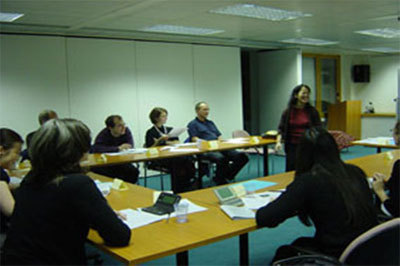
|
| Shoko Iizuka leading the Talking Contemporary Japan course on short stories |
This autumn's 'Talking Contemporary Japan' course has now finished. Eighteen intermediate and advanced learners of Japanese attended the four-week course, which focused on reading short stories in Japanese by authors such as Haruki Murakami and Banana Yoshimoto.
Valerie Henitiuk, who teaches literature and translation studies at the University of East Anglia, travelled from Norwich to attend the course. "I've just moved to the UK from Canada and the course was a good chance to meet people with similar interests. The teacher, Shoko, was fabulous - really well prepared," said Valerie.
"There was a good mix of people with different levels of Japanese - my Japanese was not so good but I didn't feel out of place. I'm not a fan of Haruki Murakami or Banana Yoshimoto, but I prefered the story 'Kusanojo' by Kaori Ekuni. If there was a part two of the course I'd like to explore some new authors."
The next Talking Contemporary Japan course is planned for February 2008. More details will appear on the website nearer the time.
28/09/2007

|
This year's European Day of Languages was on 26th September, and many schools took the opportunity to timetable language activities to celebrate the day. John Betts School in Hammersmith arranged a number of activities, which included Japanese language tasters by StepOutNet volunteers Rie Sogo and Chika Yamamoto.
The volunteers spent the first half-hour with year 3, learning Japanese numbers through word association and actions (where 'ichi' is 'itchy' and the children scratch their arms as they say it). We all then played bingo in Japanese. Following this, Rie & Chika spent 30 minutes with year 2, then Reception and Year 1, where they taught the pupils to say 'konnichiwa' and read a story about a zoo. They learnt different animals' Japanese names, and the sounds they make in Japanese (a pig in Japan says 'buu buu'!) The children practiced saying 'konnichiwa' and bowing to each other. Later in the day, Chika & Rie also spent time with year 5 and year 6, showing them Japanese calligraphy. The pupils learned about the 3 Japanese alphabets, and picked the different letters out in Japanese newspapers. They then drew pictures of trees and rivers, and tried to find the correct kanji characters from a poster. Once they had correctly located 木 and 川 they practiced painting them, copying Chika's stroke order from the white board.
If you are interested in organising a Japanese Language Taster for your school, the Japan Foundation can arrange for a StepOutNet volunteer to visit. StepOutNet visits can be organised for any phase or age group - click here for more information.
24/08/2007
|
Report - by Will Woodward
In July ten students from Lady Manners School in Bakewell travelled to Yokohama to attend their sister school (Kanagawa Sohgoh High School - Kansoh) and study the atomic bombing of Hiroshima. The schools were initially linked by the British Council Tokyo, and 20 Kanasoh students visited Lady Manners in March.
The July visit was the culmination of a joint Year 9 second year history project considering the question 'Was the bombing of Hiroshima justified' taught in the context of Japan's role in the Second World War. The students who produced the ten best responses were chosen to take part in this second part of the Joint Curriculum Project.
A total of four school days were spent at Kanasoh. 18 second and third year students from the English Language Presentation Class had spent several weeks working on the question, before broadening their research to cover current issues such as the proliferation of nuclear weapons and the threat posed by North Korea's nuclear ambitions.
The students were able to attend a range of different lessons, and were even given special lessons in Iai-dō (a Japanese martial art associated with smoothly controlled swordmanship) and Japanese paper-making. One of the highlights of the trip was being welcomed into Japanese family homes, where the students, most of whom had never left Europe, were able to try natto, sleeping on futons, and using traditional Japanese toilets. They also got to see some sights, such as Yokohama's spectacular Minato Mirai development.
What really made the trip a once-in-a-lifetime experience was being able to visit Hiroshima for three days with ten students from Kanasoh. They toured the Peace Memorial Museum, the Genbaku Dome, and the Peace Park, where they spent two minutes contemplating the event.
The group was able to meet two hibakusha (victims of the atomic bombing). The first testimony was very moving, and her memories of losing her baby born after the war helped the students understand the unique nature of the atomic bombings. In two cases hearing the testimony of the survivors drastically altered the students' perceptions of the bombing of Hiroshima.
While in Japan, the Lady Manners students were able to study a topic to a depth impossible in their weekly 75 minute history lesson at school, spending an average of three hours per day working on Hiroshima. The final outcome was a joint presentation class on the students' findings. Students from both schools took turns in expressing their ideas about Hiroshima, and the responses were surprisingly diverse. Having also visited the Edo-Tokyo Museum in Ryogoku, Tokyo, some Lady Manners students broadened their thinking on bombing of civilians to include the fire-bombing of Tokyo in March 1945.
Thanks to the Daiwa Anglo-Japanese Foundation, the Great Britain Sasakawa Foundation, the British Council and Sakae Suzuki and the staff and students of Kanagawa Sohgoh High School.
15/08/2007
The Japan Foundation in Tokyo runs the Performing Arts Network; a comprehensive resource for information on Performing Arts related happenings in Japan, featuring interviews, reviews and articles in both Japanese and English. The website has recently been updated to make it even easier to keep up to date with events in Japan. To visit the site, please click here.
08/05/2007
The Japan Foundation is pleased to announce the release of a series of picture panels depicting World Heritage sites in Japan, photographed by Kazuyoshi Miyoshi. For further information click here or contact Hal Parker. Tel: 020 7436 6695, email: hal.parker@jpf.org.uk
17/05/2006
|
Following on from the seminar held in June 2005, the Japan Foundation is pleased to announce that it is now possible to follow the progress of the conservation project on the Victoria and Albert Museum’s website. The Mazarin Chest is the finest example of Japanese export lacquer to have survived from the late 1630s and restoration work began in April 2005, using a combination of western and Japanese techniques. Cleaning of the lacquer will be followed by consolidation of the chest’s lavish pictorial decoration, which includes scenes from the Tale of Genji and the Tale of the Soga Brothers.
29/09/2005
This new guidebook "Traditional Music Today: Performing Arts in Japan" contains the latest information on the Japanese traditional music scene at the moment. If you would like to obtain a hard copy of this guidebook, please contact info@jpf.org.uk giving your name and address. The contents will also soon be available online from our Performing Arts Network Japan.




 The Japan Foundation, London