





 Japanese Language Navigation
News
Click to view news stories from these sections


08/07/2026

The Finals Day of the 2026 Japanese Language Championship for Young Learners UK (JaLaChamp) was held at Japan House London on Saturday, 20 June.
JaLaChamp is a contest for primary and secondary school students studying Japanese. It consists of two categories: the Speech Category, for secondary school students studying Japanese as a foreign language, and the Video Category, which is open to primary and secondary school students studying Japanese, including those who have previously stayed in Japan and those who speak Japanese at home.
In the Speech Category, finalists gave speeches on a topic of their choice, followed by a question-and-answer session with the judges. In the video category, finalists create original videos using their Japanese skills. This year the videos were based on the theme, “My/Our Favourite Sandwiches/ 私(たち)のおすすめのサンドイッチ”. This year, Finals Day was divided into two sessions: a morning session for primary students and an afternoon session for secondary school students.
In the morning session, primary video category finalists were invited to attend and finalist videos were shown on a large screen. Finalists in this category have a Japanese level of A1-A2 (JF standard for Japanese-language Education/CEFR). Four videos were screened and the audience was introduced to a variety of favourite sandwiches, including cream sandwiches, an onigiri-inspired recipe, and even a combination of sushi and sandwiches. After each screening, the finalists talked about their experiences of creating the sandwiches/onigiri and making their videos.
The screenings were followed by Finalist Connection Programme, during which pupils were grouped with students from different schools to take part in a Japan and UK themed quiz. The morning session was concluded with an award ceremony for the primary school finalists.
In the afternoon, the Speech Category Finals took place, and our four outstanding finalists delivered their speeches in front of a live audience and a panel of judges. The finalists delivered their speeches on a wide range of topics. Some finalists reflected on their personal experiences of learning Japanese, while others explored socio-economic and contemporary issues including the importance of language learning and the role of doujin culture in Japan.
First place in the Speech Category was awarded to Eleanor Waterhouse, a Year 12 student at Hockerill Anglo-European College for her speech entitled: “What I learned from failure / 失敗から学んだこと”. In her speech, she reflected on how communicating in Japanese had taught her the importance of embracing mistakes as an essential part of language learning and personal growth.
The three talented runners-up were: Fern Ryan, Hockerill Anglo-European College (Japanese culture in Australia and how it has shaped my identity); Max Misra, the Manchester Grammar School (The Importance of Languages); and Rivka Cunningham, Pembrokeshire College (How does doujin culture promote youth creativity?).
Following the Speech Category Finals, the shortlisted videos for the Secondary School Video Category were screened. This category is divided into two divisions: Division 1 for students with A1-A2 level Japanese (JF Standard for Japanese-language education/CEFR), and Division 2 for students with B1 level Japanese. Every single video was original and showcased the students’ creativity and individuality. Some adopted theatrical and cinematic approaches, while others used documentary-style interviews and reporting techniques. The shortlisted videos are now available to watch online.
For this year’s guest talk, we invited Mr James Meredith, a fourth-year university student studying Japanese Studies at the University of Sheffield. Mr Meredith spoke about his experiences of studying Japanese, and how it has positively influenced his academic journey and career opportunities. He also shared practical advice for students learning the language.
The afternoon session was concluded with the award ceremony for secondary school finalists. All finalists received prizes, many of which were provided by our generous sponsors.
We would like to take this opportunity to express our sincere appreciation to all of our finalists for their inspiring speeches and creative videos, which demonstrated their great Japanese language skills. We hope that participating in JaLaChamp has been a memorable milestone in their language learning journey, and we wish them every success in their future studies.
List of Awards
Speech Category
- First Place: Eleanor Waterhouse (Hockerill Anglo-European College)
- Runners-Up: Fern Ryan (Hockerill Anglo-European College); Max Misra (The Manchester Grammar School); Rivka Cunningham (Pembrokeshire College)
Video Category – Secondary School Division 2
- The Intriguing Mystery Award: Detective Sando/ サンドイッチの探偵 (Aquinas College)
- The Excellence in Creativity and Research Award: Francis (Eton College)
Video Category – Secondary School Division 1
- The Cheltenham Ambassador Award: Aubin Cussen (Dean Close Preparatory School)
- The Magnificent Manga Award: Deli Dudes Productions (Dartford Grammar School)
- The Cinematic Samurai Award: Jiro Dreams of L6-Japanese's sandwich (Marlborough College)
- The Fantastic Creativity Award: The Totally Terrific Lasagne Masters (Students learning Japanese at Sherborne Girls)
- The Impeccable Style Award: Kanji Creators (Dartford Grammar School)
- The Epic Quest Award: 日本語トリオ (Whitgift School)
- The Great Cooperation Award: サンドイッチシェフ (Aquinas College)
Video Category – Primary School Division
- The Excellent Harmony Award: 3 (san) dreams (The Japanese Saturday School Acton)
- The Expert Chef Award: Clement Chan (St. Hugh of Lincoln Primary Catholic School)
- The Looks Delicious Award: Group Ohisama Ahaha (Ohisama Ahaha)
- The Great Inventors Award: Japanese Lunchtime Club (Blackthorns Community Primary Academy)
---
Check out all the fantastic videos on our official YouTube channel and don’t forget to “like” them!
Download the JaLaChamp 2026 programme
View photos from JaLaChamp 2026 Finals Day
View videos from JaLaChamp 2026 Finals Day
We would like to thank our judges, interlocutor, special guest, and venue staff for all of their invaluable assistance in helping us to hold this event. This event would also not have been possible without the support of our generous sponsors:
23/03/2026
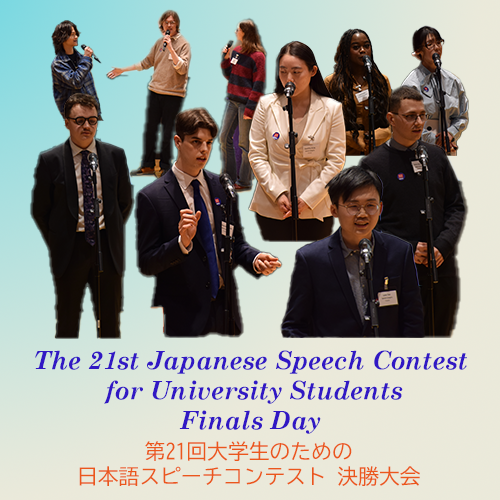
On Saturday 7th March 2026, the Finals Day of the 21st Japanese Speech Contest for University Students was held at the Bush House Auditorium, King’s College London.
This year, we received applications from seventy-six students from eighteen UK universities. On the Finals Day, twenty-four finalists from ten universities joined us from across the country to give speeches and presentations in Japanese.
The finalists discussed a range of contemporary issues and shared their indispensable perspectives through their speeches and presentations – those who missed the event can view the video on our YouTube channel:
***
Opening Ceremony
We began the day with an opening ceremony, led by Mr Kazuya Takahashi, Deputy Director of the Japan Foundation, London. Welcoming speeches were heard from Mr Shuji Maeda, Minister for Public Diplomacy and Media, Embassy of Japan in the UK, and Dr Ana Maria de Medeiros, Director of the King’s Language Centre at King’s College London, who welcomed the finalists and expressed appreciation for their courageous effort in giving speeches and presentations in Japanese.
Individual Presentation Category
Five finalists in the Individual Presentation category spoke about their chosen topics while using PowerPoint slides. This category was for learners of Japanese at the post-beginner level.
First place was awarded to Stella Shi, 4th year at The University of Warwick, who shared her powerful message in her presentation titled Tiny Beauty, Mighty Strength. This explored the idea of beauty through small moments of self-care and the courage these bring in times of vulnerability.
Second place went to Yui Shing Kwok, 2nd year student at Keele University, for his humorous yet insightful presentation My teachers are Japanese video creators, where he shared the unique aspects of learning Japanese from video streamers!
The three runners-up in this category also gave some brilliant presentations: Ria Kosaka, the University of Leeds (The Mystery of Momotaro); Jessie Baker, Newcastle University (What is ‘Alternative’?); and Leah Foster, the University of Cambridge (The Problem of Overconsumption in Japanese Otaku Culture).
Speech Category
During the Speech Category, five finalists studying Japanese as either a degree or non-degree course at advanced level took to the floor and shared their heartfelt messages to an enthralled audience.
Finalists in this category gave their speeches without visual aids or PowerPoint slides, and additionally responded to questions posed by the interlocutor, Ms Nozomi Yamaguchi, Senior Language Tutor at the School of Arts, Languages and Cultures at the University of Manchester.
The first prize was awarded to Thomas Merryfield, 4th year student at the University of Edinburgh, for his speech Towards a Society of Coexistence: Rethinking Minority and Majority Relations from an LGBT Perspective, which, through a reflection on his lived experiences, explored the complexities of acceptance and coexistence in today’s society.
The second-place prize went to Leon Fan, 4th year at the University of Edinburgh, for his speech titled To Shine Even in Loneliness: The Story of a Lonely Immigrant. The touching message of keeping your courage and shining, even during feelings of loneliness and the struggles of living abroad, resonated with many in the room.
The three talented runners-up in this category were: Alexander Campbell Brow, the University of Cambridge (The Current State of Animal Welfare in Modern Japan); Peter Ashton, SOAS University of London (A Re-evaluation of Escapism); and Carol Pui Yi Liu, the University of Leeds (The Invisible Bridge in a Cup of Tea).
Group Presentation Category
The last category of the day was the Group Presentation category, where students learning Japanese at the beginner level gave presentations in pairs or groups, using PowerPoint slides, on a topic related to countries outside Japan.
All five presentations had been selected as prize-winning entries during the initial screening stage. This year’s winning presentations were: The Best First Date in the UK by the team Romance Amateurs, University of Reading; Congratulations on your 200th birthday!!! by the team The Warwick Express, University of Warwick; A History of British Subcultures by the team Chippy Barm, University of Lancashire; Diverse English accents around the world by the team Kaleidoscope of Languages, Imperial College London; and last but not least La Buse and Piracy’s Glory during the 18th Century by the team Pirates of Lock Ness, University of Edinburgh.
***
The speeches and presentations were followed with a Japanese sing-along session led by the talented Ms Yuko Hasegawa-Arango and enthusiastic volunteers from King’s College London. It was wonderful to see everyone, even the audience, get involved in singing some traditional Japanese tunes!
Continuing the celebratory mood from the sing-along, the Awards Ceremony then began. In a speech, Mr Kaoru Miyamoto, Director of the Japan Foundation, London, shared that Keele University’s Collection of Flowering Cherries has been awarded the prestigious Ambassador’s Commendation by the Ambassador of Japan, after two Keele students presented the beautiful collection at the Japanese Speech Contest in 2023 and spoke about the power of language to bring people together. This was followed by congratulatory remarks from Chief Judge Dr Natsuko Perera, Chair of the British Association for Teaching Japanese as a Foreign Language and Lecturer in Japanese and Language Acquisition, School of Languages, Cultures and Linguistics, SOAS University of London.
All finalists in every category received some great prizes from our generous sponsors, and following this we concluded the day with a photo session and celebratory drinks reception. Ms Miyuki Nagai, Coordinator of the 21st Japanese Contest for University Students at the British Association for Teaching Japanese as a Foreign Language, opened the reception with a toast before attendees were invited to celebrate the occasion.
It was an honour to welcome this year’s talented finalists, along with friends, family, teachers of Japanese and audience members, to Bush House Auditorium at King’s College London for this year’s Finals Day. We hope that everyone thoroughly enjoyed this year’s contest, and it further motivates students of Japanese and Japanese Studies to deepen their knowledge of the language and the country.
***
[Download the event programme]
[Download speech summaries and presentation abstracts (English)]
[View speech and presentation videos (Japanese)]
[See event information on the BATJ website]
A very special thank you goes to all the students who entered the contest, their teachers and supporting friends and family, the judges and interlocuter, the audience members, King’s College London, and BATJ, without whom the 21st edition of the speech contest would not be such a success.
We give heartfelt thanks to the generous sponsors of the 21st Japanese Speech Contest for their kind support: The 21st Japanese Speech Contest for University Students was jointly organised by the British Association for Teaching Japanese as a Foreign Language (BATJ) and the Japan Foundation, London, in collaboration with King’s College London. Thank you very much to the dedicated staff and volunteers for their time and hard work to make the day run smoothly.
 Download Attachment
|
Download Attachment
|
16/05/2025

The Finals Day of the Japanese Language Championship for Young Learners UK (JaLaChamp) 2025 was held in the hall of Japan House London, on Saturday 10th May 2025.
JaLaChamp is a contest for primary and secondary school students studying Japanese, either in a formal school setting or privately. It consists of two categories: a speech category, for secondary school students studying Japanese as a foreign language, and a video category, which is open to primary and secondary school students studying Japanese, including those who have previously stayed in Japan and those who speak Japanese at home. In the speech category, finalists gave speeches on the topic of their choice and each speech was followed by the Q&A session. In the video category, finalists (individual or group) created an original video based on the theme provided using their Japanese skills. On finals day, shortlisted videos were played at a large screen in front of a large audience.
The first category of the day was the Speech Category, and our four brilliant speech category finalists delivered their speeches in front of a live audience and a panel of judges. Finalists spoke on a variety of topics such as the issue of over tourism in Japan and the appeal of Shogi, a Japanese two-player strategy board game.
First place in this category was awarded to Sebastian Pabst, a Year 12 student at Whitgift School for his speech entitled: “Japanese food culture teaches health and sustainability / 日本の食文化は健康と持続可能性を教える”. Citing that Washoku, Traditional Dietary Culture of the Japanese, was listed as an UNESCO Intangible Cultural Heritage, Sebastian introduced several traditional concepts related to Japanese food culture, such as ‘eating everything without leaving any leftovers’, ‘using all parts of food (e.g. fish)’ and ‘cooking using local and seasonal ingredients’. He emphasised the vital role of schools in Japan in teaching children about balanced diets and sustainability through school lunches (i.e. using vegetables grown in their school or from local farmers and recycling milk cartons).
Second place went to Gavin Cheng, a Year 12 student at Hockerill Anglo-European College for his speech entitled: “Good Doctor vs Bad Doctor: What is the difference? / 良い医者と悪い医者:違いはなんですか?”. Gavin’s speech explained what makes doctors “good”, using several concepts commonly used in Japan such as sincerity (seii), doing one’s best (ganbaru), and consideration (omoiyari) with good examples.
After the Speech Category, we had the Video Category finals. The video category was divided by age (secondary school and primary school), and the secondary school division was split further into two according to Japanese language ability.
The first videos to be shown were the seven videos in Secondary School Division 1 (theme: “Something I/We Want to Try / 私(たち)がやってみたいこと”). Finalists in this category have a Japanese level of A1-A2 (JF Standard for Japanese-language education/CEFR). All seven videos were ambitious in scope and with good messages and sometimes humours to engage with the audience.
First place was won by Tomei Tomatoes, a group of two students, for their video “We Want to Try Being Invisible/ 透明人間になってみたい!”. Second place went to Kira-kira boshi (Twinkle stars), a group of five students from Aquinas College, for their video “Weekend Wishes”.
Next was Secondary School Division 2, where finalists have a Japanese level of B1 (JF Standard for Japanese-language education/CEFR). The theme for their videos was “What I/We Can Learn from the Past / 私(たち)が過去から学べること”. First place was won by Timothy Pooley from James Gillespie’s High School, for his video “ぼくはもうやらないこと / Things that I won’t be doing anymore”.
After the videos from secondary school students, videos from the Primary School Division (theme: “My/Our Favourite Place / 私(たち)の好きな場所”) were shown on a large screen. Finalists in this category have a Japanese level of A1-A2 (JF standard for Japanese-language Education/CEFR). There were five videos in this division and the audience was introduced to each finalist/ finalist group’s favourite places, including London Zoo and a school Lunchtime Japanese Club!
A Special Talk by Ms Mara Yamauchi, a former elite athlete and diplomat who worked for the Foreign Office, including at the British Embassy in Tokyo, was scheduled following the finalists’ videos, but unfortunately Ms Yamauchi was unable to join us on the day. We screened a special video message she kindly made for the participants, and then Mr Shin-ichi Tanaka, Director of the Japan Foundation London, talked about his experiences running the 2024 Berlin Marathon and the 2025 London Marathon. Mr Tanaka spoke about the fun of running as well as the importance of hard work and continuity.
During the Finalist Connection Programme, finalists of various age and different levels of Japanese shared their experiences of learning Japanese. We hope all finalists had a chance to learn from other finalists who studies Japanese.
The award ceremony was held at the end of the day and all of our finalists (both those who placed and runners-up) were awarded with prizes, many of which were provided by our generous sponsors. Taking this opportunity, we sincerely thank all of our finalists who have worked so hard to reach Finals Day, and their families and teachers who supported them. It was great to see many young learners and we look forward to welcoming many of you at the next JaLaChamp.
List of Awards
Speech Category
- First Place: Sebastian Pabst (Whitgift School)
- Second Place: Gavin Cheng (Hockerill Anglo-European College)
- Runners-Up: Ermal Lisha (Hockerill Anglo-European College); Max Woodley (Whitgift School)
Video Category – Secondary School Division 1
- First Place: Tomei tomatoes – Lisa Egawa (Drayton Manor High School) and Emi Gutch (Elthrone Park High School)
- Second Place: Kira-kira boshi - Niamh, Sophie, Alexa, Beth, Hannah (Aquinas College)
- Runners-Up: SalmonSensation – Thomas Lee, Zachary Oz-Collins, Sam Todd (The Gryphon School – learning Japanese at Sherborne Girls); BAAM – Ben, Anton, Ayden, Minghao (Dartford Grammar School); Ryan Cheng (Whitgift School); Victor Richards (University College School); The Hamilton – Wright Co – Lochlann Hamilton, Ernest Wright (Whitgift School)
Video Category – Secondary School Division 2
- First Place: Timothy Pooley (James Gillespie’s High School)
- Runners-Up: Sannin-gumi – Sofia Shibata, Leonard Nakamura, Ayla Murase (Kotoba no Kakehashi), Nina Allen (NIHONGOSCHOOL/ The BRIT School)
Video Category – Primary School Division
- The Nice Cooperation Award: Maple Walk School Japanese Club (Maple Walk School)
- The Magical Teleporters Award: Luisa Andras (Blackthorns Community Primary Academy)
- The Warm Memories Award: SUN3RISE – Nanami Ikeya, Saya Gutch, Mao Catterall (The Japanese Saturday School in London)
- The London Animal Ambassador Award: Aubin & Zavi (Devonshire House School, London)
- The Learning Achievement Award: Lunchtime Japanese Club (Blackthorns Community Primary Academy)
---
We would be very grateful if everyone could see their fantastic video on our official YouTube channel and “like” the video.
Download the JaLaChamp 2025 programme
View photos from JaLaChamp 2025 Finals Day
View videos from JaLaChamp 2025 Finals Day
We would like to thank our judges, interlocutor, special guest, and venue staff for all of their invaluable assistance in helping us to hold this event. This event would also not have been possible without the support of our generous sponsors:
|
Download Attachment
|
27/03/2025

The Finals Day of the annual Japanese Speech Contest for University Students was held on Saturday, 1st March 2025 at Great Hall, King’s College London.
For this year, the 20th anniversary of the contest, we welcomed 24 student finalists from 10 universities across the UK, who delivered a packed programme of thought-provoking speeches and presentations for an eager audience – entirely in Japanese!
Those who missed the event, or those who did attend and wish to revisit, can view the event video on our YouTube channel below:
[Youtube Link (Coming soon)]
***
The Finals Day kicked off with opening remarks by Mr OKAZAKI Yasuyuki, Minister for Public Diplomacy and Media, Embassy of Japan in the UK and Dr Ana Maria de Medeiros, Director of the King’s Language Centre at Kings’ College London. They each gave words of welcome to those gathered in the Great Hall before the finalists’ speeches and presentations began.
Individual Presentation Category
In the Individual Presentation Category - for learners studying Japanese at the post-beginner level – five finalists gave presentations using PowerPoint slides to illustrate their chosen topics.
The first prize in this category was awarded to Jessica Polito, a 2nd year student at the University of Edinburgh. Her presentation titled Learning Japanese changed me! was an inspiration for those on their own language-learning journeys.
The second prize went to Zhengxi (Kevin) Cheng, a 3rd year student at Imperial College London who explored both the benefits and potential risks of artificial intelligence in his presentation AI and a Better Society.
The three talented runners-up in this category were: YuThong Low, King’s College London (Is Generation Gap a problem?); Xuanlin (Elsa) Huang, Durham University (Embrace Imperfection in the World and Yourself, Overcome Prejudices); and Jinyoung Tak, King’s College London (What is it like Being Half Korean and Half Japanese ).
Speech Category
After a short break, the audience returned to the hall to listen to our five Speech Category finalists – all studying Japanese as either a degree or non-degree course. Finalists in this category gave speeches entirely in Japanese, without visual aids or PowerPoint slides, and responded to various questions about their selected theme posed by our interlocuter, Ms YAMAGUCHI Nozomi, Senior Language Tutor, School of Arts, Languages and Cultures, the University of Manchester.
First place in this category was awarded to Ailian Pei, 4th year student at SOAS University of London, for her speech Challenges of Japan’s “Recruitment System for the Newly Graduated” from the Perspective of International Students, which resonated with the many students in attendance.
Theodore Nze, 4th year student at the University of Oxford, received 2nd place for his speech titled International English: The Challenge and Future of teaching English as a Lingua Franca, where he explored the various forms of English and the true meaning of a ‘global language’.
Our three runners-up also gave brilliant speeches: Michelle Aiko Boddey, SOAS University of London (Redefining Masculinity in Modern Japan); Jiachen Zhang, the University of Leeds (With the popularisation of artificial intelligence, has the value of learning a foreign language fallen?); and Leona Smith, the University of Central Lancashire (Is the international community’s criticism towards Japan’s whaling justified?).
Group Presentation Category
The Finals Day resumed with the Group Presentation Category, after a brief interval in which attendees could visit booths from our many generous sponsors. Students learning Japanese at the beginner level gave presentations in groups on a variety of interesting topics, using PowerPoint slides.
All finalists in this category were already selected as winners at the initial screening stage. This year’s presentations were: Music of England – Fleetwood Mac by Team Doppler Effect, SOAS University of London; Our Favourite Story Protagonists by Team Fluffy Fluffy, University of Bristol; Welcome to Shanghai by Team Shanghai-ce Cream, King’s College London; Women in STEM: Education vs Opportunity by Team Keele’s Science Girls and Guys, Keele University; and last but not least, Mahjong by Team Fans of Freedom, Imperial College London.
***
The speeches and presentations were followed with a Japanese sing-along session led by the enthusiastic volunteers from King’s College London. The celebratory mood of the sing-along served as the perfect preface for the Finals Day award ceremony!
The award ceremony itself opened with a speech from Mr TANAKA Shin-ichi, Director of the Japan Foundation, London. Chief Judge Dr UMEZAWA Kaoru, Chair of the British Association for Teaching Japanese as a Foreign Language, conveyed remarks on behalf of the judges regarding the day’s presentations and speeches.
For the award ceremony, we invited a special guest for the speech contest’s 20th anniversary – Mr Andrew Lyttle, 1st place winner at the 6th Speech Contest and graduate of SOAS University of London. Mr Lyttle shared his encouragement to finalists and reflections on the day’s proceedings before the prize-giving began in earnest.
The individual winners from each category were invited to say a few words about their experience. It was obvious how hard the students had prepared for the contest and each finalist was met with enthusiastic applause from the audience to commend their effort. Each and every finalist received prizes from our generous sponsors.
The Finals Day concluded with a photo session for finalists and sponsors, before everyone enjoyed the opportunity to network at a celebratory drinks reception - with an opening toast from Ms Jenny White, Chief Executive of the Great Britain Sasakawa Foundation.
It was an honour to welcome this year’s talented finalists, along with friends, family, teachers of Japanese and other audience members from all over the country, to King’s College London’s Great Hall for an inspiring day of speeches and presentations. We hope that everyone thoroughly enjoyed this year’s contest, and we look forward to seeing you all again next year!
[Download the event programme]
[Download speech summaries and presentation abstracts (English)]
[View speech and presentation videos (Japanese)]
[See event information on the BATJ website]
Special thanks to all students who entered the contest, their teachers and supporting friends and family, the judges and interlocuter, the special guest, the audience members, King’s College London, and BATJ, who helped to make the 20th anniversary edition of the speech contest such a success.
We also extend our unending thanks to our kind and generous sponsors for supporting the event:
 The 20th Japanese Speech Contest for University Students was jointly organised by the British Association for Teaching Japanese as a Foreign Language (BATJ), and the Japan Foundation, London. Thank you very much to all the hardworking staff who dedicated their time to ensure a successful event.
Thank you also to King’s College London for providing the beautiful Great Hall as the Finals Day venue.
|
Download Attachment
|
Download Attachment
|
20/12/2024

“Rakugo and Kobanashi: Enjoy Storytelling and Explore Japanese” event series was held on 8th and 9th of November 2024 in Oxford, and 10th November 2024 in London.
The traditional Japanese theatre art Rakugo dates back to the Edo period, where it was appreciated by all classes – and it is still enjoyed by many today. During the performance, a storyteller sits onstage, alone, in the seiza position (kneeling with tucked legs), using only their voice, a cloth (tenugui), and a folding fan (sensu), to tell comedic or dramatic stories. While Rakugo remains one of the most popular traditional theatre arts in Japan, those overseas do not often get the opportunity to enjoy it live.
We were delighted to invite the distinguished Rakugo Master Ryūtei Saryū and Professor Kazumi Hatasa to the UK. Master Ryūtei Saryū has been performing Rakugo across the world for over 30 years and achieved Shin’Uchi Rakugo Master Storyteller status in 2006. He became a visiting associate professor at Tokyo Woman’s Christian University earlier this year. Professor Hatasa is part of the School of Languages and Culture at Purdue University, USA. He works with professional performers to incorporate Rakugo and Kobanashi into Japanese language education.
While we held this event for people in the UK to enjoy Rakugo, another aim was to introduce Kobanashi. Kobanashi are short skits with an ending punchline, serving as a preface to the main Rakugo story. Every learner, from a beginner level to a higher level, from children to adults, and from those learning Japanese as a foreign language to those learning it as a heritage language, can try Kobanashi and enhance their motivation and creativity! We have been encouraging learners and teachers to try Kobanashi, and many of them have already performed it in their class or elsewhere. To spread the message of this fun and useful artform, we hosted an in-person Kobanashi showcase during this event series.

Day One – Friday 8th November 2024, Oxford
The day’s proceedings began with opening remarks by Mr TANAKA Shin-ichi, Director of the Japan Foundation, London. Following this, Professor Hatasa provided an explanation of Rakugo and yose theatre. He then introduced various gestures used in Rakugo to the audience, alongside gesture performances by Master Saryū.
The Rakugo ghost story Shinigami (God of Death) was then briefly explained by Professor Hatasa, leading into Master Saryū’s expertly performed rendition of this terrifying tale. The plight of an Edo man who made a deal with a deity of death was masterfully portrayed to a captive audience through Master Saryū’s voicework and acting.
Following the frightfully fantastic Rakugo performance, the floor opened to the audience for questions to both Professor Hatasa and Master Saryū.
The Friday event was co-organised by the Japan Foundation, London and Nissan Institute of Japanese Studies, University of Oxford. We would like to further thank the Nissan Institute for graciously providing the venue for the day’s activities.
Day 2 – Saturday 9th November 2024, Oxford, and Day 3 – Sunday 10th November 2024, London
Day 2 and Day 3 followed similar programmes. On Day 3 we were also honoured to receive Mr OKAZAKI Yasuyuki, a minister of the Embassy of Japan, to give a greeting.
Following a welco me address from Mr TANAKA Shin-ichi, Director of the Japan Foundation, London, Professor Hatasa began with an introductory lecture about the art of Rakugo and yose theatre. Alongside Master Saryū, he then presented a demonstration of various gestures used during Rakugo performances by showing Master Saryū’s gestures on the stage.
Kobanashi Happyoukai
Following the brief Rakugo taster, it was time to move onto the Kobanashi Happyoukai! Each venue filled with laughter and applause as 12 Japanese learners of all ages took to the stage one-by-one. It was a great opportunity for them to show off their language and acting skills in a programme full of entertaining and witty skits – as coached by Master Saryū during their rehearsal. Following the Kobanashi presentations, the performers were invited back to the stage for a brief talk about their experiences preparing for the Happyoukai. Please see the programme at the bottom of this report. We hope that this precious experience will motivate our performers to keep studying Japanese hard!

After a short interval, the audience returned to their seats in anticipation of two Rakugo performances by Master Saryū himself. A background explanation of the first story, ‘Long and Short’ (chōtan), was provided by Professor Hatasa, then Master Saryū launched into a hilarious rendition of the tale about two friends with opposing personalities. The second story, ‘Okiku’s Plates’ (okiku no sara), was a ghost story with a twist – it tells the tale of the young maid Okiku, who haunts an old well whilst counting plates and cursing her former master. Background context was once again provided by Professor Hatasa for Master Saryū’s captivating performance.
A talk and Q&A session then followed the performances and allowed the audience to learn more about Rakugo and Kobanashi. The day closed with a taiko drum demonstration, as would be done in an authentic theatre after a long day full of exciting Rakugo!
The Saturday and Sunday events were organised by the Japan Foundation, London. Wadham College, University of Oxford supported the event on Saturday. We would like to further thank Wadham College and Regent’s University London for graciously providing the venues for the days’ activities.


Overall, we had a packed three days full of exciting performances, and we hope that those in our audience, both in-person and watching from our online broadcast, will keep enjoying Rakugo and Kobanashi in the future! As for us, we will continue hosting various events to show how fun it is to learn about Japanese culture and language.
If you would like to try Kobanashi yourself, the information below will be useful. Don't miss it!
- Professor Hatasa's website
- KKGH website (*KKGH is "Kokusai Kobanashi Godo Happyoukai")
- Kobanashi performances video (from an online event in 2021)
Please make sure to check out our What's On page and keep a look out for our future events like this one!
Downloads:
|
Download Attachment
|
Download Attachment
|
31/05/2024

The Finals Day of the 2024 JaLaChamp, Japanese Language Championship for Young Learners UK, was held on 11th May 2024 in London.
JaLaChamp is a contest for primary and secondary school students studying Japanese, and consists of two categories: a speech category, and a video category where students are asked to create an original video. On Finals Day, speech category finalists gave their speeches in front of a live audience and a panel of judges. Additionally, videos created by all the video category finalists were played on the big screen of Japan House London Hall for everyone to enjoy.
The first category of the day was the Speech Category. The four finalists in this category gave speeches on the topic of their choice, with speeches on themes as varied as the environment and cash vs electronic money. First place in this category was awarded to Polly Fletcher, a Year 12 student at Wolfreton School and Sixth Form College for her speech entitled: “Food waste is not good for both people and the planet / 食べ残しはだれにもちきゅうにもよくないです”. Second place went to Rupert Lam, a Year 12 student at Harrow School. His speech was called: “Three Ways My School Can Help the Environment / 学校は環境を守る三つの方法”.
After the Speech Category finalists finished giving their speeches, it was time for the three video categories. The finalists in these categories made videos on a set theme while using their Japanese skills as well as harnessing their creativity. They were allowed to work solo or in a group. The video category was divided by age (secondary school and primary school), and the secondary school division was split further into two according to Japanese language ability.
The first videos to be shown were the seven videos in Secondary School Division 1 (theme: “My/Our Talent / わたし(たち)の得意なこと”). Finalists in this category have a Japanese level of A1-A2 (JF Standard for Japanese-language education/CEFR). All seven videos creatively responded to the theme, using acting, presentation skills, and graphics.
Sky Phisuthikul from Wycombe Abbey School won second place for her video “Me and my hobby- Cooking!”. First place was won by Timothy Pooley from James Gillespie’s High School, for his video “ぼくのとくいなもの / My favourite thing to do”.
Next was Secondary School Division 2, where finalists have a Japanese level of B1 (JF Standard for Japanese-language education/CEFR). The set them was “What I/We Want to Save for the Future / 私(たち)が未来に残したいもの”. There were two videos in this category, with one group awarded first prize: ロクニンジャ/ROKUNINJA from Bristol Chibikko Juku (Miyo Graham from Cotham School, Elias Arango from Cotham School, Abby Callanan from Cotham School, Mei Horobin from Winterbourne Academy, Sayo Kubo-Richards from Oldfield School and Ria Stagg from Backwell School), for their video, “What we want to save for the future… Freddo’s”.
The final videos of the day were the finalists of the Primary School Division (theme: “Where I/We Live / わたし(たち)の町”). Finalists in this category have a Japanese level of A1-A2 (JF standard for Japanese-language Education/CEFR). The audience was treated to seven videos where places all over the UK were introduced. Prizes in this category were not placed, and each finalist instead won a unique individual prize based off the theme of their video.
Following the videos, there was a JaLaChamp Special Talk with guest Dr Catherine Butler from Cardiff University. Dr Butler discussed the influence of British children’s literature on Japanese animation, using the Studio Ghibli Film “Arrietty” to illustrate her points. She took questions on a variety of topics from the audience, such as translation and her favourite Ghibli films.
The microphones were then turned to the finalists and young audience members as we held the first JaLaChamp chat show, where finalists were given a chance to ask each other questions about their speeches and videos. We all got a great idea of all the hard work that went into their preparation for the contest, and there was a lot of laughter too.
Finally was the award ceremony, during which all of our finalists (both those who placed and runners-up) won wonderful prizes, many of which were provided by our brilliant and generous sponsors. It was great to see the young finalists so well-deservedly rewarded for all of their hard work.
List of Awards
Speech Category
- First Place: Polly Fletcher (Wolfreton School and Sixth Form College)
- Second Place: Rupert Lam (Harrow School)
- Runners-Up: Eric Taylor (Whitgift School); Abubakar Sambo (Wycliffe College)
Video Category – Secondary School Division 1
- First Place: Timothy Pooley (James Gillespie’s High School)
- Second Place: Sky Phisuthikul (Wycombe Abbey School)
- Runners-Up: Hugo (Kathrine Lady Berkeley’s School); The Karate Cubers - Charis Taylor, Niamh Cardinal, Parker Bonnefin, Sean Landers (Japanese4Schools); Lochlann (Whitgift School); Yuna (Sheffield Japanese Play-group & Study-club/Tapton School); Wolfreton Year 9 Group - Rebecca H, Hannah R, Henry B, Chloe N, Sophia D (Wolfreton School and Sixth Form College)
Video Category – Secondary School Division 2
- First Place: ロクニンジャ/ROKUNINJA - Students from Bristol Chibikko Juku - Miyo Graham (Cotham School), Elias Arango (Cotham School), Abby Callanan (Cotham School), Mei Horobin (Winterbourne Academy), Sayo Kubo-Richards (Oldfield School), Ria Stagg (Backwell School)
- Runners-Up: A Japanology Producion - Polly F, James M, Harry N, Gracie F (Wolfreton School and Sixth Form College)
Video Category – Primary School Division
- The Excellent Explorers Award: JeDAK - Jessica Koga, Edward Oguri, Akihiko Kitagawa (The Japanese Saturday School in London)
- The Lindfield Ambassador Award: Blackthorns Community Primary Academy Japanese Club
- The Excellent Research Award: London Girls - Ayla Murase, Mira Nonomura, Ai Ukita (Kotoba no Kakehashi)
- The Wonderful Woking Award: Chan Brothers - Leo Chan (Hermitage School), Clement Chan (St. Hughof Lincoln Catholic Primary School)
- The Magical Teleporters Award: Gutch Girls - Emi Gutch, Saya Gutch (Fielding Primary School)
- The Edinburgh Navigators Award: Alice Barker (St Mary’s RC Primary School Edinburgh)
- The Nice Cooperation Award: Maple Walk School Japanese Club

We had an amazing day with a completely packed audience who all came out to see what young students studying Japanese want to say. Otuskaresama deshita (well done!) to all the finalists!
Download the JaLaChamp 2024 programme
View photos from JaLaChamp 2024 Finals Day
View videos from JaLaChamp 2024 Finals Day
We would like to thank our judges, interlocutor, special guest, and venue staff for all of their invaluable assistance in helping us to hold this event. This event would also not have been possible without the support of our generous sponsors:

25/04/2024
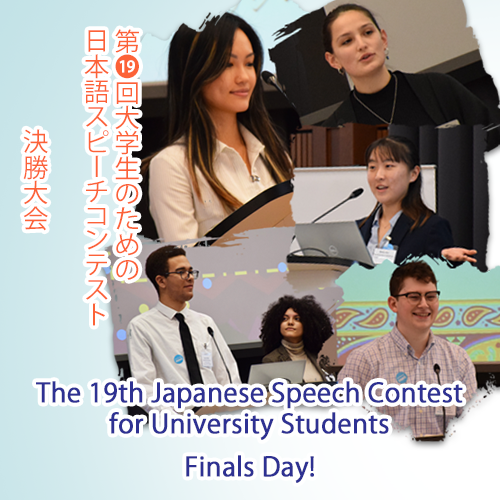
The Finals Day of the annual Japanese Speech Contest for University Students was held on Saturday 2nd March 2024, in the Great Hall of King’s College London. Twenty-three students from eleven universities across the United Kingdom gave fantastic speeches and presentations in Japanese in front of a large audience. We were honoured to welcome all the finalists and thrilled to listen to their well-thought ideas expressed entirely in Japanese.
If you missed out on attending Finals Day, or if you did attend and want to re-watch the speeches and presentations, you can view them on our YouTube channel by clicking on the link below:
The 19th Japanese Speech Contest for University Students – Finals Day Video
Opening remarks were given by Mr OKAZAKI Yasuyuki, Minister for Public Diplomacy and Media, Embassy of Japan in the UK; Ms HASEGAWA Yuko from King’s College London; and Mr TAKAHASHI Kazuya, Deputy Director of The Japan Foundation, London.
Individual Presentation Category
Five finalists in the Individual Presentation Category (post-beginner category) gave presentations using PowerPoint slides and talked about their chosen topics. We were impressed by the variety of topics chosen by the five finalists.
The first prize winner in this category was Peter Ashton, a 2nd year student at SOAS University of London, who gave a presentation on “Talent and Effort”, which made us realise how use of the label “talent” can be too easily applied disregarding an individual’s own effort.
Sam O'Connell, a 2nd year student at the University of Edinburgh, won the second prize for this presentation about “Alternative Worlds & Alternative Selves: Identity Exploration in Online Games” where he shared his own experiences of establishing a new type of global friendship and enhancing skills through participating in massively multiplayer online role-playing games.
The three runners-up who also gave brilliant presentations were: Samuel Lynn (Keele University, “English - Etymology, history, and a few fun facts”), Grace Chak Kwan Ching (University of Bath, “Chinese ligatures”), Thomas Merryfield (University of Edinburgh, “Why Humankind Seeks to Achieve the Unachieved”).
Speech Category
After a short break, five speech category finalists -students studying Japanese as either a degree or non-degree course - gave their speeches in Japanese (finalists in this category do not use visual aids or PowerPoint), and took part in a question-and-answer session with an interlocutor.
Minju Kim, a 4th year student at the University of Edinburgh, won first prize for her speech entitled “Japan and South Korea: Building a Stronger Relationship through the Power of Dialogue”, which stressed the importance of civil and open dialogue.
Second prize went to Jamie Shepherd, a 4th year student at the University of Cambridge, for his speech “Kōan in an age of intolerance”, which explained connection Kōan could have to contemporary society.
There were three fantastic runners-up in this category: Kia Puusa (University of Manchester, “Happiness Redefined: A Finnish Perspective”), Apolline Debroux (University of East Anglia, “The Silence of the Youth: Fostering Dialogue and Political Engagement in Japan”), and Callum Cafferty (SOAS University of London, “Japan’s Energy Self-sufficiency Problem”).
Group Presentation Category
After the Speech Category, Group Presentation Category finalists, who are studying Japanese at a beginner level, gave group presentations using PowerPoint slides. They all received participation prizes rather than being placed individually.
The presentation this year were: “Festivals of Leicester” (Team Golden Mile, University of Leicester), “Chinese Wedding Customs” (Team Egg-Chan Duo, Imperial College London), “The definition of a mother tongue” (Team Mancunians, University of Manchester), “Yorkshire!” (Team James & Emma: Yorkshire People, Newcastle University), and “national stereotypes” (Team (Lon)donkatsu, King’s College London.
_ _ _
After all the speeches and presentations and shortly before the award ceremony, there was a Japanese sing-along to the song “Furusato”. The award ceremony began with a short speech from Mr TANAKA Shin-ichi, Director of Japan Foundation, London, and the judges’ remarks, conveyed by Ms NARUMI-MUNRO Fumiko, Chair of the British Association for Teaching Japanese as a Foreign Language.
During the award ceremony, the students received their prizes and the winners in each category were asked to say a few words. A lot of students expressed their gratitude for the continuous support of their language teachers at their universities, which made the audience think of the tremendous effort they must have undertaken preparing for Finals Day. Everyone ave a big round of applause to the finalists and all finalists in all three categories received prizes kindly provided by our generous sponsors, displayedat the bottom of this article.
The day closed with a photo session and a drinks reception – opened with a toast from Ms Jenny White, Chief Executive of the Great Britain Sasakawa Foundation (one of the Speech Contest’s generous sponsors).
We were so honoured to welcome all the l great finalists in person, as well as many attendees, including friends and families of the finalists and teachers of Japanese, to the Great Hall of King’s College London. We hope everyone enjoyed this year’s contest.
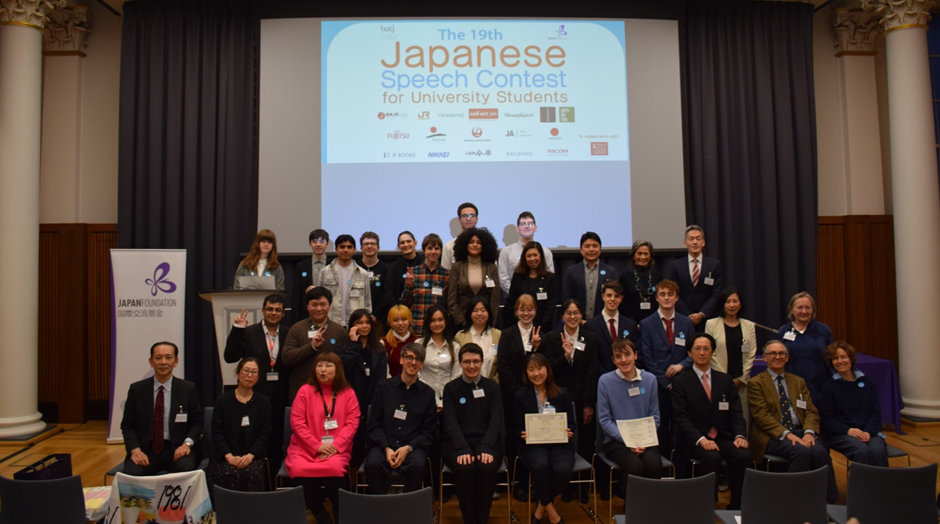
皆さん、お疲れさまでした!
Download Speech Category summaries and Individual and Group Presentation abstracts
View videos of all the speeches and presentations
Information on the BATJ website
We would like to thank all participants, their teachers and supporters, the judges, audience members and BATJ for making the contest such a success. In addition, special thanks must go to the generous sponsors who supported this event:

The Nineteenth Japanese Speech Contest for University Students was organised by the British Association for Teaching Japanese as a Foreign Language (BATJ) and the Japan Foundation, London in joint partnership. We are grateful to all the members of staff who devoted their time and energy towards making this event a success.
We would also like to express our gratitude to King’s College London, for letting us use their Great Hall as a venue.
|
Download Attachment
|
Download Attachment
|
20/07/2023
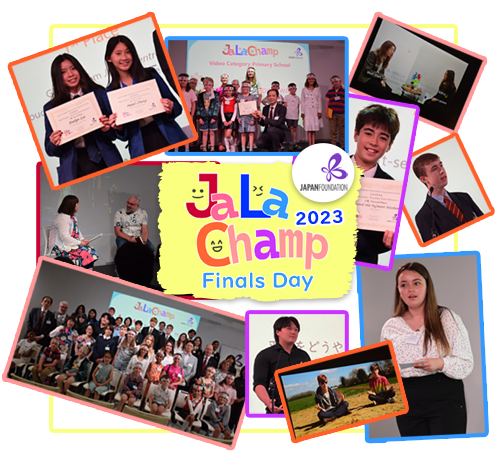
On 8th July 2023, a sunny Saturday, dozens of young learners of Japanese from around the UK travelled to London for the JaLaChamp Japanese Language Championship for Young Learners UK 2023 Finals Day.
JaLaChamp is a new contest for primary and secondary school students studying Japanese, and consists of two categories: a speech category, and a video category where students are asked to create an original video. On Finals Day, speech category finalists gave their speeches in front of a live audience and a panel of judges. What’s more, the videos created by all the video category finalists were played on the big screen of Japan House London Hall for everyone to enjoy.
The day kicked off with the five finalists of the Speech Category giving speeches on a topic of their choice. We heard about a variety of topics, from the impression made by our choice of clothes to how we can bring world peace. After deliberation from the judges, First Place was awarded to Ava Corcoran, a year 12 student from Didcot Sixth Form and studying Japanese at Oxford Japanese School. Ava’s speech was called: “The music of Japan that the West doesn’t know: Enka / 西洋が知らない日本の音楽:演歌”. Second Place was awarded to Kieran Blackley, a year 11 student from Dartford Grammar School, for his speech “Language Extinction / 言語消滅”.
After the Speech Category finalists finished giving their speeches, it was time for the three video categories. The finalists in these categories made videos on a set theme while using their Japanese skills as well as harnessing their creativity. They were allowed to work solo or in a group. The video category was divided by age (secondary school and primary school), and the secondary division was split further into two according to Japanese language ability.
The first videos to be shown were the five videos in Secondary School Division 1 (theme: “My/Our Favourite Day / わたし(たち)のすきな日”). Finalists in this category have a Japanese level of A1-A2 (JF Standard for Japanese-language education/CEFR). All five videos creatively responded to the theme, using animation, acting, and presentation skills. Edward Nicolson from Colfe’s School won second place for his video “ぼくの友達”. First place was won by Eleanor Waterhouse, Hazel Cheng, and Evelyn Liu from Hockerill Anglo European College (team name: 日光) for their video “The Perfect Day”.
The audience was then shown the three videos in Secondary School Division 2 (theme: “My/Our Life/Lives in 2050 / 2050年のわたし(たち)の生活”). Finalists in this category have a Japanese level of B1 (JF Standard for Japanese language education/CEFR). Predictions for 2050 by the finalists concerned subjects as varied as marine biology, global warming, and the UK education system. It was Amalie Brown from Westcliff High School for Girls’ who scooped first place in this category for her thoughtful video on “The UK education system. in 2050 / 2050年のイギリスの教育制度”. In the video, Amalie played two roles – the interviewer and the interviewee – leading people to think that there were two people in the video!
The final videos of the day were the finalists of the Primary School Division (theme: “My/Our Favourite Things / わたし(たち)のすきなもの”). Finalists in this category have a Japanese level of A1-A2 (JF standard for Japanese-language Education/CEFR). The audience was introduced to an assortment of wonderful things, ranging from toy cats and rabbits, highland cows, football, stop-motion animation and more. Prizes in this category were not placed, and each finalist instead won a unique individual prize based off the theme of their video.
Before the award ceremony, we were honoured to welcome Mr Phillip Breen, a well-known theatre director and playwright, to give a talk about his career in the theatre and his work in Japan. Mr Breen has directed over 60 professional productions all over the world, and has worked frequently in Japan. He knows better than anyone the hard work the finalists all put in to using their Japanese and their other skills to make creative, entertaining and thoughtful speeches and videos. Mr Breen also took questions from the audience, with many of our young attendees eager to find out how they can maximise their potential and work in the creative fields in the future.
The day ended with the award ceremony, during which all of our finalists (both those who placed and runners-up) won wonderful prizes, many of which were provided by our brilliant and generous sponsors. It was great to see the young finalists so well-deservedly rewarded for all of their hard work.
List of Awards
Speech Category
- First Place: Ava Corcoran, Didcot Sixth Form / Oxford Japanese School
- Second Place: Kieran Blackley, Dartford Grammar School
- Runners-Up: Ashton Kong, Harrow School; Jessie Baker-Piercy, Wolfreton School and Sixth Form College; Julia Sosnowska, Matthew Arnold School Sixth Form / Oxford Japanese School
Video Category – Secondary School Division 1
- First Place: Eleanor Waterhouse, Hazel Cheng, Evelyn Liu, Hockerill Anglo European College
- Second Place: Edward Nicolson, Cole’s School
- Runners-Up: Shereena and Amelia, Tomlinscote School; Lochlann Hamilton, Whitgift School; Nicky Hall, Jack Taylor, Finley Coan, Ashton Huntley, Fintan Mcnally, Wolfreton School and Sixth Form College
Video Category – Secondary School Division 2
- First Place: Amalie Brown, Westcliff High School for Girls
- Runners-Up: Adam Farhan, Cheney School / Dream Language Academy; Jessie Baker, Evie Harvatt, Emily Bowers, Kian Nutbrown, Wolfreton School and Sixth Form College
Video Category – Primary School Division
- The Family Legacy Award – Emi Nicolson, Stillness Infant School
- The Nice Cooperation Award – Japanese Club, Blackthorns Primary Academy
- The Outstanding Creativity Award – Timothy Pooley, Bun-sgoil Taobh na Pàirce
- The Scottish Animal Ambassador Award – Kikka McKee, Sion McKee, Carronshore Primary School / The Scotland Japanese School
- The Lifetime Friendship Award – Adriana Farhan, Wood Farm Primary School / Dream Language Academy
---
We were so excited to be able to hold this event, which allows young people to be creative and use their Japanese in combination with other skills. Judging from the smiling faces of the audience, we think that they had a great time watching the work of the young finalists too. We can’t wait to see how JaLaChamp will grow and develop in the future.
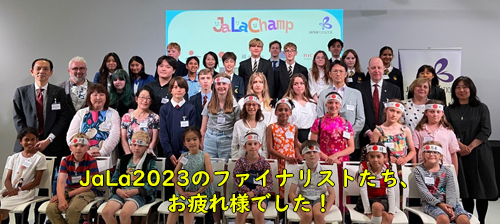
Download the JaLaChamp 2023 programme
View photos from JaLaChamp 2023 Finals Day
New! View videos from JaLaChamp 2023 Finals Day
We would like to thank our judges, interlocutor, special guest, and venue staff for all of their invaluable assistance in helping us to hold this event. This event would also not have been possible without the support of our generous sponsors:

|
Download Attachment
|
09/03/2023
On Saturday 4th March 2023, the annual Japanese Speech Contest for University Students was held in-person for the first time since 2020! We were honoured to welcome twenty-five students from twelve universities across the United Kingdom to the prestigious Great Hall of King’s College London, to give speeches and presentations in three categories – all entirely in Japanese! It was fantastic to reunite with old friends and welcome new friends to this exciting event, now in its eighteenth year.
If you missed out on attending Finals Day, or if you did attend and want to re-watch the fantastic speeches and presentations, you can view every single speech and presentation on our YouTube Channel by clicking the link below:
The 18th Japanese Speech Contest for University Students – Finals Day Videos
The day began when opening remarks were given by Mr OKAZAKI Yasuyuki, Minister for Public Diplomacy and Media, Embassy of Japan in the UK, Dr Ana Maria Sousa Aguiar de Medeiros from King’s College London, and Mr TAKAHASHI Kazuya, Deputy Director of The Japan Foundation, London.

As always, the five finalists in the Individual Presentation Category (post-beginner category) were the first to ascend the stage. In this category, students use PowerPoint slides to speak about cultural topics from around the world.
The first prize winner in this category was Patricia Szeto, a 1st year student at the University of Cambridge, who gave a presentation on “Fengshui Belief in Hong Kong”. Sebastian Serrao Skomial, a 1st year student at the University of Manchester, won the second prize for his presentation about “Europe’s Languages on the Verge of Extinction”.
The three brilliant runners-up were: Ee Jean Poh (University of Warwick, “Malaysia’s Mamaks”), Evangeline Sarah Dupret (University of Sheffield, “L’Escalade - Fête de l’Escalade Geneva/Escalade festival), and Thomas Merryfield (University of Edinburgh, “Culture VS Cruelty – The Controversy of Bullfighting”).

After a short interval where spectators were able to look at booths, samples and leaflets from some of our sponsors, the Speech Category began. This category is for students studying Japanese as either a degree or non-degree course, and finalists do not use visual aids or PowerPoints. The students in this category are free to choose their own topics. Following their speeches, they took part in a question-and-answer session with an interlocutor. Krishna Choudhury, a 5th year student at the University of Leeds, won first prize for his presentation entitled “The condition of migrant workers in Japan”. Second prize went to 4th year student at the University of Edinburgh, Hannah McCormick, for her presentation “Japan and Autism – how can we make a good environment?”.
There were three fantastic runners-up in this category: Ramona Alexandra Antonescu (University of Leeds, “The glorification of Serial Killers”), Xiaoyu Zhang (SOAS University of London, “The Japanese Sense of Nature as Contributing to Sustainable Development”), and Emily Horst (Newcastle University, “Considering the co-existence of individualism and collectivism in Japanese society through hobbies).
.png)
The final students to speak were the Group Presentation Category finalists, who took the stage while the judges left to deliberate on the Individual Presentation and Speech Categories. Group Presentation Category finalists are studying Japanese at a beginner level, and all received participation prizes rather than being placed individually.
The presentations this year were: “Our favourite British desserts” (Team Piece of Cake, University of Cambridge), “Burke & Hare” (Team The Edinburgers, University of Edinburgh), “Wedding” (Team Bridesmaid, King’s College London), “Spa Towns” (Team Hot Spring Egg, University of Warwick), and “Keele’s Cherry Blossoms” (Team Keele University’s Cherry Blossom Class, Keele University).

After the speeches and presentations concluded, there was a Japanese sing-along conducted by volunteers from King’s College London, there was a short speech from Mr TANAKA Shin-ichi, Director of Japan Foundation, London and the judges’ remarks, conveyed by Ms NARUMI-MUNRO Fumiko, Chair of the British Association for Teaching Japanese as a Foreign Language.
Next was the awards ceremony. The students received their prizes and the winners in each category were asked to say a few words. The applause was thunderous as all the friends, family, teachers and supporters of the finalists rewarded them for their hard work. Every single finalist in every category received prizes kindly provided by our generous sponsors.
The day finally drew to a close with a lively drinks reception – opened with a toast from Ms Jenny White, Chief Executive of the Great Britain Sasakawa Foundation (one of the Speech Contest’s generous sponsors).
We were so pleased to be able to hold the contest in-person again and to provide finalists and spectators with a friendly, exciting atmosphere. It is a great source of pride to us that this event continues from year to year, connecting students across the United Kingdom through their Japanese language studies.
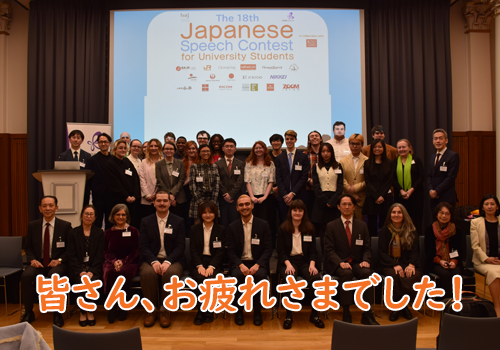
If reading all about this event makes you sad that you missed out, don't fear! Please browse the links below to see the programme, watch videos, look at photos, and read abstracts/summaries of all the speeches and presentations from Finals Day:
- Download the event programme
- View videos of all the speeches and presentations
- Download Speech Category summaries
- Download Individual and Group Presentation Category abstracts
- View photos from Finals Day
- Information on the BATJ website
We would like to thank all participants, their teachers and supporters, the judges, audience members and BATJ for making the contest such a success. In addition, special thanks must go to the generous sponsors who supported this event:
 The Eighteenth Japanese Speech Contest for University Students was organised by the British Association for Teaching Japanese as a Foreign Language (BATJ) and the Japan Foundation, London in joint partnership. We are grateful to all the members of staff who devoted their time and energy towards making this event a success.
We would also like to express our gratitude to King’s College London, for letting us use their Great Hall as a venue.
|
Download Attachment
|
28/07/2022
On Saturday 9th July 2022, we were excited and delighted to hold the finals day of the inaugural Japanese Video Championship for Young Learners UK. This was a brand new event established in 2022 for primary and secondary school and sixth form students studying Japanese in the UK. This was the first contest for young learners run by The Japan Foundation, London where both learners of Japanese as a modern foreign language, and learners of Japanese as a heritage language, were eligible to compete – either individually or as part of a team.
We asked young learners of Japanese in the UK to use their Japanese and make and submit videos on set topics. We wanted applicants to not only use their Japanese, but also make use of other skills such as video editing, presenting/performance and more. Applicants were asked to think of how to convey messages clearly, using the Japanese language and video technology.
Applicants were able to apply in one of the following three categories, according to their age and Japanese ability.
[Primary School Category]
- Japanese level: A1-A2 Level of JF standard for Japanese-language Education /CEFR
- Theme: My/Our School
[Secondary School Category 1]
- Japanese level: A1-A2 Level of JF standard for Japanese-language Education /CEFR
- Theme: My/Our Favourite Place
[Secondary School Category 2]
- Japanese level: B1 Level of JF standard for Japanese-language Education /CEFR
- Theme: “Japan” in the United Kingdom
We were completely blown away by the standard of videos submitted to us. Some were funny and some were serious; sometimes whole classes teamed up to submit a video and sometimes an applicant submitted a video recorded solo. Some applicants even sang! The Japan Foundation, London and the judges of the competition had a lot of fun watching all of the videos we received.
The online Finals Day Event gave finalists, applicants and other participants a chance to watch all submitted videos that were selected as finalists, and to attend a prize ceremony.
First, attendees watched the videos in the Primary Category, before watching the videos in Secondary School Categories 1 and 2. While we were able to show all videos for the Primary Category and Secondary School Category 2, we received so many videos for Secondary Category 1 (a whopping eighteen videos!) that we could only watch six videos chosen for Finals Day.
Before the Prize Ceremony, there was a special question and answer session with Usami Shingo. Mr Usami is a Sydney-based Japanese actor, voice artist and filmmaker, working extensively in TV, theatre and other multimedia in Australia and Japan. The Q&A was a great opportunity for all of the participants to talk to a real professional actor and filmmaker and ask for his advice on how to make short films. Mr Usami also served as a JaViChamp judge.
Next it was time for the prize ceremony, which started with feedback from two of the judges. The judges decided on special awards for each primary school finalist or finalist team, and although all of the videos submitted were high quality, they also had to select winners and runners-up in the Secondary Categories.
The prize list was as follows:
[Primary School Category]
- Jasmine Wales - Multilingual Award
- The Spain Team, Sutton Bridge Westmere Primary School – Good Role Model Award
- The Norway Team, Gedney Drove End Primary School – Nice Cooperation Award
- Iena Mirto, St Bernadette’s RC Primary School – Botanist Award
- The Canada Team, Sutton Bridge Westmere Primary School – Good Rapport Award
- St. Lucia Class, Holbeach St Marks Church of England Primary School – Well-Being Award
- Timothy Pooley, Taobh na Pairce – Eloquent Presenter Award
[Secondary School Category 1]
- 1st Place – Ana-Victoria Ojo, The Holy Cross School
- 2nd Place – Wolfreton JPN Year 10, Wolfreton School and Sixth Form College
- 3rd Place – Jason Goh, Whitgift School
- Runners Up: Hanli Jin and Maito Shinode, The Perse School; The Sneaky Foxes, Tomlinscote School; Team Sakura, Dartford Grammar School.
[Secondary School Category 2]
- 1st Place – Wolfreton Year 12, Wolfreton School and Sixth Form College
- 2nd Place – KiraKira, St Helen’s School
- Runners Up: Mayuko Hayashi, The Japanese Saturday School in London; WestminsterJA, Westminster School.
All of the winners, runners up and applicants received prizes for their fantastic work.
After the prize ceremony, there was time for a group picture before the event ended and all of the finalists were able to go and enjoy a well-deserved celebration.
This was the first time The Japan Foundation, London has held an event like this, and we were so pleased that all of the participants seemed to enjoy themselves. But don’t take our word for it check out some of the feedback we received:
“[…] I loved how easy it was to see everyone’s excitement for the competition. I really enjoyed watching the videos created by others that study the same subject as me, it gave me a sense of community” – Finalist of Secondary School Category 2
“Very proud of myself. Other finalists’ videos made me gets some ideas. I was very impressed them” – Finalist of the Primary School Category
“I was impressed with the fact that I was able to talk to an actor and learn about the experience of working both in front and behind the camera” – Finalist of Secondary School Category 2
“This contest was very creative and I enjoyed how open the guidelines were! It made for some very different and very interesting videos. I think it was a great way to encourage young people to learn Japanese and will continue to motivate them.” – Friend of finalist(s)
We hope that this was an invaluable experience for them and that what they learnt from this competition will help them in their futures.
Download an event programme here
View photos of the event here (coming soon!)
|
Download Attachment
|
15/03/2022
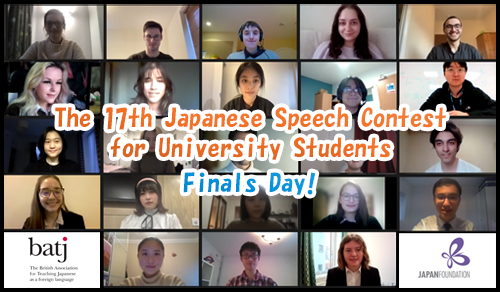

Food in Studio Ghibli films, Francophone bandes dessinée, and plastic surgery – these are just some of the fascinating topics covered by students studying Japanese at universities across the United Kingdom at the Finals Day of the 17th Japanese Speech Contest for University Students. This online event was held on 5th March 2022, with twenty-seven students from eleven universities taking part and wowing the audience with their informative and interesting speeches – delivered entirely in Japanese!
Before the speeches began, we were honoured to receive words of greeting and encouragement to all the finalists from Mr HAYASHI Hajime, Ambassador of Japan to the United Kingdom. It was a wonderful way to start the event.
The five finalists in the Individual Presentation Category (post-beginner category) kicked off the day’s speeches. For these presentations, students used PowerPoint slides while speaking about their chosen topics. Minju Kim, a 2nd year student at the University of Edinburgh, won first prize in this category for her presentation about traditional Korean mask dance drama: “’Another Face Behind the Mask’: Mask Dance Drama in Korea”. Second place in this category was awarded to Apolline Debroux, a 2nd year student at the University of East Anglia, for her presentation on French and Belgian comics, entitled: “’Bande déssinée’ of the French speaking world”. The three fantastic runners-up were Jamie Shepherd (University of Cambridge), Hang Lok Edison Au-Yeung (University of Warwick), and Travis Moy (University of Bath).
Next were the five finalists of the Speech Category. This category is for students studying Japanese as either a degree or non-degree course. Finalists were required to speak in-depth on a topic of their choice using no visual aids. Afterwards, they were asked questions in Japanese by an interlocutor. First prize in this category was awarded to Julia Mary Follan, a 4th year student reading Japanese at the University of Oxford, for her speech on bushido’s applications in modern society – “The role that bushido can play in society today”. Second prize went to a 3rd year student at the University of Sheffield, Vesela Georgieva, for her speech debating the implications of plastic surgery, entitled, “Plastic surgery: to what extent can its role as a means to gain confidence be justified”. There were also three brilliant runners-up in this category: Krishna Paul Choudhury (University of Leeds), Zhixuan Chen (Newcastle University), and Zakariah Ajaz (University of Manchester).
Last but by no means least, the five groups performing in the Group Presentation Category gave their lively presentations on a variety of topics. The groups consisted of finalists who are studying Japanese at a beginner level and were not placed individually but all received participation prizes. The presentations this year were: “Ghibli Food” (Team Ghibli Foodies, University of Oxford),”"Superstitions” (Team Superstitious Foreigners, University of Sheffield), “The Great Fire of London” (Team Firefourters, University of Warwick), “Chinese Table Manner” (Team 3 Chinese, Imperial College London), and “Exploring the Museums of Cambridge” (Team The worlds on our doorstep, University of Cambridge).
Students were awarded their prizes during the online award ceremony. This year once again the contest’s ceremony and reception were online, but even though we did not meet in person, we could feel the pride and happiness of the students and the supporters through the computer. Every single participant in the contest was awarded brilliant prizes that were kindly provided by our generous sponsors.
We are so pleased to be able to hold this event, which we believe shows the power of language to connect students across the United Kingdom. Well done to all the participating finalists and their universities!
- Download the event programme
- Download Speech Category Summaries
- Download Individual and Group Presentation Category Abstracts
- Check out the photos from Finals Day on our Facebook page (coming soon!)
- Check out videos of all the speeches and presentations
- Information on the BATJ website in Japanese and English
We would like to thank all participants, their teachers and supporters, the judges, audience members and BATJ for making the contest such a success. In addition, special thanks must go to the generous sponsors who supported this event:
The British Association of Japanese Studies, Central Japan Railway Company, Clearspring, Connect Job, Eikoku News Digest Limited, Globe-Trotter, The Great Britain Sasakawa Foundation, Japan Airlines, Japan Centre, JP Books, Nikkei Europe Limited, Ningyocho IMAHAN, Regions, Ricoh UK Limited, SUQQU Cosmetics / athletia, WASO and ZOOM Japan.
12/10/2021
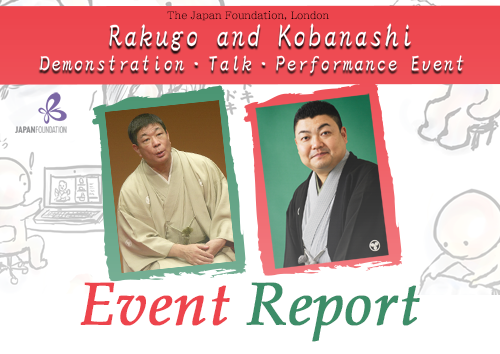
You’re in a small, Japanese-style theatre room. The house lights are up, and you’re surrounded by a chattering, excited crowd. People are sipping ice tea from plastic bottles, fanning themselves, and looking towards the empty stage. Suddenly, a loud buzzer sounds and the crowd falls silent. The room remains shining brightly, but a lone man walks onto the stage and settles down into a seiza position on a cushion – legs neatly tucked under and back ramrod straight. The only items beside the man are a Japanese folding fan and tenugui (a cotton Japanese hand towel).
As the sitting man begins to speak, he transforms into a hard-working Edo-era man walking about. He shuffles on his knees, patting his head and muttering to himself. And then – within an instant – our average Edo man is transformed: he hunches over, his flustered face morphs into a sinister smile, and he emits a terrifying laugh. He has become a Shinigami (god of death!). The figure of the performer on stage has remained seated all the while. There is no costume change, no extravagant sets. One man, sitting alone on a stage, transforms himself and tells a story using gesture, voice and a simple fan and hand towel.
This is rakugo – the traditional art of one-man storytelling in Japan. These stories can be comedic or sometimes dramatic, but the fundamentals are always the same: one person kneeling on stage, performing alone.
Most people outside of Japan do not get the chance to experience a rakugo theatre and so we were honoured to be able to transport viewers from around the world to the world of rakugo through our two day Rakugo and Kobanashi Demonstration, Talk and Performance Event on the 25th and 26th September 2021.
The two day event was MC-ed by Mr Marco Di Francesco, a DPhil Candidate, Area Studies (Japan) at the University of Oxford, and a passionate advocate for rakugo. Mr Di Francesco is currently researching contemporary rakugo in Tokyo. Over two days, Mr Di Francesco led the audience through a series of fascinating talks and funny, frightening rakugo and kobanashi performances.
Day One – 25th September 2021 (Saturday)
The event kicked off with an explanation of the art of rakugo given by Professor Kazumi Hatasa, a Professor at the School of Languages and Culture at Purdue University in the United States of America. He has many years of experience working with professional performers to incorporate rakugo and kobanashi into Japanese language education, and his talk served as a comprehensive introduction to the unique world of rakugo performance.
Professor Matilde Mastrangelo, a Full Professor of Japanese Language and Literature at Sapienza University of Rome then gave an insightful lecture on the topic: “Can Rakugo be Funny for Any Audience?” in which themes of cross-cultural communication and humour were elaborated on. This was particularly relevant to the weekend’s event, whose audience were located all over the world.
During both talks, our experts took questions from the lively and curious audience.
The day ended dramatically with a terrifying rakugo performance of the ghost story “God of Death”, performed by Master Yanagiya Sankyō, which was preceded by an introduction from Professor Hatasa. The story involves a burdened Edo man making a deal with a sinister god of death in return for money, and the audience watched in rapt silence as the scary tale reached its climax. We were honoured to see this performance by Master Sankyō, a Rakugo Master from Tokyo who has performed rakugo since 1967 and received the highest rakugo rank (Shin’Uchi Rakugo Storyteller Master). He was given the Medal of Honour with Purple Ribbon by Japan in 2017.
Day Two – 26th September 2021 (Sunday)
Day Two began with an animated and detailed Dialogue in Japanese between Professor Kazumi Hatasa and Mr Marco Di Francesco. The theme of the discussion was “The Utilisation of Kobanashi in Japanese Language Education and its Practice”. It was great to hear two expert and deep fans of rakugo discuss the important role rakugo can play in teaching Japanese language.
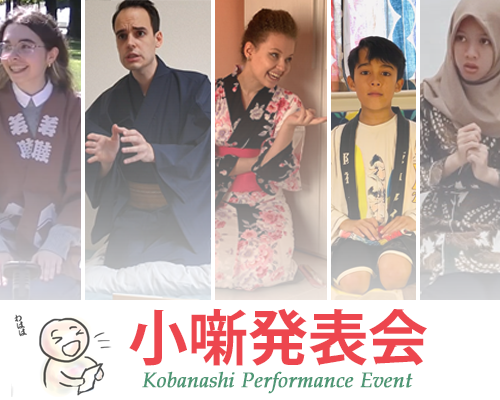
Next, we enjoyed a Kobanashi Performance Event performed by students of Japanese from around the world, with the cooperation of the Organising Team of the International Kobanashi Festival (KKGH). Kobanashi are very short, witty stories that are often performed before the main rakugo performance. The chat-function of our Zoom event, which was open to the audience, became crowded with laughter emoticons and people delighting in the comedic stories given in Japanese by students of Japanese (with English subtitles).
After these wildly entertaining kobanashi performances, our audience was ready for even more laughter. Professor Hatasa introduced the final rakugo performance of this event: “Kanjou Box”, a very funny rakugo performance given by Master Ryūtei Saryū. What a contrast from the horrors of “The God of Death” on Day One, as the audience giggled at this extremely silly story of two men going to stay in an inn and getting tangled in a misunderstanding with the proprietor. We were honoured to see this performance by Master Saryū, a Rakugo Master from Chiba Prefecture and an apprentice of Master Sankyō. Master Saryū achieved Shin’Uchi Rakugo Master Storyteller status in 2006, and lectures part-time at Tokyo Woman’s Christian University.
Following this performance, our audience was given the rare opportunity to pose questions to two masters of Rakugo (Master Sankyō and Master Saryū), with interpretation provided by Mr Marco Di Francesco. This was a great chance to find out more about what it is like to be a Rakugo performer, and was a window into the deep and long-held traditions of the world of Rakugo in Japan.
---
We are delighted at the interest people showed in this event, and the positive feedback we received from our audience. We really hope that this event has encouraged people from all over the world to seek out Rakugo and Kobanashi, and maybe to have a try at performing themselves!
We would like to thank all of the performers and speakers for kindly sharing their expertise and time with us. It is thanks to their hard work and generosity that this event was such a success.
We would also like to thank the Organising Team of the International Kobanashi Festival (KKGH), who helped us to organise this event, and who delighted us by sharing the kobanashi performances of students from across the globe.
If you are interested in attending more events like this one in the future, please keep an eye on our What’s On page for information on all upcoming events!
You can download the full programme for this event below:
16/07/2021

On Saturday 10th July, secondary school students studying Japanese across the UK competed in the Finals Day of the Nihongo Cup Japanese Speech Contest for Secondary School Students. This was the eighteenth year the contest has been held, and the second time the contest has been held online due to Covid-19 restrictions.
The event was held with a closed audience of family, teachers, and friends of the eighteen finalists. These finalists were selected from dozens of fantastic applications from students from many schools.
The categories for Finals Day were:
- Key Stage 2 (Theme: "My Ideal School)
- Key Stage 4 & 5 Pre-GCSE
- Key Stage 4 & 5 Post-GCSE
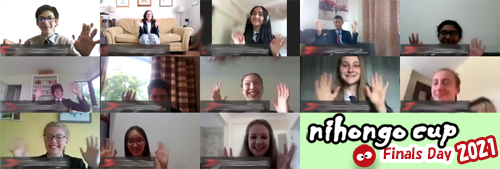
(Above: the smiling faces of some of our finalists!)
As always, the audience was able to enjoy speeches on a variety of topics, including: the popularity of cats in Japan, climate change, female scientists, music, tourism in Hungary, one school’s similarities to Hogwarts, and much, much more. We were completely blown away by the talent and creativity of all the students competing.
Due to the limits of the online competition, applicants submitted recorded videos in advance of the contes to be played during Finals Day. This added an additional challenge for Finalists, who did not have the benefit of an audience cheering them on when they recorded.
The first finalists who presented were the Key Stage 3 Category students, giving speeches on the theme of “My Ideal School”. Third place was won by Polly Fletcher (Year 9) from Wolfreton School and Sixth Form College, who described a respectful, contented school environment for her ideal school. Hannah Baumgarten (Year 9) from The Holy Cross School won second place for describing her ideal school in Kyoto, named “Peace School” where the assistant teachers are all robots! Finally, first place was won by Adam Obied (Year 8) from The Dragon School, Oxford, who described his current school and compared it to the famous fictional Hogwarts School from the “Harry Potter “books.
During the first interval, we enjoyed a percussion performance by Lewis Kentaro Isaacs. And then it was time for the Key Stage 4 & 5 Pre-GCSE Category speeches! These speeches could be on any theme the students chose. Third place went to Caspar Gower (Year 10) from Matthew Arnold School, who told us all about “tricking”, an online sport combining kicks, flips, jumps and twists. Second Place was won by Emily Downes (Year 11) from West Coventry Academy, who spoke about women in science, introducing us to famous women in the field as well as the hardships faced by female scientists. Aimme Chen (Year 10) from Sherborne Girls won first place with her joyful speech encouraging people to write their own melodies and experiment with composition and music theory.
After the Pre-GCSE Category speeches, we listened to compositions by musician and guitarist Peter Kirkbride. It was then time for the final category of the day, the Key Stage 4 & 5 Post-GCSE Category. Nicola Kalita (Year 11) from King Alfred’s Academy won third place for her speech entitled “Where are you from?”, where she described her various personal definitions of “home”. Frankie Ennis (Year 12) from Whitgift School won second place for his exploration of the impact of music in film, inspired by the use of music in the Japanese film “Your Name”. And finally, first place was won by Emma Troman (Year 12) from Hockerill Anglo-European College, who spoke about the impact of climate change on mental health, and how we can tackle this issue by working together.
Every speech by each of the finalists was of fantastic quality, and the judges faced difficult decisions in deciding the winners. You can find summaries of the speeches from the day in the event programme, which can be downloaded by clicking the attachment of this post.
We would like to thank all our sponsors. Without their support, this event would not be able to go ahead. Thank you to Japan Centre, Japan Oversea Bridging Academy, JP Books, LinguaLift, Oxford Brookes University, Ricoh UK Ltd, SCSK Europe Ltd, and SUQQU Cosmetics. We also express our gratitude to The Great Britain Sasakawa Foundation for their generous sponsorship and to the Embassy of Japan for their support.
This event was co-organised with the Japanese Language Committee of the Association for Language Learning.

We would like to offer our congratulations to all the finalists for their dedication and hard work.

31/03/2021

At the Finals Day of the Sixteenth Japanese Speech Contest for University Students on 6th March 2021, attendees were treated to speeches and presentations on topics including (but not limited to) breakfasts in different countries, Japanese yakuza films, echo-chambers, and the Japanese concept of wabi-sabi. Due to restrictions caused by Covid-19, this was the first time that the Speech Contest had ever been held online, but it was a great day and all the twenty-six students studying at nine different universities in the United Kingdom gave interesting, moving, and thought-provoking speeches all in Japanese.
The event started with the Individual Presentation Category (post-beginner level) where five finalists competed for the top prizes. Kailun Peng, a 3rd year student from Imperial College London, won first prize for her presentation on cultural stereotypes entitled “Not exactly your ‘China doll!’: Living in a world of stereotypes”. Second prize was award to Maria Dunkley, a 4th year student at the University of Warwick, who gave a presentation entitled “A Town and its Apple: A Love Story”, all about the history of the Bramley Apple and how passion for the Bramley Apple has connected people.
Wei Shan (Helen) Tan, a 4th year student from Imperial College London, was awarded a special gift from the British Association for Japanese Studies for her presentation on “Mental Health and Us”, as her presentation was highly evaluated by the President of BAJS.
Next was the Speech Category. This category is for students studying Japanese as either a degree or non-degree course. As well as giving speeches, finalists must answer challenging questions in Japanese given by an interlocutor. SOAS University of London’s Maya Estrella Jones, currently in her fourth year of a BA in Japanese won the coveted first prize for her moving speech entitled “Imperfection is beautiful – How wabi-sabi can erase mental health stigma”. She drew on her knowledge of mental health issues and discussed how the Japanese concept of wabi-sabi could be used to re-evaluate how we treat those who are struggling with their mental health. Julia Mary Follan, a third year reading Japanese at the University of Oxford, scooped second prize for her speech on the theme of “A warning on the dangers of an unequal society”, where she compared Japanese and British society based on her observations of the two countries
The final presentations of the day were given by the five Group Presentation Category finalists, all of whom are studying Japanese at a beginner level. Group Presentation finalists were not placed individually but all received participation prices for their informative and lively presentations. This year we had presentations on: “The transition in the celebration of Chinese Dragonboat Festival” (Team Katana in the Zongzi, Manchester Metropolitan University), “Things You Shouldn’t Do in England!” (Team Purple Geese, University of Warwick), “Winter Holidays – Christmas & New Year” (Team Jolly Good Snow, Imperial College London), “Breakfast Culture (UK, Poland, China and Italy)” (Team King’s Breakfast Cub, King’s College London), and “A Day in the Life of 10 Year Olds from Poland and England (Doing a Homestay in Ecuador” (Team Primary School Kids, University of Hertfordshire).
Although this year we sadly could not have our traditional reception, we held the award ceremony online. It was very emotional rewarding these students for all their hard work, especially considering the immense amount of stress university students have been under during the Covid-19 pandemic, and there were many joyful tears, even among the event organisers! All winners and runners up were awarded some brilliant prizes, provided by our generous sponsors.
We hope that next year we will be able to hold this event in person, but we thought it was a wonderful moment of connection during this year of isolation to hold our Speech Contest online. Well done and otsukaresama deshita to all our finalists!
- To download a programme, click the first "Download Attachment" link at the bottom of this article.
- To download a list of winners and finalists, click the second "Download Attachment" link at the bottom of the article.
- Check out photos from Finals Day here on our Facebook page. (Coming soon!)
- Videos of the speeches can be viewed here: https://youtube.com/playlist?list=PLGZg9IfsKtWiZzQn-iuPnzpD_LtMZQWzA
- Information on the BATJ website in Japanese and English: Speech Contest (batj.org.uk)
We would like to thank all participants, their teachers and supporters, the judges, audience members and BATJ for making the contest such a success. In addition, special thanks must go to the generous sponsors who supported this event during this difficult time:
The British Association of Japanese Studies, Central Japan Railway Company, Clearspring, Connect Job, Eikoku News Digest Limited, The Great Britain Sasakawa Foundation, IIJ Europe Limited, Japan Airlines, Japan Centre, JP Books, Ningyocho IMAHAN, Nikkei Europe Limited, Regions, Ricoh UK Limited, SUQQU Cosmetics, and ZOOM Japan.
We would like to encourage as many undergraduate students of Japanese language as possible to apply for next year’s contest! Finally, students still at school may be interesting in applying for the Nihongo Cup Japanese Speech Contest for Secondary Schools, the deadline for which is Fri 23rd April 2021. Find out more here:The Japan Foundation, London - Whats On (jpf.org.uk)
|
Download Attachment
|
Download Attachment
|
09/12/2020
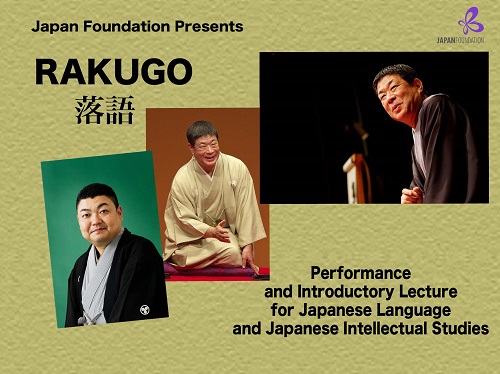
On 25th June 2020, we held a “Rakugo Performance and Introductory Lecture for Japanese Language Education and Japanese Intellectual Studies” event.
We were proud to offer those involved in Japanese language education and Japanese intellectual studies an opportunity to participate in our online performance and lecture. The online event incorporated a lecture given by Professor Kazumi Hatasa of Purdue University, as well as performances from renowned Rakugo Masters Yanagiya Sankyō and Ryūtei Saryū.
This was an online event that connected educators and students across the world to learn about Rakugo, the traditional art of one-man storytelling that has existed in Japan for over four hundred years. Our aim was to have participants from many walks of life come together to learn about Rakugo. We had undergraduates, professors, PhD students and more all taking part.
As well as funny and moving performances from both Rakugo Masters, we enjoyed listening to Professor Hatasa talked about his passion for Rakugo and sharing his expertise with us.
The event consisted of an introduction to Rakugo, followed by a demonstration of Rakugo gestures. Participants were then treated to two Rakugo performances, “Tsuru” and “Ikyuo-mochi”. Finally, there was a bilingual question and answer session which gave participants the rare opportunity to ask questions directly to people who have been involved in Rakugo for many years.
We were proud to have an almost 100% satisfaction rate for this event. Some of the comments we received were:
- “First time seeing a live Rakugo performance even though through zoom but it was still amazing!”
- “I think the event was really well balanced. The introduction was articulated, but not too long, explanations were straight to the point and the performances were wonderful. I enjoyed it a lot.”
- “All parts were fascinating, relevant and very enjoyable! The performances in particular had me enraptured (though again, I really enjoyed pretty much everything about this.”
We were also honoured that one of the participants made beautiful hand-made card following the event:
“A single moment when our hearts trembled and danced together” – Nayuta Brand
We hope that we can run more Rakugo events in the future and that people are interested in learning about this brilliant traditional Japanese performance art.
17/07/2020

The Finals Day of the Nihongo Cup Japanese Speech Contest for Secondary School Students was held on Saturday 27th June. This was an historic day for the Nihongo Cup: it was the first time in the seventeen-year-history of the contest that the Finals Day has ever been held entirely online, due to Covid-19 restrictions. The organisers wanted to make sure the hard work of all applicants was rewarded, and so decided to not cancel the competition and instead move the Finals Day online.
Every year, our judges and audience are treated to a variety of speeches given by students of Japanese at three different levels: Key Stage 2, Key Stage 4&5 Pre-GCSE and Key Stage 4&5 Post-GCSE. Topics this year included: astronauts, international journalism, climate change, curry, vegetarianism and much, much more! As always, we were blown away by the immense skill of all of the finalists and wold like to offer them our heartfelt congratulations.
This year, we received many excellent applications. In the end, eighteen finalists were selected (six in the Key Stage 3 Category, Key Stage 4&5 Pre-GCSE Category and Key Stage 4&5 Post-GCSE Category respectively). Applicants recorded their videos in advance to be played during the Finals Day, adding another level of difficulty to the contest, as they did not have the reactions of an audience to encourage them.
The day started with the Key Stage 3 Category. Students in this category gave speeches on the theme of “My Dream”. Third place was won by Benedek Payne (Year 9) from Hockerill Anglo-European College, who was inspired by the film “The Martian” to become an astronaut! Beth Kingham (Year 9) from West Coventry Academy, won second place for telling us about her dreams to be an author and a dancer. Last but not least, first place was won by Eric Taylor (Year 8) from Whitgift School, who described his dream of being a shinkansen driver, traveling from Hokkaido to Tokyo.
Next was the Key Stage 4&5 Pre-GCSE Category. Finalists in this category were allowed to give speeches on a topic of their choice. Valerie Chau (Year 12) from Hockerill Anglo-European College, chose to talk about the impact of global warming in Japan and won third place. Second place was won by Jerry Xue (Year 11) from Wycliffe College, who chose the unique topic of Navy Curry and explained to us the international origins of modern Japanese curry! Io Bitel (Year 12) from Cheney School, chose to talk about “my dream” – describing the dream to become a journalist and travel the world. With amazing Japanese language abilities like this, we have no doubt of Io’s success!
The final Category of the day was the Key Stage 4&5 Post-GCSE Category. Finalists in this category were free to give speeches on a topic of their choice. Third place was won by Anant Gupta (Year 12) from Whitgift School, who talked about vegetarianism and its links to Japanese food culture. Mimi Avworo (Year 12), from President Kennedy School, spoke about the Japanese pop music industry and its performance in Western markets compared to other international genres. First place in this category was won by Jeremy Roe (Year 13) from Whitgift School, who talked about the advancement of technology in Japan and its use in the upcoming Tokyo Olympics.
All of the eighteen speeches heard by the judges was of great quality and the judges had to make a difficult decision about who to reward with prizes. It was brilliant to hear the original and interesting thoughts of all the finalists, conveyed in Japanese. You can find summaries of all the speeches from the day in the event programme, which can be downloaded below.
- See commemorative photos from the event by clicking here. (Coming soon!)
- Download the event programme with details of all the finalists, speeches and judges.
We would like to thank all of our sponsors. Without their support, this event would not be able to go ahead. In alphabetical order, we would like to thank IIJ Europe, The Japan Centre, JP Books, Lingualift, Oxford Brookes University, Ricoh UK Ltd, SUQQU, Zoom Japan, for their generous donation of prizes for the finalists. Thank you to The Great Britain Sasakawa Foundation for their generous sponsorship and to the Embassy of Japan for their support.
We would like to offer our congratulations to all of the finalists and our gratitude to everyone who helped make the day such an unforgettable experience.


15/04/2020
The Japan Foundation has produced a short video describing our “Erin’s Challenge! Japanese Test” app designed for learners of Japanese at the beginner level. If you are interested in using the app to aid your study but are unsure about what sort of app it is, we hope that you find this video useful.
You can view the video by clicking here.
Find out more about the app here.
A new Resource Page for teachers has also been established. The page includes tips for teachers on how to use the app, as well as a list of vocabulary, expressions, conversation examples and cultural information contained on the app.
We hope that teachers find this page useful in order to maximise the best possible use of the app.
You can find the Resource Page on the “Teacher’s Room” section of the app website. Or you can click here to go there directly.
07/04/2020
The current website for “Erin’s Challenge! I can speak Japanese” will be closed with effect from July 2020. A new website offering video content will be available from 1st August 2020. We will publicise the link at a later date.
User information registered on the “Erin’s Challenge” website will be removed when the website is closed.
Thank you to everyone who has used “Erin’s Challenge! I can speak Japanese” – we hope you will continue to enjoy following Erin’s adventures on her new website from August.
Please click here to find out more information.
If you have any queries, please contact: info.language@jpf.org.uk
06/04/2020
The Japan Foundation is pleased to announce that the new online learning resource “IRODORI – Japanese for Life in Japan” has been launched.
Using this resource, Japanese learners can increase their abilities in Japanese communication in order to get on with daily life in Japan. IRODORI offers fundamental Japanese communication skills for learners of Japanese living or working in Japan.
To get started with “IRODORI – Japanese for Life in Japan”, check out the homepage here.
27/03/2020
On 14th March, experts in teaching Japanese as a foreign language located across the globe gathered together for the British Association for Teaching Japanese as a Foreign Language and the Japan Foundation, London Spring Seminar: “Using Drama as a Method of Education”. The seminar was a continuation of the April 2019 BATJ and JF Seminar, which explored “Participatory Approaches and Drama for Learning”. Although the event was scheduled to take place partly in London and partly online, due to the Covid-19 outbreak, staff worked hard to reorganise the event as an online event. Organisers were extremely pleased to be able to use technology to host an event bringing together teachers of Japanese language from all over the world. In total, seventy-three participants from thirteen countries took part in the seminar: Japan, the United Kingdom, France, Spain, the Czech Republic, the Netherlands, Portugal, Germany, Austria, Italy, Norway, Taiwan and Thailand.
The main speaker and facilitator of the innovative online workshop was Professor Michiharu Miyazaki from Hirosaki University, an experienced teacher and writer, as well as an acting president of the Society for Acquisition Oriented Learning. Professor Miyazaki and his Workshop Facilitation Team from the Society for Acquistion-Oriented Learning kindly offered his time and expertise to help the participants in the seminar explore using drama as a means of education.
After welcome speeches and greetings, the day started with Professor Miyazaki’s talk on utilising drama in order to teach language. As well as detailing the theory of the method, he explained how group drama activities can be used. Participants were able to split up into break-out groups to work together to create dramatic soundscapes.
In the afternoon, teachers working at different institutions across the world gave informative presentations on how they have used drama and dramatic techniques in their own lessons. We would like to extend our gratitude to all of the teachers who worked hard to create such fascinating lectures, which covered all learning levels and abilities. It was a lot of fun to see the hard work of many of the students, including incredible filmed skits using Japanese as a second language! After the individual presentations, participants in the seminar presented in groups about work they have done in their organisations as part of their teachings. The group presentations were given as exciting and dynamic “news show” style broadcasts. It was really great to see presenters fully utilise the creative possibilities of online workshops by performing their presentations in an original and interesting way.
To finish up the day, seminar participants discussed in groups about their findings and reflections from the day’s presentations. It was great to hear about the new thoughts and ideas prompted by the day’s activities. Everyone enjoyed talking too much that the end of the event got extended because there was so much to say.
Although the seminar was changed to an online seminar, we are so pleased everyone was able to participate and have meaningful and interesting discussions. It was an exciting challenge for us to create a new genre of interactive workshop, and we hope that the experience can be utilised for future workshops as well.
We would like to offer our heartfelt gratitude to King’s College London, who kindly offered us a modern room in the historical Bush House to serve as a base for staff in the United Kingdom helping to run the seminar. Bush House was the home to the BBC World Service until 2012, and it was an honour to be able to work in such an esteemed building rich in history. It was the perfect setting for a seminar with participants from all over the world.
We would also like to thank Professor Miyazaki, his Workshop Facilitation Team from the Society for Acquisition-Oriented Learning and all of our speakers, as well as all participants in the seminar. Thank you to all staff involved from the British Association for Teaching Japanese as a Foreign Language, King’s College London and the Society for Acquisition Oriented Learning. Without your hard work, this seminar would not have been possible.
Organised by:


In collaboration with:

04/03/2020
Important notice regarding Covid-19:
Although we are still accepting applications for this position up until the deadline (27th March 2020), the screening process has been postponed. This is because the general operations of the Japan Foundation, London have been temporarily changed. We will let all applicants know when the situation changes, and we appreciate your understanding.
Salary: £22k to £26k depending on experience and qualifications
The Japan Foundation is Japan’s principal agent for cultural relations between Japan and other countries.
The Japan Foundation London is seeking to appoint an Assistant Programme Officer to carry out the general administration and programming mainly in the area of Japanese Language Education.
This is a full-time, permanent position, based at our office in London. Applicants must already be eligible to work in the UK.
Working directly under the supervision of the Deputy Director, the post holder will manage the Japanese Language Proficiency Test (JLPT) in the UK, process grant programmes. Further responsibilities include a variety of administrative tasks such as maintaining our databased and dealing with enquiries including our book loan services. Other duties will include the role of PA to the Director General. Assisting the Director General and he or she may be also asked to carry out all general office administrative duties, occasionally beyond the main remit.
The post offers considerable scope for someone with initiative, flexibility and a willingness to play a proactive role as well as being a good team player. Applicants should be graduates and have excellent written and spoken communication skills in English (native speaker level or equivalent). Japanese language ability too, at least N2 (former level 2) of the JLPT would be preferable.
Proven excellent administrative skill and experience in the use of the Microsoft Office package are all essential. To be familiar with the use of Photoshop as well as CSS and HTML would be highly advantageous.
The deadline for applications is Friday 27th March 2020.
Interviews including a brief test in computer skills will take place the week commencing 30th March 2020.
The post is tenable from early April 2020.
Applicants should send a CV by post and covering letter to Ms Masayo Hasegawa at the address below, outlining the reason for your application and your experience and suitability for this position.
Enquiries: please contact Masayo Hasegawa 020 7492 6570 or
03/03/2020
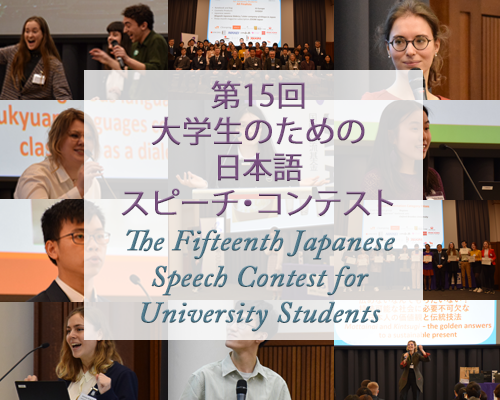
Chiune Sugihara, the Japanese concept of mottainai, the power of translation, the Swiss Army, and ghosts in Edinburgh were just some of the topics coverd by the finalists of the Fifteenth Japanese Speech Contest for University Students. The Finals Day of the Fifteenth Japanese Speech Contest for University Students was held on 29th February 2020 at King’s College London. The Finalists at this year’s event were 21 students studying at 11 different universities throughout the United Kingdom wowed the audience with their Japanese and public speaking skills. There were 15 speeches throughout the day on a huge variety of topics.
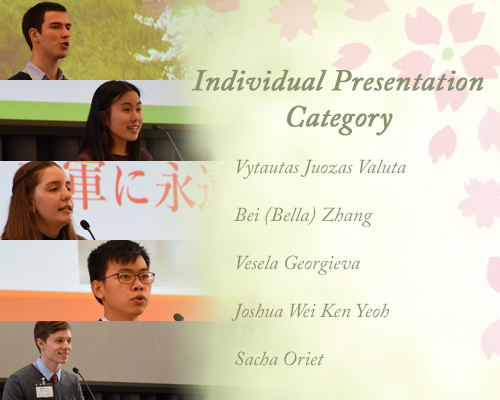
First up was the Individual Presentation Category (post-beginner level), with five competing finalists. The first prize was won by Joshua Wei Ken Yeoh, a 3rd year at Imperial College London, for his presentation entitled “Materialism and Environment”. Sacha Oriet, a 2nd year student at SOAS, University of London, claimed second prize with his presentation “The Swiss Army – A means to achieve neutrality”.
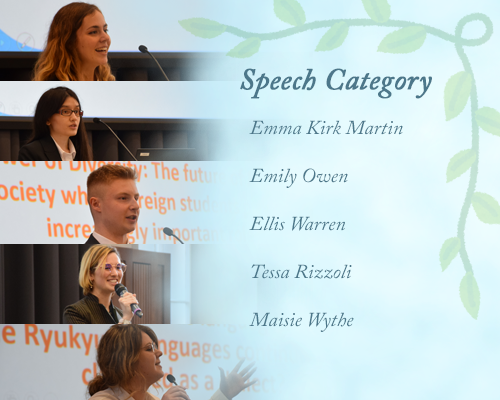
The Speech Category finalists had their turn to speak next. The speech Category is for students studying Japanese as either a Degree or Non-degree Course. After their speeches, the finalists were asked detailed questions on their chosen topics by an interlocutor, all in Japanese. Tessa Rizzoli, a 4th year student at the University of Cambridge, won the top prize for her lively speech about sustainability and Japanese tradition, “Mottainai and Kintsugi – the golden answers to a sustainable present”. The second prize was won by Ellis Warren, who in his speech entitled, “The Power of Diversity: The future of Japanese Society where foreign students play an increasingly important role”, spoke about the importance of the role of foreign students in Japan – a very relevant topic for all of our finalists!
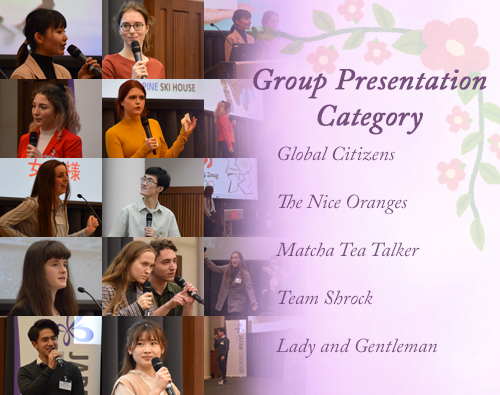
The last presentations of the day were given by the five Group Presentation Category (beginner level) finalists. The Group Category contestants were not placed individually, but instead received prizes for their participation. The audience enjoyed talks on: “Home sweet home” (Team Global Citizens, King’s College London), “Seasons in the UK” (Team The Nice Oranges, University of Leeds), “Olympics, here we come!” (Team Matcha Tea Talker, University of Bath), “Edinburgh Ghost Tour” (Team Shrock, University of Edinburgh) and “Bubble Tea” (Team Lady and Gentleman, Imperial College London).
Following the speeches, we were treated to video message past finalists, many of whom are now working in Japan and/or continuing their Japanese studies, as well as a beautiful song performance given by student volunteers from King’s College London.
After all of the hard work of all the finalists throughout the day, and excitement of the prize-giving, everyone really deserved a break! The day ended with a reception, where finalists, their supporters, sponsors, guests and staff were given an opportunity to get to know each other.
It was a great day and the hard work and dedication of all the finalists really shone through in their speeches. Minna-san, otsukaresama deshita!
- Check out photos from Finals Day here on our Facebook page
- Download the Programme from Finals Day here, with details of the finalists, judges and prizes
- Download the report of the contest winners
- Videos of the speeches - coming soon!
- Information on the BATJ website in Japanese and English – Coming soon!
We would like to thank all participants, their teachers and supporters, the judges, audience members and BATJ for making the contest such a success. In addition, special thanks must go to the generous sponsors: Central Japan Railway Company, Clearspring, Connect Job, Globe-Trotter, IIJ Europe Limited, Japan Airlines, Japan Centre, JP Books, King’s College London, Nikkei Europe Limited, Ningyocho Imahan, Oxford Brookes University, Regions, Ricoh UK Ltd, The Great Britain Sasakawa Foundation, SUQQU Cosmetics, Wagashi Japanese Bakery and ZOOM Japan.

We would like to encourage as many undergraduate students of Japanese language as possible to apply for next year’s contest! Finally, students still at school may be interesting in applying for the Nihongo Cup Japanese Speech Contest for Secondary Schools, the deadline for which is Fri 20th March 2020.
10/01/2020
Applications now being accepted for overseas schools for the 12th Japan Exchange Program for overseas children from the Hakuhodo Foundation.
This is a brilliant opportunity for Japanese teachers and pupils learning Japanese between the ages of 12 and 16 to experience Japan. Through the Preparatory Training in Japan for Overseas Teachers, teachers of Japanese language are able to train and develop their skills in Japan. Pupils on the Japan Exchange Program are able to not only travel to Japan but to also experience what life is like in a Japanese school and make friends with Japanese pupils their age.
- Application deadline: March 6, 2020 (applications must arrive by this date)
- Preparatory training in Japan for overseas teachers: November 16, 2020 – December 5, 2020 (tentative)
- Japanese language exchange program period: May 19, 2021 –June 3, 2021 (tentative)
If you are interested, you need to send your application to JF London:
The Japan Foundation, London, 101-111 Kensington High Street, London, W8 5SA
You can find further information here: https://www.hakuhodofoundation.or.jp/en/globalnetwork/
And see the application guide here: https://www.hakuhodofoundation.or.jp/download/pdf/gn12_oubo_en.pdf
19/07/2019
国際交流基金では、2020年度に海外に派遣する日本語上級専門家、日本語専門家、日本語指導助手を募集しています。
締め切りは8月14日(水)です(書類必着)
各国の日本語専門家のレポート「世界の日本語教育現場から」2019年度版が公開されています。
12/07/2019
These are some of the Japanese taster sessions that our volunteers in the Japanese Tasters for Schools (JTS) Programme have held in schools around the UK in 2018-19 so far. We would like to thank all the volunteers for their extremely hard work on the programme!
If you would like to arrange a Japanese Taster Session at your school, or if you speak good Japanese and you would like to become a JTS volunteer yourself, click here to find out more about the JTS Programme.
Comberton Village College, 8th July 2019
Academy in Cambridgeshire
Aims of the taster: Part of Japan Week.
Activities in Taster: Japanese phrases.
King Edward's School / Business Language Champions, 21st June 2019
Boarding and day school in Surrey
Aims of the taster: Event involving multiple schools.
Activities in Taster: Japanese culture and language.
Sarah Bonnell School, 12th February 2019
Academy in London
Aims of the taster: Japanese language and culture day.
Activities in Taster: Japanese greetings and numbers.
Dulwich Cranbrook Prep School, 12th October 2018
Independent school in Kent
Aims of the taster: Part of a Geography subject day (Japan focused).
Activities in Taster: Japanese writing and numbers.
Notes: "A great success!" - school staff member.
Oakham School / Business Language Champions, 20th June 2018
Independent school in the East Midlands
Aims of the taster: Part of Business Language Champions project.
Activities in Taster: Introducing Japanese language and designing manga characters for group presentations.
Notes: The volunteer "did a brilliant job and was very engaging [...] Would very much recommend her skills to anyone wanting a Japanese taster" - Mrs Sally Fagan of Business Language Champions.
Dilkes Academy, 4th June 2018
Primary school in Essex
Aims of the taster: Introduction to Japanese Language and Culture.
Activities in Taster: Japanese games, writing, simple phrases, numbers.
Kelso High School, 30th May 2018
High School in the Scottish Borders
Aims of the taster: Learning about Japanese culture.
Activities in Taster: Japanese history, culture, geography, script, and numbers.
05/07/2019
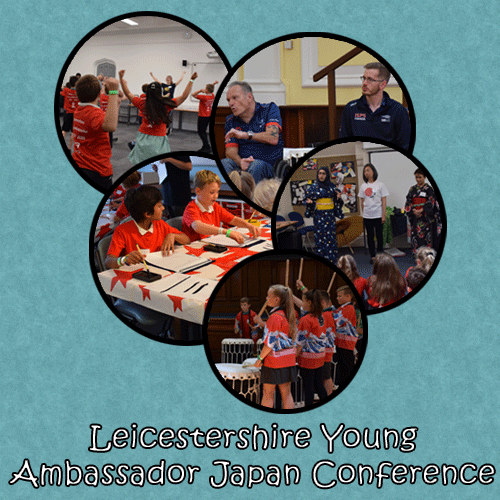
On the 3rd of July 2019, 180 pupils from 10 schools in Leicestershire took part in the Leicestershire Young Ambassador Japan Conference held at the University of Leicester. This event was to mark the run-up to the 2020 Tokyo Olympic and Paralympic Games, as well as to celebrate the links between sports and culture.
The pupils had a busy day full of activities, including taiko drumming, Japanese language, radio exercises, origami, dancing and even more!
Perhaps the most exciting part of the day was when the pupils were able to talk to an aspiring Paralympian: Great Britain Wheelchair Rugby team member, Nick Cummins. They also met his coach, Rob Tarr, a former Paralympian and assistant coach for GBWR. It was an unmissable opportunity for the pupils to meet people who are deeply involved in sports and understand how sport opens doors to so many things, including experiencing other cultures through international tournaments.
The pupils who took part in the conference will carry on preparing for the 2020 Tokyo Olympic and Paralympic Games by taking part in and organising activities that continue the themes of culture and sport.
This event would not have been possible without the cooperation and support of multiple organisations and individuals. We would like to thank all the enthusiastic pupils and teachers who took part. We would also like to thank Fleckney C of E Primary School, Little Bowden Primary School, the University of Leicester, Great Britain Wheelchair Rugby and the Japan Society.
We hope that other schools are encouraged to celebrate the run-up to the 2020 Games through sport and culture.

Organisers:
Supported by:


04/07/2019
28/06/2019
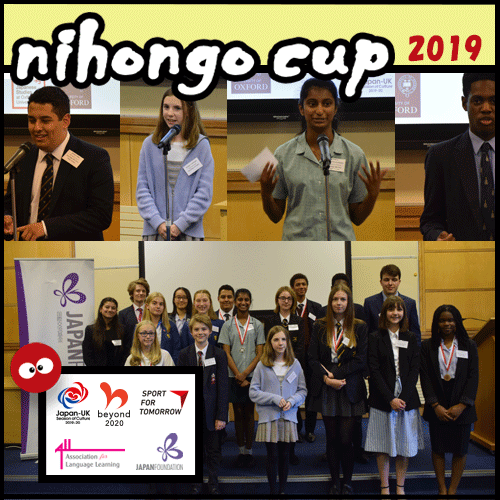
On a sunny Saturday on 22nd June, the Finals Day of the Nihongo Cup Japanese Speech Contest for Secondary School Students 2019 was held at the Nissan Institute of Japanese Studies, University of Oxford. Every year, our judges and the audience get to hear fantastic speeches from talented young Japanese-learners around the UK, and this year our finalists really surpassed themselves. Topics included (but were not limited to): ideal towns, tea ceremony, animal testing, the importance of empathy, personal growth and much, much more.
The contest started off with a whopping seventy-two individual applicants from nineteen different schools, all competing for the coveted eighteen places in the finals. The eighteen finalists (six in the Key Stage 3 category, Key Stage 4&5 Pre-GCSE category and Key Stage 4&5 Post-GCSE category respectively).
The Key Stage 3 category kicked things off, with all six finalists giving talks on “My Ideal Town”. The winner of this category was Year 8 Sharnbrook Academy pupil Scarlett Surridge, who described an idyllic rural New Zealand Town. Emily Downes (Year 9, West Coventry Academy) and Grace Mortimer (Year 7, The Harrodian) scooped second and third place respectively with their wonderful speeches.
Before the Pre-GCSE category contestants gave their speeches, we were treated to performances of traditional Japanese songs from the pupils of Holbrook Primary School. Their pronunciation of Japanese lyrics was excellent and it really goes to show that you are never too young to start earning Japanese!
Year 10 Hockerill Anglo-European College student Emma Troman took first prize in the Key Stage 4&5 Pre-GCSE category, who emphasised the importance of empathy. Second prize was won by Meera Balasubramaniam (Year 10, St Helen’s School) in her speech about safety in Japan. Ayo Ladenika (Year 12, Bexley Grammar School) scooped third prize with her discussion on animal testing in medical research.
The last six speeches of the day were in the Key Stage 4&5 Post-GCSE Category. The first prize winner in this category wins a ticket to Japan and an invitation to speak at the Japanese Speech Awards. This fantastic prize was won by Theodore Nze (Year 12, Aylesbury Grammar School), who gave a fascinating speech on “What is ‘Japanese’?”, which explored national identity. Leonid Goltsblat (Year 12, MPW London) and Jeremy Roe (Year 12, Whitgift School) took second and third place. Leonid talked about the ways of thought that influenced Japanese society, and Jeremy Roe spoke about the benefits of cultural change in an era of globalisation.
As well as the winners in each category, all of the finalists in all categories gave brilliant speeches and you can read all about them in our programme, available to download below.
We would like to offer our congratulations to all of the finalists and our gratitude to everyone who helped make the day such an unforgettable experience.
- Photos from the contest can be viewed at our Facebook page here (COMING SOON)
- Download the event programme with details of all the finalists, speeches and judges.
This event was held in collaboration with the Nissan Institute of Japanese Studies, University of Oxford.

We are very grateful to CLAIR, Japan Centre, JOBA, JP Books, LinguaLift, Oxford Brookes University, Ricoh UK, SCSK Europe and Zoom Japan for donating prizes, to the Great Britain Sasakawa Foundation for their generous sponsorship, and to the Embassy of Japan for their support.
 The event was organised by the Japanese Language Committee of the Association for Language Learning, in association with the Japan Foundation London.
28/05/2019
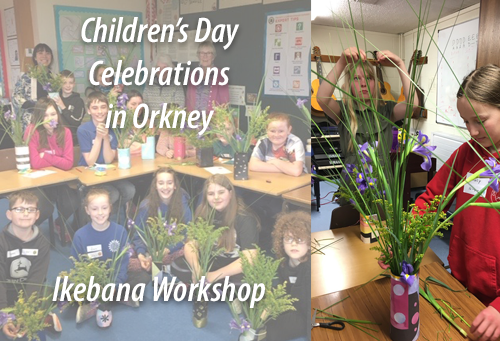
On Saturday, 4th May, the Japan Foundation, London co-organised the Japanese Children’s Day family event at King Street Halls in Orkney. The event was organised by Orkney Islands Council, Orkney Japan Association, The Consulate-General of Japan in Edinburgh, The Japan Society of Scotland and blue earth work.
As part of the day, participants took part in ikebana (flower-arranging) public demonstrations and children’s ikebana workshops. The latter was to mark Children’s Day, which is a Japanese annual holiday on 5th May. Participants were able to try out Japanese flower-arranging and take their creations home.
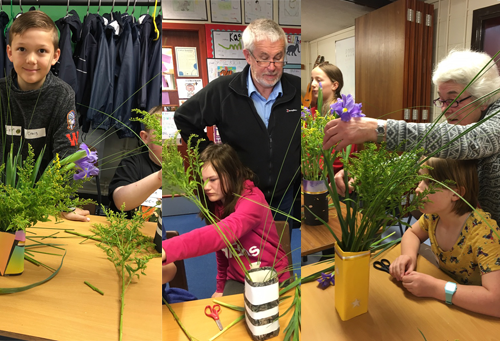
You can also learn all about ikebana on the Minato e-learning “Kadoo” course! Please click here for more information.
Thank you to everyone whose hard work made the Children’s Day family event such a huge success and thank you to everyone who took part!
07/03/2019
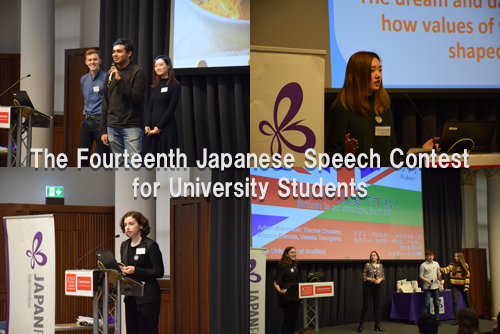
The Finals Day of the Fourteenth Japanese Speech Contest for University Students took place on 2nd March 2019 at Kings College London. The audience watched 16 speeches from finalists who had competed against students from 17 universities across the UK to get to the finals. The finalists talked about a fascinating variety of topics and the judges had a very difficult decision to make.
First up was the Individual Presentation Category (post-beginner level), with five competing finalists. The first prize was won by Karolina Jankiewicz, a 4th year student at Imperial College London, for her presentation entitled “30 years of change: Poland after 1989”. Jin Hui Teh, also a fourth year at Imperial College London, claimed second prize with his presentation on “Malaysia: Racial Diversity and Harmony”.
Next, the audience was treated to speeches from the Speech Category finalists. The speech Category is for students studying Japanese as either a Degree or Non-degree Course. After their speeches, the finalists had to think on their feet as they were grilled by an interlocutor asking questions in Japanese. Shuyuan (Shelly) Chen, a 2nd year at SOAS University of London, wowed the judges with her speech, “The dream and darkness of ‘idol culture’, how values of young generation are shaped by ‘fandom’” and was awarded first prize. Second prize went to 4th year University of Sheffield student, Alexander Thacker, who presented on: “The End of the Heisei: The Japanese Imperial Household System”. Finally, Callum Sarracino scooped the third prize. The 4th year student at the University of Edinburgh spoke about “’A Silent Voice’: The Power within Manga to Overcome Societal Prejudice”.
The presentations of the six groups participating in the Group Presentation Category (beginner level) presentations followed. The Group Category contestants were not placed individually, but instead received prizes for their participation. The audience enjoyed talks on: “Foreign Food” (University of Bristol), “The Eastern European Culture and our Backgrounds” (University of Oxford), “Britain is strange, isn’t it?” (University of Sheffield), “Melting Pot: Are These Our Countries’ Food?” (SOAS University of London), “Loch Ness Monster” (University of Edinburgh), and “’Double Eleven’ in China”.
It was a great day and the hard work and dedication of all the finalists really shone through in their speeches. Minna-san, otsukaresama deshita!
- Check out photos from Finals Day here on our Facebook page
- Download the Programme from Finals Day here, with details of the finalists, judges and prizes
- Download the report of the contest winners
- Videos of the speeches - coming soon!
- Information on the BATJ website in Japanese and English
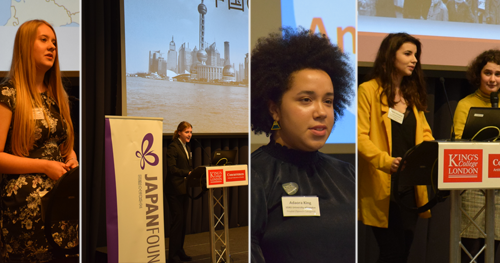
We would like to thank all participants, their teachers and supporters, the judges, audience members and BATJ for making the contest such a success. In addition, special thanks must go to the generous sponsors: Central Japan Railway Company, Connect Job, Gendai Travel Limited, The Great Britain Sasakawa Foundation, Japan Airlines, Japan Centre, JP BOOKS, King’s College London, NHK Cosmomedia (Europe) Ltd., Ningyocho IMAHAN, Nikkei Europe Ltd., Oxford Brookes University, Regions, Ricoh UK Ltd, Toshiba of Europe Ltd, Wagashi Japanese Bakery /sister company of Kitaya in Japan, ZOOM Japan.

We would like to encourage as many undergraduate students of Japanese language as possible to apply for next year’s contest! Finally, students still at school may be interesting in applying for the Nihongo Cup Japanese Speech Contest for Secondary Schools, the deadline for which is Fri 22nd March 2019.
27/12/2018
現在、国際交流基金関西国際センターでは2019年5月1日着任(応相談)の日本語教育専門員と任期付日本語教育専門員をそれぞれ若干名募集しています。海外在住の方の面接審査については、オンラインでも実施予定です。
本募集に関する提出期限を含めた詳細情報やお問い合わせ先については以下リンク先をご覧ください。
25/09/2018
This year the Japan Foundation London will carry out our Survey on Japanese Language Education in the UK. This is part of the Japan Foundation’s worldwide survey that takes place every three years and aims to find out about the state of Japanese language education around the world.
In the beginning of October, we will send details about this survey to every school and institution that we think teaches Japanese as a foreign language. If you know of any institutions that have recently started teaching Japanese, please do let us know by contacting survey@jpf.org.uk, so that we can include them in this survey. We need to have an accurate idea about the state of Japanese language education in the UK. We hope this will enable us to find better ways to support both teachers and learners of Japanese.
13/08/2018
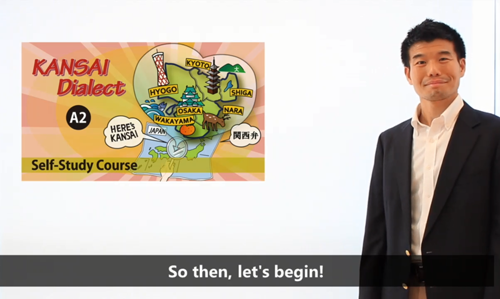
There is a new course on the Japan Foundation's Minato e-learning platform: Introduction to Kansai Dialect A2 Self-Study Course
Kansai is a region in the west of Japan famous for its delicious food, fascinating history and distinctive dialect. Lively Osaka, beautiful Kyoto and deer-filled Nara are just some of the many places to visit in the area.

Two photographs of gorgeous Kyoto.
Studying the famous dialect of the region is one way to really discover the vibrant culture of Kansai. By studying the FREE self-study Minato Course, you can work on completing the course objectives:
1. Understand the basic cultural/linguistic features of the Kansai dialect.
2. Understand simple, daily exchanges in the Kansai dialect, and with practise, be able to take part in a short conversation about a topic familiar to you.
Learning is done interactively using videos and quizzes, etc.
To find out more and get started speaking the Kansai dialect, click here!
21/06/2018
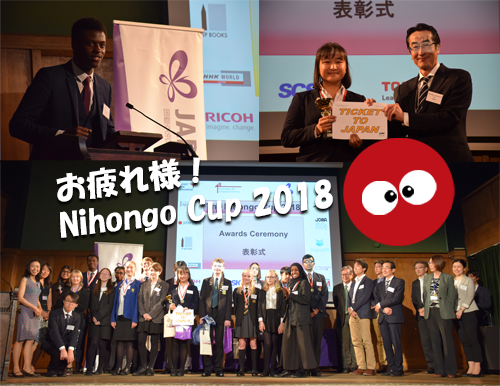
The Finals Day for the Nihongo Cup Japanese Speech Contest for Secondary School Students 2018 was held on 16th June 2018 at Conway Hall in London. It was a fantastic day full of learning, laughter and even a few tears. Students from across the UKs wowed the audience and judges with their entertaining, informative and often moving speeches, ranging from subjects such as wagyu (Japanese beef), Greek mythology, Japan’s shinsengumi and the mating habits of cicadas!
This year, 97 applicants from 22 different secondary schools applied for the contest. The quality of entries was a high standard, but eventually 18 finalists were selected to take part in the finals. Each and every one of the finalists showed fantastic skill – not just as linguists, but as speech-givers who can enthral their audience.
First up were the Key Stage 3 finalists who each gave talks on the theme of “My Ideal Day”. The wide range of interesting speeches coming from a single topic really demonstrated the finalists’ creativity. The winner in the KS3 category was Adrian Manickarajah (Year 9) from Dartford Grammar School, who talked about going to see Japanese cherry blossoms and playing the traditional Japanese game, go. Adrian was awarded with a Kindle presented by SCSK. Second place was won by Emma Troman (Year 9) from Hockerill Anglo-European College. Like Adrian, Emma also wanted to spend her ideal day in Japan, but she chose a Japanese summer’s day rather than a spring one. Finally, Skye Simpson (Year 8) scooped third place by entertaining us all with her dream of spending the day experiencing the life of a samurai, which included waking up extremely early in the morning to study bushido (“the way of the warrior”).
Next, there was an interval, during which James Long played beautiful music on the traditional Japanese flute, the shakuhachi and then it was time for the Key Stage 4 & 5 Pre-GCSE category. This category was for all students at Key Stage 4 and above who had not yet taken GCSE Japanese. This time the students were able to choose their own theme. First place went to Maryam Jaama (Year 11) from Greenford High School, for her impassioned speech on history and the legacy of war. Among her prizes, Maryam was presented with a laptop computer from Toshiba. Kiara Desai (Year 10) from North London Collegiate School swooped into second place with an informative speech on how to learn foreign languages (she currently learns five!). Timi Akinsola (Year 12) from Bexley Grammar School won third prize for his fascinating speech during which he talked about xenophobia in Japan from the perspective of a Japanese-speaking British Nigerian.
Finally, it was time for the Key Stage 4 & 5 Post-GCSE Category, a category for students who are studying Japanese beyond GCSE level. Like the previous category, finalists were free to choose their own topic, but they also had to be prepared to answer questions about their speeches in Japanese. Kei See (Year 13) from Hockerill Anglo-European College wowed the judges with her speech on the shinsengumi (the military police force that was formed in Japan by the shogunate in the late 1800s) and was a well deserving of the first prize, which won her a trip to Japan and a chance to perform her speech there at the international Japanese Speech Award. Second prize was awarded to Anthony Cho (Year 12) from Harrow School, who enthralled the audience with his speech on an unusual subject – cicadas. Ethan Madsen (Year 12) from Westminster School won the third prize in this category for talking about the timely issue of Japan’s shrinking population.
We would like to offer our congratulations to all of the finalists and our gratitude to everyone who helped make the day such an unforgettable experience.
We are very grateful to Japan Centre, JOBA, JP Books, LinguaLift, NHK Cosmomedia, Oxford Brookes University, Ricoh UK, SCSK Europe Ltd, Toshiba of Europe Ltd and A Concept for donating prizes, to the Great Britain Sasakawa Foundation for their generous sponsorship, and to the Embassy of Japan for their support.

The event was organised by the Japanese Language Committee of the Association for Language Learning, in association with the Japan Foundation London.
27/03/2018
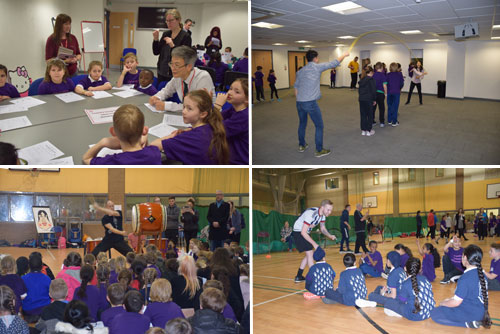
Pupils enjoy a Japanese language lesson (top left). An indoor skipping workshop (top right). A brilliant taiko drumming performance in the main hall (bottom left). Pupils take part in a football workshop (bottom right).
On 16th March 2018, lucky pupils from primary schools throughout Coventry took part in a day full of Japanese cultural activities and sports at the Coventry Young Ambassador Japan Conference, held at the Centre AT7 in Coventry.
The purpose of the event was to celebrate the upcoming Tokyo 2020 Olympic and Paralympic Games, highlighting the links between culture, language and sport. Participants in the day's events are now Young Ambassadors who are thinking up great action plans to get schools involved in various Japanese language, Japanese culture and sports related activities in the run-up to the Tokyo 2020. The event was organised by Japan Foundation, Howes Primary School, Coventry University, CSW Sport, Finham Primary School, Stivichall Primary School and West Coventry Academy and was attended by around 240 pupils from 29 schools.
The day kicked off with speeches from Mr Takashi Okada, Envoy Extraordinary and Minister Plenipotentiary from the Embassy of the Japan in the UK and Mana Takatori, Director-General at the Japan Foundation London. Five-time Paralympian gold-medallist and fluent Japanese speaker Noel Thatcher MBE then got everyone on their feet for some Japanese Radio Exercises.
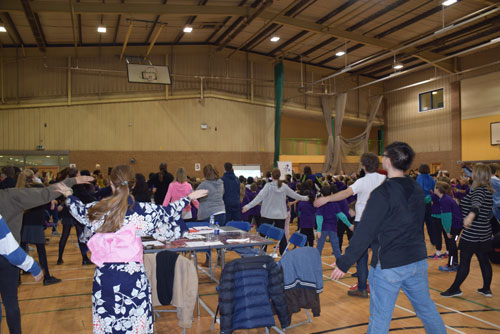
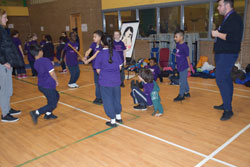
Everyone gets on their feet for some Japanese Radio Exercises (top). Paralympian gold medalist Noel Thatcher teaches a group of Young Ambassadors about Japan (bottom left). Coventry pupils try out their kendo skills (bottom right).
Well and truly warmed up, the pupils enjoyed a morning of Japanese culture with workshops on: Japanese language, origami, games, sushi, manga (comic books), ikebana, Japanese clothes, calligraphy, woodcuts, using chopsticks and Japanese stories.
After a short break for lunch, pupils were able to take place in a number of sports workshops. These included: kendo (Japanese sword-fighting), Japanese dance, football, rugby, goalball, martial arts, skipping and taiko drumming (traditional Japanese drums). It was great to see everyone trying out so many different kinds of sports and even the teachers got to join in!
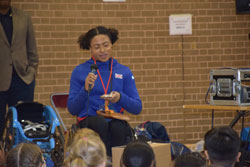

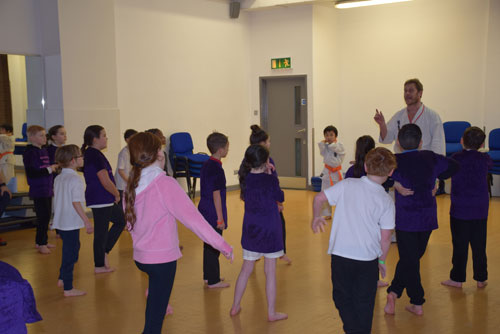
Medal-winning Paralympian, Kare Adenegan, speaks about her experiences as an athlete (top left). Young Ambassadors try out some archery (top right). A workshop all about karate, a Japanese martial art (bottom).
When the sports workshops had finished, everyone gathered in the main hall to hear a speech by Kare Adenegan, a silver and bronze medal winning Paralympian, who encouraged everyone to be ambitious and to dream. For many of the attendees, the Conference was the first time they had met professional athletes and it was a really special experience. We would like to extend our gratitude to Kare and to Noel for taking time out of their busy schedule to take part in the Conference.
To finish off the day, pupils formed teams and discussed their action plans for Japanese-related activities to help celebrate Tokyo 2020. Pupils were then each presented with a certificate and a set of prizes.
Before going home, everyone enjoyed some loud and energetic Japanese taiko drumming, which was a perfect end to a day full of activity!
This event would not have been possible without the hard work of all of the organisers. We would also like to thank the event’s supporters for their invaluable contributions to the day:

Aspire Sports, British Kendo Association, Chiba Prefecture, Coventry Building Society, Embassy of Japan in the UK, Engage! Coventry, Japan Sport Council, Kenilworth Books, Ricoh UK Limited, The Great Britain Sasakawa Foundation, The Japan Society, University of Warwick, Warwick Arts Centre and Yo!Sushi.
We hope everyone reading this has been inspired to go out and practise some sport and learn about Japan in the run-up to the Olympic Games! Minna-san, ganbatte! (Everyone, go for it!)
26/02/2018
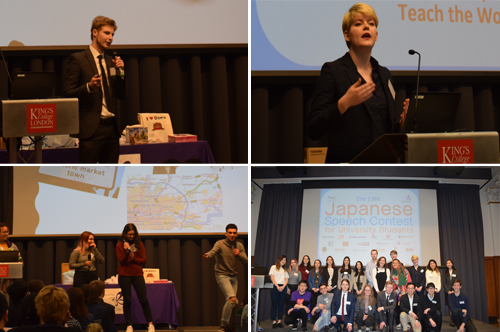
A huge “otsukaresama deshita”* and “omedetou gozaimasu”** to the 23 finalists who took part in the finals day of the Thirteenth Japanese Speech Contest for University Students Finals Day on 24th February 2018 at Kings College London.
* (“You’ve worked hard!”)
** (“Congratulations!”)
This year’s finalists competed against applicants from 17 universities across the UK to make it to the finals. The quality of the entries this year was exceptional and the audience was treated to a series of fascinating speeches on a wide variety of topics.
The day kicked off with the Individual Presentation Category Finalists (post-beginner level), with the five finalists in this category impressing the audience with their knowledge on a number of topics, ranging from diversity in Germany to the Tour de France. The first prize was won by Ellis Warren, a 2nd year student at SOAS, University of London, for his fascinating speech: “Regarding the British – The British and Racial Tolerance”. Second place was won by Sebastian Lim, a 4th year at Imperial College London, for his lively and amusing introduction to “Singapore’s Past and Present”.
Next up was the Speech Category for students studying Japanese as either a Degree or Non-degree Course. The judges were extremely impressed with not only the range of topics discussed by the finalists, but the breadth of their knowledge and their ability to talk fluently in Japanese about complicated issues. Hester Mullen, currently in her 4th year at the University of Edinburgh, scooped the top prize for her speech reflecting on what she had learnt during her internship in Shimokawa, Hokkaido. In her speech “Shimokawa, the Vibrant Future City of the Forest: What a Small Japanese Town Can Teach the World” she deftly discussed wider societal issues such as environmentalism and Japan’s ageing population using Shimokawa as an example. Second Place was won by Yee Ching Chow, a 4th year at SOAS, University of London, for her talk on “Negative body image and the influence of media amongst young women in Japan”, during which she movingly and effectively talked about her own personal experiences dealing with these issues. Finally, 2nd year University of East Anglia student Yin Kwan Lao won the third prize for her fascinating discussion of the causes of and possible solutions to the “NEET” issue in Japan and the UK, “From Young to Middle-Aged: Aggravating NEET Problem and the Importance of Family Education”.
After the Individual Category, the audience and judges were entertained by four lively group talks given by finalists in the Group Presentation Category (beginner level). The Group Category contestants were not placed individually, but instead received special prizes based on their chosen topics. The audience enjoyed talks on: “Alice in Ingurland, North and South” (University of Bristol), “Superstitions in Romania’s Cultural Events” (University of East Anglia), “Britain: expectation vs reality” (University of Leeds) and “Spicy!” (King’s College London).
Videos of the speeches - coming soon!
We would like to thank all participants, their teachers and supporters, the judges, audience members and BATJ for making the contest such a success. In addition, special thanks must go to the generous sponsors: Bloomberg L.P., Central Japan Railway Company, Gendai Travel Limited, The Great Britain Sasakawa Foundation, Japan Airlines, Japan Centre, JP BOOKS, King’s College London, NHK World, Nikkei Europe Ltd., Oxford Brookes University, Regions, Ricoh UK Ltd, TOP CAREER, Toshiba of Europe Ltd, Wagashi Japanese Bakery and ZOOM Japan.

We would like to encourage as many undergraduate students of Japanese language as possible to apply for next year’s contest! Finally, students still at school may be interesting in applying for the Nihongo Cup Japanese Speech Contest for Secondary Schools, the deadline for which is Fri 23rd March 2018.
- Download the Finals Day Programme, with details of the finalists, judges and prizes
- Download report of the contest winners
- View photos from the contest at our Facebook page
- View videos from the contest - coming soon!
- Information on the BATJ website in Japanese and English
27/06/2017
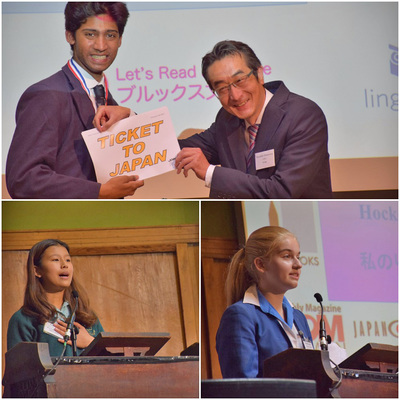 |
|||
Japan’s Shinto religion, morals in folktales and the impact of Japanese culture on music and art turned out to be winning topics at the Nihongo Cup Japanese Speech Contest for Secondary School Students 2017, which was held on 24th June at Conway Hall in London. The 18 finalists, who had been selected from 127 applicants from 26 different secondary schools across the UK, all demonstrated great creativity, thoughtfulness and incredible ability in Japanese in performing their speeches – not to mention extraordinary courage to present their ideas in a foreign language to an audience of over 100 people! The day began with speeches by students studying Japanese at Key Stage 3, who were all in Year 9. They all had to talk on the theme of “My Ideal Holiday,” but they could interpret these theme as they wished. The winner in this category was Olivia Boutell from Hockerill Anglo-European College, who spoke about how desire to travel to Japan and see the many wonderful sights there – including visiting a cat café! Her prizes included a Kindle presented by SCSK. Samiha Rahman from Greenford High School came second with her speech – she also wants to travel to Japan to visit the aquariums there. George Amis of Bexley Grammar School came third, with his speech about travelling to Ethiopia. Next was the Key Stage 4 & 5 Pre-GCSE category, for all students at Key Stage 4 and above who had not taken GCSE Japanese. They could choose any theme they liked, and the winner was Boju Khaw, a Year 10 student from St Helen’s School, who gave a fascinating speech on Japanese and Western folktales. Boju was presented with a laptop by Toshiba, among other prizes. Coming second was Anya Burakowski, Year 11 at Wolverhampton Girls’ High School, who explored the differences between Japanese and Western Art. In third place was Patrycja Juchum, a Year 10 student from St Michael’s Catholic Grammar School, who talked about what sort of jobs she would like to do in the future. The final category was the Key Stage 4 & 5 Post-GCSE Category, for students who had taken their Japanese studies beyond GCSE level. In addition to performing a speech, they also had to answer some challenging questions about their speech to demonstrate their ability to use Japanese spontaneously. The winner, demonstrating excellent presentation skills, very thoughtful speech content on the subject of Shinto and a superb ability to answer questions, was Krishan Emmanuel, a Year 13 student at Harrow School, who won the top prize of a trip to Japan to perform his speech at the international Japanese Speech Awards. The second prize went to Amy Watson, a Year 13 student at Wolfreton School and Sixth Form College, for her speech about the vocaloid Hatsune Miku, and the third prize was won by Ruchika Ganesh, a Year 13 student at Cheney School who talked about microaggressions and racial stereotypes. Between each of the three categories of speeches, the audience had the opportunity to watch a performance of the Japanese myth of “Orochi” by , and have a go at “radio taisō” exercises! Many congratulations to all the finalists, and a big thank you to everyone who came together to make the day such a success. The event was organised by the Japanese Language Committee of the Association for Language Learning, in association with the Japan Foundation London. We are very grateful to Japan Centre, JOBA, JP Books, LinguaLift, Oxford Brookes University, Ricoh UK, SCSK Europe Ltd, Toshiba of Europe Ltd and ZOOM Japan for donating prizes, to the Great Britain Sasakawa Foundation for their generous sponsorship, and to the Embassy of Japan for their support. More photos from the contest can be viewed at our Facebook page here. You can download the event programme with details of all the finalists, speeches and judges below. |
|||
| |||
02/06/2017
 |
|
Japan Foundation has launched a new course on our Minato e-learning platform: Japanese in Anime & Manga A2 (School Expressions by Scene) Self-Study Course. This is an online self-study course for learning expressions used within an anime/manga school setting. This is for people with A2 level (Elementary) Japanese ability and an interest in anime/manga. The course objectives are: 2. Able to read a simply written manga script and generally understand the content. 3. Able to understand the situation and speak the lines like the character. Learning is done interactively using videos, web sites, and quizzes. |
|
03/05/2017
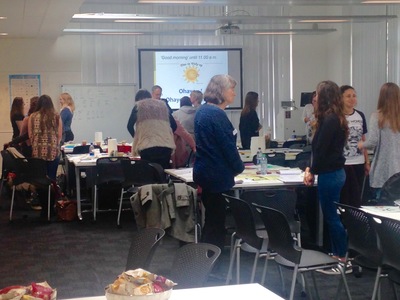 |
|
On the 29th of April 2017, 22 teachers attended a Primary Japanese Up-skilling Level 1 course at Bath Spa University. The course was set up by Network for Languages South West and supported by the Japan Foundation’s Local Project Support Programme grant. The course was led by Crispin Chambers, Head of Japanese at Tavistock College and winner of the Pearson National Teaching Award of Teacher of the Year in a Secondary School for his work in Japanese. Crispin is an excellent teacher, so everyone was inspired and left with lots of resources. One of the attendees gave the following feedback: “The best language lesson I have ever had! Crispin taught me more in one day than any language teacher has.” There will be another Primary Japanese Up-skilling Course - Level 2 on the 17th of June 2017. If you are interested in this fantastic free course, please sign up here. This event is designed for teachers who already have some basic knowledge of Japanese. |
|
07/03/2017
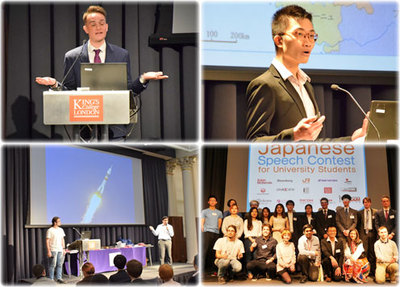 |
|||
A huge OMEDETOO GOZAIMASU (Congratulations!) to all 20 finalists who took part in the Twelfth Japanese Speech Contest for University Students, which took place at King’s College London on Saturday March 4th. The 20 finalists had been selected from a total of 88 applications from 18 universities across the UK. The day began with the Individual Presentation category finalists, all of whom are studying Japanese at post-beginner level. The presentations were all of a very high standard and it was very difficult for the judges to decide the winner. However, the first prize eventually went to Wei Lun Toh, a 3rd year student at Imperial College London, for his very engaging and informative speech on The History and Origins of English. In second place was Polena Lilyanova, also in her 3rd year at Imperial College London, who was also a finalist in the previous year’s contest. This year, she gave a very lively presentation on The Beauty of Bulgaria, while dressed in Bulgarian national costume! The Individual Presentation Category was followed by the Speech Category. All six finalists demonstrated not only exceptional Japanese ability, but also a great degree of insight and knowledge of their chosen subjects. After much deliberation, the first prize was awarded to Giordano Epifani, 4th year at SOAS, University of London, for demonstrating outstanding skills in delivering his speech on the topical subject of Adaptation problems of foreign expatriates in Japan .The second prize was awarded to Robin Reh, another 4th year at SOAS, for showing much insight and fresh perspectives on the theme of The opportunities of an ageing society. The third prize was awarded to Dominic Oben, still only in his 1st year at the University of Oxford, for showing real academic flare and understanding of Japanese culture in his talk on The significance of aesthetic values in contemporary Japan and their relationship with the Japanese identity This year’s Group Presentation Category gave beginner-level students the chance to give presentations on a topic of their choice. The four outstanding groups that made it through to Saturday’s finals were chosen from an initial 17 groups that applied, and represented the University of Warwick, the University of Hertfordshire, Imperial College London and King’s College London. They gave talks on “Italy and Hong Kong,” “Songkran Festival & Tihar Festival,” “Tim Peake’s Expedition to Space” and “Culinary Customs in China and Singapore.” These groups were not placed individually, but instead received special prizes based on their chosen topics. Videos from the contest can be viewed here. We would like to thank all participants, their teachers and supporters, the judges, audience members and BATJ for making the contest such a success. In addition, special thanks must go to the generous sponsors: Baker & McKenzie LLP, Bloomberg L.P., Central Japan Railway Company, Gendai Travel Limited, The Great Britain Sasakawa Foundation, Japan Airlines, Japan Centre, JP BOOKS, King’s College London, NHK World, Nikkei Europe Ltd., Oxford Brookes University, Ricoh UK Ltd, Toshiba of Europe Ltd, Wagashi Japanese Bakery and ZOOM Japan.
We would like to encourage as many undergraduate students of Japanese language as possible to apply for next year’s contest! Finally, students still at school may be interesting in applying for the Nihongo Cup Japanese Speech Contest for Secondary Schools, the deadline for which is Fri 24th March 2017.
|
|||
| |||

27/02/2017
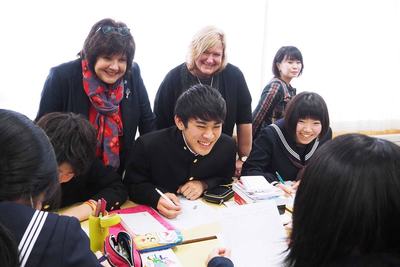 |
|
The recent Japan Study Tour for Scotland’s Education Leaders, in which 20 educational professionals from Scotland visited Japan to learn about Japanese society, culture and education, was reported in Entrance, the local newspaper of Kamaishi in Iwate Prefecture. You can find the original story in Japanese here. We have provided a basic English translation of the article below. This is an unofficial translation by the Japan Foundation London produced to the best of our knowledge. We are unable to guarantee or take responsibility for the accuracy of the content. *** Photo 1 Caption: Scottish education professionals visited Kamaishi High School and strengthened their relations with the six students who visited Orkney last year. On February 15th, 20 education professionals from Scotland, a country with a strong tradition of rugby, visitied Kamaishi City in order to deepen their understanding of Japan’s culture and education system, as well as the current disaster reconstruction efforts. They observed an English class at Kamaishi High School (Head Teacher: Kazuya Sato, Roll: 531 pupils). They also visited the building site of a school in Unosumaicho where construction on a stadium for the Rugby World Cup in 2019 is taking place, in which Scotland has a keen interest. This visit was part of an invitation programme by the Japan Foundation (Head office: Tokyo) in response to the increasing interest in Japanese as a second language, as part of an overall strategy of Scottish education policy to introduce two languages in addition to the mother tongue languages at primary schools . The purpose is to give young people in Scotland a more globally competitive outlook for the future. The tour aimed to enable participants to experience not only Japanese language, but also the culture and the education environment of Japan and to get a feel for the potentials Japanese has to offer. The delegation, who arrived in Japan on February 12th, visited an elementary school in Tokyo and held discussions with the school community. Admiration for the enthusiasm of High School students Kamaishi High School, which has been designated by the Ministry of Education, Culture, Sports, Science and Technology as a Super Science High School, has organised visits to the Orkney Isles in Scotland as part of overseas study tour into marine energy. This occasion was a chance for the Orkney Isles to develop the relationship further by making the trip to Kamaishi City. The delegates observed 37 pupils in Year 1 in an English class. They heard the pupils make speeches about their future dreams in English. Among the aspiring teachers, nurses and accountants, one pupil said, “I want to do work that helps with the reconstruction effort. I want to develop leadership skills in order to guide people involved to do this.” Mr Wilf Weir, Executive Director for Education, Leisure and Housing at Orkney Islands Council, found this admirable. “I am impressed to see the incredible enthusiasm of these pupils. I would like to share Japan’s excellence in education with Scottish people,” he commented. Picture 2 Caption: Many smiling faces as pupils make an effort to communicate The Scottish delegates asked the pupils many questions about their study. After putting the English vocabulary they knew to use, the pupils felt an added impetus to study English, saying, “We just about managed to communicate. I want to brush up on the parts that are still difficult.” The delegates also got a chance to hear about the school’s educational principles and daily life, and to talk with the six 3rd Year pupils who took part in the research visit to Orkney in September last year. After this, the delegation visited Unosumaicho. They heard about the damage situation at the building site of a school which is being rebuilt on the plateau, and learn more about the current state of the reconstruction efforts. Picture 3 Caption: Observing the school building site at Unosumaicho Dr Petra McLay, Curriculum Leader of Languages & International Culture at Bell Baxter High School in Fife which has already introduced Japanese language education, was impressed by Japan’s education system and the enthusiasm of its educational professionals, but explained that there is a lack of teachers in Scotland who can promote Japanese language education. “There is a possibility we can do this if we form a regional network of schools thinking of introducing Japanese. We hope to compare educational systems and adopt the best parts,” she said. The delegation will also experience Japanese culture through temples and Zen meditation in Kyoto, and will return to Scotland on February 18th. (Fukkou Kamaishi Newspaper, 18th February 2017, Issue 564) |
|
31/01/2017
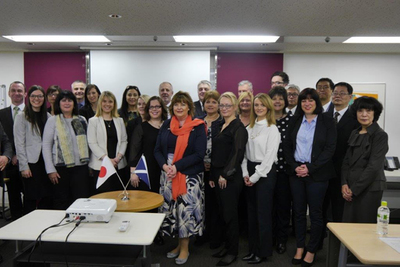 |
|||
As part of the Japan Foundation’s London’s support for links between Japan and Scotland, we will embark on a trip to Japan for 20 Scottish Leaders in Education. The trip will take place from 10th February – 18th February 2017 and will give participants the chance to learn more about Japan and the Japanese education system. We hope the programme will help deepen the participants’ understanding of Japan. It involves visiting three areas, Tokyo, Kamaishi City in Iwate Prefecture as well as Kyoto. The trip will include a wide range of activities, including lectures about the relationship between Scotland and Japan, discussions to facilitate cultural exchange with Japanese educational leaders, school visits, a visit to the area struck by The Great East Japan Earthquake in 2011, as well as cultural experiences in Kyoto. The participants are listed in the file below. |
|||
| |||
31/01/2017
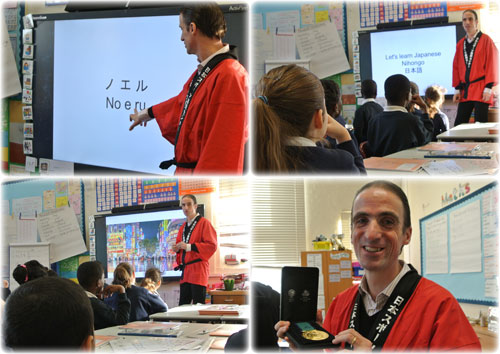
Paralympian gold medalist Noel Thatcher MBE teaching a volunteer Japanese taster at Randal Cremer Primary School in Hackney
These are some of the Japanese taster sessions that our volunteers in the Japanese Tasters for Schools (JTS) Programme have held in schools around the UK in 2017. We would like to thank all the volunteers for their extremely hard work on the programme!
If you would like to arrange a Japanese Taster Session at your school, or if you speak good Japanese and you would like to become a JTS volunteer yourself, click here to find out more about the JTS Programme.
Bartley Junior School, 1st November
Primary school in Hampshire
Aims of the taster: Part of a Japan Day.
Activities in Taster: Japaese culture and language sessions.
Notes: The JTS volunteeer "had wonderful idea of other activities we could do with he choldren and was an amazing asset to the day" - Miss Nicola Collings, Class Teacher.
St Michael's Primary School, 18th October
Primary school in Berkshire
Aims of the taster: Part of term learning project on Japan
Activities in Taster: Introduction to basic Japanese language and culture linked to the novel "Kensuke's Kingdom" by Michael Morpurgo, which the pupils had been studying.
Farringtons Junior School, 29 September
Independent School in Kent
Aims of the taster: Part of European Day of Languages
Activities in Taster: Greetings, culture, geography.
Reed's School, 26 September
Independent School in Surrey
Aims of the taster: Part of an International Day
Activities in Taster: Greetings, numbers up to 100, self introductions in Japanese, making bookmarks, Japanese culture quiz, Japanese geography, letters.
Notes: This school has taught Japanese in the past.
Darrick Wood School, 6 July
Secondary Academy in Bromley
Aims of taster: Part of an International Day
Activities in taster: Japanese greetings, Japanese numbers, self introductions in Japanese, quiz about Japan, origami, introduction to Japanese writing
Feedback: "The pupils really enjoyed the lessons and teachers present were very impressed. We are very grateful to the teachers who came in to deliver them." (Mrs Hobson, Head of Languages)
Notes: This school has taught Japanese in the past and are considering options for offering Japanese again
St Philip and James' Church of England Aided Primary School Oxford, 3 July
Voluntary Aided Primary School in Oxfordshire
Aims of taster: There are a small number of pupils at the school whose parents are Japanese
Activities in taster: Japanese greetings, Japanese numbers, body parts in Japanese, singing “atama, kata, hiza, ashi” (Head, shoulders, knees and toes in Japanese), Japanese calligraphy
Feedback: " "Children responded well to the activities. They enjoyed speaking and singing in Japanese and writing their own names. Several said they would like to continue learning Japanese at school. The "Atama, kata, hiza, ashi" song really stuck in their heads.” (Mrs Poole, Teacher and MFL Coordinator)
Notes: This school has since expressed an interest in launching a Japanese club.
Swaythling Primary School, 28 June
Community Primary School in Southampton
Aims of taster: The schools has a 2 year rolling curriculum with pupils studying the book Kensuke's Kingdom, which features Japanese language. Additionally, the school holds a Festival of Culture each year when each class has a country to study. A Japanese language taster would help to support both themes.
Activities in taster: Introduction to Japan, trying on kimono, learning about Japanese schools, greetings in Japanese, numbers in Japanese, learning about kanji characters, writing names in Japanese, origami, chopsticks
Feedback: "It was a fantastic taster day which gave the children a mixture of activities. They were able to learn lots and ask questions."
Stivichall Primary School, 25 May
Community Primary School in Coventry
Aims of taster: The Headteacher visited Japan last October with Japan Foundation. They also have link with the local Howes Primary School , which teaches Japanese. The school are therefore interested in exploring the potential for launching Japanese classes themselves.
Activities in taster: Introduction to Japan, Japanese numbers, “karuta” and bingo games, Japanese greetings, body parts in Japanese, origami
Feedback: "The teachers arrived promptly and were extremely friendly and engaging. They were very courteous to all our other guests, staff and children. The taster sessions were lively and our teachers and children said that they found the lessons interesting and learnt some Japanese. The children really enjoyed learning about Japanese culture and history. We all very much enjoyed seeing the teachers in traditional costume and the artefacts they brought into share. Lessons were taught in a fun and interactive way, with singing and actions.”
Notes: The school are investigating the possibility of launching a Japanese club.
Eastling Primary School, 2 May
Community Primary School in Kent
Aims of taster: To form part of the pupils’ learning about the wider world and developing rural children's knowledge and experience of different international cultures
Activities in taster: Japanese greetings, Japanese numbers, Japanese song, introduction to Japanese life and culture
Feedback: "Very satisfied.” (Mr Walsh, Headteacher)
Fairlawn Primary School, 3 March
Community Primary School in Lewisham
Aims of taster: The children are currently studying the book “Kensuke’s Kingdom” which features Japanese language. The Japanese taster linked into this topic.
Activities in taster: Japanese greetings, introduction to Japanese writing with song, writing some basic Japanese, learning about the Japanese festivals of Hinamatsuri and Kodomo no Hi.
Feedback: "Great engagement from the children. Really well led session that engaged all learners. Children found the session really exciting and were happy to learn greetings and about the alphabet. Really engaged them in our topic and about languages in general." (Mr Evans, Class Teacher)
Boughton Monchelsea Primary School, 21 February
Community Primary School in Kent
Aims of taster: The school has a child who has family from Japan and they thought that it would be nice for the other children to learn all about their culture
Activities in taster: Introduction to Japan, greetings in Japanese, numbers 1-10 in Japanese, explanation about the Japanese festival “Kodomo no Hi” (Children’s Day) and making a Kodomo No Hi carp streamer.
Feedback: "The children thoroughly enjoyed the taster session. The volunteer ensured that her lesson had the right amount of pace, particularly for each of the different age groups. The volunteer made her sessions interactive for the children which they really loved. They have been trying out the different greetings at different opportunities during the school day.” (Mrs Rose, KS1 leader and Year 2 teacher)
Notes: The children are now looking forward to celebrating 'Children's Day' in May.
Dartford Science & Technology College, 21 February
Foundation Secondary School in Kent
Aims of taster: Hoping to lead towards staple Japanese enrichment activity.
Activities in taster: Introduction to Japan, greetings in Japanese, numbers 1-10 in Japanese, making origami hearts
Feedback: “"Students were very engaged” (Mrs Cordery, Director of Learning for MFL)
Notes: Following the taster, the school has expressed a keen interest in launching a Japanese club
Temple Ewell Church of England Primary School, 8 February
Primary Academy in Kent
Activities in taster: Greetings, self-introductions in Japanese, colours in Japanese, making origami planes
Feedback: "The children thoroughly enjoyed working with Aiko. We had an Ofsted inspection at the time - they were very impressed and it is mentioned in the report."” (Mrs Matthews, Head of School) – You can view the school’s Ofsted report here (the taster is mentioned on Page 4)
Notes: The school has since expressed an interest in launching a Japanese club
Holtspur School, 7 February
Community Primary School in Buckinghamshire
Aims of taster: Part of term topic on Japan
Activities in taster: Looking at volcanoes in Japan, introduction to Japanese writing, introduction to Japanese seasons and culture, greetings in Japanese, trying Japanese writing
Feedback: “The volunteer was very approachable and delivered a great session."
Notes: Following the taster, the school has expressed an interest in doing more work with Japanese language and culture.
Randal Cremer Primary School, 6 February
Community Primary School in Hackney
Aims of taster: Linking to the topic of robots, with a focus of robots in Japan
Activities in taster: Introduction to Japan, greetings in Japanese and bowing, Japanese numbers
Feedback: "Noel and Kanako were fantastic volunteers. They were so enthusiastic and really engaged the children in the learning. Noel was so kind to bring resources with him and the powerpoints were really interesting and informative. Many thanks!" (Miss Ekers, Class Teacher)
Notes: The lead volunteer for this taster, Noel Thatcher MBE, is a Paralympic gold medallist and fluent Japanese speaker who has previously supported the Japan Foundation at other events such as the Language Show Live. During his taster, the pupils also got to hear about his experiences in Japan and see his gold medals!
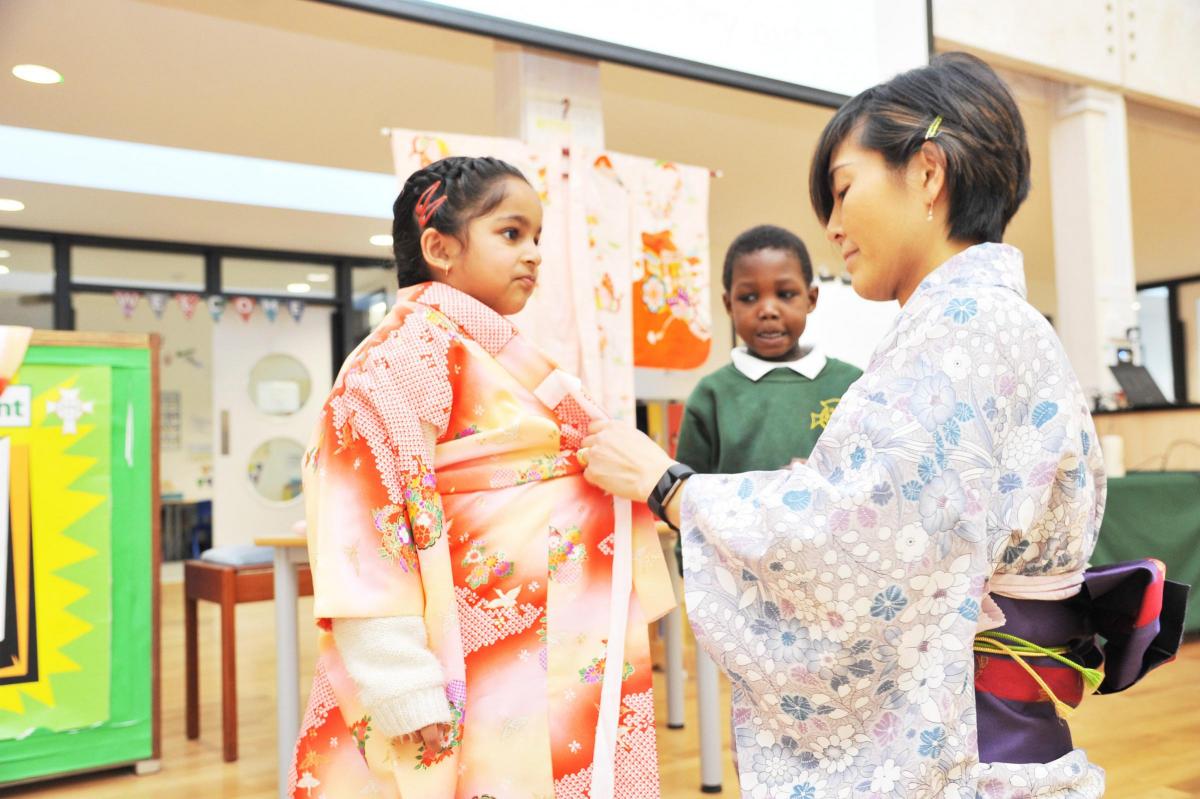
Japanese taster at Holy Cross Catholic Primary School, January 2017.
From This Is Wiltshire.
Holy Cross Catholic Primary School, 27 January
Primary Academy in Swindon
Aims of taster: Part of an International Day
Activities in taster: Introduction to Japan, greetings in Japanese and bowing, origami, names and sounds of animals in Japanese, counting in Japanese, writing in Japanese
Feedback: " The PowerPoint produced by our volunteer was excellent and child friendly. The children were inspired to repeat Japanese spoken words by listening and repeating the language... Japanese day was enjoyed by all pupils."
Notes: The visit was reported in the local press, This Is Wiltshire
Eldersfield Lawn CofE Primary School, 13 January
Voluntary Controlled Primary School in Worcestershire
Aims of taster: Part of a Japanese Day. The Headteacher had recently returned from a trip to Japan through the Japan Foundation’s Group Tour Programme for Headteachers. He had given the pupils a taste of his visit and they are were keen to learn more about Japanese culture and its language
Activities in taster: Japanese greetings, bowing, quiz about Japanese culture, numbers in Japanese, origami
Notes: The school has said that it is keen to start Japanese lessons
11/01/2017
Ofsted have reacted very positively to seeing a popular Japanese club at Longman's Hill Community Primary school in Selby, Yorkshire. The school received the following comments in their Ofsted report:
“Personal development, behaviour and welfare: Outstanding
There is a wide range of after-school and lunchtime clubs, such as a computing club and a very popular Japanese club. Pupils were very keen to tell inspectors the Japanese phrases they had learned and how they study Japanese culture.”
This primary school has been running a successful Japanese club since 2015. Since introducing the club, the number of pupils wanting to be involved has doubled, so the school applied and received a grant from the Japan Foundation’s Local Project Support Programme in 2016. You can see the full Ofsted report here.
15/12/2016
 |
|||
On December 5th 2016, 26 teachers of Japanese joined the Japan Foundation for a resource sharing workshop at Conway hall in London. This event brought together primary teachers of Japanese to share their ideas about what went well with their Japanese teaching over the last year. The day started with the introduction of the fantastic Momotaro (Peach Boy) play that was written and tested by Helen Morris from Madley Primary School. Participants got to see how Helen introduced the vocabulary and how she prepared them for their performance. You can see a small clip of the play here, and a performance of a Japanese dance here. The next presentation was from Clare Kuroishi, from the Norton Knatchbull School who showed how she has used kendo and rajio taiso to teach actions and parts of the body. Clare has been teaching Japanese though physical education and so it was really interesting to see how she integrated language learning with movement. After this, Aya Kamura Mirto from Carden Primary school shared how she taught about the weather in Japanese. Aya encouraged her pupils to make teru teru bozu (weather charms), as well as getting them to sing lots of songs which she shared with other participants. One participant, Sarah Hart told us that she “enjoyed all the sessions, as each offered a different perspective to teaching Japanese.” Lastly, the Japan Foundation’s Chief Language Advisor Makoto Netsu, introduced some new sections of the Japan Foundation Japanese Scheme of Work for Primary Schools, which is packed full of lesson plans, resources and exciting and fun ideas for teaching primary-level Japanese to Year 3, Year 4 and Year 5 pupils. Participants were shown the topics for the new materials and then went through the new materials for teaching about shopping (including role plays). These new materials will be available to download on our website soon. One participant, Jacob Smith said the following: “really useful event- I never realised there were so many useful resources/ so much support available!” While Shraddha Payyappilly mentioned that “all speakers distributing materials that they have used in past was really helpful.” You can see photos from this event on the Japan Foundation Facebook page here, and you can download some of the presentations and resources below. We would like to thank all participants for coming, especially our guest speakers! |
|||
| |||
28/11/2016
 |
|
On November 25th 2016, 32 current and prospective volunteers attended a Training Day for the Japan Foundation’s Japanese Taster for Schools (JTS) Programme, in which native and fluent Japanese speakers conduct free Japanese taster sessions in UK schools. The Training Day was held at Conway Hall in London. After an overview for new volunteers about the Japan Foundation and the JTS programme itself, the participants heard reports from volunteers who had held Japanese tasters at schools via the JTS Programme. Aya Kamura Mirto on her visit to Westdene Primary School in Brighton; a taster which led to her being employed there as teacher of their Japanese club. Next, Ceri Edwards talked about her visit to Chaddesley Corbett Primary School in Worcestershire, which also resulted in the school starting a Japanese Club at which Ceri now works. These reports were followed by workshops held by two of the JTS Programme’s most experienced volunteers. Mihoko Noguchi, who has been volunteering for JTS for over 2 years and has visited 12 schools, presented some of the ways to teach Japanese in Secondary Schools, with a particular focus on numbers and enjoyable ways to teach them. She was followed by Hitomi Ito-Burton, who has been a JTS volunteer for over 4 years and has visited 9 schools, and she presented on teaching activities for Primary School pupils, including song and dance. Finally, the Training Day ended with a discussion session on ideas for teaching Japanese as a home, heritage and mother-tongue language, led by Japan Foundation London’s Chief Japanese Language Advisor, Makoto Netsu. The discussion enabled participants to exchange tips and tricks on teaching Japanese to their pupils and their own children. Some of the feedback from participants from the training day included: 「訪問報告についてのセッションがとても勉強になりました。実際の状況の雰囲気を感じることができました。」 (“The reports on school visits by volunteers were really useful. I got a good grasp of volunteering is really like.”) “I enjoyed the activities for teaching Japanese. By being made to join in the activities, I was able to understand clearly their effectiveness and how fun it can be for both the student and volunteers themselves.” 「色んな意見交換ができて良かったです。日本語を教えるための具体的なアクティビティーは今後役立てていきたいです。」 We would like to thank all participants for coming, especially our guest speakers! You can view more photos from the event on our Facebook page here. If you are interested in taking part in the JTS programme as a volunteer, please click here for more information. |
|
07/11/2016
 |
|||
The Japan Foundation London is inviting travel agents based in the UK to submit their offer for the service of coordinating an organised group study tour to Japan in February 2017. The necessarily procedures and specifications can be downloaded from here. Because of the nature of the tour (i.e. most of the arrangements will occur within Japan), all the information as well as communication concerning this procedure is either provided or conducted only in Japanese. |
|||
| |||
21/10/2016
A big thank you to everyone who visited the Japan Foundation’s stand at the Language Show Live on 14th, 15th and 16th October at the Olympia, London.
Held once a year, the Language Show is the UK's biggest event for language learners, teachers, linguists and anyone with a passion for languages. The Japan Foundation’s stand gave visitors a chance to experience Japanese language and culture, including writing their name in Japanese and making origami ninjas! Visitors also assisted by completing surveys about Japanese. 96% of those surveyed said that they were currently studying, had previously studied or were interested in studying Japanese, which is very encouraging! We also found out that a number of Japan Foundation resources, including the Marugoto textbook series, Erin's Challenge! I Can Speak Japanese and MARUGOTO+, were popular among those surveyed. Throughout the show, visitors could also have a free Japanese taster session with Japan Foundation’s Assistant Japanese Language Advisor, Kanako Ukai.
On Saturday morning, we were very lucky to be joined by Mary-Grace Browning MBE, Chair of Examiners for Edexcel GCSE Japanese. She presented a seminar on learning language through problem-solving via a case study of UK-Japan Young Scientists partnerships, which involve exchanges between school students in the UK and Japan to experience science as a cultural bridge where by working together they learn to value each other’s languages and way of life.
Later in the afternoon, we were joined in the Language Show’s Piazza by representatives of the Japan Sport Council, and Paralympian Gold Medallist (and fluent Japanese speaker) Noel Thatcher, to introduce Japanese “radio exercises” or rajio taisoo. First, Noel told us a little bit about what it means to be a Paralympian and the many ways his Japanese language skills have contributed towards his life. Next, Ukai-sensei from the Japan Foundation taught the audience how to count in Japanese and were then given opportunity to practise their new language skills together with trying rajio taisoo for themselves, led by Noel. You can try out rajio taisoo for yourself by watching the video and viewing more information at our Marugoto Life & Culture Lab website.
We would like to thank Mary-Grace Browning, Japan Sport Council, Noel Thatcher and all our Japanese Taster for Schools volunteers who generously donated their time and expertise for the show. Domo arigato gozaimashita!
Japan Foundation will also be attending the 2017 Language Show Live in London on October 14th – 16th. We hope to see you there!
18/10/2016
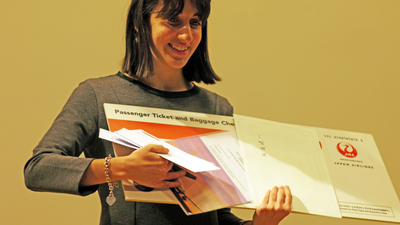 |
|
In this series of mini interviews, we’d like to introduce previous winners of the Japanese Speech Contest for University Students, and catch up on how things have been going with them since winning the contest... Giulia Surace What made you decide to enter the Speech Contest? “My Japanese teacher encouraged me to apply, as I had already taken part in the Group Presentation Category during my first year. I remember watching the Speech Category participants and thinking that it would be amazing to be able to do it someday.” You got First Prize in the contest, which means you won a free return plane ticket to Japan from JAL! What did you do in Japan? “My trip to Japan was amazing as expected. As I'd already visited most of Honshu while studying abroad in Tokyo, I decided to visit Kyushu, since I'd never been there. Great experience! I visited Fukuoka, Nagasaki and its beautiful bay with so much history; Kagoshima and Kumamoto, with its incredible castle and Inari shrine! But the best part was definitely my onsen (hot spring) tour, travelling around the Oita prefecture and surround by beautiful natural landscapes.” Do you have any funny stories to share from your time in Japan? “There was the time when I accidentally walked into an empty onsen for men, realising it was the wrong one only when a group of naked middle-aged men walked in (with my consequent scream and running away naked)!” Haha, oh dear! So what are you doing now? “I'm currently in charge of digital sales for the Asian market at Penguin Random House UK, a book publishing house. Before that I worked as a reporter/assistant correspondent for the London bureau of the Chunichi Shimbun/Tokyo Shimbun. “ Have your Japanese language skills been useful for these jobs? “I use my Japanese when dealing with Japanese clients and that's extremely helpful. I certainly used it more when I worked at the newspaper since the two journalists were Japanese and spoke little English. Nevertheless, being able to speak Japanese is definitely an advantage even when dealing with Asia in general.” How has taking part in (and winning!) the Speech Contest helped you in your career? “Winning the contest frequently came up during job interviews, as it's quite an impressive achievement. It certainly is a proof that I can speak Japanese as a lot of employers are worried that people say they speak a language without actually being able to. It also shows initiative, proactivity and the ability to research and speak in public about a topic, skills that are very valued by employers nowadays. So it definitely helped me in my career. It adds something special to the CV that others are less likely to have, and anything that sets you apart is always good!” Finally, do you have a message for all those thinking of applying for the contest this year? “Being able to take part in such a challenging competition was the greatest reward after studying Japanese for four years . When I took part in the contest, many classmates who definitely stood a chance of winning or getting the top prizes did not apply out of fear (and I was almost one of them), so it'd be great if in the future more students feel encouraged to try.” We’d like to thank Giulia for taking the time to catch up with us, and we wish her the best of luck for all her future plans. 頑張ってください! You can read a full report from the 9th University Speech Contest here. Why not try yourself?! Applications for the Twelfth Speech Contest are now open – find out more and apply here The return flight to Japan was generously provided by Japan Airlines.
|
|

11/10/2016
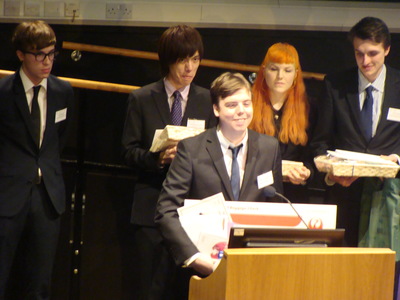 |
|
In this series of mini interviews, we’d like to introduce previous winners of the Japanese Speech Contest for University Students, and catch up on how things have been going with them since winning the contest... Ash Leigh Spreadbury You got First Prize in the contest, which means you won a free return plane ticket to Japan from JAL! What did you do in Japan? “I made good use of another prize, the Japan Rail Pass from the Japan Centre, and spent most of my time travelling around the country visiting friends. Perhaps most interesting was going to Akita prefecture where I got to go inside one of the old samurai residences (武家屋敷, bukeyashiki) in Kakunodate and visited Lake Tazawa (one of the filming locations for IRIS if you're a K-drama fan!) which was beautiful in autumn.”
Photos by taken by Ash Leigh during his trip What are you doing now with your Japanese? “I am currently enrolled on a Master's program at Keio University studying linguistics with a MEXT scholarship. It was through studying the Japanese language (because it is so different to English) that I became interested in linguistics in general and chose to pursue it for my Master's. Furthermore, were it not for having studied Japanese, I would not have been able to enrol on this course as all of the classes and communication with professors is conducted in Japanese.” How has taking part in (and winning!) the Speech Contest helped you in this path? “Winning the Speech Contest is something which I made sure to mention in both my MEXT scholarship and Keio entrance applications. I like to think that the Speech Contest provided more practical evidence of my ability to live and study in Japan (in Japanese).” We’d like to thank Ash Leigh for taking the time to catch up with us, and we wish him the best of luck with his Master’s program. 頑張ってください! You can read a full report from the 10th University Speech Contest here. Why not try yourself?! Applications for the Twelfth Speech Contest are now open – find out more and apply here. The return flight to Japan was generously provided by Japan Airlines and the JR Rail Pass by the Japan Centre.
|
|


04/10/2016
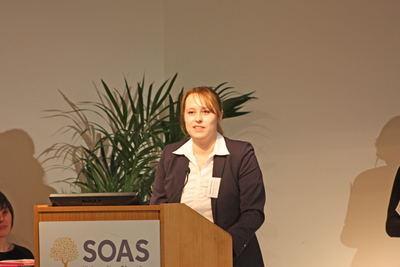 |
|
In this series of mini interviews, we’d like to introduce previous winners of the Japanese Speech Contest for University Students, and catch up on how things have been going with them since winning the contest... Laura Onciu What did it feel like to take part in the contest and win First Prize? “This was the second time I took part in the Speech Contest, the first being in 2014 when I won 2nd prize in the Individual Category, so I was much more relaxed about it. I had decided to enjoy it, rather than worry about winning, and to be honest, it never even crossed my mind that I would win First Prize! I believe it is quite easy to tell that from the face I made when my name was called. I was extremely happy when I won however, as this meant I could return to Japan sooner than I had expected.” Your prizes included a free return plane ticket to Japan from JAL, didn’t it? Have you used it yet? “I went to Japan in August, almost a year after my exchange there ended. It was great to be able to return and meet all my friends.” What was it like flying with JAL? “When I boarded the JAL plane in London, it felt as if I was already in Japan. Impeccable service, plane looked completely new and the cabin assistants were among the nicest I ever flew with. It made my flight experience so much better, and that was very important because it was a long haul flight. In addition to this, I was very excited to find out that the JAL entertainment system had loaded some of the Japanese films I wanted to watch, such as the 20th Conan movie or the 2nd Ansatsu Kyoshitsu one. Not going to the cinema most of the time means 6-8 month wait for the DVDs to be released, so being able to watch them on the plane took my mind off the long flight time. All in all, what I can say is that, if I ever have to fly to Japan again, JAL will be the obvious choice.” So what did you do in Japan? “I went to Tokyo and spent most of my time there, but thanks to the JR Pass I received, I was able to travel throughout Japan! When I lived in Japan, I did travel, but there were and still are many place I wanted to visit. This time, I went to Nagoya, Ise, Kanazawa, Aomori, Hakodate and Izu. I went to the Ise Jinguu, toured the Ninja Temple in Kanazawa, drank apple cider in Aomori, enjoyed Hakodate’s 1 million dollar night view and drove by the ocean in Izu! It was by far the best trip ever.” What things did you most enjoy? “First of all, I loved being back in Japan. The perfect service, the amazing food, the sights, but most importantly my dear friends there. Something that got my attention this time was a small hostel in Hakodate – Oyado Aozora – which had a sky mural on the ceiling. I love the sky so it was a nice surprise. Plus, the lady in charge was also very nice so I had a great time! Hakodate is definitely at the top of my what-to-visit recommendation list.” What are you doing now? What plans do you have for the future, and will they involve Japanese? “Right now, I am back at Newcastle for my last year of bachelors. My plans for the future most certainly include Japan and the use of Japanese. I will hopefully be back in Japan soon, and who knows, maybe watch the Tokyo Olympics live!” Do you have any words of encouragement or advice for students studying Japanese? And would you encourage other students to enter the contest? “Work on your practical Japanese skills! Exams are important, but they are useless if you can’t actually use it. Do participate in the speech contest! Thanks to taking part in the Speech Contest, I can now talk in front of people without stressing out (not so much at least!). It is a very useful experience, and working hard to get there improves your Japanese more than studying for a test does. And also, you might win and get to tour Japan! There is literally nobody in the world that has never wished for that!” We’d like to thank Laura for taking the time to catch up with us, and we wish her the best of luck in her final year at university. 頑張ってください! You can read a full report from the 10th University Speech Contest here. Why not try yourself?! Applications for the Twelfth Speech Contest are now open – find out more and apply here. The return flight to Japan was generously provided by Japan Airlines and the JR Rail Pass by Central Japan Railway Company.
|
|

29/09/2016
 |
|
We’re pleased to announce that the new Marugoto Intermediate B1 textbook will be released on October 1st 2016. You can get a sneak preview of the contents, sample pages and audio learning materials at the Marugoto series homepage here. About Marugoto Marugoto: Japanese Language and Culture is a coursebook series that is based on the JF Standard for Japanese Language Education, and offers learning in both language and culture. Marugoto is designed in such a way that Japanese language and culture can be studied together. It aims to increase communicative skill and responds to the needs of learners who desire to become able to speak in Japanese in as short a time as possible. Through useful topics, audio learning materials and full-colour photographs and illustrations that let you get a glimpse of Japanese life and culture, it is possible to rapidly deepen learners' interest in Japan and Japanese language. This book allows learners around the world to feel the joy of using Japanese and steadily increasing what they can do in the language. Find out more about Marugoto: |
|
News Archive
Archives of Mado language
| Click here for older news articles from the Mado newsletter. |




 The Japan Foundation, London