





 Arts & Culture Navigation
Reports
Japan Foundation events
Yoko Ono's Meltdown
14 - 23 June 2013

2013's Meltdown festival at the Southbank Centre, which took place in July, was curated by Yoko Ono, celebrating her achievements in music, visual arts and activism and coinciding with her 80th birthday.
The festival, which marked its 20th anniversary, featured performances by a number of artists from around the globe, including Japanese artists and performers such as Yoko Ono Plastic Ono Band, Ryuichi Sakamoto, Cibo Mato and Ikue Mori (pictured performing as part of the festival at the Queen Elizabeth Hall).
Serpentine Gallery Pavilion 2013 - Designed by Sou Fujimoto
8 June - 20 October 2013

Prior to the official opening of the Serpentine Gallery Pavilion 2013, architect Sou Fujimoto gave a special talk at the Serpentine Gallery taking place inside the structure.
Sou Fujimoto is the youngest architect to accept the invitation to design the structure, which will stand outside the Serpentine Gallery in Kensington Gardens until the end of October this year.
The Japan Foundation Touring Film Programme
Once Upon a Time in Japan
1 February 27 March 2013
Beginning 1 February 2013 at the ICA London, The Japan Foundation Touring Film Programme 'Once Upon a Time in Japan' has been a great success so far. This years special guest was contemporary film director Isshin Inudo; whose 2009 film Zero Focus also received its UK premiere as part of the programme. Isshin Inudo appeared for a Q&A at the film's screenings at the ICA, London and Showroom Workstation, Sheffield.
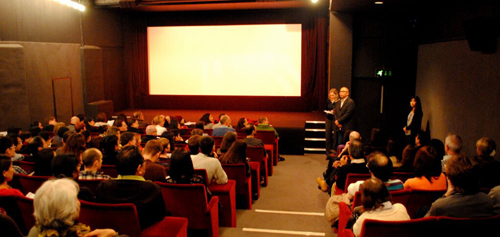
Isshin Inudo introducing Zero Focus at the ICA, London on 3 February 2013. A second screening was also held on 5 February 2013, with both screenings selling out.
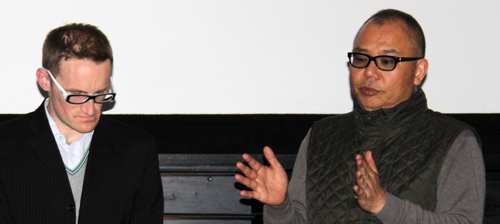
Isshin Inudo introducing Zero Focus through his interpreter (left) at the Showroom Workstation, Sheffield on 8 February 2013 (Image courtesy of Showroom Workstation).
Also during Inudo's visit to the UK, he gave a special talk at the Japan Foundation, London, where he was joined by James Bell, Features Editor for Sight & Sound magazine, before travelling to Oxford to enlighten students at Oxford Brookes University about his filmmaking career to date.

'A Life in Film: An Evening with Isshin Inudo', 6 February 2013: Isshin Inudo talks to students at Oxford Brookes University, as part of the Europe Japan Research Centre Seminar Series.
The Japan Foundation Touring Film Programme is currently touring to regional venues in the UK and continues until 27 March 2013. Further details can be found at www.jpf-film.org.uk
Tangling: A special lecture by Akihisa Hirata
18 September 2012
.jpg)
The Architecture Foundation, in collaboration with the Japan Foundation, held a special lecture at Bloomberg with emerging architect Akihisa Hirata on 18 September 2012, following the opening of his Architecture Foundation exhibition and on the occasion of the London Design Festival 2012.
A video of his lecture and the discussion chaired by Dr Sarah Teasley, Royal College of Art, can be viewed on the Architecture Foundation website.
Image courtesy of the Architecture Foundation.
Shishi-Odori in the UK
The Japan Foundation invited the Oshu Kanatsu-Ryu Shishi-Odori Dance Troupe to perform Shishi-Odori for the first time in the UK. Shishi-Odori is a popular folk performing art from the Tohoku region of Japan, an area devastated by the Great East Earthquake in March 2011.
During their time in the UK, the troupe performed as part of the Mayors Thames Festival, and also travelled for lunchtime performances in Oxford and Maidstone. The weather was very kind to the troupe, although the troupe say that it never rains wherever they perform, as the dance casts spirits to ward off rain (believe it or not!).
Thank you to everyone who came to see the performances. Here are some photos of their visit to share:
 Performing outside the Ashmolean Museum, Oxford. The beating drums resonating around Oxford attracted hundreds of passers-by, many of whom were on their lunchbreak from work!
Thursday 6 September 2012
Performing outside the Ashmolean Museum, Oxford. The beating drums resonating around Oxford attracted hundreds of passers-by, many of whom were on their lunchbreak from work!
Thursday 6 September 2012

Performing and taking over the main shopping area Jubilee Square in Maidstone. Friday 7 September 2012 (Image copyright Thomas Cogley)
 First performance at Thames Festival at the Bernie Spain Gardens outside the OXO Tower.
Saturday 08 September 2012 (Photography by Adrian Snood)
First performance at Thames Festival at the Bernie Spain Gardens outside the OXO Tower.
Saturday 08 September 2012 (Photography by Adrian Snood)
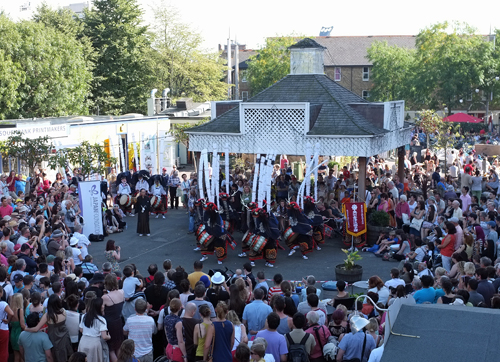 A huge crowd gathered to catch one of the two performances at Gabriels Wharf.
Saturday 08 September 2012 (Photography by Adrian Snood)
A huge crowd gathered to catch one of the two performances at Gabriels Wharf.
Saturday 08 September 2012 (Photography by Adrian Snood)
 Whoops! Not ready yet! - The troupe setting up even attracted many curious passers-by!
Saturday 08 September 2012
Whoops! Not ready yet! - The troupe setting up even attracted many curious passers-by!
Saturday 08 September 2012
 The troupe performing at Jubilee Gardens on Bankside with a spectacular view!
Sunday 09 September 2012 (Photography by Adrian Snood)
The troupe performing at Jubilee Gardens on Bankside with a spectacular view!
Sunday 09 September 2012 (Photography by Adrian Snood)
 The final performance as part of the Night Carnival the troupe crossing over Blackfriars Bridge, dazzling thousands of spectators. The resounding verdict by onlookers was that the dance is really cool!
Sunday 09 September 2012 (Photography by Adrian Snood)
The final performance as part of the Night Carnival the troupe crossing over Blackfriars Bridge, dazzling thousands of spectators. The resounding verdict by onlookers was that the dance is really cool!
Sunday 09 September 2012 (Photography by Adrian Snood)
Yayoi Kusama - Curator Talk by Frances Morris
07 June 2012
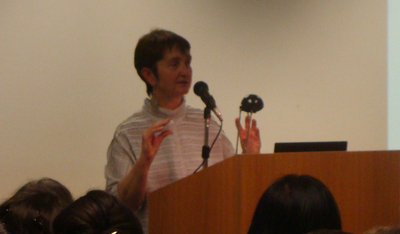
As a complement to the major retrospective, Yayoi Kusama, (8 February 5 June 2012), the Japan Foundation invited Frances Morris, Curator and Head of Collections (International Art) at Tate Modern to a special talk event held 24 May 2012. Frances Morris provided her special insight to the curatorial process behind the exhibition, a culmination of years of planning and close collaboration with the artist, bringing Kusamas work to an international audience. The talk was popular amongst audience members who commented that the most interesting part of the event was 'hearing [Frances'] personal account of working with Kusama', and that the event was 'wonderfully interesting and pleasant evening.' The exhibition will tour to the Whitney in New York in July 2012.
Yet another successful year for the Japan Foundation Touring Film Programme
29 March 2012
.jpg)
The Japan Foundation Touring Film Programme continues to go from strength to strength. Following last year's successful season, this year's season Whose Film Is It Anyway? Japanese Contemporary Auteurs sought to give voice to those auteur directors in Japan whose films perhaps are rarely screened in UK cinemas, showcasing to audiences nationwide narrative creativity within a cinema industry often dominated by derivative cinema designed for pre-existing markets.
With a record 9 films screening this year, across 7 venues (in London, Sheffield, Edinburgh, Glasgow, Belfast, Bristol & Nottingham), the Arts & Culture department at the Japan Foundation has been doing its best to make exciting creative Japanese cinema more accessible - to audiences both in London, and beyond.
This year the Foundation invited renowned director Masayuki Suo, director of the acclaimed feature I Just Didn't Do It which screened as part of this year's season, and also Katsumi Sakaguchi, documentary-film maker turned feature film maker, whose film Sleep screened as part of this year's programme. Both directors introduced their respective screenings, and also held conversation events at the Foundation, giving audiences a chance to hear more about their work, approach to filmmaking, and also learn more about the Japanese film industry in general. Many thanks to Jasper Sharp and Roger Clarke, both who kindly joined the directors in conversation.
The Touring Film Programme finished at the final venue in Nottingham yesterday, and the Japan Foundation would like to thank all 7 participating venues for their support of the season, and also to cinema-goers nationwide.
.jpg)
L-R: Masayuki Suo, Katsumi Sakaguchi
One year on - Japanese Art After 3.11
15 March 2012
.jpg)
In conjunction with the exhibition at Asia House Memory - Things We Shouldn't Forget, a selection of photographs relating to the Great East Japan Earthquake on March 11th 2011, the Japan Foundation organised a talk by Professor Hiroshi Minamishima concerning the effect of the disaster on art in Japan, and how it influenced the perception and approach of artists in the country. Professor Minamishima was joined afterwards in conversation by Angus Pryor, who explored with him further the extent of the impact.
Dr Teruaki Matsuzaki on Beauty and Form in Japanese architecture
05 March 2012
.jpg)
On 28th February 2012, the Japan Foundation London organised a very popular lecture by Dr Teruaki Matsuzaki on the subject of Japanese architecture, its history and underlying principles. Fully-booked within a week, this talk event gave the audience - largely specialists in the field of architecture - an insight into the underlying principles of Japanese architecture, putting this into an historical and cultural context, whilst also exploring comparisons between European and Japanese principles and methods.
After the lecture, Dr Matsuzaki was able to take a number of interesting questions from the floor, and as a result had the opportunity to explore in a little more detail some of the particularly interesting ideas touched upon in his talk.
Characters at the Japan Foundation!
12 January 2012
Before the opening of the Japan Foundation Touring Exhibition JAPAN: Kingdom of Characters at the Sainsbury Centre for Visual Arts, the Japan Foundation invited Hiroyuki Aihara, President of the Character Research Institute and also main curator of the exhibition, to come to the Foundation to explore in an illustrated talk the loving relationship between Japanese society and characters.
Many guests brought their own character goods, and some even came dressed as their favourite characters!

Events archive
New Stages: Approaches to Performing Arts Projects Beyond the Theatre
Recent examples from Japan
12 July 2010
Japan Foundation, London
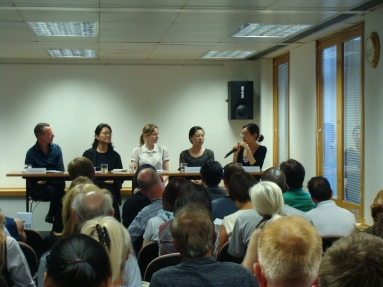
Organised in conjunction with the British Council, this event featured three performing arts professionals from Japan talking about their respective arts organisations and the ways in which they are working to present performing arts projects.
Speakers:
Yumina Kato (Steep Slope Stusio)
Hiromi Maruoka (Japan Centre , Pacific Basin Arts Communication / PARC)
Hisako Yamaura (Museum of Art, Kochi)
Hearing Kabuki
The Enchanting Sound of Kuromisu Music
5 June 2010
Japan Foundation, London

Acclaimed hayashikata (musical accompanist), Tasaku Mochizuki III, visited the Japan Foundation to talk about the role and function of kuromisu music in kabuki. He also demonstrated some of the common sounds of kuromisu music and their meanings using actual kuromisu instruments as well as videos of performances.
Artist Talk: Nihonga and the Recent Site-specific Works of Toshiyuki Higashi
26 May 2010
Japan Foundation, London

One of Japans most prominent Nihonga artists, Toshiyuki Higashi, spoke about the techniques involved in creating Nihonga works and the processes behind some of his recent site-specific works at various temples in Japan.
Explosion of Energy: Japanese Contemporary Theatre from the 1980s to the Present and Future
A Talk by Akihiko Senda
25 May 2010
Japan Foundation, London

The highly regarded veteran theatre critic, Akihiko Senda visited the Japan Foundation to talk about how contemporary Japanese theatre has progressed in the past thirty years and what the future might hold.
- Artists Open Doors: Japan/UK, 26th and 27th September 2008
- Artist Talk Yukio Fujimoto, 10th July 2008
- Japanese Cinema for Busy People II, 9th, 16th, 23rd and 30th July 2008
- Japanese Cinema: Up Close and Personal, 11th July 2008
- A Playreading of Uchiya Matsuri,16th June 2008
- Japan Foundation Organised Event at The British Museum: Crafting Beauty in Modern Japan
- Japanese Art Collections in the UK Event, co-organised by The Japan Foundation and The V&A
Appendices
- Handout for Rebecca Hill’s Presentation
- Online resources for the British Museum’s collections
- Handout for Tim Clark’s Presentation
- Schematic Plan for new Japanese Galleries at the British Museum
- Buddha of Infinite Light (World Museum Liverpool)
- Nicole Rousmaniere’s Presentation
- Japanese Lantern (Ulster Museum)
- Institution Details for Attendees
Online map of Japanese art collections in the UK, please click here
Reviews archive:
- Japan Foundation Supported Project Mikio Naruse Season at the BFI Southbank
- Japan Foundation Supported Project Alvar Aalto – Through the Eyes of Shigeru Ban
- Japan Foundation Supported Project Wild Japan: Outlaw Masters of Japanese Film at the National Film Theatre
- Japan Foundation Supported Project Funeral Parade of Roses – Part of Wild Japan at the National Film Theatre
- Japan Foundation Supported Project Makoto Shinkai Triple Bill – Part of Japan on Film at the Barbican
- The Cruel Beauty of Masumura Yasuzo
- Out of the Ordinary/Extraordinary: Japanese Contemporary Photography
- Karakuri!
- Miyagi Dance: Asterisk
- Japanese Mask Dance: Hongawa Kagura
- Japan's Artists Today (Bracknell Gallery)
- Counter–Photography:Japan's Artists Today (Oriel Davies Gallery)
- Japanese Theatre from Modern to Contemporary and its Prospects
- Contemporary Art and the Museum in Japan
- 12th Raindance Film Festival
- Tsugaru-Shamisen 2004
- Jellyfish Eyes: Takashi Murakami at Liverpool Biennial 2004
- Instal. 04: Brave New Music
- Manga Live! Manga Masterclass
- Makoto Nomura: His Most Unconventional World of Art Talk and Workshop


 The Japan Foundation, London