Japanese Language Refresher Course 2008
5th August, 2008
From 21st to 25th July 2008, 14 teachers came to the Japan Foundation London Language Centre to attend this year's Japanese Language Refresher Course. The course aims to submerse Japanese-language teachers in Japanese for a week, so they can brush up and improve their language skills.
Each morning the group came together for some warm up activities, which included Japanese dancing (Bon-odori) and singing (Hotaru no hikari).
The teachers were then split into two groups depending on their self-assessed level of Japanese, and had language sessions throughout the day, delivered by the JFLLC's Japanese-language advisors, and Japanese teachers from SOAS. As part of the language sessions the participants worked on writing their own haiku, and the participants in the higher-level group worked on their own production of a Japanese ninja drama.
In the morning of Wednesday 23rd July (the third day of the course) participants visited the British Museum, and were given a tour of the Japanese exhibits. They then chose their favourite exhibits, and the lower-level group used these as inspiration for their haiku. The higher-level group later made posters on their chosen artefacts. Following the British Museum, all participants joined teachers for a lunch at a Japanese Restaurant.
Following each afternoon's language sessions, participants were offered resources sessions including a tour of the Japan Foundation library and introductions to various resources produced by the Japan Foundation (Erin's Challenge, Ready Steady NihonGO!, and Minna no Kyozai).
On the final day of the Refresher Course, Japan Foundation staff and StepOutNet members were invited to watch as participants presented their haiku and gave their Japanese drama performance. The participants were then presented with certificates by JFLLC director Harufumi Murata.
The participants' comments below reflect the popularity of this year's course:
Super language teaching which had helped secure some of my dodgy understanding of grammar! ... Thank you all so much for your hard work and kindness (Meredith Bryer, primary school teacher)
I received many useful teaching materials and I am so impressed with the facilities that the JFLLC has to offer teachers of Japanese. I feel thoroughly supported and can't wait to try out some of the materials in September. I found the teachers inspiring and well-prepared and very professional (London secondary school teacher)
I enjoyed the variety of the course and opportunity to learn more about Japanese culture as well as the language. I loved doing the [play]! I feel a lot more confident about doing creative things in my lessons and can see how valuable drama is in learning a language. All the teachers were excellent and this made the whole course very enjoyable and stimulating (Mairi Smart, Audenshaw School, Manchester)
The Japan Foundation would like to thank the participants for their hard work and success during the course.
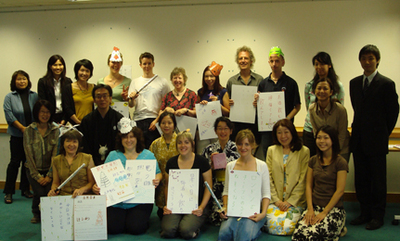 |
Refresher Course participants with StepOutNet members and Japan Foundation staff |
Back to News
Japan Foundation Mailing list
If you would like to receive information about news and events from the Japan Foundation please provide us with your details by registering with the Japan Foundation.
News Archives
Archives of Mado
The archives of Mado (April 1999- September 2006) may be particularly useful in the following ways:
- For ideas, texts and activities to use in the classroom see the Teacher’s pages. To see what is included in the Teacher’s pages of each edition click here.
- To find out what other schools have done to introduce and develop Japanese language education in their schools.
 |
 |
News, views, teaching ideas and course information designed for everyone involved in teaching Japanese in the UK.
| Nihongo Cup attracts record number of entries |
| Setting up a network for Stepping Out |
| Japanese Works |
| Teacher's Pages: Lafcadio Hearn: A love of Old Japan |
| Undergraduates compete in new Japanese speech contest |
|
Download
Download ZIP version |
|
|
| Mado is now available to you online! |
| |
To make the most of this interactive online only version simply download as usual and then save a copy to your desktop.
From the saved copy you will be able to access the sound files with ease. |
| Undergraduates compete in new Japanese speech contest |
| Head start inspires action in japanese |
| Expanding the Japan-related Network |
| Teacher's Pages: Waste not want not: Mottanai! |
|
Download
Download ZIP version |
|
| The Launch of Ready Steady NihonGO! |
| Why Practice Pronunciation? |
| Japanese Clubs - 35 Years of Gonenkai |
| Teacher?fs Pages: Japanese Pronunciation |
|
Download
Download ZIP version |
|
| Setting standards for Japanese |
| Manga and anime in your classroom |
| The power of speech |
| Teachers Page: Dealing with dilemmas |
|
| Download |
|
| 15 years of Urawa |
| Higher Education Focus |
| New Library books |
| GCSE Reading Resource |
|
| Download |
|
| Ready Steady NihonGO: Moving forward in 2005 |
| Q & A: WJEC Level 1 Certificate in Japanese |
| Resources: Using ICT in the Classroom |
| Teachers Page: CV for the Future |
|
| Download |
|
| Speech Contest; Finals Day report |
| Annual Support Programmes |
| Resources: Tobu reviewed |
| Teachers Page: Kanji Mix and Match |
|
| Download |
|
| Working together with other Japan-related organisations |
Standards in Japanese :The Languages Ladder
Head Start 2004 reviewed |
| Stretching Out reviewed |
| Teachers Page: Reading for A Level |
|
| Download |
|
JLC Re-launches Speech Contest for Schools
Stepping Out reviewed |
| Ready Steady NihonGO |
| Reports from the Primary Conference |
| Teachers Page: Laughter Brings Good luck (Fukuwarai) |
|
| Download |
|
| Refresher
course at new centre |
| Ready Steady NihonGO |
| British Council Education and Training |
| What’s New in the Library |
| British Council Education and Training |
| Teachers Page: Plan your Dream Trip to Japan with Dragons, Snakes and Ladders |
|
| Download |
|
| Japan Foundation on the move |
| Biggest ever Head Start |
| The National Languages Strategy: Languages for all, Languages for life |
| Top-ten online resources |
| Teachers Page: Using ICT to keep up with current issues |
|
| Download |
|
| Celebrating Japanese Teaching in the UK |
| Taking Control – event review |
| Japanese for Everyday Communication – event review |
| Primary Japanese |
| Jle-uk |
| Tobu wins award |
| Teachers Page: Haiku for the New Year |
|
| Download |
|
| Starting Younger |
| Getting to grips with Grammar |
| The Green Paper |
| Urawa Nikki |
| Teacher Page: A Place Near Me |
|
| Download |
|
| Japanese Degree Course Report Update |
| Japan 2001: Education reviewed |
| Teachers Page: Teaching Japanese through Mathematics |
|
| Download |
|
| Class Acts: Success Stories from the UK |
| Japanese Classroom |
| Q & A: AS exam |
| Resources: CD-ROMS reviewed |
| Teachers Page: Writing a Diary |
|
| Download |
|
| Symposium on Bridging the sectorial divide |
| Flights of Fancy |
| Resources: Preview of Mirai stages 3 & 4 |
| Teachers Page: Making a Speech in Japanese |
|
| Download |
|
| WJEC |
| Teachers Page: Motivating through Manga, |
|
| Download |
|
| Tobu |
| Japan 2001 Special inc. Class Acts, Homestay UK, Higher Education seminar |
| Resources: Ima reviewed… |
| Teachers Page: Kanji Families |
|
| Download |
|
| Starting Young |
| Japanese A Level set texts… |
| Teachers Page: Let’s Recycle |
|
| Download |
|
| Staffing Japanese |
| A level update |
| Focus on A Level Resources… |
| Teachers Page: Omikuji |
|
| Download |
|
| Refresher Course reviewed |
| Annual Support Programmes |
| Exchanges with Japan |
| Teachers Page: Talking Timetables, |
|
| Download |
|
| Head Start reviewed |
| The new A level Japanese |
| ALL launches Japanese Language Committee… |
| Teachers Page: Food, Fitness and Health |
|
| Download |
|
|
|