UK Students Visit Japanese Sister School
24th August, 2007
Report - by Will Woodward
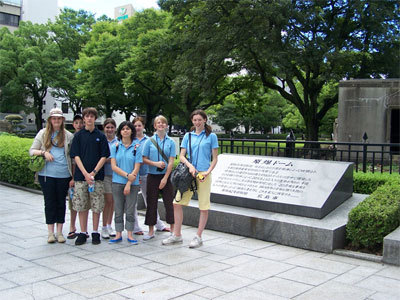
In July ten students from Lady Manners School in Bakewell travelled to Yokohama to attend their sister school (Kanagawa Sohgoh High School - Kansoh) and study the atomic bombing of Hiroshima. The schools were initially linked by the British Council Tokyo, and 20 Kanasoh students visited Lady Manners in March.
The July visit was the culmination of a joint Year 9 second year history project considering the question 'Was the bombing of Hiroshima justified' taught in the context of Japan's role in the Second World War. The students who produced the ten best responses were chosen to take part in this second part of the Joint Curriculum Project.
A total of four school days were spent at Kanasoh. 18 second and third year students from the English Language Presentation Class had spent several weeks working on the question, before broadening their research to cover current issues such as the proliferation of nuclear weapons and the threat posed by North Korea's nuclear ambitions.
The students were able to attend a range of different lessons, and were even given special lessons in Iai-dō (a Japanese martial art associated with smoothly controlled swordmanship) and Japanese paper-making. One of the highlights of the trip was being welcomed into Japanese family homes, where the students, most of whom had never left Europe, were able to try natto, sleeping on futons, and using traditional Japanese toilets. They also got to see some sights, such as Yokohama's spectacular Minato Mirai development.
What really made the trip a once-in-a-lifetime experience was being able to visit Hiroshima for three days with ten students from Kanasoh. They toured the Peace Memorial Museum, the Genbaku Dome, and the Peace Park, where they spent two minutes contemplating the event.
The group was able to meet two hibakusha (victims of the atomic bombing). The first testimony was very moving, and her memories of losing her baby born after the war helped the students understand the unique nature of the atomic bombings. In two cases hearing the testimony of the survivors drastically altered the students' perceptions of the bombing of Hiroshima.
While in Japan, the Lady Manners students were able to study a topic to a depth impossible in their weekly 75 minute history lesson at school, spending an average of three hours per day working on Hiroshima. The final outcome was a joint presentation class on the students' findings. Students from both schools took turns in expressing their ideas about Hiroshima, and the responses were surprisingly diverse. Having also visited the Edo-Tokyo Museum in Ryogoku, Tokyo, some Lady Manners students broadened their thinking on bombing of civilians to include the fire-bombing of Tokyo in March 1945.
Thanks to the Daiwa Anglo-Japanese Foundation, the Great Britain Sasakawa Foundation, the British Council and Sakae Suzuki and the staff and students of Kanagawa Sohgoh High School.
 |
|
Back to News
Japan Foundation Mailing list
If you would like to receive information about news and events from the Japan Foundation please provide us with your details by registering with the Japan Foundation.
News Archives
Archives of Mado
The archives of Mado (April 1999- September 2006) may be particularly useful in the following ways:
- For ideas, texts and activities to use in the classroom see the Teacher’s pages. To see what is included in the Teacher’s pages of each edition click here.
- To find out what other schools have done to introduce and develop Japanese language education in their schools.
 |
 |
News, views, teaching ideas and course information designed for everyone involved in teaching Japanese in the UK.
| Nihongo Cup attracts record number of entries |
| Setting up a network for Stepping Out |
| Japanese Works |
| Teacher's Pages: Lafcadio Hearn: A love of Old Japan |
| Undergraduates compete in new Japanese speech contest |
|
Download
Download ZIP version |
|
|
| Mado is now available to you online! |
| |
To make the most of this interactive online only version simply download as usual and then save a copy to your desktop.
From the saved copy you will be able to access the sound files with ease. |
| Undergraduates compete in new Japanese speech contest |
| Head start inspires action in japanese |
| Expanding the Japan-related Network |
| Teacher's Pages: Waste not want not: Mottanai! |
|
Download
Download ZIP version |
|
| The Launch of Ready Steady NihonGO! |
| Why Practice Pronunciation? |
| Japanese Clubs - 35 Years of Gonenkai |
| Teacher?fs Pages: Japanese Pronunciation |
|
Download
Download ZIP version |
|
| Setting standards for Japanese |
| Manga and anime in your classroom |
| The power of speech |
| Teachers Page: Dealing with dilemmas |
|
| Download |
|
| 15 years of Urawa |
| Higher Education Focus |
| New Library books |
| GCSE Reading Resource |
|
| Download |
|
| Ready Steady NihonGO: Moving forward in 2005 |
| Q & A: WJEC Level 1 Certificate in Japanese |
| Resources: Using ICT in the Classroom |
| Teachers Page: CV for the Future |
|
| Download |
|
| Speech Contest; Finals Day report |
| Annual Support Programmes |
| Resources: Tobu reviewed |
| Teachers Page: Kanji Mix and Match |
|
| Download |
|
| Working together with other Japan-related organisations |
Standards in Japanese :The Languages Ladder
Head Start 2004 reviewed |
| Stretching Out reviewed |
| Teachers Page: Reading for A Level |
|
| Download |
|
JLC Re-launches Speech Contest for Schools
Stepping Out reviewed |
| Ready Steady NihonGO |
| Reports from the Primary Conference |
| Teachers Page: Laughter Brings Good luck (Fukuwarai) |
|
| Download |
|
| Refresher
course at new centre |
| Ready Steady NihonGO |
| British Council Education and Training |
| What’s New in the Library |
| British Council Education and Training |
| Teachers Page: Plan your Dream Trip to Japan with Dragons, Snakes and Ladders |
|
| Download |
|
| Japan Foundation on the move |
| Biggest ever Head Start |
| The National Languages Strategy: Languages for all, Languages for life |
| Top-ten online resources |
| Teachers Page: Using ICT to keep up with current issues |
|
| Download |
|
| Celebrating Japanese Teaching in the UK |
| Taking Control – event review |
| Japanese for Everyday Communication – event review |
| Primary Japanese |
| Jle-uk |
| Tobu wins award |
| Teachers Page: Haiku for the New Year |
|
| Download |
|
| Starting Younger |
| Getting to grips with Grammar |
| The Green Paper |
| Urawa Nikki |
| Teacher Page: A Place Near Me |
|
| Download |
|
| Japanese Degree Course Report Update |
| Japan 2001: Education reviewed |
| Teachers Page: Teaching Japanese through Mathematics |
|
| Download |
|
| Class Acts: Success Stories from the UK |
| Japanese Classroom |
| Q & A: AS exam |
| Resources: CD-ROMS reviewed |
| Teachers Page: Writing a Diary |
|
| Download |
|
| Symposium on Bridging the sectorial divide |
| Flights of Fancy |
| Resources: Preview of Mirai stages 3 & 4 |
| Teachers Page: Making a Speech in Japanese |
|
| Download |
|
| WJEC |
| Teachers Page: Motivating through Manga, |
|
| Download |
|
| Tobu |
| Japan 2001 Special inc. Class Acts, Homestay UK, Higher Education seminar |
| Resources: Ima reviewed… |
| Teachers Page: Kanji Families |
|
| Download |
|
| Starting Young |
| Japanese A Level set texts… |
| Teachers Page: Let’s Recycle |
|
| Download |
|
| Staffing Japanese |
| A level update |
| Focus on A Level Resources… |
| Teachers Page: Omikuji |
|
| Download |
|
| Refresher Course reviewed |
| Annual Support Programmes |
| Exchanges with Japan |
| Teachers Page: Talking Timetables, |
|
| Download |
|
| Head Start reviewed |
| The new A level Japanese |
| ALL launches Japanese Language Committee… |
| Teachers Page: Food, Fitness and Health |
|
| Download |
|
|
|