





 Japanese Studies & International Dialogue Navigation
What's On - Archive
Click to see what's on in these sections


 Beyond Words: Understanding Japanese Society Through Literature and Translation
|
|
*Applications Open* Japanese Studies Grant Programmes 2026-27
|
|
War and Peace: How ‘Grave of the Fireflies’ Speaks to Japanese Literature, Art, History, and International Relations
|
|
Okinawan Crafts: History and the Present
|
|
The JF Japanese Studies Survey 2025
|
|
Call for Applications: Japan Foundation London Grant Programme (Japanese Studies & Intellectual Exchange) 2025-2026
|
|
The UCL-Japan Youth Challenge 2025 is Looking for UK-based Participants!
|
|
*Looking for Volunteers* for the UCL-Japan Youth Challenge 2025!
|
|
Exploring the World of Japanese Studies - Ghibli in the Machine: AI Controversies and the Appropriation of Anime
|
|
Mobility, Migration, and Transnational Communities around the Globe
|
|
Symposium on the 80-year legacy of War and Paths to Peace: Commemorating VJ Day
|
|
The Art of Recovery: Legacies of the Fukushima Triple Disaster
|
|
Lafcadio Hearn’s Japan: from Enchantment to Intercultural Understanding
|
|
JF/BAJS PhD Workshop 2025 - Career Development in Japanese Studies
|
|
The Japan Foundation Awards 2024 Commemorative Lecture: How Japanese Arts and Cultures Can Make Us Happier
|
|
Theory and Film in the Political Reconstruction of Post-War Japan, a talk at Edinburgh University
|
|
Echo-locations: Toward a Sonic Aesthetics of Japanese Karaoke at Edinburgh University
|
|
Space and Us Symposium and Reception - UCL-Japan Youth Challenge
|
|
*Looking for Volunteers* UCL-Japan Youth Challenge 2024
|
|
In the Shadows of Gratitude: AGEING & CARE in Japanese Society - *Talk and Documentary Screening*
|
|
Translation of Bodies: performance work of a professional puppeteer inspired by Japanese otome bunraku at Edinburgh University
|
|
JF/BAJS Japanese Studies Postgraduate Workshop 2024
|
|
The Scots and Japan: First Contact (1613 - 1623) at the University of Edinburgh
|
|
Seeds in the Heart and Leaves of Words: Traditional Japanese Poetry Beyond the Haiku
|
|
Japan-Britain Contemporary Theatre Exchange
|
|
The UCL-Japan Youth Challenge 2023
|
|
*Looking for Volunteers* UCL-Japan Youth Challenge
|
|
Remembering Hiroshima and Nagasaki
|
|
BAJS/Japan Foundation Postgraduate Workshop 2023
|
|
*Looking for Volunteers* UCL-Japan Youth Challenge
|
|
Postgraduate Workshop 2022
|

|
|
Japanese Documentary Filmmaker Haneda Sumiko: Authorship and Gender Discourses
|
|
UCL-Japan Youth Challenge
|
|
Postgraduate Workshop 2021
|
|
Women and Sport in Japan
|
|
Japan Foundation/BAJS Japanese Studies Postgraduate Workshop 2020: Publishing Your Research
|
|
Twenty-First Century Perspectives on Kazuo Ishiguro – an international conference
|
|
Experience Japan Exhibition 2019
|
|
Okinawan Art in its Regional Context
|
|
Call For Applications: Europe-Japan Intellectual Exchange Session 2019
|
|
Joint East Asian Studies Conference 2019
|
|
What is Manga?
|
|
Japan Youth Challenge 2019
|
|
Japan Information Day 2019
|
|
Reopening the Opening of Japan: A Two-Day International Conference to Mark the 150th Anniversary of the Meiji Ishin
|
|
Japan Foundation/BAJS Japanese Studies Postgraduate Workshop 2019: Career Progression
|
|
Sake Symposium: Understanding the Unique Aspects of Sake
|
|
Experience Japan Exhibition 2018
|
|
Japanese Study Seminar in Alsace 2018: Call for Participation!
|
|
Countdown to Kickoff: Japan's rugby history one year out from the 2019 Rugby World Cup
|
|
BAJS 2018 Conference: Crisis? What Crisis? Continuity, and Change in Japan.
|
|
UCL-Japan Youth Challenge 2018
|
|
UKABS 2018 Annual Conference
|
|
Japan Foundation / BAJS Japanese Studies Postgraduate Workshop 2018: Bridging the Academic Worlds of the UK and Japan
|
|
Conference: At the Roots of Visual Japan. Word-text dynamics in early-modern Japan
|
|
Contemporary Japan Speaker Series by the London Asia Pacific Centre
|
|
Japan Foundation at Experience Japan Exhibition 2017
|
|
Conference: Foreign Graduate Employment in Japanese Companies – Implications for Japanese Studies Teaching & Research
|
|
Japan’s Changing Diplomatic and Security Practice – A Research Workshop
|
|
Ecologies of Knowledge and Practice - Japanese Studies and the Environmental Humanities
|
|
Japanese Study Seminar in Alsace 2017: Call for Participation!
|
|
BAJS Workshop: Meiji Japan in Global History
|
|
International Workshop on Reflective Transitions of Politics in Japanese Art
|
|
UCL-Japan Youth Challenge 2017
|
|
Japanese Cultural Studies outside of Japan – its current status and future perspectives
|
|
Japan Orientation at the University of East Anglia
|
|
London, Rio, Tokyo Olympics Symposium
|
|
Sport and Diplomacy: Past Reflections and Looking Towards 2020
|
|
A Silent Voice - Discover Japanese Studies through Anime!
|
|
Japan Foundation / BAJS Japanese Studies Postgraduate Workshop 2017: Make an Impact
|
|
Japan Foundation at Experience Japan Exhibition 2016
|
|
Silence is Golden? Classroom Silence in Universities in Japan and the UK
|
|
Japanese Study Seminar in Alsace 2016: Call for Participation!
|
|
JF Supported: Joint East Asian Studies Conference 2016
|
|
PARO - The Therapeutic Robot: Robotics for an Ageing Society
|
|
Public Seminar: Female Entrepreneurship in Japan
|
|
Japan Foundation / BAJS Japanese Studies Post-graduate Workshop 2016
|
|
Can a Freeter Buy a House? Contemporary Housing Issues in Japan from the 'Lost Generation' to 'Generation Rent'
|
|
Safe as Houses? Housing and Welfare in an Ageing Society: Japan and UK Perspectives
|
|
Japanese Study Seminar in Alsace 2015: Call for Participation!
|
|
BUKATSUDŌ: Teaching Character in Japanese School Clubs
|
|
Central and Local Governance in Japan and the UK: Lessons from Okinawa and Scotland
|
|
SAKE: Tradition Meets Innovation - The Story of the First Non-Japanese Sake Master Brewer
|
|
Public Seminar: STEMming the Gender Gap: A New Era for Japanese Women in Science and Engineering?
|
|
Japan Foundation Japanese Studies Student Survey 2015
|
|
Public Seminar: INEMURI: The Art of Napping in Japan
|
|
Public Seminar: People Make Places: Empowering Locals through Community Design
|
|
Workshop: Rethinking 'Japanese' Pop Culture: A Topic for Academic Study?
|
|
Rethinking 'Japanese' Pop Culture: Transnational media cultural connections and the question of cultural diversity
|
|
Windows on a Modern World: The Role of the Department Store in 20th Century Japan
|
|
Japanese Studies Post-Graduate Workshop, 2015
|
|
Public Seminar: The Role of Education in Disaster Risk Reduction: Lessons from Kobe and Tohoku
|
|
Public Seminar: The Happy Youth of a Desperate Country
|
|
Public Seminar: Online Election Campaigns and Digital Democracy in Japan
|
|
Public Seminar: The Real Story Behind Japan's Marriage Crisis
|
|
Public Seminar: 50 Years of the Shinkansen
|
|
Public Seminar - Maths-As-It-Could-Be: The life and philosophy of Kiyoshi Oka
|
|
Public Seminar: Prof AKIRA IRIYE - An Historian Looks at the Contemporary World
|
|
Public Seminar: WORLD LITERATURE, Japanese perspectives
|
|
Book Launch: The Growing Power of Japan, 1967-1972
|
|
Talk: An Introduction to Sake
|
|
Public Seminar: Japanese Archaeology in the Digital Age
|
|
Japanese Studies Seminar in Alsace: Call for Participation!
|
|
Public Seminar: Economic Policy and the Welfare State in Japan and the UK
|
|
Public Seminar - Always on and connected: young people and their mobile social media use in Japan, the US, and the UK
|
|
Public Seminar - NAGADORO: Rural Life after the Fukushima Nuclear Disaster
|
|
Public Seminar: Tracing Colours and Characters in the Work of HARUKI MURAKAMI
|
|
Public Seminar: The Work of the Visual in Mourning the Dead in Post-Tsunami Japan
|
|
Public Seminar - Freeter, the Japanese Precariat: Youth and Labour Disintegration in Japan
|
|
Book Launch & Talk: Making Tea, Making Japan. Kristin Surak in conversation with Christine Guth and Fabio Gygi
|
| Beyond Words: Understanding Japanese Society Through Literature and Translation |

|

|
Date: Friday 23 January 6pm - 7.30pm GMT
Venue: Lecture Theatre 2, Sir Bob Burgess Building, University of Leicester, Freemen's Common, LE2 7TF*
Online Streaming Available via Zoom
Are you someone with a general interest in Japanese culture and society? Or are you a sixth form student or current university student, either studying Japanese language or with an interest in learning more about Japan? Why not come and listen to our next lecture as part of our seminar series: 'Exploring the World of Japanese Studies'!
Our third talk, Beyond Words: Understanding Japanese Society Through Literature and Translation, is hosted by the University of Leicester.
Talk Description
In recent years, Japanese literature has been gaining attention in the UK. Reading literature offers much more than the enjoyment of a story; it provides a window into the social and cultural values that shape it. This session explores how literary works help us understand Japanese society and the wider world, and how we can make sense of Japanese literature's recent growth in popularity. We will also consider what happens when such works are translated from Japanese into English: how is the cultural context of the original text conveyed, adapted, or transformed in the process? For example, we will consider how onomatopoeic expressions used commonly in Japanese can be translated to be understood worldwide.
To discuss these questions, we will bring together a literary scholar, a specialist in translation studies, and a professional translator working between Japanese and English.
*Arriving by car: There is a paid car park available for visitors.
Paid car park: The Freemen's multi-storey car park is the closest parking space to the Sir Bob Burgess building. Access to the car park is on Putney Road (please see the map above). The cost for 3 to 6 hours will be £2.50, payable by card (no cash). THIS CAR PARK IS ACCESSIBLE FOR WHEELCHAIR USERS.
About the Speakers
 |
Dr Michael Tsang is Senior Lecturer in Japanese Studies and Programme Director for BA Japanese Studies at Birkbeck, University of London. His research focuses on world literature, postcolonial literature, and popular culture with an emphasis on East Asia. He has published widely in journals and edited volumes, including Murakami Haruki and Our Years of Pilgrimage (co-edited with Gitte Marianne Hansen: Routledge, 2021). He is also a creative writer and has published tanka poetry in English. |
 |
Professor Nana Sato-Rossberg is a leading scholar in the field with expertise in Japan and East Asia. She is currently Chair of the Centre for Translation Studies at SOAS, and the programme convener for the BA Translation pathway and MA Translation and Intercultural Studies. She is also an Executive Council member of the International Association of Translation and Intercultural Studies and the co-founder of the East Asian Translation Studies conference series (since 2014). She is author of thre monographs and five co-edited books, including Translation and Translation Studies in the Japanese Context (co-edited with Judy Wakabayashi, Bloomsbury, 2012) and 「翻訳と文学 (Translation and Literature)」(ed. Misuzu, 2021). |
 |
Ms Joanna Dare is University Librarian at De Montfort University in Leicester. Alongside her work as a university librarian, Joanna Dare is active as an emerging literary translator and Coordinator of the East Midlands Regional Group of the Institute of Translation and Interpreting. She studied Japanese at the University of Sheffield, and Translation Studies at Portsmouth University. She currently studies Japanese through the Languages at Leicester programme at the University of Leicester. In 2020, she won second prize in the 4th Japanese Literature Publishing Project International Translation Competition, followed by first place in the Institute of Translation and Interpreting Japanese Network Translation Competition in 2022, 2023, and 2024. |
This event is free to attend, but registration is essential for online and in-person attendees.
| For IN-PERSON attendance, click here. |
| For ONLINE attendance, click here. |
|
Organised by The Japan Foundation |
With support from University of Leicester |
 |
 |
| Date: | 23 January 2026 |
| Back to Top |
| JF/BAJS PhD Workshop 2025 - Career Development in Japanese Studies |
|
Date: Friday 21 February, 2025
Venue: The University of Edinburgh
If you are Ph.D. student whose research focuses on Japan, why not attend the Japan Foundation/British Association for Japanese Studies Ph.D. Workshop 2025!
This year, our workshop will be held at The University of Edinburgh, with the theme 'Career Development in Japanese Studies'.
Student attendees will be divided into groups and will spend their morning sharing their research with one another in short presentations, before receiving specialist feedback from peers and the experienced academics assigned to the group!
This is an opportunity to gain experience in presenting your work, no matter what stage of your research you are in. Whether you want to develop your ideas at the start of your research project, or if you want to practice presenting your completed findings, the morning session will be of huge benefit! It is also a fantastic opportunity to learn more about your peers' research, and current developments in postgraduate research in the field.
During the afternoon session, funding organisations will present on their programmes and opportunities to help postgraduate speeches.
Then, there will be a keynote speech on the theme of career development, delivered by an established academic. The day will end with a chance to grill the assembled panel of academics on their wide-ranging experiences and expertise, followed by a drinks reception!
As ever, the workshop will also include breaks to allow attendees to network with one another and the lecturers in between sessions.
It is always an inspiring and enlightening event, and we look forward to seeing many of you there!
Student Submissions:
As an essential part of the workshop, attendees will be asked to present their research in small groups. Further information about this will be provided after the registration deadline. However, if you have any questions about this, please email Mara Patessio at BAJS, mp78@soas.ac.uk.
Financial Support:
Travel Grant: JF will offer a partial travel grant for student participants. Once an initial 30 GBP is covered, JF will provide up to 110 GBP maximum for public transportation to the event. For any questions, please contact Iona Vos LO_JapaneseStudies@jpf.go.jp.
Hotel Grant: As many attendees will be travelling to Edinburgh from further away locations, BAJS has generously decided to offer a two-night hotel grant, of maximum 90 GBP a night per attendee. This maximum amount is based on absolute necessity. BAJS would be very grateful if students could still cooperate, by seeking budget/cheaper accommodation, or organising shared accommodation with other attendees, to try and avoid reaching the maximum amount. For any questions about the hotel grant, please contact Mara Patessio mp78@soas.ac.uk.
Please note:
Attendance to this event is limited to 40 students, on a first come, first served basis. As the number of participants is limited, please only register if you know you can attend, and email Iona Vos at LO_JapaneseStudies@jpf.go.jp if you have registered but need to cancel your place.
Ph.D. students will be prioritised. MA students will join a waitlist, with MA places being confirmed after the deadline has passed.
Deadline for registration for this event has now passed.
If you have any questions or concerns, please contact Iona Vos at LO_JapaneseStudies@jpf.go.jp.
| Date: | 21 February 2025 |
| Venue: |
The University of Edinburgh |
| Back to Top |
| War and Peace: How ‘Grave of the Fireflies’ Speaks to Japanese Literature, Art, History, and International Relations |
|

Date: Tuesday 4 November, 6pm – 7.30pm GMT
Venue: Council Chamber*, University of East Anglia
*Search ‘Council House’ on https://www.uea.ac.uk/about/campus-map
Online Streaming Available via Zoom
Are you someone with a general interest in Japanese culture and society? Or are you a sixth form student or current university student, either studying Japanese language or with an interest in learning more about Japan? Why not come and listen to our next lecture as part of our new seminar series: Exploring the World of Japanese Studies!
Our second lecture, War and Peace: How ‘Grave of the Fireflies’ Speaks to Japanese Literature, Art, History, and International Relations, is hosted by the University of East Anglia. This talk will feature contributions from Dr Ra Mason (Sasakawa Associate Professor); Dr Sherzod Muminov (Associate Professor in Japanese History); Dr Hannah Osborne (Lecturer in Japanese Literature); Dr Eriko Tomizawa-Kay (Associate Professor in Japanese Art History & Director of the Centre for Japanese Studies) and Dr Nadine Willems (Associate Professor in Japanese History).
Talk Description: This event takes inspiration from Studio Ghibli’s renowned film Grave of the Fireflies, a powerful story of war and loss. We will begin with a screening of the film’s trailer, using it as a starting point for an open discussion with both the panel and audience. Each speaker will then give a short presentation (around 10 minutes) from their area of expertise, followed by interactive discussion and questions from the audience.
The talks will explore themes such as the intersections of art and war, the ethics of representing wartime experiences through film and literature, Japan’s anti-nuclear movement, the dynamics of modern Japan–China relations, and the role of nationalism in twentieth-century Japan. Taken together, these perspectives invite us to reflect on how the themes depicted in Grave of the Fireflies connect to broader questions of memory, ethics, politics, and international relations.
Note: As with past events, video clips and trailers will be shown during the live session but may be omitted from any online recordings.
| This event is free to attend but registration is essential! To register, click below or scan the QR code! |
|
For IN-PERSON attendance, click here Or scan:
|
For ONLINE attendance, click here Or scan:
|




About the Speakers
 |
Dr Ra Mason (Sasakawa Associate Professor, School of Politics, Philosophy and Area Studies) is an internationally recognised specialist in the international relations of the Indo-Pacific, with a specific focus on Japan. His work draws on theories of risk, security and social construction to understand the complex relations between regional alliances, states and non-state actors. He is also interested in wider questions about global politics and conflict.
|
 |
Dr Sherzod Muminov (Associate Professor in Japanese History) is a multilingual historian working with sources in Japanese and Russian, and is also fluent in Turkish. His primary research is in modern Japanese and East Asian History, Japanese-Soviet/Russian relations, the Cold War in East Asia, the post-WWII, post-imperial migrations in East Asia, and the international and transnational history of the Soviet system of forced labour camps for prisoners-of-war. |
 |
Dr Hannah Osborne (Lecturer in Japanese Literature) is Japan Foundation Lecturer in Japanese Literature at the School of Literature, Drama and Creative Writing and the Centre for Japanese Studies at the University of East Anglia. She completed her doctoral thesis, Gender, Love and Text in the Early Writings of Kanai Mieko at the University of Leeds in 2015. Her research interests include: intersections between text, illustration and the avant-garde arts; gender and the body; and women's writing and translation in modern Japanese literature. |
 |
Dr Eriko Tomizawa-Kay (Sainsbury Institute Associate Professor in Japanese Art History and Director of the Centre for Japanese Studies at the University of East Anglia)’s research focuses on modern and contemporary Japanese art, with particular emphasis on nihonga and Okinawan visual culture. She explores their roles in identity, diplomacy, and memory, and her curatorial projects highlight collaboration with artists, museums, and communities. She received her PhD from SOAS, University of London, and has previously held positions as Art History Fellow at the Metropolitan Museum of Art, Robert and Lisa Sainsbury Fellow at the Sainsbury Institute, Toyota Visiting Professor at the University of Michigan, and Visiting Research Associate at the Okinawa Prefectural University of Arts. |
 |
Dr Nadine Willems (Associate Professor in Japanese History) is an intellectual and cultural historian of modern Japan, whose research interests include historical geography, early 20th century agrarian movements, the anarchist critique of modernisation in a transnational perspective, and the literature of dissent. She is currently engaged in a project that examines the personal accounts and visual records produced by rank-and-file soldiers who participated in Japan’s military intervention in Siberia between 1918 and 1922. She obtained her PhD from Oxford University. |
| Date: | 4 November 2025 |
| Back to Top |
| *Applications Open* Japanese Studies Grant Programmes 2026-27 |
|
Applications are now open for our head office grants: the Japan Foundation Japanese Studies Fellowship Program for Ph.D. candidates and researchers, the Grant Program for Japanese Studies Projects, and the Program for Specialists in Cultural and Academic Fields.
Applications for Fellowships in collaboration with other institutions are also open: JF-CIJS-EAJS Fellowship programme for Ph.D. candidates in Europe, the JF-GJS Fellowship Program for post-doctoral researchers, and the JF-Nichibunken Fellowship Program for post-doctoral researchers.
Details on each programme and application information follows below.
Japanese Studies Fellowship Programme
This program provides preeminent foreign scholars and researchers in the field of Japanese studies with opportunities to conduct research in Japan, with the aim of supporting them and promoting Japanese studies overseas. Experts in the fields of natural science, medical science, and engineering are excluded.
There are three subcategories as follows.
1. Scholars and Researchers (Long Term) (4 - 12 months)
For scholars and researchers who have a Ph.D. degree or equivalent professional experience at the time of application and are conducting research related to Japan (comparative research included) in the humanities and social sciences, whose projects require them to travel to Japan to carry out research over a long period of time. A named affiliate in Japan is also required at the time of application.
2. Scholars and Researchers (Short-term) (21 days - 89 days)
For scholars and researchers who have a Ph.D. degree or equivalent professional experience at the time of application are conducting research related to Japan (comparative research included) in the humanities and social sciences, whose projects require them to travel to Japan to carry out research, gather materials, etc., intensively over a short period of time. A named affiliate in Japan is also required at the time of application.
3. Doctoral Candidates (4 - 12 months)
For doctoral candidates working in the field of Japanese Studies, the humanities and social sciences who are in the closing stages of their Ph.D. and who need to undertake fieldwork in Japan in order to complete their dissertation/thesis. A named affiliate in Japan is required at the time of application.
Grant Coverage:
- Round-trip airfare (discount economy class - most direct and economical route)
- Stipend and other allowances
Dates for FY 2026-2027 programme:
- Applications available: Apply through our Online Application Portal. Details on the programme list on our Tokyo site.
- Application Deadline: Apply through Online Application Portal by 4am GMT (1pm JST) on Tuesday 2 December 2025
- Notification of Results: By the end of April 2026
- Project Duration: Research trips must commence between 20 June, 2026 and 20 March, 2027.
US citizens residing in the UK without UK permanent resident status should submit their applications on-line via the website of the Japan Foundation, New York.
For further information, please contact the Japan Foundation London The Japan Foundation, London (LO_JapaneseStudies@jpf.go.jp) or go to the programme list on our Tokyo site.
Please contact the Japan Foundation to discuss eligibility before applying.
Grant Programme for Japanese Studies Projects
This programme is designed to promote Japanese Studies overseas by providing grants to non-profit organisations such as higher education institutions and research institutions that are implementing Japanese Studies activities.
Eligible projects must fall into any of the following four categories:
- Research or conference on Japan; study or training in Japan; or publications that promote and contribute to the development of Japanese studies;
- Inviting scholars or researchers from Japan or other countries to deliver lectures on Japan;
- Purchase of books and materials on Japanese studies;
- Other relevant projects which would further promote and expand the horizon of Japanese studies.
*Projects in the field of natural sciences, commercial activities, arts and cultural activities, activities in support of specific doctrines or claims, and so forth are not eligible for this programme.
Grant Coverage:
Part of the following expenses:
- Travel expenses (international airfares and other transportation expenses, daily allowances and accommodation fees)
- Honoraria (for lecturers, collaborators, interpreters, etc.)
- Meeting expenses (for preparing materials, venues, equipment, public relations, etc.);
- Other direct expenses (for purchasing materials, etc.)
Dates for FY 2026-27 programme:
- Applications available: Apply through our Online Application Portal. Details on the programme list on our Tokyo site.
- Application Deadline: Apply through Online Application Portal by 4am GMT (1pm Japan Standard Time) on Tuesday 2 December 2025.
- Notification of Results: By end of April 2026.
- Project Duration: Projects must be implemented and completed during FY 2026-25 (Between April 1, 2026 and March 31, 2027)
For further details on this programme and application forms either contact the Japan Foundation London The Japan Foundation, London (LO_JapaneseStudies@jpf.go.jp) or go to our Tokyo site.
Please contact the Japan Foundation to discuss eligibility before applying.
Programme for Specialists in Cultural and Academic Fields
This programme provides a six-month residential language course for specialists (researchers, postgraduate students, librarians, museum and art gallery curators, etc.) who need to improve their Japanese for academic or professional purposes. Courses take place at our Japanese-Language Institute in Kansai, Japan. Tuition, accommodation and meals are included in the programme but UK based applicants bear their own return travel expenses to Japan. The programme is open to those who are in a field of Japan-related humanities and social sciences, who are aged under 40, and who have a proficiency in Japanese, equivalent to or higher than level JLPT N4 (level 3 of the old JLPT).
Dates for FY 2026-27 programme:
Course Dates:
- Course Dates: 6 month course, from early-October 2026 to late-March 2027
- Applications available: on the programme list on our Tokyo site
- Application Deadline: Apply through Online Application Portal by 4am GMT (1pm Japan Standard Time) on Tuesday 2 December 2025
- Notification of Results: Late April 2026
For further details on this programme, please contact the Japan Foundation London The Japan Foundation, London (LO_JapaneseStudies@jpf.go.jp) or go to our Tokyo site.
Please contact the Japan Foundation to discuss eligibility before applying.
JF-CIJS-EAJS Fellowship Program
Tohoku University's Center for Integrated Japanese Studies (CIJS), in collaboration with the Japan Foundation (JF) and supported by the European Association for Japanese Studies (EAJS) has announced a research fellowship programme that allows Ph.D. candidates who conduct research related to Japan in the humanities or social sciences, and feel the need to visit Japan to complete their doctoral research to do so at Tohoku University.
Dates and length of fellowship: The fellowship will last between 4 and 12 months, commencing between September 1, 2026 and March 1, 2027.
Application Deadline: Applicants must send their application paperwork to JF-CIJS-EAJS@jpf.go.jp before Friday 21 November, 2025 (Japan Standard Time).
Full eligibility details and application information can be found at:
https://cijs.oii.tohoku.ac.jp/en/news/detail---id-69.html
For any inquiries, please email: JF-CIJS-EAJS@jpf.go.jp.
2026 JF-GJS Fellowship Program
In order to promote Japanese Studies overseas, this programme, jointly organised by the Japan Foundation (JF) and the Institute for Advanced Studies on Asia of the University of Tokyo (Tobunken), provides post-doctoral researchers in the field of Japanese Studies with opportunities to conduct research in Japan while belonging to Tobunken. The Fellows will also be expected to gain experience as project facilitators through operation and management work at various meetings or workshops, and to form and expand networks with people involved in international exchange.
Dates and length of fellowship: The fellowship will last between 6 and 24 months, commencing between September 1, 2026 and March 1, 2027.
Application Deadline: Applicants must send their application paperwork to JF-GJS@jpf.go.jp before Monday 1 December, 2025 (Japan Standard Time).
Full eligibility details and application information can be found at:
https://gas.ioc.u-tokyo.ac.jp/networking/2026-jf-gjs-fellowship/
For any inquiries, please email: JF-GJS@jpf.go.jp.
JF-Nichibunken Fellowship Program
This programme is jointly organised by the Japan Foundation and the International Research Center for Japanese Studies, National Institutes for the Humanities (Nichibunken). It provides post-doctoral researchers in the field of Japanese Studies with the opportunity to conduct research in Japan while belonging to Nichibunken. The Fellows will also be expected to gain experience as project facilitators through operation and management work at various meetings or workshops, and to form networks with people involved in international exchange.
Eligibility
Eligible research themes examine Japanese culture from an international, interdisciplinary, and comprehensive perspective in the fields of the humanities and the social sciences. Applicants must hold a Ph.D. at the time of application, and must have received the Ph.D. within 6 years as of April 1, 2026.
Grant Coverage
- Round-trip airfare (discount economy class - most direct and economical route)
- Stipend and other allowances
Dates for FY 2026-27 programme:
- Applications available: Apply by filling out and sending the Application Form to JF-Nichibunken@jpf.go.jp. For full details and Application Form, click here.
- Application Deadline: Monday, 1 December (JST)
- Notification of Results: Applicants who pass the first screening will be invited for interview in January, 2026. Successful Fellows will be informed in April 2026.
- Project Duration: Fellows will be invited to stay continuously in Japan for a period from over 6 months to a maximum of 24 months. Projects must commence between September 1, 2026 and March 1, 2027.
If you have any questions regarding the JF-Nichibunken Fellowship, please email JF-Nichibunken@jpf.go.jp .
| Date: | 21 November 2025 - 1 December 2025 |
| Back to Top |
| The Japan Foundation Awards 2024 Commemorative Lecture: How Japanese Arts and Cultures Can Make Us Happier |
|
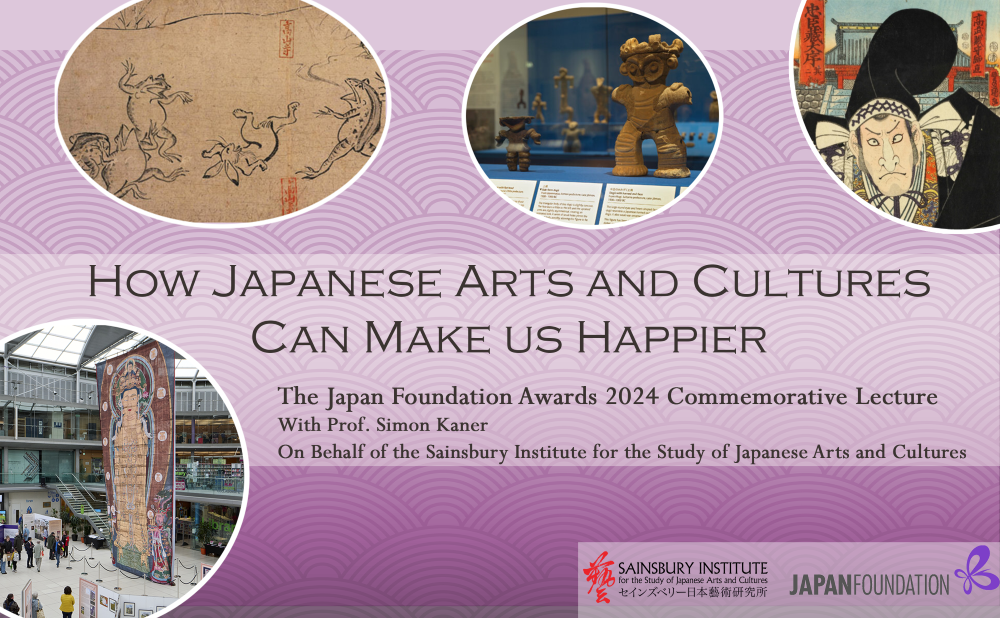
Date: Thursday 16 January, 6.30pm
Venue: Japan House London (Livestream available)
We are proud to announce that the Japan Foundation London will be welcoming Prof. Simon Kaner from the Sainsbury Institute for the Study of Japanese Arts and Cultures (SISJAC) to deliver a special talk on 'How Japanese Arts and Cultures Can Make Us Happier'. SISJAC were a recipient of the Japan Foundation Awards 2024 for their work in helping to promote Japanese Studies and Japanese arts and cultures.
Talk Description:
Artistic and cultural activity is intrinsic to being human. Engaging with such activity, whether visiting a museum, gallery or heritage site, attending or taking part in a performance, or creating one’s own works, improves our well-being. Taking examples from a range of recent projects undertaken by the Sainsbury Institute for the Study of Japanese Arts and Cultures at venues including Stonehenge, the British Museum and an old shoe factory in Norwich, this talk will explore how engaging with Japanese arts and cultures makes us happier. It will also consider how we can best exploit the Digital Revolution to bring what the Chief Executive of Arts Council England, Darren Henley, describes as the ‘Arts Dividend’ to new global audiences.
About the Speaker:
Professor Simon Kaner, MA (Cantab.) PhD, FSA, is Executive Director of the Sainsbury Institute for the Study of Japanese Arts and Cultures, where he is also the Head of the Centre for Archaeology and Heritage. He is Founding Director of the Centre for Japanese Studies at the University of East Anglia. He has curated a number of exhibitions, including at the British Museum, the Fitzwilliam Museum in Cambridge and the Sainsbury Centre in Norwich. His current research projects include Global Perspectives on British Archaeology and The Shinano-Chikuma River Project: investigating the historic environments of Japanese longest river drainage. In 2011 he was awarded the 10th Miyasaki Eiichi Togariishi Jomon Prize.
This event is free to attend, but booking is essential. Click here to register to attend in person. |
If you are unable to attend in person, this talk will also be livestreamed.
To register for the livestream, click here. |
This event is taking place in partnership with SISJAC and Japan House London.
If you have any questions about this event, please email LO_JapaneseStudies@jpf.go.jp.
To learn more about the Japan Foundation Awards and its past recipients, click here.
| Date: | 16 January 2025 |
| Venue: |
Japan House London 101-111 Kensington High St, London, W8 5SA |
| Back to Top |
| *Looking for Volunteers* UCL-Japan Youth Challenge 2024 |
|
Are you interested in Japanese culture, or currently learning Japanese? Do you want to help pre-university students shape their future studies and careers?
The UCL-Japan Youth Challenge is looking for volunteers to assist during this year's summer school for pre-university students from the UK and Japan, to help the participants to make the most out of their experience.
Volunteer roles:
- Join and facilitate group discussion during the UCL Grand Challenge Workshop on Tuesday 30th JUly
- Encourage Japanese high school students to communicate in English as much as possible
- Support the staff (catering, guide to venues and the toilet)
Dates and Venues:
- Rikkyo School in England: Saturday 27th July
- University of Cambridge: Sunday 28th & Monday 29th July
- UCL (University College London): Tuesday 30th - Satuday 3rd August
*Volunteers may join us from one day to the whole programme between Saturday 30th July and Saturday 3rd August
Times:
9am to 6pm (BST) *Times may vary depending on the day (may finish slightly earlier or later)
What is provided:
Reasonable travel costs will be reimbursed, and lulnch will be provided
Eligibility:
Over 18 years old, who can travel to the location(s)
If you are interested in volunteering, please email ujyc@japanatuk.com
To find out more about the UCL-Japan Youth Challenge, visit the official website: ucl-japan-youth-challenge.com
To download the information flyer for volunteers, click here.
| Date: | 27 July 2024 - 3 August 2024 |
| Venue: |
Rikkyo School in England Cambridge University University College London (UCL) |
 Download UCL-Japan Youth Challenge 2024 volunteer flyer 20230627v1
|
|
| Back to Top |
| Exploring the World of Japanese Studies - Ghibli in the Machine: AI Controversies and the Appropriation of Anime |
|
 Date: Friday 4 July, 5pm BST
Venue: Lecture Theatre 2, Fylde College, Lancaster University.
Livestreaming available via Zoom
Are you someone with a general interest in Japanese culture and society? Or are you a sixth form student or current university student, either studying Japanese language or with an interest in learning more about Japan? Why not come and listen to our first lecture as part of our new seminar series: Exploring the World of Japanese Studies!
Our first lecture, Ghibli in the Machine: AI Controversies and the Appropriation of Anime will be hosted by Lancaster University, with Dr Zoe Crombie, (Associate Lecturer in Film Studies, Lancaster University) and Prof. Rayna Denison (Professor of Film and Digital Arts and Head of Department for Film and Television at the University of Bristol).
Talk Description:
Earlier this year, ChatGPT released a new Photo to Anime filter that turns user images into not just "anime" images but Hayao Miyazaki-inspired images. Controversially this filter quickly became one of ChatGPT's most popular image generators, while also being roundly condemned for the theft of Studio Ghibli's animation art. In this talk, we discuss how AI is currently reshaping the anime industry in Japan, and impacting upon one of Japanese animation's best loved studios. We consider how Japanese Studies can help us to unpack and understand this pivotal moment in Japanese animation history.
The lecture will be one hour long, followed by a 15 minute Q&A Session with the two academics. Participants can enjoy asking questions about the lecture topic itself, or about research on Japan!
This talk is open to the general public, and sixth-formers and undergraduate students are especially encouraged to join.
Speaker Profiles:
 Dr Zoe Crombie
Zoe Crombie is Associate Lecturer in Film Studies at the Lancaster Institute for the Contemporary Arts, University of Lancaster. She is an early career academic currently working on a monograph about Studio Ghibli’s transnational reinterpretations of Western literature through the Trailblazers scheme.
 Professor Rayna Denison
Rayna Denison is Professor of Film and Digital Arts at the University of Bristol where she teaches and does research into contemporary Japanese film and animation. Her books include Anime: A Critical Introduction and Studio Ghibli: An Industrial History along with edited collections like Princess Mononoke: Understanding Studio Ghibli's Monster Princess.
|
 |
Organised by the Japan Foundation London with support from Lancaster University


| Date: | 4 July 2025 |
| Venue: |
Fylde College, Lancaster University. Livestreaming available via Zoom |
| Back to Top |
| Call for Applications: Japan Foundation London Grant Programme (Japanese Studies & Intellectual Exchange) 2025-2026 |
|

The second round of applications for the Japan Foundation London Grant Programme FY 2025-26 has opened!
Deadline: Friday 8 August 2025
For projects taking place between 1 September 2025 – 31 March 2026.
This programme is designed to provide grant assistance to projects (e.g. lectures, workshops, conferences) in any discipline of the humanities and social sciences that have a significant Japan element, or involve collaboration with Japanese researchers/practitioners.
Projects must take place in the UK to be eligible for support and applications can only be accepted from not-for-profit organisations in the UK.
Priority will be given to projects that fall under one or more of the following descriptions:
1. Projects that will bring together researchers/ practitioners from a variety of disciplines and sectors that are relevant to Japan
2. Projects organised by, and/or involving core participation by, early career researchers/ practitioners
3. Projects that will nurture diverse interests in Japan among future generations in the UK
Applications for preliminary project development will be considered as long as such projects include some of the above elements.
Grant coverage:
Only specific items such as travel expenses, honoraria, venue hire, printing/publicity costs etc. which are deemed to be essential in order to carry out the project.
Successful applicants may be granted up to £1500. As successful applicants will not necessarily be granted the full requested amount, applicants are strongly encouraged to secure additional funding from their own organisation and elsewhere.
Before contacting us, please read the full Application Instructions, containing further details about eligibility and the Application Process.
Application Deadline: Friday 8 August
Results will be notified by the end of August.
To read the Application Instructions PDF, click here.
If you have any questions, email Iona Vos at LO_JapaneseStudies@jpf.go.jp.
When you email us, please CC Natsumi_Abe@jpf.go.jp (Assistant Director for JF London and Manager of Japanese Studies Affairs) and Iona_Vos@jpf.go.jp (Assistant Programme Officer for Japanese Studies).
| Date: | 8 August 2025 |
|
Download 01_2025_Application_Instructions (2nd call)
|
|
| Back to Top |
| The JF Japanese Studies Survey 2025 |
|

The Japan Foundation London has begun collecting information for the Japanese Studies Survey 2025.
JF London, with the cooperation of the British Association for Japanese Studies (BAJS), conducts a survey every 5 years. Our survey targets universities, researchers and students undertaking Japan-related studies in the humanities and social sciences, to analyse trends and support researchers in expanding their networks.The survey is essential in investigating the current landscape of Japanese Studies and Japan-related research in the UK
What will the survey include?
(1) University Directory Survey - This directory aims to provide students and the general public with useful reference information by listing universities that offer humanities and social sciences programs related to Japanese studies, employ faculty members specialising in such areas, or provide Japanese language education.
(2) Student Survey - This survey is intended for students in academic departments offering Japan-related studies programs, students in the humanities and social sciences whose topic of research or primary interest includes Japan, and undergraduate, master's, and doctoral students majoring in Japanese language or translation studies. (Students studying only Japanese language are not eligible.)
(3) Researcher Survey - This survey is intended for researchers affiliated with Japan-related studies departments, as well as researchers in the humanities and social sciences whose research includes Japan as a research subject.
(4) Researcher Directory Survey - To facilitate networking among students and researchers, we will create a directory of humanities and social sciences researchers whose work includes Japan-related studies, regardless of whether they are affiliated with Japanese studies department. This directory will be published on our website.
Deadline for All Responses: 12th September 2025
How can I help?
We have begun requesting information from universities across the UK, their students, and researchers in the field.
If you would like to participate in the survey or you would like any further information, please contact us at:
LO_JapaneseStudies@jpf.go.jp (CC Natsumi_Abe@jpf.go.jp and Iona_Vos@jpf.go.jp)
We look forward to hearing from you and thank you in advance for your cooperation.
You can view the 2020 Japanese Studies Survey here.
| Date: | 12 September 2025 |
| Back to Top |
| The Scots and Japan: First Contact (1613 - 1623) at the University of Edinburgh |
|
 for website.png)
We are proud to be partnering with the University of Edinburgh for a number of talks in their Asian Studies Seminar Series.
Join the University of Edinburgh for this talk, The Scots and Japan: First Contact (1613-1623) by Professor Ian Gow which will reveal evidence of Scots working with Japan in the early 17th century!
This talk event is free and booking is not required, just turn up!
| Date: | 13 December 2023 from 4.00pm - 6.00pm |
| Venue: |
University of Edinburgh Project Room 1.06, 50 George Square |
| Back to Top |
| In the Shadows of Gratitude: AGEING & CARE in Japanese Society - *Talk and Documentary Screening* |
|

Date: Wednesday 5 June, 6:30pm – 9pm (Doors at 6pm)
Venue: Japan House London
The world is ageing. According to the World Health Organization, increased life expectancy and declining birth rates mean that between 2000 and 2050, the proportion of the world’s population over 60 will have doubled. Nowhere is this trend easier to see than in Japan, where 1 in 10 people are over the age of 80 and almost 30% of the population is over the age of 65, according to a study published in 2023 by the Japanese Ministry of Internal Affairs and Communications. Who will provide care to the growing number of frail and cognitively impaired older people in this historically unprecedented reality?
Japan relies on a combination of informal, unpaid care (primarily family members, but also local community volunteer groups) and formal, paid care to address the increasing needs of its ageing population. Despite the introduction of a national Long-Term Care Insurance system in 2000, family involvement in daily care of older family members has not decreased. Family members play a vital role as primary carers for almost three-quarters of frail and dependent older people, but as dependency increases with age, it is not uncommon for family carers to leave their jobs or move in with the person they are caring for, leading to dangerous levels of stress and fatigue. Understanding and recognizing the value of unpaid care is essential for ensuring their support over the course of what is often a long, painful, but ultimately transformative journey.
Join us for a discussion on this issue, with Dr Jason Danely, Reader in Anthropology at Oxford Brookes University and Chair of the Healthy Ageing and Care Research Innovation and Knowledge Exchange Network.
This event will feature a documentary film screening of I Go Gaga: Welcome Home, Mom as part of the release of new titles to the JFF + Japanese Film Festival Online.
The event will involve a 10 minute introductory talk from Dr Danely, followed by the documentary screening. After the screening, Dr Danely will lead a 30 minute Q&A session to share his expertise and facilitate an audience discussion.
About the Film
I Go Gaga: Welcome Home, Mom is the sequel to director NOBUTOMO Naoko's 2018 hit documentary I Go Gaga, My Dear. It is a record of the director’s own mother who was diagnosed with Alzheimer’s disease in her mid-eighties and the director’s nonagenarian father who continues to take care of his wife. Since the first film, the mother’s dementia has progressed and upon having a stroke, she begins hospital life. The ageing father goes to visit the mother every day at the hospital and continues to shower his wife with love and hope. A gently observed story about a fate that could happen to any family living in an ageing society.
Watch the trailer here.
About the Speaker
 |
Dr. Jason Danely is a Reader in Anthropology and Chair of the Healthy Ageing & Care Research Innovation and Knowledge Exchange Network at Oxford Brookes University. He is the author of over 20 publications, including his most recent book, Fragile Resonance: Caring for Older Family Members in Japan and England (2022). His research expertise relates to cultural understanding and experiences of ageing and care in |
Japan, where he has at various times taught, studied, performed theatre, travelled, meditated and raised children, over the last twenty years.
|
This is a free event, however booking is essential. |
Keep an eye on this page for the title of the documentary, screened as part of this event!
For enquiries, please email LO_info@jpf.go.jp
| Date: | 5 June 2024 from 6.30pm - 9.00pm |
| Venue: |
Japan House London |
| Back to Top |
| Seeds in the Heart and Leaves of Words: Traditional Japanese Poetry Beyond the Haiku |
|

|
About this Event
Poetry has been a part of Japanese life for more than a millennium, with the first major anthology of waka - poems in Japanese - compiled in the late eighth century. Later, it was to become an essential part of life for the aristocrats of the new capital city of Heian-kyō - modern Kyoto - and through their production and patronage exert a profound influence on almost all aspects of Japan’s cultural life, as warlords, warriors and merchants sought the social status and approval that came with the composition of poetry. Images from waka were used in painting, on clothing, and utensils of various kinds. Waka topics influenced which plants and animals were cherished, and which were not and subtly shaped Japan’s ideas of itself as a nation and people. Indeed, the influence of waka has been so pervasive and enduring that it’s possible to say without an understanding of waka, you don’t really understand Japan.
This lecture will trace the development of waka from its early beginnings as a tool for communication and social relationships among the elite nobility, through its role in providing a ritual underpinning to the aristocratic state, and its development into an arena of critical and literary conflict between factions determined to maintain and promote their views of appropriate poetic style, leading eventually to the development of new poetic form such as the haiku. It will reveal how and why waka thrived, and how its topics and the emotions associated with them came to express many of the attitudes which are considered quintessentially Japanese.
About the Speaker
 |
Dr Thomas McAuley is a Senior Lecturer in Japanese Studies at the University of Sheffield, and an expert on premodern Japanese poetry and culture. Among his publications is the complete translation and commentary of Roppyakuban uta’awase (‘Poetry Contest in Six Hundred Rounds’; 1193-94), one of the most significant poetic and critical texts of the period. |
An experienced translator, he regularly posts new translations of premodern Japanese poetry on his website, www.wakapoetry.net.
Among his current projects are studies of premodern critics’ attitudes to the inclusion of Chinese-influenced material in waka poetry and the impact of poets’ gender on their compositional practice.
To register for this event, click here.
Booking for this event has now closed.
| Date: | 7 December 2023 from 6.30pm |
| Venue: |
Japan House London, 101-111 Kensington High St, London W8 5SA London W8 5SA |
| Back to Top |
| *Looking for Volunteers* UCL-Japan Youth Challenge |
|
*Looking for Volunteers* UCL-Japan Youth Challenge
Interested in Japanese culture? Learning Japanese? Want to help pre-university students shape their future studies and careers?
The UCL-Japan Youth Challenge are looking for university student volunteers who can join the in person summer school programme for a week at the end of July, to help the participants make the most out of their experience!
Volunteer roles:
• Join and facilitate group discussion during the UCL Grand Challenge Workshop on Tuesday 25 July
• Encourage Japanese high school students to communicate in English
• Support the staff (catering, guide to venues, etc.)
Dates:
• Rikkyo School in England: Saturday 22 July
• University of Cambridge: Sunday 23 & Monday 24 July
• UCL (University College London): Tuesday 25 - Saturday 29 July
*Volunteers may join us from one day to the whole programme between Saturday 22 and Saturday 29
Times:
9am to 6pm (BST)
* Times may vary depending on the day (may finish slightly earlier or later)
To download the information flyer, click here.
If you can participate, please email ujyc@japanatuk.com
Website: www.ucl-japan-youth-challenge.com
The UCL-Japan Youth Challenge is an annual summer school programme for pre-university students from UK sixth form colleges and Japanese high schools for cultural interaction through various educational activities and events held at UCL (University College London) and the University of Cambridge, since 2015, celebrating the 150th anniversary of Japan’s Choshu Five and Satsuma 19, all of whom studied at UCL in 1863 and 1865 respectively.
If you are a pre-university student interested in learning more and attending this event, please see our previous post here: https://www.jpf.org.uk/whatson.php#1264
Or visit the official event website: https://www.ucl-japan-youth-challenge.com/
| Date: | 22 July 2023 - 29 July 2023 from 12.00am |
| Venue: |
Rikkyo School in England Cambridge University University College London (UCL) |
|
Download UCL-Japan Youth Challenge 2023
|
|
| Back to Top |
| The UCL-Japan Youth Challenge 2023 |
|
 The UCL-Japan Youth Challenge 2023
The UCL-Japan Youth Challenge is back in person for its 9th iteration!
Suitable for pre-university students in the UK, the Youth Challenge is a week long summer school, this year taking place between Saturday 22nd July ~ Sunday 30th July 2023.
The Youth Challenge 2023 will be hosted in three locations: Rikkyo School in England, West Sussex; Cambridge University, Cambridge; and UCL, London.
This year's theme is Resilience:
"Our world in 2023 is experiencing diverse challenges, including natural disasters, war, the pandemic and economic recession. We need a society where it can adopt rapid and agile recovery from dynamic and unpredictable challenges. Therefore, we are confronting the topic of ‘resilience of the global society’ in the UCL-Japan Youth Challenge 2023 this year, offering opportunities to every individual to consider what resilience means to you."
The programme is a great chance for students from the UK to meet high school students coming from Japan, to participate in cultural exchange, and gain valuable skills to prepare for higher education with the guidance of university lecturers!
The two-week programme includes:
--- University-style lectures delivered by professors from top universities
--- UCL Grand Challenge Workshop which facilitates teamwork, problem solving, and presentation skills
--- Social activities
How much does it cost?
The fee below covers the complete cost of the UCL-Japan Youth Challenge 2023, excluding accommodation fees.
To secure your place on the UCL-Japan Youth Challenge 2023, you will need to pay your fees in full. Details of how to pay your fees will be provided as part of the application process.
£100
The standard programme fee in the past was £300, however by courtesy of various sponsors in the UK, the fee for UK based participants has been reduced to £100.
As an added bonus, the UCL-Japan Youth Challenge may count for your Gold Duke of Edinburgh's Award (DofE) as a Residential activity.
Your participation in the UCL-Japan Youth Challenge 2023 does not count towards a DofE Award in itself.
Applications are now open but spaces are limited and may fill up, so register now to avoid disappointment!
For more detailed information and registration, please visit the official website:
https://www.ucl-japan-youth-challenge.com/
| Date: | 22 July 2023 - 30 July 2023 |
| Back to Top |
| JF/BAJS Japanese Studies Postgraduate Workshop 2024 |
|
|
| Date: Friday 2nd February, 2024
Venue: University of Sheffield, exact location TBA
|
*Grants available for UK-based students only
| Date: | 2 February 2024 |
| Back to Top |
| *Looking for Volunteers* UCL-Japan Youth Challenge |
|
|
*Looking for Volunteers* UCL-Japan Youth Challenge
Interested in Japanese culture? Learning Japanese? Want to help pre-university students shape their future studies and careers?
The UCL-Japan Youth Challenge are looking for university student volunteers who can join our online summer school programme in the second half of August 2022 for one week to see the world through the lens of a top-notch design thinker.
Volunteer roles:
• Join and facilitate group discussion during Workshop and Preparation for Presentation
• Be an active member of an allocated group to deliver a group presentation smoothly
• Encourage Japanese high school students to communicate in English
Dates:
• Workshop—Tuesday 16th August
• Preparation for Presentation—Wednesday 17th, Thursday 18th & Friday 19th August
• Presentation—Tuesday 23rd August
Times:
9am to 12pm (midday) (BST)
* Preparation for Presentation may vary slightly depending on the group
If you can participate, please email ujyc@japanatuk.com
Website: www.ucl-japan-youth-challenge.com
The UCL-Japan Youth Challenge is an annual summer school programme for pre-university students from UK sixth form colleges and Japanese high schools for cultural interaction through various educational activities and events held at UCL (University College London) and the University of Cambridge, since 2015, celebrating the 150th anniversary of Japan’s Choshu Five and Satsuma 19, all of whom studied at UCL in 1863 and 1865 respectively.
If you are a pre-university student interested in learning more and attending this event, please see our previous post here: https://jpf.org.uk/whatson.php#1227
Or visit the official event website: https://www.ucl-japan-youth-challenge.com/programme-2022/
| Date: | 16 August 2022 - 23 August 2022 from 9.00am - 12.00pm |
| Venue: |
Hosted online by UCL |
| Back to Top |
| BAJS/Japan Foundation Postgraduate Workshop 2023 |
|
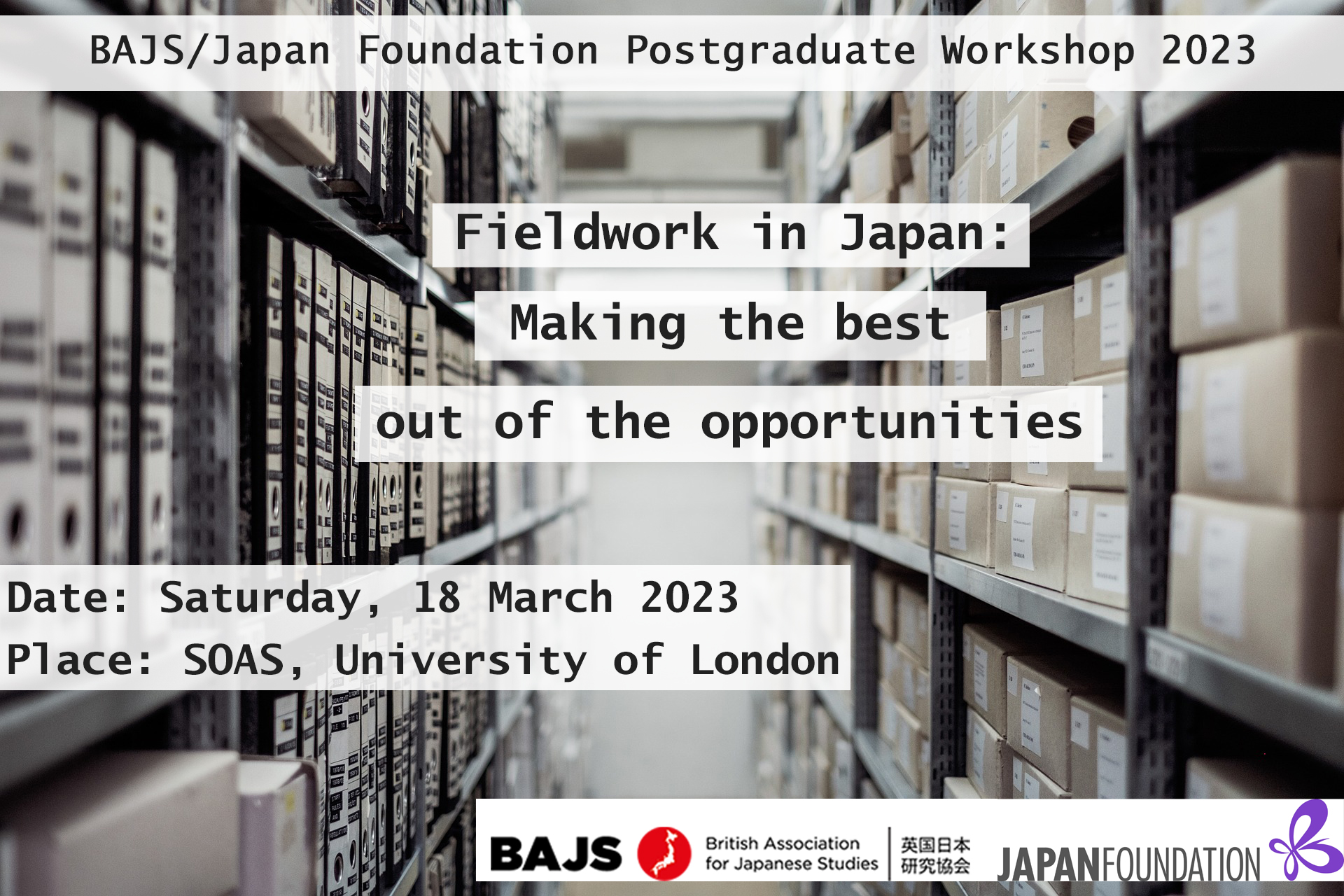
Date: Saturday 18 March 2023
|
|
The BAJS/Japan Foundation Postgraduate Japanese Studies Workshop is returning for its 12th year and will be held at SOAS, University of London. *Grants available for UK-based students only |
Registration and Eligibility:
Registration is free and the workshop is open to all PhD students undertaking research about Japan (including comparative) in humanities and social science subjects. To keep a workshop atmosphere, we are limiting spaces to 40 students. Spaces will be allocated on a first come, first served basis. Any additional registrants will be placed on a waiting list.
|
| Date: | 18 March 2023 |
| Venue: |
SOAS, University of London |
| Back to Top |
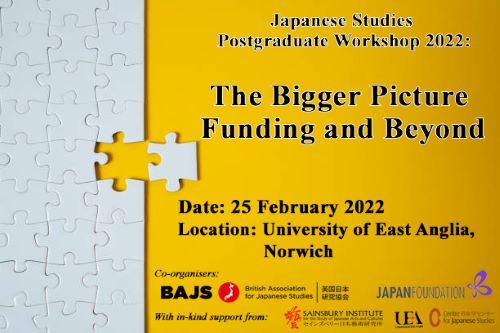
| Postgraduate Workshop 2022 |
|
|
We are delighted to announce that the 2022 Japan Foundation and British Association for Japanese Studies (BAJS) Postgraduate Workshop will be held at University of East Anglia. This will be an in person event!
This annual workshop aims to assist the development of the next generation of Japanese Studies researchers and to provide networking opportunities to strengthen Japanese Studies in the UK.
The workshop provides opportunity for participants to present their current research projects and receive feedback from peers and senior colleagues. This year’s key note theme is ‘The Bigger Picture – Funding and Beyond’. The afternoon will be dedicated to learning about larger-scale funding applications, projects and interdisciplinary collaborations.
In addition, there will also be an opportunity to hear presentations from various organisations regarding funding for current and future research, both in the UK and Japan.
Travel Bursaries:
For all participants, a travel bursary of up to £70 is available after students have covered the first £20.
A hotel bursary of £50 is also available.
Eligibility: This workshop is open to postgraduate students in Japanese Studies and those undertaking Japan related research in any discipline within humanities and social sciences.
Priority registration will be giving to Ph.D. candidates From Tuesday 18th January 2022 registration will be extended to Master’s students who are thinking about doing a Ph.D.
The deadline for all workshop registrations is Tuesday 25th January 2022.
*The Japan Foundation is offering partial travel grants to student participants. Please get in touch for more details.*
Booking: Please fill in the form at this link to book your place!
| Date: | 25 February 2022 |
| Venue: |
University of East Anglia |
| Back to Top |
| UCL-Japan Youth Challenge |
|

|
The UCL-Japan Youth Challenge is a prestigious annual summer school programme which has had a tremendous reputation and impact since 2015. Pre-university students from Japan and the UK attend a series of university-style lectures on a wide range of subjects by academics from leading UK universities including UCL (University College London), and engage in the UCL Grand Challenge Workshop.
In 2021, the programme will be held online due to COVID-19 guidelines.
Theme
Through the past UCL-Japan Youth Challenge programmes, young students have been provided with opportunities to look into social problems, mainly through science and technology. This year, the cultural side of the issues will be highlighted and discussions of how art and design could contribute to solving those problems and developing the sustainable future will be held.
For the full programme, please visit the UCL-Japan Youth Challenge homepage.
Eligibility
Non-Japanese sixth-form students residing in the UK, aged 15, 16, 17 and 18 years (Parental consent will be required prior to the event for under 18s.)
Applications
To apply, please complete the forms available here.
All participants will receive a complimentary ticket for Hyper Japan Online and two UK based participants will be selected to for a free trip to Japan in 2022.
There is no application deadline, though please note that spaces are limited.
| Date: | 3 August 2021 - 24 August 2021 |
| Venue: |
Online |
| Back to Top |
| Japanese Documentary Filmmaker Haneda Sumiko: Authorship and Gender Discourses |
|
|
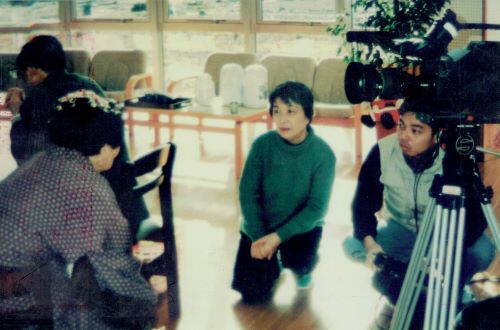
This project proposes a rediscovery of probably the most important female documentary maker from Japan, Haneda Sumiko (1926-), who was a pioneer female documentarist and one of the most prolific in post-war Japan. Haneda was one of the few women working in the influential Iwanami Productions where she participated in the creation of many short and long non-fiction works from the early years of the company between 1950s and 1980s and as an independent filmmaker until 2012.
The project is the result of a collaboration of scholars working on Japanese Cinema from several angles -Gender Studies, Documentary Film, Film Theory and Authorship- who are joining efforts to cast light on this still under-researched female director.
Programme:
Thursday 30th September (All times BST)
Online Symposium
| 09:00 - 09:10 |
Welcome. Fabio Gyi (SOAS JRC Chair). Introduction. Marcos Centeno, Irene González-López, Alejandra Armendáriz-Hernández, Ricardo Matos. |
| 09:10 - 10:05 |
Professor Mitsuyo Wada-Marciano (Kyoto University). Making Meaning of Haneda's 'Japanese Women': A Women's College in the Village (Mura no fujin gakkyu, 1957) and The Cherry Tree with Gray Blossoms (Usuzumi no sakura, 1977). Moderator: Marcos Centeno |
| 10:05 - 10:15 | Break |
| 10:15 - 10:35 |
Marcos Centeno (Birkbeck/UV Guest Lecturer Nanzan University) Haneda Sumiko's Transnational Cinema: Japanese Settlers in Manchuria |
| 10:35 - 10:55 |
Hikari Hori (Toyo University) Documentary and the Intimate Sphere: Haneda Sumiko in the 1980s and the 1990s. |
| 10:55 - 11:15 |
Discussion Moderator: Forum Mithani (Cardiff) |
| 11:20 - 11:45 |
Screening the work of Haneda Sumiko. Notes on the circulation and distribution of Japanese documentary - Part I Working with Haneda Sumiko Pre-recorded conversation with Satō Tokue, filmmaker, Haneda Sumiko’s personal assistant, Manager of Kanatasha, Inc.. Interviewer: Irene González-López |
Afternoon Session
| 15:00 - 16:00 |
Live Screening: Dedicated Treasures of Horyuji-Temple (Hōryūji ken'nō hōmotsu, Haneda Sumiko, 1971, 20min) Introduction: Alejandra Armendáriz-Hernández (Universidad Rey Juan Carlos) |
| 16:00 - 16:55 |
Anne McKnight (University of California, Riverside) Usuzumi and Eco-thinking Moderator: Teresa Castro (Université Sorbonne Nouvelle - Paris 3) |
| 16:55 - 17:05 | Break |
| 17:05 - 17:50 |
Screening the work of Haneda Sumiko. Notes on the circulation and distribution of Japanese documentary - Part II Roundtable Alexander Jacoby (Oxford Brookes University), Irene González-López (Birkbeck) Moderator: Ricardo Matos (Birkbeck) |
| 17:50 - 18:00 | Closing Remarks |
Friday 1st - Saturday 2nd October
Online film screening: The Japanese Settlers to Manchuria and Inner Mongolia of Mainland CHina (Aa Manmo Kaitaku-dan, Haneda Sumiko, 2008, 120 mins). BIMI. Free but prior registration to the symposium is essenetial in order to access the film.
Registration
This event is free and open to public. If you would like to attend the event please register. Please register via Zoom.
Image: Kanatasha and Haneda Sumiko
| Date: | 30 September 2021 - 2 October 2021 |
| Back to Top |
| Women and Sport in Japan |
|

|
Unfortunately, due travel restrictions surrounding Coronavirus, several speakers and commentators have become unable to attend this event. The organisers have therefore taken the difficult decision to cancel this event. We apologise for any inconvenience caused.
This is the fourth event in our Sport Symposia Series organised together with SOAS Japan Research Centre This event will focus on the theme of Women and Sport in Japan.
Guest speakers will be a mix of academic researchers and sportswomen. Discussion will focus on the changing environment for women and sport, in terms of participation, progress and challenges. Guest speakers will share the inspirational stories of their sporting careers.
|
Helen Macnaughtan |
 |
Guest Speakers |
|
|
Sakai Mariko |
.jpg) |
|
Hirano Yuka |
 |
|
Christian Tagsold |
 |
|
Konul Nurullayeva Konul conducts research at the University of Azerbaijan and is on the Executive MBA program at the Swiss Business University. She worked for the National Olympic Committee of Azerbaijan as Director of International Relations for over 10 years. She was the youngest and the first female chef de mission in the history of the Olympic Games to represent her national team in Vancouver (2010) and Sochi (2014) Winter Olympic Games. She was deputy chef de mission during the Summer Olympic Games in Beijing (2008) and London (2012). She was the youngest female CEO of “Baku 2020” (Olympic Games Bid Committee) in the history of the Olympic movement. In 2015 she was a member of the Board of Directors of the Inaugural European Games and chef de mission of the biggest team in the history of Azerbaijan. She is the first female representative from Azerbaijan to be elected in the European Olympic Committees’ “Gender Equality in Sport” Commission. In 2013 she was elected as the first female member to the Executive Board of the Islamic Solidarity Sports Federation (ISSF). She is Director of the “Gender Equality” Commission of the ISSF and member of the Coordination Commission of the 5th Islamic Solidarity Games - “Konya 2021”. She is fluent in Azerbaijani, Russian and English. |
 |
Panel Commentators |
|
|
Nefeli Chondrogianni |
 |
|
Dikaia Chatziefstathiou |
.jpg) |
|
Mara Yamauchi Mara Yamauchi is a former elite British marathon runner and diplomat. A two-time Olympian, she is the second fastest British marathon runner ever, with a PB of 2:23:12. She grew up in Kenya, and has lived in Japan for many years as a diplomat and professional athlete. Mara finished 6th in the 2008 Beijing Olympic marathon – the best performance ever by a British woman in this event – and was runner-up in the 2009 London marathon. She also competed for Team GB at the 2012 London Olympics. In January 2013 Mara retired from elite competition and now works as a running coach, commentator and motivational speaker. She lives in London. |
 Photo Credit: Marimo Images |
|
Simon Rofe |
 |
| Date: | 11 March 2020 from 5.00pm - 7.00pm |
This event is free to attend but registration is essential
| Organised by: | |
.jpg) |
.png) |
| Sponsored by: | |
.jpg) |
|
| Supported by: | |
.png) |
.png) |
| Part of: | |
.jpg) |
.jpg) |
.jpg) |
| Back to Top |
| Postgraduate Workshop 2021 |
|
|
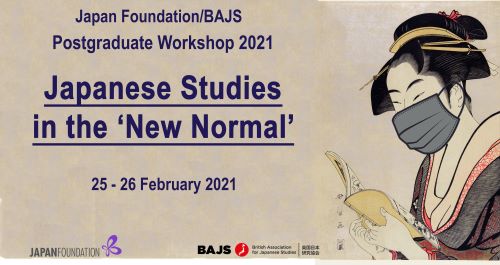
The Japan Foundation/BAJS Postgraduate Workshop is back! A lot has changed since the 2020 iteration, and this year’s online workshop will be tackling the effects of the global pandemic on academia head on. The workshop will take place online and will be spread over two mornings. The aim of this workshop will be to help postgraduate students develop their careers in JS navigating the 'new normal'.
This year, participating students will also be able to present their latest research to academics and their peers, gaining important feedback at a time when presenting opportunities is low.
There will also be talks and discussions about key areas surrounding the rapidly changing world of Japanese Studies. Topics will include:
- Funding opportunities available to PhD candidates and early career researchers.
- The current state of academia in Japan and the effects of COVID-19
- Job opportunities both inside and outside of academia
- Creating a social media research presence
- And more…
Eligibility
Registration is open to postgraduate in any field of the humanities of social sciences with a focus on Japan (including comparative studies). Spaces are limited and priority will be given to PhD/Dphil students from the UK/Ireland. Master’s level students may apply at any time but their places will not be confirmed until closer to the event. Students must be able to attend both days.
Registration is free for all participants. To register, please fill in this form.
| Date: | 25 February 2021 - 26 February 2021 |
| Venue: |
Online |
| Back to Top |
| Sake Symposium: Understanding the Unique Aspects of Sake |
|
|
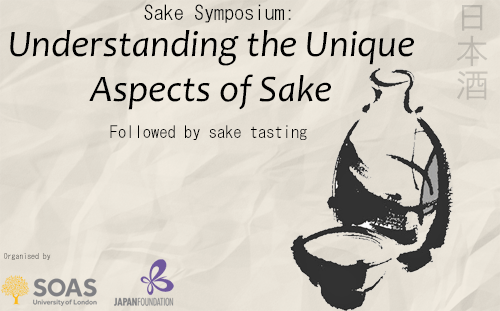
The Japan Foundation and SOAS are hosting a special symposium looking at the Japanese phenomenon that is sake. Widely seen as the national drink of Japan, sake exports have been booming in recent years, with its unique taste and wide range of flavours, it has been appearing more and more on UK menus. This seminar will bring together experts to discuss sake from various perspectives: historically, culturally, commercially and diplomatically.
The symposium will be followed by a sake tasting session, with experts on hand to guide you through the different types of sake available.
We are delighted to be joined by five eminent speakers, each bringing a unique set of personal expertise.
Heritage of Sake Making and Future
Mr Koichi Saura ( 13th Generation of Kuramoto, Owner Urakasumi Sake Brewery, Vice President of Japan Sake and Shochu Makers Assosiation, Founding Chairman of Sake Samurai Association)
Internationalisation of Sake
Mr Yusaku Shimizu (Minister of Finance at the Embassy of Japan in the UK)
Sake Export from Japan and Overview of the UK Sake Market
Mr Hirohisa Ichihashi (Food Division Director of JETRO London)
International Sake Promotion through the IWC Wine Platform
Mr Chris Ashton (Director of International Wine Challenge IWC)
Promoting Sake Globally from London
Ms Rie Yoshitake (Sake Promoter, Sake Samurai UK, Rep of Japan Sake & Shochu Makers Association)
For more information and to see the speakers' full biographies, please visit the SOAS website.
| Date: | 20 February 2019 from 5.00pm |
| Venue: |
Khalili Lecture Theatre, SOAS, London WC1H OXG |
This event is free to attend, though booking is essential and spaces are limited. This is event is now fully booked. If you would like to be the first to hear about our events, please sign up to our e-bulletin here
Sponsored by:

A offical event of


| Back to Top |
| What is Manga? |
|

|
Manga has boomed in popularity in recent years. Whilst it is enjoyed globally by a varied audience, there remains a lack of understanding about its breadth and depth, and its relationship with Japan and the rest of the world. This symposium aims to redefine manga by suggesting ways of looking at it as a cultural activity and an expression of historical activities.
Although manga has become a major global art form, East and West remain relatively isolated from each other in the field of comic studies. By bringing together scholars, manga artists and manga industry members from Japan, Europe and beyond, the symposium creates a dialogue on the definition, reaches, and impact of manga in a global context, seeking to find and answer the questions that need to be answered about this global, cultural phenomenon.
Click here to view the day's programme.
Presented by the Japan Foundation and SISJAC, in collaboration with British Library.
| Date: | 23 August 2019 from 10.00am - 5.30pm |
| Venue: |
Knowledge Centre |
Booking is available through the British Library's Website.
Full price £15
Students/Under 18's/Concessions £8
The programme was created with support form the British Museum

| Back to Top |
| Japan Foundation/BAJS Japanese Studies Postgraduate Workshop 2020: Publishing Your Research |
|
|
The Japan Foundation/BAJS Postgraduate Japanese Studies Workshop is returning for its 8th year and will be held at SOAS, University of London.
The theme for this year is ‘Publishing Your Research’ and will focus on helping participants navigate the world of academic publishing. Throughout the student-focused workshop, participants will be guided both leading scholars and those with insider knowledge of the academic publishing industry. The workshop also provides an excellent opportunity for networking among PhD students and academics, as well as a forum to discuss future collaborations. Organisations will also be presenting their funding programmes and giving details of how they can help.
Student Submissions:
Once registered, we ask students to send in a piece of work that they will be submitting for publication in the future. The work will be shared ahead of the event and feedback on submitted work will be provided by other students and academics throughout the morning session in small groups. If you are unable to submit a piece of work you can still participate in the event and provide feedback to other students. If you have any questions about this, please contact Mara Patessio at mp78@soas.ac.uk.
Travel Grants:
The Japan Foundation is able to offer a partial travel grant of £70 per attendee after attendees have covered the first £20 of their fare. The British Association for Japanese Studies is able to offer £50 per attendee towards the cost of accommodation.
Registration:
Registration for this event has now closed.
Registration is free and the workshop is open to UK based PhD students who are undertaking research about Japan (including comparative) in humanities and social science subjects.
Should places still be available, registration will be extended to masters students on January 13th.
The final deadline for registration is January 21st.
| Date: | 13 February 2020 from 10.00am |
| Venue: |
SOAS, University of London |
| Back to Top |
| Japan Youth Challenge 2019 |
|

|
Hosted at UCL (University College London), the UCL-Japan Youth Challenge (UJYC) brings together pre-university students from the UK and Japan in a 10-day summer school programme, as well as hosting various public events.
Students from both countries will engage in a series of topic-focused activities including workshops, lectures and a symposium. Our highlight is the Grand Challenge Workshop where “Accessibility for All: AI and Robotics”, a topic important in our society today.
You can find more information by downloading the programme brochure here.
Eligibility
Non-Japanese sixth-form students residing in the UK, aged 15, 16, 17 and 18 years (Parental consent will be required prior to the event. All students are supervised by UCL staff during the event.) Students will be joined by a group of Japanese students from Japan
Application Deadline
There is no application deadline, though early applications are encouraged as places are limited.
Applications
To apply please visit https://www.ucl-japan-youth-challenge.com/
For enquiries, please email programme conductor Hideyuki Miyahara
Public Events:

The Japan Youth Challenge are proud to present a public screening of the short documentary Imphal 1944.
This documentary tells the story of Japanese veteran Masao Hirokubo and the Battle of Imphal, a key turning point of the East-Asian Theatre in World War Two. Hirokubo devoted a great deal of his life to reconciliation work with his former adversaries. This heart-warming documentary looks at his early reconciliation work and reflects on the interconnectedness of the three countries involved and on the futility of war.
The screening will be followed by a talk and a Q&A by the director Junichi Kajioka.
Date: 23 July 2019, Doors open at 17:00 - Screening begins at 17:40
Venue: UCL Medical Sciences 131 AV Hill LT
Gower Street, London, WC1E 6BT
This screening is free to attend, but registration is required.

The UCL Japan Youth Challenge will culminate in the UCL-Japan Youth Challenge Symposium.
This event will bring together industry profressionals, academics, and athletes to discuss the importance of AI and robotics in the field of accessibility. Part one of the symposium will focus on the current state of the Fukushima Nuclear Power Plant and Part two will focus on accessibility in other areas.
The symposium will be followed by a reception.
Date: 26 July 2019, from 13:00.
Venue: University College London,
Christopher Ingold Building, XLG2 Auditorium
WC1H 0AJ
This symposium is free to attend, but registration is required.
| Date: | 20 July 2019 - 27 July 2019 |
Volunteers
We are currently seeking volunteers to help at this event. Please click here for more details (in Japanese).

| Back to Top |
| Call For Applications: Europe-Japan Intellectual Exchange Session 2019 |
|

The Japan Foundation and the Centre Européen d'Études Japonaises d'Alsace (CEEJA) are now accepting applications for the Europe-Japan Intellectual Exchange Session 2019 in Alsace, scheduled for September 30th - October 1st 2019. The Japan Foundation and CEEJA have carried out a series of seminars since 2007, with an aim to encourage networking among young researchers on Japan in Europe and further promote Japanese studies in Europe.
The title of this year's study seminar is "Representations of Japanese Culture and Arts in Europe: from 'Japonism' to 'Cool Japan'. (ヨーロッパにおける日本の文化・芸術のイメージ -「ジャポン二スム」から「クールジャパン」へ)Please note that the language of this event will be Japanese with no interpretation.
Applicants from Europe are being sought from a wide range of fields including Sociology, Arts, Literature, History, Language, Philosophy, Political Science, Economics etc.
Applicants must currently be on a graduate or post-graduate scheme or hold a junior teaching/research position at an academic institution in Europe.
For more details and applications, please click here. (Japanese version).
The deadline for applications is July 12th 2019.
| Date: | 30 September 2019 - 1 October 2019 |
| Venue: |
Centre Européen d'Études Japonaises d'Alsace |
| Back to Top |
| Japan Information Day 2019 |
|
The Japan Foundation are proud to be a co-organiser of Japan Information day 2019. Along with other Japan related organisations and universities, we will be introducing our programmes, grants, and the work that we do in the fields of Japanese Language and Japanese Studies.
With an increasing number of tourists as well as international students choosing Japan as their destination, British interest in Japan, including its higher education and research institutions, has been growing. The day aims to provide relevant professionals with information about various opportunities for graduates in teaching, studying and conducting research in Japan. This is the only annual event in the UK where attendees can learn about the diverse programmes in these fields.
For more information including the event timetable, please click here.
(Please note that this event is not suitable for students)
| Date: | 17 May 2019 from 12.15pm - 4.30pm |
| Venue: |
The Embassy of Japan in the UK, |
Registration for this event has now closed. For any equiries please contact scholarship@ld.mofa.go.jp

| Back to Top |
| Japan Foundation/BAJS Japanese Studies Postgraduate Workshop 2019: Career Progression |
|
|
We are delighted to announce that the 2019 Japan Foundation and British Association for Japanese Studies (BAJS) Postgraduate Workshop will be held at Cardiff University.
This workshop aims to assist the development of the next generation of Japanese Studies researchers and academics currently studying in the UK. Every year it provides a great opportunity for students to receive practical advice on their own research from senior colleagues, and to get to know fellow postgraduate students and members of the Japanese Studies Community.
This year's interactive workshop will centre on career development in academia/research in the UK, Japan and abroad. It will include several sessions by senior academics addressing concerns and challenges faced by at the early stages of an academic career and how to take full advantage of the opportunities available. There will be a chance for students to present their research and receive feedback from both peers and senior colleagues. There will also be an opportunity to hear from organisations and the funding they can offer for current and future research.
Eligibility: Registration is open to postgraduate students in Japanese Studies as well as those undertaking Japan related research in other disciplines in the social sciences and humanities. Priority will be given to Ph.D candidates.
This year the Japan Foundation are able to provide partial travel grants: please e-mail the below address for more details.
BAJS are also offering a grant to help cover the cost of accommodation please click here for details.
Registration for this workshop has now closed. If you would like to be the first to hear about all of our events in the future, please sign up for mailing list.
| Date: | 8 March 2019 from 10.30am - 5.45pm |
| Venue: |
Cardiff University, Wales |
*Doors will open from 10:00AM.
To register, or if you have any questions, please e-mail Programme Office Michael Salter at michael.salter@jpf.org.uk
| Back to Top |
| Japanese Study Seminar in Alsace 2018: Call for Participation! |
|

|
The Japan Foundation and Centre Européen d'Études Japonaises d'Alsace (CEEJA) are now accepting applications for participation in this year’s Japanese Study Seminar scheduled for 15 to 16 October 2018 at CEEJA, in Kientzheim, France. The official language of the seminar will be JAPANESE (no interpretation).
The Japan Foundation and CEEJA have carried out a series of seminars since 2007, with an aim to encourage networking among young researchers on Japan in Europe and further promote Japanese studies in Europe.
Participants will join a two-day intensive workshop in the cozy and intimate atmosphere of CEEJA's facility in Kientzheim where they will present and discuss their current research projects with fellow participants and a guest mentor.
The theme of this year’s seminar will be 'Transfiguration of employment at the time of globalization and technical innovation: A question about Japanese employment practice in the present and the future (グローバル化と技術革新の時代における雇用の変貌:日本型雇用慣行の現在・将来を問う).'
We are calling for applications from young researchers in Europe specialising in Sociology, Gender Studies, Literature, History, Arts, Language, Philosophy, Political Science, Economics, etc.
Please note the deadline for applications has now closed.
For further details including eligibility and application procedures, please visit the Japan Foundation Tokyo website here.
| Date: | 15 October 2018 - 16 October 2018 |
| Venue: |
Centre Européen d'Études Japonaises d'Alsace (CEEJA), Kientzheim, France |

| Back to Top |
| Countdown to Kickoff: Japan's rugby history one year out from the 2019 Rugby World Cup |
|
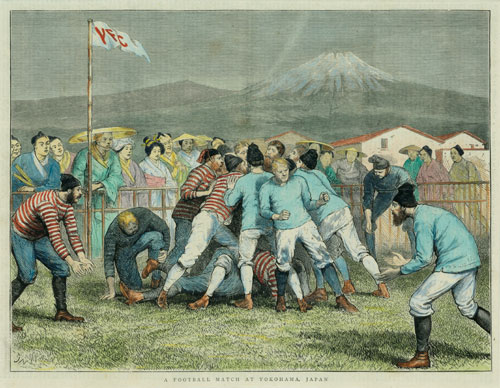
|
Yokohama 1874, courtesy of the World Rugby Museum, Twickenham
With just one year to go before the Rugby World Cup 2019's first match kicks off in Japan; the Japan Foundation London is delighted to announce a special symposium "Countdown to Kickoff: Japan's rugby history one year out from the 2019 Rugby World Cup", in partnership with SOAS Japan Research Centre.
Japan will be the first Asian nation to host the Rugby World Cup and the lead-up provides a great opportunity to reflect upon the relationship between Japan, rugby, and sporting mega-events.
The symposium will look at Japan's rugby history, its place within society and culture, and the possible effects and challenges of hosting such a major sporting event in the current climate. There will be a chance to reflect on the rationale of Japan's bid for the tournament, as well as an analysis of the orgnaisational differences between Japan's previous sporting mega-events, i.e. the 2002 FIFA World Cup and the 1998 Nagano Winter Olympics, and the upcoming 2019 Rugby World Cup. There will also be reflection on Japan's perfomance at the previous tournament and their prospects for the upcoming tournament. The symposium will be chaired by Dr J. Simon Rofe, the Programme Director of MA Global Diplomacy at SOAS whose research has a particular focus on diplomacy in sport.
We are delighted to be hosting four speakers at the symposium, who will reflect on a wide range of topics:
Session 1:
Phil McGowan (Curator of the World Rugby Museum, Twickenham) and Mike Galbraith (De Montford University) will discuss Japan's rugby history and introduce key characters up until the Second World War, placing Japanese rugby in a wide social context.
Session 2:
Helen Macnaughtan (Chair of the SOAS Japan Research Centre) will be talking about Japan's post war rugby history up until the present day, reflecting on the place of Japan's university, and steel and iron industry teams.
Session 3:
Simon Chadwick (Professor of Sports Industry, Salford University Manchester) will reflect on bidding for international sporting mega-events and explore some of the key economic and business issues affecting the 2019 Rugby World Cup.
Session 4:
Hilary Frank (Cornwall Council) will give a personal insight into some of Japan's previous mega-events such as the 1998 Nagano Winter Olympics and the 2002 FIFA World Cup. She will also reflect on Japan's 2015 World Cup Performance an the outlook for Japan as they prepare to become the host nation.
Please click here for a full list of the speakers' biographies.
| Date: | 20 September 2018 from 5.00pm - 8.00pm |
| Venue: |
SOAS (Alumni Lecture Theatre, Paul Webly Wing), London |
|
Download Timetable
|
|
This event is now fully booked and we are unable to accept anymore registrations.
Organisers: Japan Foundation London and SOAS Japan Research Centre
Sponsor:

Supported by:

This event will be follow by a reception with:

For further details: please click here


| Back to Top |
| Public Seminar: Tracing Colours and Characters in the Work of HARUKI MURAKAMI |
|

|
In this special seminar, Dr Gitte Marianne Hansen (Newcastle University) will explore some of the connections and meanings between colours and characters throughout the work of Haruki Murakami. She will begin by analysing Murakami's latest novel Colorless Tsukuru Tazaki and His Years of Pilgrimage, before looking at earlier characters from well-known longer novels such as Norwegian Wood and 1Q84 as well as from short stories such as The Little Green Monster.
Following the talk, Dr Hansen will be joined in discussion by Dr Sebastian Groes, Senior Lecturer in English Literature, University of Roehampton.
| Date: | 26 August 2014 from 6.30pm - 8.00pm |
| Venue: |
The Japan Foundation, London |
Booking:
**This event is now FULLY BOOKED** If you would like to be added to the waiting list, please e-mail your name and the title of the event you would like to attend to event@jpf.org.uk.
| Back to Top |
| Public Seminar - Freeter, the Japanese Precariat: Youth and Labour Disintegration in Japan |
|

|
In the first of two special talks at the Japan Foundation, David H. Slater (Sophia University), drawing on 25 years of ethnographic research, will explore the tangled relations between patterns of work, representation and politics in Japan. Following the talk Dr Slater will be joined in discussion by Dr Helen Macnaughtan (SOAS, University of London).
Abstract:
The rise of "freeter" on the Japanese scene in the early 1990's is in part the result of a shift in labour patterns among youth, and particularly young men, that had been occurring since economic growth began slowing in the 1970's. The term initially held the false promise of labour mobility, a certain "freedom" from the constrictions of Japan Inc institutionalized work patterns and the possibility of personal self-realization in diverse social domains. This momentary distraction from the neoliberal fragmentation of social identity lasted for a short period of time, mostly spurred on by a corporatist mass media and opportunistic academics.
Today the structural and policy patterns are familiar to late capitalist society around the world, but the cultural effects are somewhat more crushing. On the one hand, there is a desperate desire to return to the "suffocating embrace" of exploitative life-time employment in full-time work - work that is no long available after 25 years of labour degradation, and which seem to only accelerated with the rise of Abenomics. On the other hand, we also see glimpse of politicization, the rise of precariat-style mobilization here and there.
| Date: | 12 August 2014 from 6.30pm - 8.00pm |
| Venue: |
The Japan Foundation, London |
This event is free to attend but booking is essential. To reserve a place, please e-mail your name and the title of the event you would like to attend to event@jpf.org.uk
Image by Lee Chapman
| Back to Top |
| Public Seminar: The Work of the Visual in Mourning the Dead in Post-Tsunami Japan |
|

|
3.11 was probably the most minutely documented disaster in history. And yet for all of these images, the impulse to archive representations of loss points to another set of images that have themselves gone missing: hundreds of thousands of family photo albums that were washed away by the tsunami.
In this special talk, Dr David H. Slater (Sophia University) addresses the various issues that have been raised therein, including the anxiety and ambivalence surrounding the uncontrolled circulation and handling of other people's photos; issues of obligation and debt to both the living and the dead; the role of the visual in the larger project of the 'work of mourning;' and the problems of politics and representation when these pictures end up in galleries around the world. Joining Dr Slater to discuss these issues will be Dr Dolores Martinez, Emeritus Reader in Anthropology at SOAS, University of London.
| Date: | 13 August 2014 from 6.30pm |
| Venue: |
The Japan Foundation, London |
This event is free to attend but booking is essential. To reserve a place, please e-mail your name and the title of the event you would like to attend to event@jpf.org.uk
Image: Collage by Y. Sasaguchi (2012), photographed by Saori Sasaguchi, Photo Kizuna Project
| Back to Top |
| Public Seminar - Always on and connected: young people and their mobile social media use in Japan, the US, and the UK |
|

|
Smartphone use has seen a meteoric rise in the past few years. Indeed, it is now hard for most of us, especially young people living in cosmopolitan urban centres, to imagine a world without the smartphone – and, for that matter, without the social media apps it supports such as Twitter, Facebook and LINE. But how do people in different parts of the world use their smartphones? What do they share cross-culturally – and what do they choose not to share? Do cultural differences really matter when the technology is the same?
In this public seminar, Professor Toshie Takahashi (Waseda University) will present findings from a comparative study of digital media use amongst young people in Japan, the US and the UK, focusing on their practices of connectivity with intimate and distant others through social media on smartphones. Joining Takahashi to discuss these findings will be Dr Chris Davies, joint convenor of the Learning and New Technologies Research Group at the Department of Education, University of Oxford.
| Date: | 11 September 2014 from 6.30pm - 8.00pm |
| Venue: |
The Japan Foundation, London |
This event is free to attend but booking is essential. To reserve a place, please e-mail your name and the title of the event you would like to attend to event@jpf.org.uk
Image by Lee Chapman
| Back to Top |
| Public Seminar - NAGADORO: Rural Life after the Fukushima Nuclear Disaster |
|
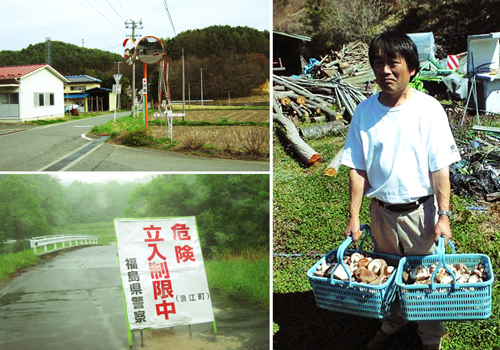
|
Since the Fukushima nuclear disaster of March 2011, Prof Tom Gill (Meiji Gakuin University) has made some 26 field trips to Nagadoro, a tiny hamlet that has absorbed some of the highest levels of radiation in Fukushima prefecture. During the course of these field trips Prof Gill has got to know the people of Nagadoro as they undergo an agonizing series of trials and tribulations. In this special public seminar he tells their story and offers a glimpse of what life is really like for the residents of the nuclear disaster zone. Joining Prof Gill in discussion will be Prof Ian Neary from the University of Oxford.
Abstract
The Fukushima nuclear disaster of 2011 will continue to affect millions of people for decades to come. The tremendous scale and complexity of this catastrophic event make it almost impossible to comprehend what is really going on in Fukushima. Any researcher must contend with the widely varying levels of radiation, the differing conditions for return to evacuated zones, the mixed fortunes of the decontamination programmes, the massive variation in compensation payments and many other challenges. I long since realized that my only hope of keeping abreast of events was to focus very tightly on a single small community that I could get to know reasonably well through a long series of field trips. That community is Nagadoro. Nagadoro is a tiny hamlet of 71 households, on the southern edge of Iitate village. After 3.11, it absorbed more radiation than any other hamlet in the village, and it is currently totally evacuated and barricaded with locked gates and sentries on all the four roads that lead into it. In three years and 26 field trips, I have slowly got to know the people of Nagadoro as they undergo an agonizing series of trials and tribulations. By telling their story, I hope to offer a glimpse of what life is really like for the residents of the nuclear disaster zone.
| Date: | 4 September 2014 from 6.30pm - 8.00pm |
| Venue: |
The Japan Foundation, London |
This event is free to attend but booking is essential. To reserve a place, please e-mail your name and the title of the event you would like to attend to event@jpf.org.uk
| Back to Top |
| Public Seminar: 50 Years of the Shinkansen |
|
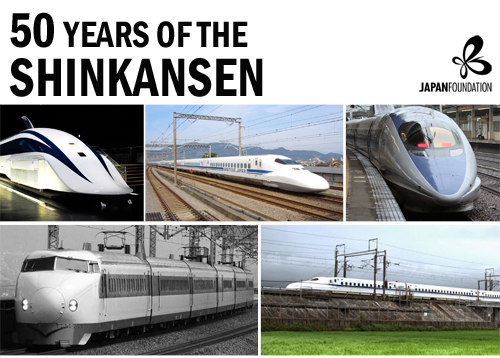
|
The Japan Foundation is delighted to present this special public seminar marking the 50th anniversary of the Tokaido Shinkansen. Joining us will be Yoshinori Hatta, General Manager of JR Tokai London Office, who will chart the history of the Tokaido Shinkansen, highlighting its strengths and achievements, while also looking to the future and the development of the new Chuō Shinkansen. Also joining us will be Dr Christopher Hood, Reader in Japanese Studies, Cardiff University, who will examine the regional differences in design and usage of the Shinkansen and how this in turn reflects the diversity of Japanese cultures.
| Date: | 31 October 2014 from 6.30pm |
| Venue: |
The Japan Foundation, London |
Booking:
This event is free to attend but booking is essential. To reserve a place, please e-mail your name and the title of the event you would like to attend to event@jpf.org.uk
Images: Top Left: Daylight9899; Centre/Top Right/Bottom Right: Dr Christopher Hood
| Back to Top |
| Public Seminar: Economic Policy and the Welfare State in Japan and the UK |
|

|
In this public seminar political scientists Prof Nobuhiro Hiwatari and Prof Junko Kato from the University of Tokyo join us to discuss their latest research into social policy reforms during financial crises, and tax politics and the welfare state.
Abstracts
Are Neo-Liberal Reforms Undemocratic? Evidence from the OECD and cases from the UK and Japan
Prof Nobuhiro Hiwatari, University of Tokyo
In this paper I provide a new way of addressing whether spending cuts and social policy reforms are undemocratic. Although measures that weaken market protection and social safety nets are opposed by organized interests and are unpopular with the voters, what if they reflect the position of the democratically elected legislature and not just the incumbent government? To show this is a possibility, I hypothesize that, when faced with global recessions, party leaders competing for power must show that they have viable plans to revive the economy, and as such, they have strong incentives to persuade the median voter that such reforms are unavoidable in order to stabilize the economy and assure international investors. Evidence from 20 OECD countries shows that the major left and right parties tend to move rightward during global recessions, but not so much leftward during economic recoveries with the rise of economic inequality. In addition, I show that spending cuts do represent the policy position of the legislative centre rather than the government centre. The validity of the argument is further demonstrated by examining the cases of Japan and the UK.
Taxation and the Welfare State: Japan in a Comparative Perspective
Prof Junko Kato, University of Tokyo
Since the 1980s, the institutionalization of regressive taxes for effective revenue-raising during a period of high growth has helped industrial democracies resist welfare state backlash. Building on this observation, I argue that the funding capacity of a welfare state is path-dependent on a revenue shift from progressive to regressive taxation. Tax politics is a critical intervening factor. Japan has been regarded as a proto-typical example in which the government failed to introduce a strong revenue-raising machine during a period of high economic growth. Today, Japan has again accumulated a massive government debt that is greater than twice its GDP and recently managed to increase consumption tax rates (from 5 to 8 %) for the first time in seventeen years. Strong opposition to tax increases in Japan appears puzzling considering its relatively low tax level and extremely high debt compared with other industrial democracies. Yet, it is consistent with a comparative analysis of tax politics in mature welfare states. I will explain the current situation in Japanese tax politics in comparison with other industrial democracies, focusing especially on European countries.
| Date: | 17 September 2014 from 6.30pm - 8.00pm |
| Venue: |
The Japan Foundation, London |
This event is free to attend but booking is essential. To reserve a place, please e-mail your name and the title of the event you would like to attend to event@jpf.org.uk
Image: ©Asher Isbrucker
| Back to Top |
| Public Seminar - Maths-As-It-Could-Be: The life and philosophy of Kiyoshi Oka |
|

|
Kiyoshi Oka was one of the greatest Japanese mathematicians of the 20th century. His contribution to mathematics was such that Carl Siegel mistakenly believed ‘Oka’ to be the name of a group of mathematicians. In Japan, Oka is known not only for his tremendous contribution to maths, but also as a great thinker and philosopher. His thoughts were shaped through the prisms of the Japanese language and culture and he was greatly influenced by traditional Zen Buddhist philosophy (in particular, that of Dōgen) and Japanese literature such as Matsuo Bashō and Natsume Soseki.
In this public seminar, independent scholar Masao Morita will introduce Oka’s unique philosophy of mathematics and the Japanese traditional thoughts underlying his ideas. He will also shed light on Oka’s life and thinking as a mathematician while examining how Oka pursued a "maths as it could be". Joining Morita in discussion will be Professor Tadashi Tokieda from the University of Cambridge.
| Date: | 17 October 2014 from 6.30pm |
| Venue: |
The Japan Foundation, London |
Booking:
This event is free to attend but booking is essential. To reserve a place, please e-mail your name and the title of the event you would like to attend to event@jpf.org.uk.
| Back to Top |
| Public Seminar: The Real Story Behind Japan's Marriage Crisis |
|

|
In this special public seminar, sociologist and opinion-maker, Professor Masahiro Yamada (Chuo University) joins us to examine the reasons behind Japan’s falling marriage rate and what the future holds for the country's ‘parasite singles’.
Joining Prof Yamada in discussion will be Professor Joy Hendry, Emeritus Professor of Anthropology, Oxford Brookes University.
ABSTRACT
It is not just that the rate of marriage per se is declining in Japan, relationships between men and women are not actively developing in toto. The reasons for this are 1) the expectation that men ought to shoulder the burden of paying for household expenses after marriage continues to be strong, 2) the incomes of young men have become increasingly unstable, and 3) almost all unmarried people continue to live with their parents. In short, although people would like to form ‘traditional families’ (nuclear families) of their own, the economic circumstances will not allow this and the number of unmarrieds who continue to live in their parents' home as ‘parasite singles’ is increasing instead. One consequence of this is that young people are increasingly attracted to ‘virtual romance’ in anime and with idols.
| Date: | 6 November 2014 from 6.30pm |
| Venue: |
The Japan Foundation, London |
Booking:
This event is free to attend but booking is essential. To reserve a place, please e-mail your name and the title of the event you would like to attend to event@jpf.org.uk
**Prof Yamada will also be speaking at Manchester University on 4 November, 2014. Click here for more information
| Back to Top |
| Talk: An Introduction to Sake |
|
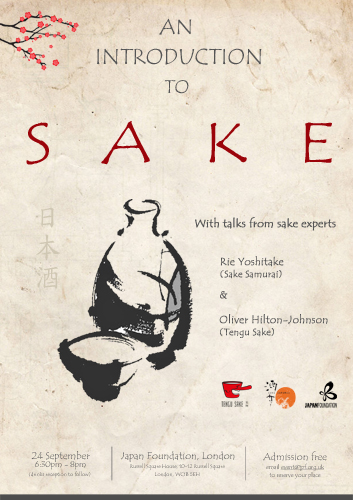
Sake, or nihonshu, is one of Japan’s most famous exports and is an increasingly popular fixture on menus at bars and restaurants across the UK. But with such a dizzying array of classifications and often confusing terminology it’s not easy for the uninitiated to know where to start.
In this special talk, sake specialist Oliver Hilton-Johnson (Tengu Sake) joins us to demystify this ancient drink covering everything from the history of sake, how sake is made and its main classifications, to different flavours and suitable food pairings. Also joining us will be Rie Yoshitake who will discuss the recent fortunes of Japan’s sake industry, while also introducing the activities of the Sake Samurai Association, an organisation formed by young sake brewers in Japan that works to promote sake in overseas markets.
Following the talk, guests will have the opportunity to sample some of the varieties of sake discussed by our experts.
| Date: | 24 September 2014 from 6.30pm |
| Venue: |
The Japan Foundation, London |
Booking
**This event is now fully booked**
If you would like to be added to the waiting list please e-mail your name and the title of the event you would like to attend to event@jpf.org.uk
Supported by:


| Back to Top |
| Public Seminar: WORLD LITERATURE, Japanese perspectives |
|

|
In recent years, there has been a growing trend to read literary texts as “world literature.” Some Japanese writers and critics welcome this trend as an opportunity to gain a larger readership beyond national and linguistic borders, yet others are wary of it. While these diverse responses today are symptoms of the increasing globalization of cultures, it is also important to take a historical look.
In this public seminar, Dr Shion Kono (Sophia University) will situate the current Japanese debates on world literature in the global circulation and reception of Japanese literature over the past century. He will also discuss the prospects of Japanese literature as world literature. Joining Kono to explore these issues further will be Dr Irena Hayter from the University of Leeds.
| Date: | 9 October 2014 from 6.30pm |
| Venue: |
The Japan Foundation, London |
Booking:
This event is free to attend but booking is essential. To reserve a place, please e-mail your name and the title of the event you would like to attend to event@jpf.org.uk.
*Shion Kono will also deliver a lecture in Durham on Firday 10th October as part of Durham University's 'Celebration of Japan Week'. Click here for more details.
| Back to Top |
| Public Seminar: The Happy Youth of a Desperate Country |
|
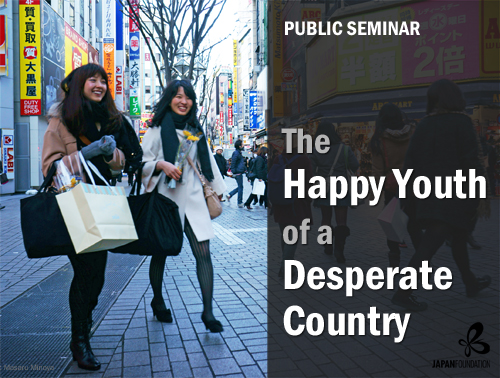
|
In this special public seminar, Japan’s leading young sociologist and author of the controversial book ‘The Happy Youth of a Desperate Country’ Noritoshi Furuichi (Tokyo University), joins us to explain why, despite fewer opportunities for long-term stable employment, the majority of Japan’s youth are in fact satisfied with their lives, and how this contentment challenges the dominant media discourse which portrays young adults as a disappointed and unhappy generation. Furuichi will also examine why young Japanese seem to be politically apathetic even in the face of rising social inequalities and an uncertain future.
Joining Furuichi in discussion following his presentation will be Dr Tuukka Toivonen from SOAS, University of London.
| Date: | 12 November 2014 from 6.30pm |
| Venue: |
Rm642, Institute of Education, University of London, 20 Bedford Way, WC1H OAL |
Booking:
This event is free to attend but booking is essential. To reserve a place, please e-mail your name and the title of the event you would like to attend to event@jpf.org.uk
**Noritoshi Furuichi will also be speaking at SEAS, University of Sheffield on Tuesday 11 November, 2014. Click here for more information
Image: masaru minoya
| Back to Top |
| Japanese Studies Post-Graduate Workshop, 2015 |
|
|
We are delighted to announce that the annual Japan Foundation / BAJS Post-Graduate Workshop will be held on Wednesday 11th March, 2015.
This workshop aims to assist the development of the next generation of Japanese specialists here in the UK, and to further strengthen the Japanese Studies community in this country. It is a great opportunity to receive some practical advice on your research from senior colleagues, and to get to know fellow post-graduate students and others in the Japanese Studies community.
This year’s workshop will include practical sessions on the following topics:
‘Getting Access to Interviewees’
Dr Peter Cave (University of Manchester)
‘Post-doctoral Career Development in Japan and the UK’
Dr Peter Matanle (University of Sheffield)
‘Funding your Research’
Representatives from the Daiwa-Anglo Japanese Foundation, Japan Society for the Promotion of Science, and the Japan Foundation will give short presentations on their funding programmes.
| Date: | 11 March 2015 from 11.00am - 6.00pm |
| Venue: |
University of Leeds |
The event will be followed by a dinner reception.
Eligibility: This workshop is open to PhD candidates in Japanese Studies/Japan-related disciplines. Japanese Studies Masters students who are thinking of doing a PhD are also welcome to attend.
Booking: E-mail Julie Anne Robb at julieanne.robb@jpf.org.uk to register your interest in attending or if you have any enquiries. The last event was over-subscribed so please get in touch as soon as possible if you would like to come along.
**Please note, travel expenses of up to £40 will be available to all participants**
| Back to Top |
| Workshop: Rethinking 'Japanese' Pop Culture: A Topic for Academic Study? |
|
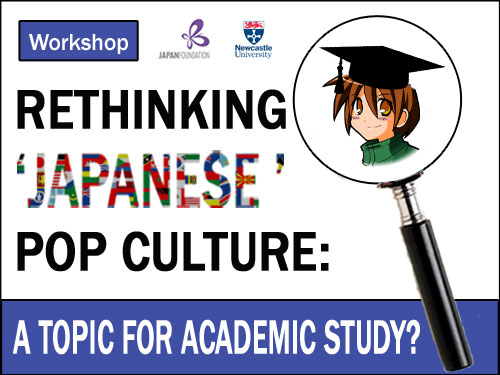
|
|
We are delighted to announce that leading Japanese media and cultural studies scholar Professor Koichi Iwabuchi (Monash University), will be visiting Newcastle University in April to lead this special Japanese Studies workshop. Recent years have seen an explosion of English language scholarship on the subject of Japanese pop culture such as manga, anime and video games. In this workshop, Professor Iwabuchi will encourage participants to explore the challenges and opportunities presented by this study. Can the study of Japanese popular culture lead to a deeper understanding of the diversity of Japanese society in an increasingly globalised world? This workshop will seek to answer questions like this through a series of interactive and dynamic group discussions. Professor Iwabuchi will be joined by Dr Gitte Hansen, Lecturer in Japanese Studies at Newcastle University, who will be on hand to facilitate the discussion. This workshop is designed for any students with an interest in Japanese Studies. |
| Date: | 15 April 2015 from 1.30pm - 4.30pm |
| Venue: |
Old Library Building, Room 3.14 (Pybus room), Newcastle University |
| Back to Top |
| Public Seminar: People Make Places: Empowering Locals through Community Design |
|
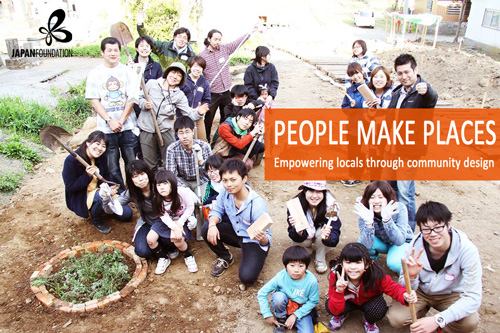
|
Ryo Yamazaki defines community design as 'the empowerment of locals through design to make them happy'. He is one of the speakers at this special seminar, which will discuss the principles behind community design and how they have been applied in projects in both Japan and the UK.
As CEO of community design company studio-L, and Professor and Director of the Department of Community Design at the Tohoku University of Art and Design, Ryo Yamazaki is involved in wide ranging activities throughout Japan which aim to facilitate local communities to not only create and improve public spaces, but also to seek their own solutions for the social problems that they are facing. Starting with the development of Japan’s first park managed through citizen participation, more recent projects have ranged from developing new ways to use open space in a department store, to helping an island community promote tourism.
At this public seminar Ryo Yamazaki will be joined by Sophia de Sousa, Chief Executive of The Glass-House, an independent charitable organisation which plays a leading role in the promotion of community led design in the UK. Sophia de Sousa will introduce the aims and activities of the Glass-House, which strives to put local people at the heart of making changes to their neighbourhoods. She will also join Ryo Yamazaki to discuss the development of community design in both Japan and the UK, and what can be learned from each other’s experiences.
| Date: | 7 May 2015 from 6.30pm - 8.00pm |
| Venue: |
Brockway Room, Conway Hall, 25 Red Lion Square, London, WC1R 4RL |
The event will be followed by a drinks reception.
For more information:
The Glass-House, Community Led Design
| Back to Top |
| Public Seminar: STEMming the Gender Gap: A New Era for Japanese Women in Science and Engineering? |
|

|
|
In January 2014, Japanese Prime Minister Shinzo Abe stated that ‘Japan should be the place that gives women the opportunity to shine. Thirty per cent of leadership positions should be occupied by women by 2020’. This promise seemed to herald a new era for women in the workplace in Japan. 30 years ago, the Equal Employment Opportunity Law was introduced in Japan which was intended to enable companies to fully utilise human resources regardless of gender. Despite this, even in 2013, the proportion of female leaders in large corporations was only 10.2 percent. Although the gender gap in science, technology, engineering and mathematics (STEM) does vary greatly from country to country, the number of Japanese women in these fields remains particularly low, and the proportion of female researchers in science and technology is still one of the lowest (14.4 percent) among OECD countries. Why so few? In this seminar, Dr Naonori Kodate (University College Dublin) will try to answer this question, by shedding light on historical developments and the current gender equality situation in Japan through the lens of women in STEM. He will explore how gender equality policy in science has been intertwined with social norms, family and individual life decisions and other policies. He will also look into measures the government, universities and research institutes are taking to address this issue, and explore whether these measures have led to an increase in female representation in these fields. During this special seminar, we are also delighted to welcome Dr Ekaterina Hertog (University of Oxford), an expert on Japanese family trends, who will join Dr Kodate in conversation to explore the effect of changes in Japanese family structure on the position of Japanese women in STEM. Contributors: Dr Naonori Kodate is a Lecturer in Social Policy at University College Dublin, Ireland. His main research area is comparative social policy, particularly in health care. His book, Japanese Women in Science and Engineering: History and Policy Change (co-authored by Professor Emeritus Kashiko Kodate) will be published in July 2015 by Routledge. Dr Ekaterina Hertog is a family sociologist in the Department of Sociology and the School of Interdisciplinary Area Studies at the University of Oxford. Her current research interests include contemporary Japanese society, marriage and childbearing trends in industrialised countries, and marriage partner selection. Image: Peter Close/Shutterstock.com |
| Date: | 1 July 2015 from 6.30pm - 8.30pm |
| Venue: |
The Swedenborg Society, 20-21 Bloomsbury Way, London, WC1A 2TH |
| Back to Top |
| Japanese Study Seminar in Alsace 2015: Call for Participation! |
|

|
The deadline for applications has been extended until July 15 2015.
The Japan Foundation and Centre Européen d'Etudes Japonaises d'Alsace (CEEJA) are now accepting applications for participation in Japanese Study Seminar: Everyday Life and Culture (日常生活文化) scheduled for 21st and 22nd September, 2015 at CEEJA, in Kientzheim, France. The official language of the seminar will be JAPANESE.
This seminar aims to encourage networking among young researchers on Japan in Europe and further promote Japanese Studies in Europe.
Participants will join a two-day intensive workshop in the cozy and intimate atmosphere of CEEJA's facility in Kientzheim where they will present and discuss their current research projects with fellow participants and guest mentors from Japan.
The theme of this year’s seminar will be “Everyday Life and Culture (日常生活文化).” We are calling for applications from young researchers in Europe specialising in politics, history, sociology, literature, arts, language, philosophy, economics, architecture, religion, etc.
Please note that the deadlnie for applications has been extended to 15th July, 2015.
For further details including eligibility and application procedures, please visit the Japan Foundation Tokyo website here.
| Date: | 21 September 2015 - 22 September 2015 |
| Venue: |
Centre Européen d'Etudes Japonaises d'Alsace (CEEJA), Kientzheim, France |
| Back to Top |
| Central and Local Governance in Japan and the UK: Lessons from Okinawa and Scotland |
|

|
The coral reefs, white sand beaches and sub-tropical rainforests of Okinawa, a chain of islands stretching over 600 miles of ocean between Southwest Japan and Taiwan, seem a distant world from the misty mountains and lochs of Scotland, but recent political developments in Scotland have brought to light some surprising parallels.
Like Scotland, Okinawa is a smaller, once independent, area incorporated within a far larger entity, which possesses its own distinct history, culture and political outlook. Debate on the balance between central and local governance has recently taken prominence in political discussion in Okinawa, and last September, intrigued by recent events in Scotland, several Okinawan journalists and researchers, including the founding member of an Okinawa independence movement, flew to Edinburgh to observe the independence referendum.
Professor Takayoshi Egami (Waseda University), is an expert in regional policy in Okinawa, having worked as a lecturer and researcher at the University of the Ryukyus in Okinawa for over 26 years. Since last September, he has spent one year as a visiting researcher at the University of Edinburgh to draw lessons from developments in devolution in Scotland post referendum.
In this seminar Professor Egami will discuss the complex historical and political background of Okinawa prefecture, which lies behind recent interest in devolution in the region.
After his talk he will be joined for a comparative discussion on devolution in the UK and Japan by Professor Paul Cairney, Professor of Politics and Public Policy at the University of Stirling, an expert in both Scottish politics and UK-wide comparative public policy.
Recent discussion on devolution and regionalism in the UK and Japan has not been confined to Scotland and Okinawa of course. Recent hot topics in the UK have included devolving more powers to Wales, the 'Northern Powerhouse’ and even the development of London as a city state, while in Japan, debate was recently ignited over plans to devolve more powers to Osaka City. Through exploring some of these issues, Professor Cairney and Professor Egami will discuss what can be learned from the experience of each country and how regionalism may develop in future years.
The seminar will be followed by an opportunity to pose your own devolution-related questions to the experts, and a drinks reception.
Image (left): Martin M303/Shutterstock.com
Image (right): (c)Tomo.Yun (http://www.yunphoto.net)
| Date: | 22 July 2015 from 6.30pm - 8.00pm |
| Venue: |
The Swedenborg Society, 20-21 Bloomsbury Way, London, WC1A 2TH |
| Back to Top |
| BUKATSUDŌ: Teaching Character in Japanese School Clubs |
|
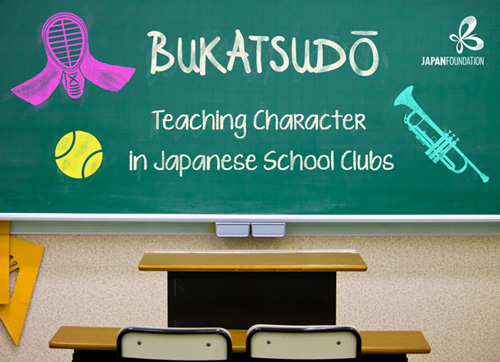
|
The bell rings for the end of the school day, but for children in schools across Japan it only signals the start of the next stage of their daily education.
Bukatsudō (extracurricular sports or cultural clubs), have played a formative role in the secondary school experience for school children around Japan for generations. On entry to junior high school, children are encouraged to pick a club, and stick with it though the rest of their time at school. Clubs demand huge time, effort and commitment from students, and from the teachers who take part as coaches. Practices at some schools can be held for up to two or three hours a day, up to six or seven days a week, after school, during weekends, and even school holidays, and are characterised by strict routine and ritual, group spirit, and hierarchical relationships between juniors and seniors.
In this special seminar, Dr Peter Cave, Lecturer in Japanese Studies at the University of Manchester, an anthropologist and Japanese education expert who has conducted extensive fieldwork and research in schools in Japan, will discuss the practice and origins of bukatsudō (including their surprising link to Victorian Britain), and the role they play in the Japanese school system today.
While Japanese educators have diverse views about clubs and their purposes, the practice of bukatsudō reflect the broad view that the Japanese school system is responsible not only for intellectual development of students but also for social and moral development, by teaching children basic values and social skills.
In the UK, 'character education' has been a subject of much recent debate with the Department for Education championing the idea that schools should not just focus on student’s academic achievement but also take responsibility for cultivating good character.
In this context, Dr Cave will consider what Britain might learn from Japanese school clubs, arguing that Britain could learn a lot from their example, but would need to adapt rather than copy them.
Following his talk, to continue to explore these themes, Dr Cave will be joined for a comparative discussion on education for character development in the UK and Japan by leading character education expert Professor James Arthur, Head of the School of Education and Director of the Jubilee Centre for Character and Virtues at the University of Birmingham.
Chairing the discussion will be Professor Takehiko Kariya, Professor in the Sociology of Japanese Society at the University of Oxford, an expert in the sociology of education, social stratification, and Japanese educational policies.
| Date: | 16 September 2015 from 6.45pm - 8.15pm |
| Venue: |
Mander Hall, Hamilton House, Mabledon Place, London, WC1H 9BD (Close to Kings Cross, St Pancras and Euston stations) |
| Back to Top |
| Public Seminar: Female Entrepreneurship in Japan |
|

|
The Japan Foundation, in collaboration with Kobe University, is delighted to present this special seminar exploring the rise of female entrepreneurship in Japan.
As part of recent economic revitalisation measures, the Japanese government has hoped to encourage business and career aspirations of women through a series of policies including promoting leadership roles for women in traditional business models, and also offering funding and support to nurture young female entrepreneurs.
Despite this, some reports indicate that the number of female entrepreneurs in Japan is still less than half that of men, and the 2015 Female Entrepreneurship Index, which assesses favourable conditions for women entrepreneurs, ranks Japan in forty-fourth place, substantially lower than other comparable economies. Why so low?
To explore the challenges facing emerging female entrepreneurs in Japan the seminar will feature a diverse panel including Professor Kazufumi Yugami (Kobe University) a specialist in labour economics who will explore contemporary employment and management practices and policies to explain why growing numbers of women may be more attracted to advancing their careers outwith the typical corporate environment; sociologist Professor Itsuko Kamoto (Kyoto Women’s University) who will explore the impact of changing family structure in Japan on the social advancement of women; and Mr Tatsuya Imoto, a representative of Ladies’ Entrepreneur Discussions (LED) Kansai, a new government led network which supports and promotes emerging female entrepreneurs.
Drawing from their extensive range of expertise the panel will explore how Japanese culture, society, and economy has encouraged - or discouraged - the growth of female entrepreneurship, and consider how best emerging female entrepreneurs can be supported in future to maximise their potential.
Joining the discussion will be Professor Ute Stephan, Professor of Entrepreneurship at Aston Business School who will offer some comparative comments from a UK/European perspective; and chairing the seminar will be sociologist Professor Kiyomitsu Yui, Executive Director of the Centre for EU Studies at Kobe University.
| Date: | 22 February 2016 from 6.30pm |
| Venue: |
Mander Hall, Hamilton House, Mabledon Place, London, WC1H 9BD (Close to Kings Cross, St Pancras and Euston stations) |
Image (left): takayuki/Shutterstock.com
| Back to Top |
| PARO - The Therapeutic Robot: Robotics for an Ageing Society |
|

|
Cute, cuddly and resembling a baby seal, PARO is actually an advanced interactive robot designed to provide physical and emotional support to the sick and elderly.
Through a variety of sensors which react to touch, light and temperature, PARO can interact with people and respond as if it were alive, moving its head and legs, making seal like sounds, recognising names, and learning actions that generate a favourable reaction from the user.
Development on PARO began in 1993 and since then 4,000 PAROs have been used in hospitals and care facilities in more than 30 countries, and it has even been recognised as the 'World's Most Therapeutic Robot' by the Guinness World Records.
In this seminar, Prof Takanori Shibata, the creator of PARO, and Chief Senior Research Scientist at the National Institute of Advanced Industrial Science and Technology in Japan, will discuss the development of PARO and its practical applications through live demonstration. He will also look at the wider cultural impact of robotics in Japan's rapidly ageing society where every year there are more elderly people who need care and fewer working age people to provide it.
In the UK too, with dementia affecting approximately 800, 000 people and numbers estimated to double over the next 20 years, robotics have been identified as a possible strategy to deal with increasing pressures on the health and care services.
To explore the possibilities of robotics in the UK's ageing society, following his talk Prof Shibata will be joined in conversation with Dr Penny Dodds and Dr Kathy Martyn (University of Brighton) who are working in collaboration with Sussex Partnership NHS Foundation Trust to understand the impact of introducing PARO into the everyday care of patients with dementia in the UK.
After the seminar guests will have the chance to interact with PARO!
| Date: | 9 March 2016 from 6.30pm |
| Venue: |
Paget Room, BMA House, Tavistock Square, London, WC1H 9JP |
The seminar will be followed by a drinks reception.
Booking: The seminar in London on March 9 is now fully booked.
**Prof Shibata and PARO will also be visiting Sheffield Hallam University for a public seminar on the evening of Thursday 10 March 2016. Click here to view our EventBrite page for more information and to book your place. (booking now closed)
Attendees of this event may also be interested in a seminar to be held by the Japan Local Government Centre on 16 March 2016 entitled ‘Better Ageing in Japan-UK City Regions'. Please click here for more information
| Back to Top |
| Silence is Golden? Classroom Silence in Universities in Japan and the UK |
|

|
As Japan and the UK continue to make strides to globalise their university campuses, leading to increasingly culturally diverse classrooms, understanding factors which could lead to communication problems between teachers and students is of increasing importance.
In this seminar Dr Jim King, Lecturer in Education at the University of Leicester, will focus on one aspect of student behaviour which is considered to be particularly prevalent in the Japanese classroom - silence. Silence does not always merely represent an absence of noise, but can carry different meanings and have various functions, which, particularly in intercultural contexts, can often be misunderstood or misinterpreted. Dr King will discuss his recent Japan Foundation sponsored investigation into silence in second language and mainstream university settings in Japan and in the UK. While his research offers useful guidance for non-Japanese educators who would like to better navigate the silences of Japanese students, it also uncovers some surprising similarities in how UK and Japanese students react to classroom silence, providing important lessons in not making assumptions about student behaviour based purely on cultural trends.
Following his talk, Dr King will be joined in conversation by second language acquisition expert Dr Kazuya Saito (Birkbeck, University of London), to continue to explore other communication related challenges occurring within cross-cultural teaching in the UK and Japan.
| Date: | 16 November 2016 from 6.30pm |
| Venue: |
Mander Hall, Hamilton House, Mabledon Place, London, WC1H 9BD (Close to Kings Cross, St Pancras and Euston stations) |
| Back to Top |
| Sport and Diplomacy: Past Reflections and Looking Towards 2020 |
|

|
|
Japan is due to host two sporting ‘mega-events’ in the next few years: The Rugby World Cup 2019 and The Summer Olympics, Tokyo 2020. The build up to these events provides an opportunity to reflect on the past, present and future role of sport as an opportunity for diplomacy. This symposium, organised by the Japan Foundation London in collaboration with the Japan Sport Council London and SOAS Japan Research Centre, focuses on mega-sporting events as a public diplomatic platform, and how they create legacies for the global community. Sport Diplomacy is a relatively new and flourishing field in academia building upon the heritage of studies in sport and history, politics and sociology. With the 2019 and 2020 events on the horizon, this event will examine the role of sports throughout history in Japan since the hosting of the Olympics in 1964 in Tokyo. We are pleased to welcome Mr Tetsuya Kimura, the Director General of Japan Sports Agency, the extra-ministerial bureau of Japanese sports, as a key speaker to talk about the nation’s government led initiative 'Sport for Tomorrow'. Sport for Tomorrow is an international project to implement changes on a national and international scale in time for and beyond 2020, which consists of three pillars: international cooperation through sports, academy for future sports leaders, and promotion of sport integrity through global anti-doping activities. [Sport for Tomorrow] HP / Facebook / Instagram / Twitter The symposium looks at sports’ versatility as a diplomatic communication medium, and how Japan approaches the unique opportunity of hosting mega-sporting events to leverage the power of sport in this time of globalization. |
Keynote Speakers
- Tetsuya Kimura ( Director-General, Japan Sports Agency)
- Richard Caborn (former Minister of Sport 2001-7)
- Dr Helen Macnaughtan (Chair, SOAS Japan Research Centre)
- Dr J Simon Rofe (SOAS University of London)
Organisers: Japan Foundation London with Japan Sport Council, London and SOAS Japan Research Centre

The event is also supported by JSPS London and is followed by a reception sponsored by Sake Samurai.
Image: courtesy of the Japan Sport Council
| Date: | 15 May 2017 from 5.30pm - 9.00pm |
| Venue: |
Brunei Gallery Lecture Theatre, SOAS University of London, WC1H 0XG |
| Back to Top |
| Public Seminar: Online Election Campaigns and Digital Democracy in Japan |
|
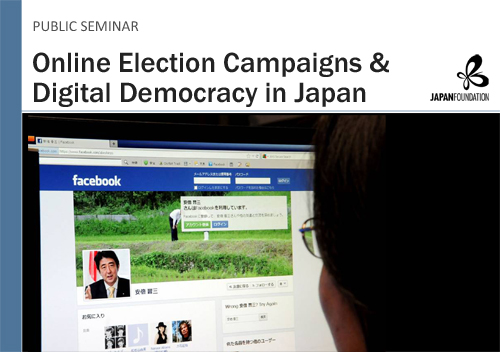
|
In April 2013 Japan’s Public Offices Election Law was revised and a ban on using the Internet for election campaigns was lifted. Prior to the revision, there were hopes that this would stimulate greater political debate and lead to increased voter turnout, particularly among younger voters. Contrary to expectations, however, the introduction of web-based electioneering appears to have had little influence on voting patterns and election results.
In this special public seminar, Ryosuke Nishida (Ritsumeikan University) joins us to chart the rise of web-based election campaigns in Japan and to examine the current debates surrounding this new form of electioneering. With reference to the recent Upper House and Tokyo gubernatorial elections, Nishida will also explain why Internet election campaigns have thus far failed to attract more young voters to the polls.
Joining Nishida in discussion following his presentation will be Dr Andy Williamson, an internationally recognised expert in digital democracy, online campaigning and citizen engagement.
| Date: | 10 November 2014 from 6.30pm |
| Venue: |
The Japan Foundation, London |
Booking:
This event is free to attend but booking is essential. To reserve a place, please e-mail your name and the title of the event you would like to attend to event@jpf.org.uk
**Dr Nishida will also be speaking at SEAS, University of Sheffield on Tuesday 11 November, 2014. Click here for more information
Image: Satoko Kawasaki
| Back to Top |
| Public Seminar: The Role of Education in Disaster Risk Reduction: Lessons from Kobe and Tohoku |
|

|
The Japan Foundation, in collaboration with Kobe University and Miyagi University of Education, is delighted to present this special public seminar looking at the role of education in disaster risk reduction. We will be joined by scholars from both universities who will introduce their projects for promoting disaster risk reduction and creating more resilient societies.
Presentations:
Risk Communication after Severe Earthquakes, Prof Tsuyoshi Matsuda, Kobe University
Disaster Risk Reduction and Education for Sustainable Development, Dr Takashi Oda, Miyagi University of Education
Education for Disaster and Recovery in Sendai and Kesennuma, Dr Takaaki Koganezawa, Miyagi University of Education
Chair: Prof Kiyomitsu Yui, Kobe University
Discussant: Prof Ros Wade, London South Bank University
| Date: | 13 November 2014 from 6.30pm |
| Venue: |
The Japan Foundation, London |
Booking:
This event is free to attend but booking is essential. To reserve a place, please email your name and the title of the event you would like to attend to event@jpf.org.uk



| Back to Top |
| Public Seminar: INEMURI: The Art of Napping in Japan |
|

|
|
Japan is known for long working hours and a strong work ethic, and recent polls have shown that Japanese workers enjoy less sleep at night than workers in any other country. Yet, one thing that surprises many foreign visitors to Japan is the number of people in public that can be seen napping during the day, whether in the train or in a restaurant, in the classroom or in the office, or even in a TV broadcast from parliament. This practice of sleeping in a situation not meant for sleep is known as inemuri in Japanese, which literally translates as ‘to be asleep while present’. In a society that prizes dedication to hard work, and where many people seem to sacrifice nocturnal sleep for work and study, why is sleeping on the job tolerated? This is a question that puzzled Dr Brigitte Steger, Senior Lecturer in Modern Japanese Studies at the University of Cambridge, which led her to write a book on the topic which entered the bestseller charts in Japan. In this seminar Dr Steger will explore the phenomenon of inemuri in Japanese society, as well as the unwritten social rules that govern the practice. Far from being a sign of laziness, inemuri has even been linked to better productivity. Dr Steger will be joined in discussion with sleep expert Dr Robert Meadows (University of Surrey) to compare attitudes to sleep in the UK and Japan and discuss whether anything can be learned from the custom in the UK where the demands of modern life have led to an increase in sleep deprivation. Image: Stéphane Bidouze |
| Date: | 4 June 2015 from 6.30pm - 8.30pm |
| Venue: |
Nunn Hall, Institute of Education, 20 Bedford Way, London, WC1H 0AL |
| Back to Top |
| Can a Freeter Buy a House? Contemporary Housing Issues in Japan from the 'Lost Generation' to 'Generation Rent' |
|

|
Since the collapse of its speculative asset bubble in the early 1990s and the onset of Japan’s first ‘lost decade’, it has become evident that younger adults have been finding it increasingly difficult to adopt standard life courses, inhibited, in particular, by shifts in economic and labour market conditions. One issue that has seemed to symbolise this shift is the emergence of so called freeters, young casual workers who seemingly reject the Japanese traditional life-course in favour of flexible work and personal goals.
Tapping into these contemporary social concerns, the 2010 Fuji Television drama ‘Furita, ie o kau’ (Freeter, buy a house) followed the life of Seiji, a recent college graduate who quits his secure office job but resolves to work as a part time labourer to buy a house for his family. But, can a freeter really buy a house in contemporary Japan? And to what extent is Seiji’s dream of home ownership still a key life goal for new generations of Japanese young adults today?
This seminar will approach the various issues thrown up by Japan’s changing social and economic environment through the lens provided by housing. Drawing on a range of sources, including examples from television drama, art, and architecture, Dr Chris Perkins (University of Edinburgh) will investigate the role of housing in post-war Japan, examining ways in which housing has been used to mobilise the workforce, and how some activists in Japan are now radically reconceptualising housing.
Professor Richard Ronald (The University of Amsterdam/The University of Birmingham) will then place this media and cultural reaction into the broader context of shifts in housing markets and the household careers of young people in Japan, exploring recent trends such as a rise in one person-households, a surge of younger people residing in private rental sector rather than purchasing a family home, and also recent data which suggests that the latest generation of Japanese millennials may be readapting ideas of home and household around various forms of shared living.
This seminar will provide an opportunity for reflection and debate on the role of housing in advanced industrial economies: an issue that, in an age of austerity and increasing income inequality, is as pertinent as ever.
Speakers:
Dr Chris Perkins is Lecturer in Japanese at The University of Edinburgh, a position initially funded by a Japan Foundation Staff Expansion grant. He completed his PhD thesis entitled ‘National Thinking and the Politics of Belonging in Contemporary Japan’ at Royal Holloway University of London and has since published on a range of subjects including television and film, memory, nationalism and borders. His most recent publication is The United Red Army on Screen: Cinema, Aesthetics, and the Politics of Memory (Palgrave).
Professor Richard Ronald is Associate Professor at the Centre for Urban Studies at the University of Amsterdam, the Netherlands, and Professor in the School of Social Policy at the University of Birmingham, UK. His work focuses on housing in relation to social, economic and urban transformations in Europe and Pacific Asia, with his latest research project (HOUWEL: Housing Markets and Welfare State Transformations) supported by a European Research Council StG grant. He has previously held Japan Foundation as well as Japan Society for the Promotion of Science Fellowships at Kobe University in Japan.
| Date: | 27 November 2015 from 6.30pm |
| Venue: |
Mander Hall, Hamilton House, Mabledon Place, London, WC1H 9BD (Close to Kings Cross, St Pancras and Euston stations) |
Image (right): Payless Images/Shutterstock.com
| Back to Top |
| Japan Foundation / BAJS Japanese Studies Post-graduate Workshop 2016 |
|
|
We are delighted to announce that the annual Japan Foundation/BAJS Post-graduate Workshop will be held on Thursday 4th February 2016 in London.
This workshop aims to assist the development of the next generation of Japanese specialists here in the UK, and to further strengthen the Japanese studies community in this country. It is a great opportunity to receive some practical advice on your research from senior colleagues, and to get to know fellow post-graduate students and others in the Japanese Studies community.
This year's workshop will include practical sessions on the following topics:
'Academic Opportunities outside East Asian Studies'
Professor Susan Townsend (University of Nottingham)
'Japanese for Academia: Culturally Convincing Japanese Academic Presentations using Social Media'
Dr Thomas McAuley (University of Sheffield) and Dr Luli van der Does-Ishikawa
'Panel Discussion: Early Career Development'
Panel of early career researchers and lecturers to answer your questions and give tips on post doctoral career development. Panellists include Dr Gitte Hansen (Newcastle University), Dr Jonathan Service (University of Oxford) and Dr Ruselle Meade (Cardiff University).
'Funding your Research'
Representatives from Japanese Studies related funding bodies will give short presentations on their funding programmes.
The workshop will also provide opportunities for a small number of participants to give a 15 minute presentation on their research and receive feedback from each other and senior academics. Applications to make a presentation at the workshop are now closed.
Eligibility: This workshop is open to postgraduate students in Japanese Studies or postgraduate students who are undertaking Japan related research in other disciplines.
Lunch will be provided on the day, and the workshop will be followed by a dinner reception.
**Please note that travel expenses of up to £40 will be available to all participants**
Image: donatas1205/Shutterstock.com
| Date: | 4 February 2016 from 10.30am - 6.00pm |
| Venue: |
Holiday Inn Bloomsbury, Coram Street, London, WC1N 1HT |
| Back to Top |
| Safe as Houses? Housing and Welfare in an Ageing Society: Japan and UK Perspectives |
|

|
In both Japan and the UK, housing policy has largely fixated on the goal of widening access to home ownership, underpinned to some extent with the ideology of asset-based welfare, or that home ownership can play a role as a supplement or alternative to state welfare by allowing families from all walks of life to accumulate wealth, and provide social security to ageing home owners.
In Japan the promotion of home ownership has long been embedded in welfare provision, however recent social and economic changes have exposed weaknesses in this ideology.
Two decades of post-bubble recession and housing price volatility have highlighted the vulnerability of housing asset values, creating barriers to turning real estate into cash to fund welfare needs. A construction based approach to housing has further devalued existing stock resulting in a huge surplus of 'akiya' or abandoned decaying housing, scattered across Japan. Widening social inequality, as a result of economic recession and neo-liberal policy reform has also limited accessibility to home ownership for some.
In this special public seminar, Dr Misa Izuhara (University of Bristol) will critically explore the focus on home ownership in housing policy in Japan, and will consider the future of home ownership in Japan's ageing society, especially the challenges arising around using housing assets in later life in the existing social and market systems.
Later Dr Izuhara will be joined in discussion by UK housing expert Dr Beverley Searle (University of Dundee) to take a look at the future of home ownership in Japan and the UK, and consider whether anything can be learnt from how the situation is developing in each country, both of which are facing challenges arising from ageing populations, economic recession, housing price volatility and the effects of neo-liberal policy reforms.
Can promotion of home ownership be an egalitarian and inclusionary policy and provide social security for the elderly in later life? Or should alternative policies be promoted to make housing more accessible and affordable and a better fit to meet the changing demands of our rapidly ageing populations?
| Date: | 10 November 2015 from 6.30pm |
| Venue: |
Mander Hall, Hamilton House, Mabledon Place, London, WC1H 9BD (Close to Kings Cross, St Pancras and Euston stations) |
| Back to Top |
| Japan Foundation / BAJS Japanese Studies Postgraduate Workshop 2018: Bridging the Academic Worlds of the UK and Japan |
|
|
We are delighted to announce that the next annual Japan Foundation and British Association for Japanese Studies (BAJS) Postgraduate Workshop will be held in 2018 at SOAS, University of London.
This workshop aims to assist the development of the next generation of Japanese Studies researchers in the UK. It is a great opportunity to receive practical advice on your research from senior colleagues, and to get to know fellow postgraduate students and others in the Japanese Studies community.
This year’s interactive workshop will explore how emerging Japanese Studies researchers in the UK can help to bridge the academic worlds of UK and Japan through their research. It will include a series of sessions by senior academics addressing key challenges relating to conducting and disseminating research in Japan, and improving communication between researchers in both countries, along with opportunities for the participants themselves to introduce their own research and why they believe it is important for the advancement of Japanese Studies in the UK and Japan.
In addition, there will be an opportunity to hear presentations from various agencies on potential sources of funding for current and future research, including funding to support research in Japan.
Eligibility: This workshop is open to postgraduate students in Japanese Studies and those undertaking Japan related research in other disciplines in the humanities and social sciences. Priority registration will be given to PhD candidates.
| Date: | 16 February 2018 from 10.30am - 6.00pm |
| Venue: |
SOAS, University of London |
*Doors will open from 10am.
FULLY BOOKED: Due to high demand, the 2018 workshop is now fully booked. Thank you to everyone for your interest and we look forward to seeing all participants at the workshop.
Please email Programme Officer Julie Anne Robb at julieanne.robb@jpf.org.uk if you have any enquiries.
*The Japan Foundation will be able to offer partial travel grants to student participants. Please get in touch for more details.*
Image (left): donatas1205/Shutterstock.com
| Back to Top |
| Rethinking 'Japanese' Pop Culture: Transnational media cultural connections and the question of cultural diversity |
|
|
Since the late 1980s, Japanese consumer technologies, and subsequently pop culture exports such as Pokemon and Hello Kitty, have become increasingly familiar to many people around the world. But has our increased exposure to these cultural exports led to a greater understanding of the diversity of contemporary Japan?
Eminent Japanese media and cultural studies scholar Professor Koichi Iwabuchi (Monash University, Australia) will lead this seminar, which will discuss the phenomenon of the spread of Japan’s cultural exports and consequent cross-border dialogue; and will challenge ideas and assumptions of a single ‘national’ Japanese pop culture. While many 'Japanese' cultural products are, as in most other popular cultures, not purely Japanese inventions, what has become prevalent is the re-accentuating of national cultural borders as a result of the inter-nationalized circulation and display of media cultures. This presentation will discuss in the Japanese and East Asian context how this process contains and discourages engagement with growing multicultural situations, and will suggest the need for trans-Asian perspectives and collaboration to tackle this situation.
Professor Iwabuchi will be joined in conversation with Dr Griseldis Kirsch (SOAS, University of London).
| Date: | 13 April 2015 from 6.30pm - 8.30pm |
| Venue: |
Swedenborg Hall The Swedenborg Society 20-21 Bloomsbury Way (Entrance on Barter Street) London WC1A 2TH |
| Back to Top |
| Japanese Study Seminar in Alsace 2016: Call for Participation! |
|

|
The Japan Foundation and Centre Européen d'Etudes Japonaises d'Alsace (CEEJA) are now accepting applications for participation in Japanese Study Seminar: Women and Men (女と男) scheduled for 26th and 27th September, 2016 at CEEJA, in Kientzheim, France. The official language of the seminar will be JAPANESE.
This seminar aims to encourage networking among young researchers in Europe specialising in Japan related topics, and further promote Japanese Studies in Europe.
Participants will join a two-day intensive workshop in the cozy and intimate atmosphere of CEEJA's facility in Kientzheim where they will present and discuss their current research projects with fellow participants and guest mentors from Japan.
The theme of this year’s seminar will be “Women and Men (女と男).” We are calling for applications from young researchers in Europe specialising in politics, history, sociology, literature, arts, language, philosophy, economics, architecture, religion, etc.
The deadline for applications is 30 June, 2016.
For further details including eligibility and application procedures, please visit the Japan Foundation Tokyo website here.
| Date: | 26 September 2016 - 27 September 2016 |
| Venue: |
Centre Européen d'Etudes Japonaises d'Alsace (CEEJA), Kientzheim, France |
| Back to Top |
| Public Seminar: Prof AKIRA IRIYE - An Historian Looks at the Contemporary World |
|
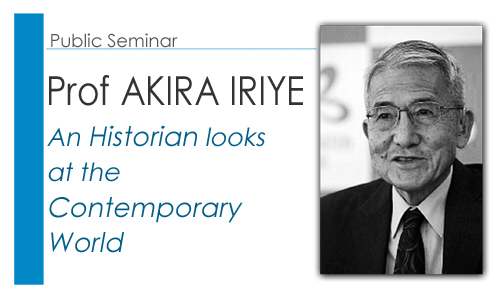
|
The Japan Foundation is delighted to present this special public seminar with Professor Akira Iriye, Professor Emeritus, Harvard University and recipient of the Japan Foundation Award 2013. Drawing on decades of research, Prof Iriye will examine historical study today and international relations history, before discussing the defining characteristics of the contemporary world and offering his thoughts on the future. Joining Professor Iriye in discussion will be Professor Rana Mitter, Director of the University China Centre at the University of Oxford.
| Date: | 13 October 2014 from 6.30pm |
| Venue: |
The Japan Foundation, London |
Booking:
This event is free to attend but booking is essential. To reserve a place, please e-mail your name and the title of the event you would like to attend to event@jpf.org.uk.
| Back to Top |
| Japan Foundation Japanese Studies Student Survey 2015 |
|

|
The Japan Foundation Japanese Studies Student Survey is part of the Japan Foundation’s periodic assessment of the state of Japanese Studies in the UK which has been conducted once every 3-4 years since 1996.
The Japan Foundation is Japan’s principal organisation for promoting international cultural exchange worldwide and through our funding programmes we offer support to organisations and individuals working in the field of Japanese Studies throughout the UK.
In order for us to consider future plans for the enhancement of Japanese studies, we are eager to learn the views of Japanese Studies students in the UK, both at undergraduate and postgraduate level, so that we can continue to support you and the field of Japanese Studies as effectively as possible.
Please note that the deadline for completing the survey has been extended to 30th September 2015.
Who can take part in the survey:
Any students undertaking Japan-related study at a higher education institution in the UK. Whether you are at undergraduate level or postgraduate, undertaking a single or joint honours Japanese Studies degree, or simply taking a module in a Japan related subject, we would be delighted to hear from you.
Taking the survey:
The survey can be accessed through the following link: (link removed)
We estimate that the entire survey can be completed in around 15 minutes.
Deadline and Publication:
Please fill out the survey before 30th September 2015.
The results of the survey will be published in late 2015, and individual answers will remain anonymous.
You can find the results of the Japanese Studies Students Survey 2010 on the Japan Foundation Japanese Studies Survey website here.
Prize draw:
If you choose to provide us with your name and e-mail address, you will be entered into a prize draw, for a chance to win one of up to 10 Japan-related book tokens worth £20 each.
If you have any questions about the survey, please email Julie Anne Robb, Programme Officer for Japanese Studies and Intellectual Exchange, Japan Foundation London: julieanne.robb@jpf.org.uk
Japanese Studies Institutions Survey
As part of our overall assessment of the state of Japanese Studies in the UK, the Japan Foundation is also conducting a survey of higher education institutions in the UK which provide opportunities for Japan related study. If you are a member of staff at a higher education institution which offers Japan related study please get in touch with Julie Anne Robb to take the survey: julieanne.robb@jpf.org.uk
| Date: | 1 July 2015 - 30 September 2015 |
| Back to Top |
| Japan Foundation / BAJS Japanese Studies Postgraduate Workshop 2017: Make an Impact |
|
|
We are delighted to announce that the annual Japan Foundation and British Association for Japanese Studies (BAJS) Postgraduate Workshop will be held in 2017 at the University of Sheffield.
This workshop aims to assist the development of the next generation of Japan specialists in the UK. It is a great opportunity to receive practical advice on your research from senior colleagues, and to get to know fellow postgraduate students and others in the Japanese Studies community.
This year’s interactive workshop will explore how emerging Japanese Studies researchers can increase the impact of their research on wider academia and society in the UK and Japan.
It will combine a series of presentations from senior colleagues on their own experience of conceiving, generating and recording the impact of their research with hands-on workshop sessions designed to allow participants to produce a skeleton statement of the potential impact and audience for their research, which can then be developed into a more formal impact statement for funding applications. In addition, there will be an opportunity to hear presentations from various agencies on potential sources of funding for current and future research.
Eligibility: This workshop is open to postgraduate students in Japanese Studies and those undertaking Japan related research in other disciplines. Priority registration will be given to PhD candidates. From 6th February 2017 registration will also be extended to Japanese Studies Masters students who are thinking about doing a PhD.
All participants will need to bring a wifi-enabled laptop or tablet with them to participate in the afternoon workshop sessions.
| Date: | 24 February 2017 from 11.00am - 6.30pm |
| Venue: |
University of Sheffield |
Booking: E-mail Julie Anne Robb at julieanne.robb@jpf.org.uk to register your interest in attending or if you have any enquiries.
*The Japan Foundation will be able to offer partial travel grants to student participants. Please get in touch for more details.*
Image (left): donatas1205/Shutterstock.com
| Back to Top |
| Japanese Study Seminar in Alsace 2017: Call for Participation! |
|

|
The Japan Foundation and Centre Européen d'Études Japonaises d'Alsace (CEEJA) are now accepting applications for participation in Japanese Study Seminar: Digital Media and Communication (デジタル・メディアとコミュニケーション) scheduled for 25 to 26 September 2017 at CEEJA, in Kientzheim, France. The official language of the seminar will be JAPANESE.
This seminar aims to encourage networking among young researchers in Europe specialising in Japan related topics, and to further promote Japanese Studies in Europe.
Participants will join a two-day intensive workshop in the cozy and intimate atmosphere of CEEJA's facility in Kientzheim where they will present and discuss their current research projects with fellow participants and a guest mentor from Japan.
The theme of this year’s seminar will be "Digital Media and Communication (デジタル・メディアとコミュニケーション)". We are calling for applications from young researchers in Europe specialising in politics, history, sociology, literature, arts, language, philosophy, economics, architecture, religion, etc.
Please note that the deadline for applications has now closed.
For further details including eligibility and application procedures, please visit the Japan Foundation Tokyo website here.
| Date: | 25 September 2017 - 26 September 2017 |
| Venue: |
Centre Européen d'Études Japonaises d'Alsace (CEEJA), Kientzheim, France |
| Back to Top |
| Windows on a Modern World: The Role of the Department Store in 20th Century Japan |
|
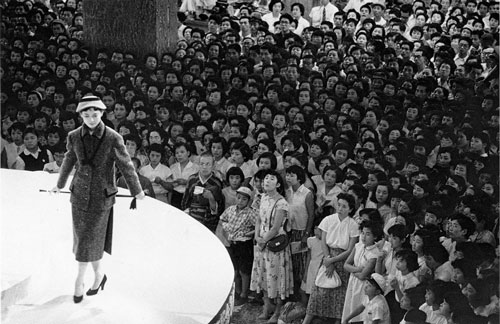
|
For the people of Japan throughout the 20th century, department stores offered a window into modernity and the outside world. Since the opening of the first department store in Japan in 1904, these institutions have been influential in introducing modern, urban and foreign lifestyles to Japan. Not only shops selling fashion, food and homeware; the department stores also hosted exhibitions and workshops to educate customers, and offered a more luxurious and sophisticated shopping and leisure experience.
In this special seminar, Dr Tomoko Tamari, (Goldsmiths, University of London) will discuss the development of department stores in Japan and their effect on popular culture and lifestyle. She is joined by Professor Janet Hunter, (London School of Economics and Political Science), who will place the development of the department store into the broader context of the changing Japanese economy through the 20th century.
The seminar is inspired by a photograph of a fashion show held in the Mitsukoshi department store in 1956, on display at the Japan Foundation's exhibition "Metamorphosis of Japan after the War" until 26th April (click here for more details about the exhibition).
| Date: | 20 March 2015 from 6.30pm - 8.30pm |
| Venue: |
Room 728, Institute of Education, 20 Bedford Way, London |
Image: Shigeichi Nagano, Fashion show at the Mitsukoshi department store, Nihonbashi, Tokyo, 1956
| Back to Top |
| Book Launch & Talk: Making Tea, Making Japan. Kristin Surak in conversation with Christine Guth and Fabio Gygi |
|
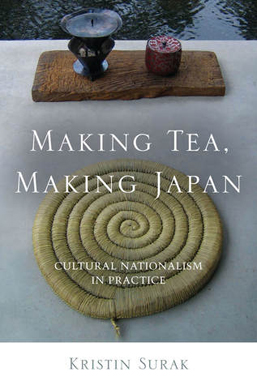
|
Why did an activity as mundane as tea preparation and drinking become one of the most potent symbols of Japan? How does the tea ceremony create an experience of Japaneseness – not just for foreigners, but for Japanese as well?
Drawing on her new book Making Tea, Making Japan: Cultural Nationalism in Practice, Dr Kristin Surak (SOAS) will explore the relationship between culture and nation in conversation with Dr Christine Guth (RCA) and Dr Fabio Gygi (SOAS).
The discussion will examine the tension-filled transformation of chanoyu from an aesthetic pleasure of elite men to a hobby of housewives as it came to embrace not merely the elite few, but the nation as a whole, and probe the ways that tea masters have capitalized on the association between tea and Japanese culture. As such, the tea ceremony serves as an exceptionally vivid illustration of one of the fundamental processes of modernity: the work of making nations.
| Date: | 11 June 2014 from 6.30pm |
| Venue: |
The Japan Foundation, London |
This event is free to attend but booking is essential. To reserve a place, please e-mail your name and the title of the event you would like to attend to event@jpf.org.uk
Book Synopsis
Few practices are simultaneously as exotic and representative, instrumental and sensual, political and cultural as the tea ceremony. Pre-modern in origin, the ritual was recast as a political emblem of the modern Japanese state, and then transformed into its contemporary incarnation as a cultural icon of the country. Throughout these conversions, its practitioners have played an integral role in defining and redefining what it means to be Japanese. Employing ethnographic, historical, institutional, and phenomenological methods, Kristin Surak shows how the tea ceremony has become intimately tied to national identity through a process she terms "nation-work." Making Tea, Making Japan: Cultural Nationalism in Practice includes an account of the historical evolution of the tea world and a detailed investigation of its contemporary organization to offer a systematic study of the ways that cultural practices define, explain, embody, and cultivate nations.
| Back to Top |
| A Silent Voice - Discover Japanese Studies through Anime! |
|

|
Attend the Japan Foundation Touring Film Programme screening of the emotional and beautifully animated school anime ‘A Silent Voice’ at HOME, Manchester, and discover opportunities to study Japanese Studies and Japanese Language in the UK through fun activities inspired by the film.
Before or after attending the screening of ‘A Silent Voice’ come to visit the ‘Discover Japanese Studies’ booth in the cinema foyer where you will have the opportunity to get advice from current students and graduates about studying Japanese at university and try your hand at a Japanese language taster.
All visitors to the Discover Japanese Studies booth will enter our free prize draw to win a selection of Japanese study resources to further their studies!
Discover Japanese Studies Booth in Cinema Foyer: from 4.30pm - 8.30pm
Screening of 'A Silent Voice' (12A) at HOME, Manchester: 5.40pm
| Date: | 26 February 2017 from 4.30pm - 8.30pm |
| Venue: |
Cinema Foyer (2nd Floor), HOME, Manchester, M15 4FN |
Event Booking: Ticketed screening with concessions available. See HOME website to book tickets.
For more information about other Japan Foundation Touring Film Programme screenings please see the Japan Foundation Touring Film Programme website.
Related event: A level and GCSE students may also be interested in attending the ‘Sixth Form and GCSE Students’ Japan Day’ which will be held at the University of Manchester on Friday 31 March 2017 by the Japan Society and the University of Manchester.
| Back to Top |
| SAKE: Tradition Meets Innovation - The Story of the First Non-Japanese Sake Master Brewer |
|
|
|
The brewing of sake is a craft steeped with tradition, but one which has risen to many new challenges in modern times. Philip Harper has a unique perspective on tradition and innovation in the world of sake, having worked for more than 20 years in the industry, and being the only non-Japanese to have earned the prestigious title of ‘toji’ or master brewer. Japanese sake has played an important role in Japanese culture since ancient times, but in recent times social change had pushed sake towards the periphery of Japanese lifestyle. In response to this, innovative efforts have been made to revitalise the sake market within Japan, as well as to widen its appeal internationally. In this special talk, through sharing his own experiences of learning the complex and sometimes arcane traditions of sake-brewing, Philip Harper will also shed light on how the sake industry has responded to recent challenges, preserving traditional methods and wisdom, while adopting new modern techniques in production and marketing. Philip’s own range of sake embodies this marriage of innovation and tradition, bucking modern trends to brew to traditional forgotten recipes, and using adventurous techniques to create new flavours. At this special seminar, held in the grand Conway Hall, guests will not only have the rare opportunity to put their questions to a toji, but they will also be able to sample some of Phillip’s sake from the award-winning Kinoshita Brewery in Kyoto. Also joining us will be Rie Yoshitake who will introduce the activities of the Sake Samurai association, an organisation formed by young sake brewers in Japan which works to protect sake traditions and to promote sake in overseas markets. Image (right): Tsukinokatsura, Hyogo
|

| Date: | 6 July 2015 from 6.45pm - 8.30pm |
| Venue: |
Conway Hall, London, WC1R 4RL |
| Back to Top |
| Japanese Studies Seminar in Alsace: Call for Participation! |
|

|
Centre Européen d'Etudes Japonaises d'Alsace (CEEJA) and the Japan Foundation are now accepting applications for participation in Japanese Studies Seminar: Tokyo(東京) scheduled for 22 and 23 September, 2014 at CEEJA, in Kientzheim, France. The official language of the seminar will be JAPANESE.
This seminar aims to encourage networking among young researchers on Japan in Europe and further promote Japanese Studies in Europe.
Participants will join a two-day intensive workshop in the cozy and intimate atmosphere of CEEJA's facility in Kientzheim where they will present and discuss their current research projects with fellow participants and guest mentors from Japan and the USA.
The theme of this year’s seminar will be “Tokyo (東京).” We are calling for applications from young researchers in Europe specializing in politics, history, sociology, literature, the arts, language, philosophy, economics, architecture, religion, etc.
The deadline for applications is 30 June, 2014.
Please see the attached file 'Japanese Studies Seminar in Alsace' for further details including eligibility and application procedures.
| Date: | 22 September 2014 - 23 September 2014 |
| Venue: |
Centre Européen d'Etudes Japonaises d'Alsace (CEEJA), Kientzheim, France |
|
Download Japanese Studies Seminar in Alsace_
|
|


| Back to Top |
| Okinawan Crafts: History and the Present |

|
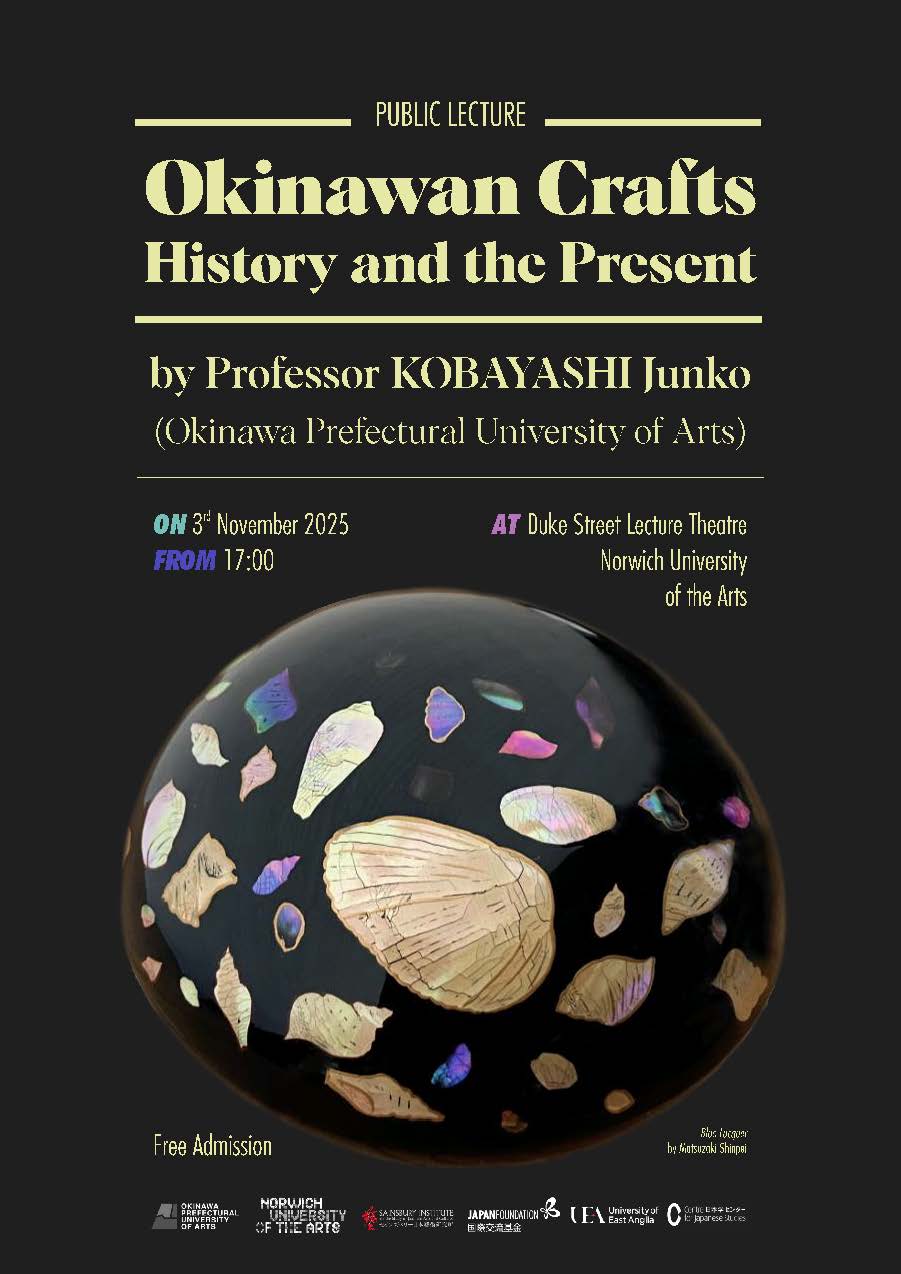
Date: Monday 3 November, 5pm GMT.
Venue: Duke Street Lecture Theatre, Norwich University of the Arts
The Japan Foundation London is proud to support our friends at the University of East Anglia on their upcoming lecture, Okinawan Crafts: History and the Present with Professor Junko KOBAYASHI (Okinawa Prefectural University of Arts).
This lecture by Professor Kobayashi will explore the history and contemporary relevance of Okinawan craft, addressing themes such as identity, regional heritage, and sustainability. The work of eight Okinawan artists will be reflected on, exploring their historical context, the evolution of Ryukyuan aesthetics, the preservation of identity through craft, and the adaptation of traditional practices in the modern era.
The lecture is part of the accompanying programme for the exhibition ‘Okinawan Kogei: Crafting Continuity and Change’ that runs from Wednesday 29 October – Saturday 1 November, at the Crypt Gallery, Norwich.
This lecture will be taking place in person, but will be available via livestream.
To find out more about the lecture and exhibition, click here.
| Date: | 3 November 2025 from 5.00pm |
| Back to Top |
| The Art of Recovery: Legacies of the Fukushima Triple Disaster |
|
.jpg)
We are pleased to be supporting University of Bristol's event, 'The Art of Recovery: Legacies of the Fukushima Triple Disaster', taking place on 11-12 March, 2025.
Marking the 14th anniversary of the Fukushima triple disaster, this event brings together academics and artists who have studied or documented the tragedy and its aftermath, to explore the cultural, social and emotional impacts of man-made disasters.
The programme for the two day event includes:
Tuesday, 11th March 2025
UK Premiere of The Invisible Island, dir. Keiko Curdy (2021), with a Q&A and discussion with the director.
Time: 18:00 - 20:00
Venue: Watershed, Cinema 3, 1 Canon's Rd, BS1 5TX
Wednesday 12th March 2025
Academic Workshop, "Cross-disciplinary Approaches to the Fukushima Disaster".
Time: 9:45-17:00
Venue: Bristol University, Room G.H01, Arts Complex, 7 Woodland Road, BS8 1TB, Clifton Campus
Wednesday 12th March 2025
UK Premiere of Tracing the Future: Photographer Naoya Hatakeyama, dir. Yohei HATAKEYAMA (2015).
Time: 18:00-20:00
Venue: University of Bristol, B.H05 Lecture Theatre, 7 Woodland Road, BS8 1TB, Clifton Campus
All events in this 2 day programme are free but booking is essential. You can find full details of each event, including booking information, by visiting:
https://theartofrecovery.blogs.bristol.ac.uk/
| Date: | 11 March 2025 - 12 March 2025 |
|
For more information, please click here. |
|
| Back to Top |
| Lafcadio Hearn’s Japan: from Enchantment to Intercultural Understanding |
|
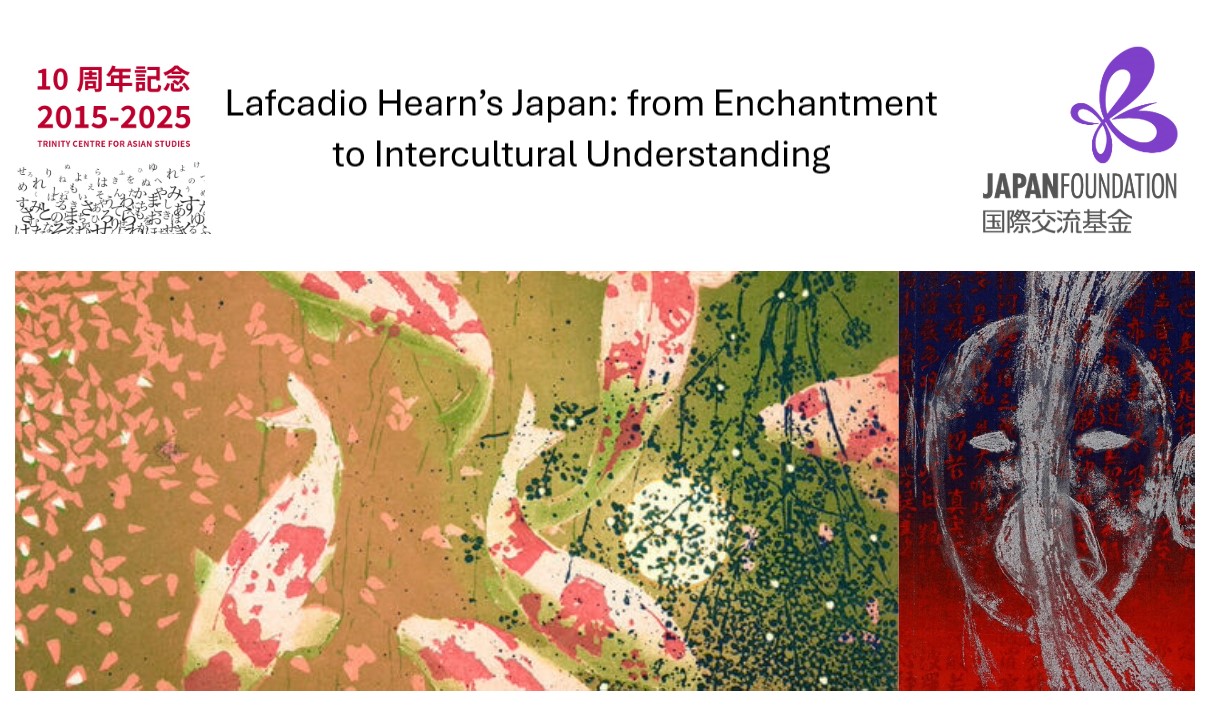
We are very proud to support this event, 'Lafcadio Hearn's Japan: from Enchantment to Intercultural Understanding', hosted by Trinity College Dublin's Centre for Asian Studies.
This is a one-day academic workshop honouring the life and works of Hearn, recognising him as a person dedicated to understanding across cultures, ambitious in his rejection of bigotry, and sensitive to Japanese life and ethics despite their contrast to the West.
Speakers include prominent scholars, diplomats, and politicians from Ireland, Japan, Britain and the USA, including Professor Bon Koizumi, descendent of Lafcadio Hearn.
This event is free to attend, but registration is essential.
Further details, including the workshop schedule and registration, can be found here:
https://www.tcd.ie/Asian/events/tcd-Event-Lafcadio-Hearn/
For more details please contact Dr Lijing Peng (pengl@tcd.ie) or Professor Nathan Hill (nathan.hill@tcd.ie).
| Date: | 7 March 2025 from 9.00am - 7.00pm |
| Venue: |
Neill Lecture Theatre, Trinity Long Room Hub, Trinity College Dublin, Dublin 2, Ireland |
|
For more information, please click here. |
|
| Back to Top |
| Theory and Film in the Political Reconstruction of Post-War Japan, a talk at Edinburgh University |
|
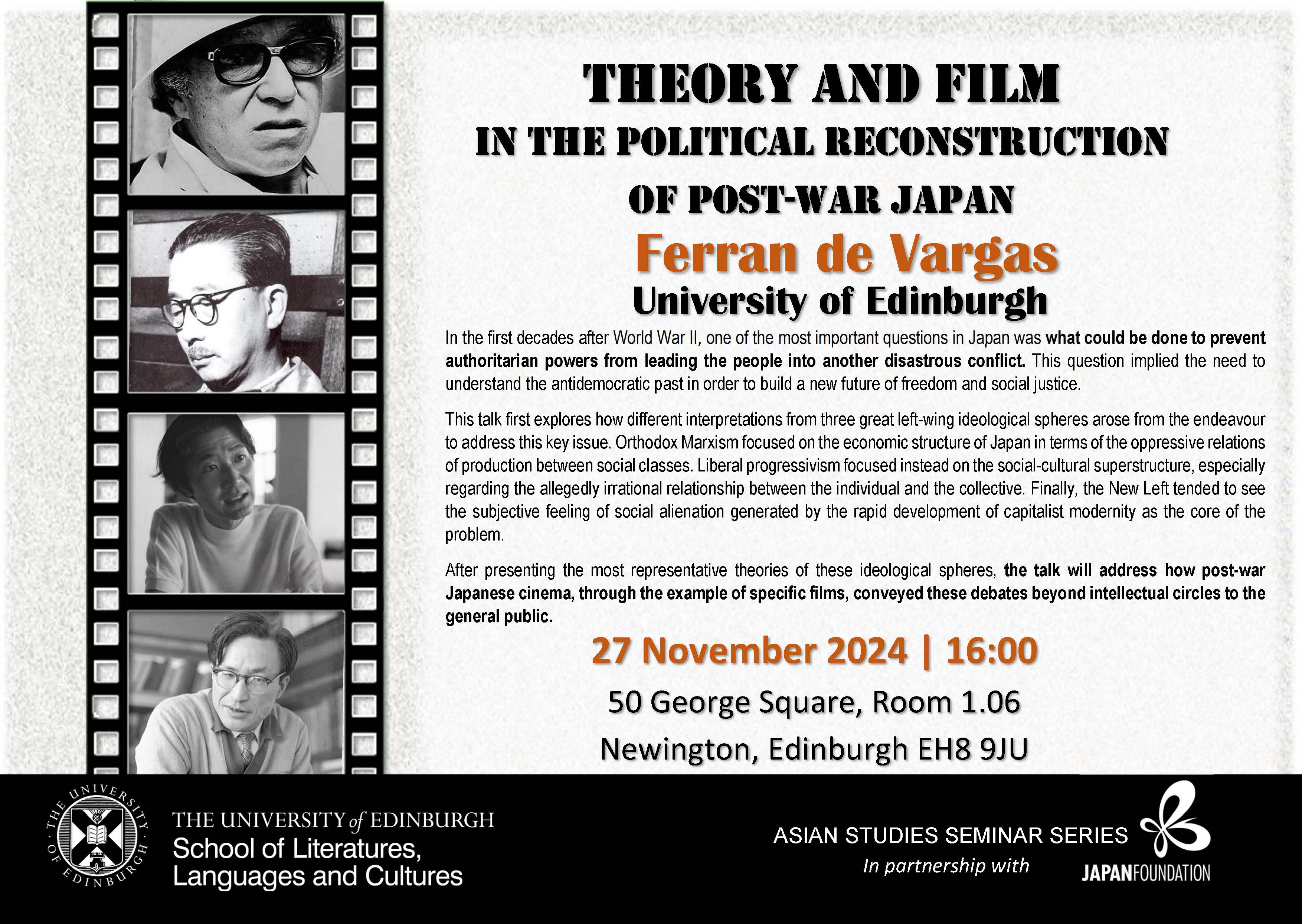
As part of our on-going partnership with The University of Edinburgh, we are proud to support the next talk in their Asian Studies Seminar Series, "Theory and Film in the Political Reconstruction of Post-War Japan" with Dr Ferran de Vargas.
In the first decades after World War II, one of the most important questions in Japan was what could be done to prevent authoritarian powers from leading the people into another disastrous conflict. This question implied the need to understand the antidemocratic past in order to build a new future of freedom and social justice.
This talk first explores how different interpretations from three great left-wing ideological spheres arose from the endeavour to address this key issue. Orthodox Marxism focused on the economic structure of Japan in terms of the oppressive relations of production between social classes. Liberal progressivism focused instead on the social-cultural superstructure, especially regarding the allegedly irrational relationship between the individual and the collective. Finally, the New Left tended to see the subjective feeling of social alienation generated by the rapid development of capitalist modernity as the core of the problem.
After presenting the most representative theories of these ideological spheres, the talk will address how post-war Japanese cinema, through the example of specific films, conveyed these debates beyond intellectual circles to the general public.
This talk will first present three left-wing ideological spheres that arose in post-war Japan, to address the question of what could be done to prevent authoritarian powers from leading people into another disastrous conflict. Then, it will explore how these ideas were conveyed, via cinema, to the general public.
This event is free to attend and no booking is required. Just turn up!
For more information, click here.
Date: Wednesday 27 November, 16.00 - 18.00
Venue: Room LG.08, 40 George Square, The University of Edinburgh
| Date: | 27 November 2024 |
| Venue: |
Room LG.08, 40 George Square, The University of Edinburgh |
| Back to Top |
| *Looking for Volunteers* for the UCL-Japan Youth Challenge 2025! |
|

The UCL-Japan Youth Challenge 2025 is looking for volunteers!
If you are interested in Japanese culture or learning Japanese, and are over 18, why not come along to this week-long campus summer school programme to help pre-university students shape their future studies and careers?
The UCL-Japan Youth Challenge is an annual summer school programme for pre-university students from UK sixth form colleges and Japanese high schools for cultural interaction through various educational activites held at UCL and the University of Cambridge.
Dates and Venues*: Saturday 26 July (Rikkyo School in England), Sunday 27, Monday 28 July (University of Cambridge), and Tuesday 29 - Saturday 2 August (University College London).
*Volunteers may choose to join from one day to the whole programme.
What will be provided: Reasonable travel costs and lunch.
Eligibility: Volunteers must be 18 years of age and able to travel to the volunteer locations.
If you can volunteer, please email ujyc@japanatuk.com to register your interest.
To find out more about the UCL-Japan Youth Challenge, visit: ucl-japan-youth-challenge.com.
| Date: | 26 July 2025 - 2 August 2025 |
| Back to Top |
| Mobility, Migration, and Transnational Communities around the Globe |
|

We are proud to support this hybrid event organised by SOAS, University of London and the University of Oxford. The event will screen interview recordings of the Japanese diaspora in the UK, before a panel discussion, and a private viewing (for in-person attendees). The full event description can be found below.
This event is free to attend, but registration is essential. It is an English-Japanese bilingual event.
In-person & live streaming available.
Registration: https://forms.office.com/e/x8y6mXbdX8
Theme:
All are welcome to the event! Who are we, living in different countries? What legacy did our predecessors and pioneers leave? How should we continue and renew it? Let us discover answers and directions through the panel discussion and public viewing of the Wasurena-gusa Project interview recordings of the Japanese diaspora in the UK.
Schedule:
14.40-15.00 Public viewing of interview recordings
15.00-17.00 Panel discussion
17.00-17.55 Public viewing and reception
Speakers (in alphabetical order):
Prof. Emeritus John C. Maher of International Christian University
Associate Prof. Laura Mark of University of Sussex
Prof. Emeritus Kazuko Miyake of Toyo University
Prof. Yoshiko Nakano of Tokyo University of Science
Mrs. Momoko Williams of Japan Association in the UK
Padlet (for more information)
For any enquiries, please email: kaori.nishizawa@ames.ox.ac.uk
All welcome.
| Date: | 19 June 2025 |
| Venue: |
University of Oxford Faculty of Asian and Middle Eastern Studies
Basement Teaching Room 1 |
| Back to Top |
| Symposium on the 80-year legacy of War and Paths to Peace: Commemorating VJ Day |
|

We are proud to support this significant event that commemorates the 80th anniversary of VJ day at The University of Westminster.
This symposium brings together social scientists, activists and practitioners of Second World-War-related studies involving the UK and Japan, to reflect on the legacies of the Second World War and explore ideas of memory, reconciliation, peace and international cooperation.
This event is open to the public, and free to attend in-person and online.
Date: Tuesday 6 May, 9:30am - 6pm
Venue: Portland Hall, 4-12 Little Titchfield Street, University of Westminster. Livestreaming available.
For full details and to register for the event, click here.
| Date: | 6 May 2025 from 9.30am - 6.00pm |
| Back to Top |
| The UCL-Japan Youth Challenge 2025 is Looking for UK-based Participants! |
|

If you are a pre-university student in the UK, and you are interested in making friends from Japan and learning Japanese culture, while also attending lectures at top UK universities delivered by academics and professionals and learning crucial team work and presentation skills through participating in the UCL Grand Challenge Workshop, then why not register for the UCL-Japan Youth Challenge 2025?!
This is a prestigious, annual summer school programme that was established in 2015. The programme brings together students visiting from high schools across Japan with pre-university students from the UK.
The programme takes place across various locations, including the Rikkyo School in England, the University of Cambridge, and UCL.
This year marks the 10th anniversary of the programme! The theme is “Space for the Future”, focusing on how we can shape our future with the most advanced science and technology.
This year’s programme will run from Saturday 26th July – Sunday 3rd August 2025. Please note that some dates are optional, and full details can be found on the UCL-Japan Youth Challenge website.
The programme is now taking applications from UK students, so if you know anyone you think might be interested, please share the information with them!
For more information, visit the UCL-Youth Challenge official website: UCL-Japan Youth Challenge - Summer school programme
| Date: | 26 July 2025 - 3 August 2025 |
| Back to Top |
| Echo-locations: Toward a Sonic Aesthetics of Japanese Karaoke at Edinburgh University |
|
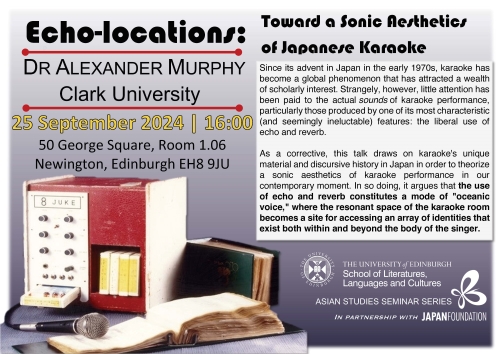
|
We are proud to be partnering with The University of Edinburgh this year, for their 2024-25 Asian Studies Seminar Series!
The first talk in the series is by Dr Alexander Murphy, Assisant Professor in Language, Literature and Culture at Clark University. He will provide fascinating insight into the use of echo and reverb in karaoke, and how this enables karaoke-goers to embody different identities.
This event is free to attend and registration is not essential. Just turn up!
| Date: | 25 September 2024 from 4.00pm |
| Venue: |
50 George Square, Room 1.06 Newington, Edinburgh EH8 9JU |
| Back to Top |
| Translation of Bodies: performance work of a professional puppeteer inspired by Japanese otome bunraku at Edinburgh University |
|

Join the University of Edinburgh for the final talk in their Asian Studies Seminar Series for the academic year 2013 - 2014, in partnership with The Japan Foundation.
This free talk by Dr Caroline Astell-Burt is entitled 'Translation of Bodies: performance work of a professional puppeteer inspired by Japanese otome bunraku'.
Dr Astell-Burt first encountered puppets based on otome bunraku at a training workshop in 2009 at the London School of Puppetry. This developed into a long study of the bodily presence of the puppeteer before being formalised into a doctoral enquiry and the opportunity to observe the extremely rare and beautiful performances at Hitomiza in Japan.
She regularly writes academic articles about puppets and puppetry often within an educational or therapeutic context. She is a puppet-maker, performer and teacher and co-founder of the first full-time professional training for puppeteers in the UK. She holds two Masters Degrees from Middlesex and Royal Holloway Universities and a doctorate from Loughborough University.
No booking essential, just turn up!
To visit the event page on the University of Edinburgh's website, click here.
| Date: | 3 April 2024 from 4.00pm - 6.00pm |
| Venue: |
University of Edinburgh Project Room 1.06, 50 George Square |
| Back to Top |
| Japan-Britain Contemporary Theatre Exchange |
|
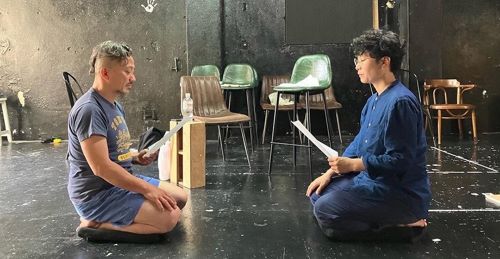
|
Proudly supporting Japan-Britain Contemporary Theatre Exchange.
How is contemporary theatre and performance inspired by imaginary and/or real travel? How can theatrical exchange and collaboration become a transformative force and give agency to both those present and absent from the places of gathering?
Lancaster University are inviting researchers, artists, academics and students of theatre and performance from Japan and Britain for a three-day exchange that will take place at Lancaster University and Salford University this November 2023.
During the programme, one of the leading Japanese theatre scholars, Professor UCHINO Tadashi (Gakushuin Women's College, Tokyo), will be introducing recent post-dramatic or 'other' theatre practices in Japan. There will also be roundtable discussion on 'Travelling, Gathering, Exchanging'.
To view the full programme and for registration information, please click here.
Organised by:

Supported by:
 |
 |
 |
| Date: | 3 November 2023 - 6 November 2023 |
| Venue: |
Nuffield Theatre, Lancaster University (Friday 3 November 3:30 - 6:45pm) New Adelphi Studio, University of Salford (Peel Park Campus) (Monday 6 November 1:30 - 2:30pm) |
Main image credit: Performers Honami Shimizu and Shin Ito during residency in Naha, Okinawa. Courtesy of Kamome Machine
| Back to Top |
| Twenty-First Century Perspectives on Kazuo Ishiguro – an international conference |
|
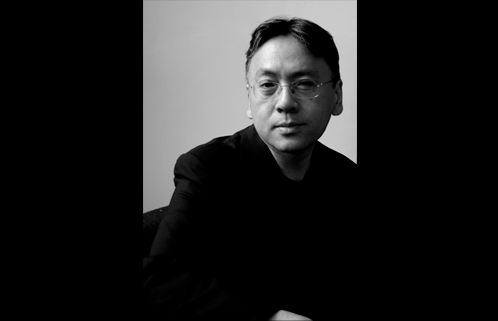
|
Image ©Chika Kihara
The early twenty-first-century presents us with a host of pressing contexts and challenges, from concerns about climate change and technological innovation to diversity issues and shifts in geopolitical power. To what extent does Ishiguro’s writing anticipate and comment on the early twenty-first century Zeitgeist? Surely, The Remains of the Day anticipates Brexit, Never Let Me Go argues against posthumanism, whilst The Buried Giant comments on our distracted, amnesic times. This conference invites critical and creative responses that connect Ishiguro’s work in new ways and/or situate it in new contexts.
| Date: | 1 February 2020 from 9.00am - 6.00pm |
| Venue: |
Chancellor's Hall |
For more information and to book tickets, please click here
| Back to Top |
| Joint East Asian Studies Conference 2019 |
|
|
The Triennial Joint East Asian Studies Conference will be held at Edinburgh University
The JEASC is open to members of the British Association for Chinese Studies, the British Association for Japanese Studies, the British Association for Korean Studies and non-members alike. We welcome participants from all countries and backgrounds.
Panel and individual paper proposals have been submitted across the full range of disciplines within the humanities and social sciences that address topics related to Japan, China, Taiwan, Korea, other parts of the East Asia region, or the region as a whole.
For more information, please visit the conference website
| Date: | 4 September 2019 - 6 September 2019 |
| Venue: |
Abden House |
This event has received funding through the Japan Foundation London Local Grant Programme (Japanese Studies and Intellectual Exchange). If you would like to know more about the programme, please click here
| Back to Top |
| Okinawan Art in its Regional Context |
|

|
This two-day conference will address the socio-cultural complexities of Okinawan identity over the course of history, and explore the intersection between art, politics, and identity from an interdisciplinary perspective. The object of the conference and its ensuing studies is to shed light on how Okinawan arts and cultures have been shaped by internal political situations and by a triple subjugation to the United States, Japan, and China.
In this conference, we will bring together a unique selection of scholars in art history, history, politics, sociology, and visual arts, primarily to identify historical and political processes behind art and cultural forms.
To view the full poster for this event, please click here.
| Date: | 10 October 2019 - 11 October 2019 |
| Venue: |
University of East Anglia |
For more information about attending this event, please visit the UEA website
This event has received funding through the Japan Foundation London Local Grant Programme (Japanese Studies and Intellectual Exchange). If you would like to know more about the programme, please click here
| Back to Top |
| Reopening the Opening of Japan: A Two-Day International Conference to Mark the 150th Anniversary of the Meiji Ishin |
|
On the 10th and 11th May 2019, the Nissan Institute of Japanese Studies at the University of Oxford will host an international graduate-led conference to commemorate the 150th anniversary of the Meiji Ishin, commonly known in English as “The Meiji Restoration”. The conference seeks to promote renewed historical understandings by revisiting the “Opening of Japan” as an aspect of the birth of “modern Japan”. Until now, the “Opening of Japan” has mainly been understood as the opening of the nation to “the West”, its political discourse, and the accompanying ideas of civilisational progress. However, as Japan opened its borders to a specifically “Western” modernity, it simultaneously opened to competing visions of progress, conceptions of time, and new forms of social organisation. At the same time, with the multiplication of its transnational connections and multilateral flows of knowledge-transfer, the world seemed as much to be opening up to Japan as it did vice versa.
| Date: | 10 May 2019 - 11 May 2019 |
| Venue: |
Nissan Institute of Japanese Studies, |
This event is free and open to the public. For more information and registration please visit the event website.
This event has received funding from the Japan Foundation London Grant Programme. For more information about this programme, please click here

| Back to Top |
| Experience Japan Exhibition 2018 |
|

|
Experience Japan Exhibition will be back in London this November for the 8th year, bringing information on the growing range of exciting study and research opportunities in Japan.
The event, hosted by Keio University and co-hosted by the British Council, allows participants to meet representatives of Japanese Universities and receive information on the various study programmes. There will also be a chance to find out about various scholarships and funding opportunities offered to international students and how to take advantage of them. There will also be guest speakers to give an insight into basic life in Japan, talk about their personal experiences of studying/researching in Japan and showcase recent Japanese innovations that may be of interest. The hugely popular JET Programme will also have a guest speaker to discuss the scheme.
Throughout the day the Japan Foundation will be introducing our support programmes and language resources for Japanese Studies and Japanese Language Learning at our information stand. The Japan Foundation's chief Japanese Language advisor, Ms. Fujimitsu, will be giving a guest talk "Insights into Japanese Culture through Language". So, please come by and visit us for any Japanese language learning or Japanese studies advice.
| Date: | 17 November 2018 from 12.00pm |
| Venue: |
The Royal Society, 6-9 Carlton House Terrace, St James's, London, SW1Y 5AG |
Online booking is not required but recommended, please visit the Experience Japan Exhibition website
| Back to Top |
| BAJS 2018 Conference: Crisis? What Crisis? Continuity, and Change in Japan. |
|

The 2018 British Association for Japanese Studies (BAJS) 2018 conference “Crisis? What Crisis? Continuity and Change in Japan” will bring together scholars and students from a wide range of locations and fields to discuss the relevance of viewing Japan as being in states of social, economic, and/or demographic crisis. With Japan creating, resisting, and implementing major constitutional changes in recent years, signs of sustained growth have begun to emerge and a resurgent image of what it means to be Japanese is being promoted, particularly with the 2020 Tokyo Olympics approaching. The BAJS conference will look at the relevence of a crisis and continuity framework in modern Japanese Studies discourse.
Accompanying the talks from a wide range of speakers, the conference will also include a conference film programme, a postgraduate student workshop, and a postgraduate student poster session.
The key note speakers for this conference are Professor Mori Yashitaka (Tokyo University of the Arts) and Professor Gennifer Weisenfeld (Duke University) who will be exploring cultural and social change in Japan from two different perspectives.
| Date: | 5 September 2018 - 7 September 2018 |
| Venue: |
The University of Sheffield, Sheffiled |
For more information and for registration details please visit the BAJS website
| Back to Top |
| UKABS 2018 Annual Conference |
|
|
This year's UK Association for Buddhist Studies annual conference, taking place at the University of Bristol, explores the theme of 'Buddhism and Material Culture' and will feature a keynote address by Japanese Buddhism expert Prof Fabio Rambelli (University of California, Santa Barbara).
| Date: | 21 June 2018 - 22 June 2018 |
| Venue: |
Wills Memorial Building, University of Bristol, Queens Road, Clifton, Bristol, BS8 1RJ |
The conference is open to both members and non-members of the UK Association for Buddhist Studies but registration is essential.
For more information, the full programme and registration instructions please click here: https://ukabs.org.uk/current-confereces/
The UKABS Annual Conference 2018 is sponsored by the Japan Foundation London Grant Programme for Japanese Studies and Intellectual Exchange. For more information about this programme please click here.
| Back to Top |
| UCL-Japan Youth Challenge 2018 |
|
UCL-Japan Youth Challenge 2018 brings together sixth form and high school students from the UK and Japan to take part in an exciting series of activities during which students will learn about each other’s culture, society and language and discuss solutions to global problems.
The theme of the 2018 UCL-Japan Youth Challenge is ‘Our Life in an Ageing Society - How the young generation can solve various problems associated with ageing’ and students from a range of backgrounds will discuss this from medical, social and technical points of view.
The programme will also include three events open to the public including a symposium examining problems in an ageing society. More information can be found on the UCL-Japan Youth Challenge Website.
| Date: | 28 July 2018 - 4 August 2018 |
| Venue: |
University College London (UCL), University of Cambridge, Rikkyo School in England |
For more information please see the UCL-Japan Youth Challenge website.
The UCL-Japan Youth Challenge 2018 is supported by the Japan Foundation London Grant Programme for Japanese Studies and Intellectual Exchange.
| Back to Top |
| London, Rio, Tokyo Olympics Symposium |
|

|
JF London are delighted to support this three day symposium organised by Goldsmiths, University of London, which will explore the changes accompanying the 2012 London Olympics, the 2016 Rio de Janeiro Olympics and the preparations for the 2020 Tokyo Olympics.
The meeting will focus on existing research and interventions concerning the ways that global events have been accompanied by urban transformations and new forms of social (dis)advantage and exclusions, in different urban/nation-state contexts. What does the future hold for existing Olympic Cities? Are there ways of holding mega events which bring genuine benefits to cities and their citizens? How might the promises of ‘legacy’ be realised in more open and democratic ways?
London, Rio, Tokyo Olympics is a three-day event including documentary film screenings, a photography exhibition, academic presentations, a London Olympic site walking tour, workshops and networking sessions.
| Date: | 8 June 2017 - 10 June 2017 |
| Venue: |
Goldsmiths, University of London, 8 Lewisham Way, London, SE14 6NW |
Booking Information
Participation is free of charge. For more information and to register a place please see the symposium website
This symposium is sponsored by the Japan Foundation London Grant Programme for Japanese Studies and Intellectual Exchange.
| Back to Top |
| Conference: Foreign Graduate Employment in Japanese Companies – Implications for Japanese Studies Teaching & Research |
|
|
Japanese companies are important employers of university graduates with knowledge on Japan and Japanese language skills. Yet, much of this employment has happened in overseas subsidiaries and often graduates have seen limited career opportunities. Recently, Japanese companies have begun to hire graduates for employment in Japan itself and have also reemphasized the need to localize their overseas subsidiaries. These trends coincide with universities having become more interested in the employability of their graduates.
This conference, organised by the University of Sheffield in collaboration with SOAS, University of London, aims to assess these developments in foreign graduate employment in Japanese companies and to explore how Japanese studies and language teaching as well as research should respond. The conference brings together international representatives of Japanese studies and language departments, Japanese company executives, employment agents, as well as Japanese studies students and graduates to explore these issues.
| Date: | 6 November 2017 - 7 November 2017 |
| Venue: |
Khalili Lecture Theatre, Russell Square, SOAS, University of London, London |
For more information please see the SOAS website
This workshop is supported by the Japan Foundation London Grant Programme for Japanese Studies and Intellectual Exchange. For more information about this programme please click here.
| Back to Top |
| Japan’s Changing Diplomatic and Security Practice – A Research Workshop |
|

|
How far is Japanese policy changing? Progression or break with the past?
This workshop, organised by King’s Japan Programme together with Free University of Berlin, and sponsored by the Japan Foundation, tackles the relationship between recent changes in Japanese domestic policy institutions and Japan’s diplomatic and security practice.
The workshop will showcase expert discussion on Japan’s changing decision-making and policy output in several key fields pertaining national security: foreign economic policy, arms exports, diplomatic negotiations, free trade agreement negotiations, military planning, and economic development statecraft. Following one day of closed door discussion, experts will engage with interested audience on the morning of Friday October 27 to present their most recent findings.
| Date: | 27 October 2017 from 9.30am - 1.00pm |
| Venue: |
War Studies Meeting Room (K6.07), Department of War Studies, King’s College London, Strand Campus, London, WC2R 2LS |
This workshop was supported by the Japan Foundation London Grant Programme for Japanese Studies and Intellectual Exchange. For more information about this programme please click here.
| Back to Top |
| Contemporary Japan Speaker Series by the London Asia Pacific Centre |
|
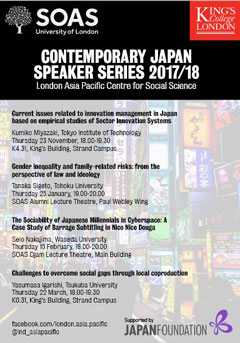
|
The Japan Foundation is delighted to sponsor the second year of the London Asia Pacific Centre’s Contemporary Japan Speaker Series. From November 2017 to March 2018, the series will bring five top Japanese professors to London to discuss contemporary Japanese economics, politics and society
Confirmed speakers for 2017/2018 include:
23 November 2017: Professor Kumiko Miyazaki, Tokyo Institute of Technology
25 January 2018: Professor Tanaka Sigeto, Tohoku University (Event information)
15 February 2018: Professor Seio Nakajima, Waseda University (Event information)
22 March 2018: Professor Yasumasa Igarashi, Tsukuba University (Event information)
| Date: | 23 November 2017 - 22 March 2018 |
| Venue: |
SOAS, University of London/ King’s College London |
For more information please see the homepage of the London Asia Pacific Centre
This workshop is supported by the Grant Programme for Japanese Studies Projects. For more information about this programme please click here.
| Back to Top |
| UCL-Japan Youth Challenge 2017 |
|
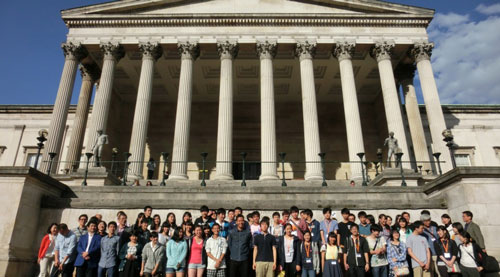
|
UCL-Japan Youth Challenge 2017 brings together sixth form and high school students from the UK and Japan to take part in an exciting series of activities during which students will learn about each other’s culture, society and language and discuss solutions to global problems.
This year’s programme will include special activities exploring the themes of ‘Soseki in the UK’, and ‘Social Entrepreneurship’ including two events which are open to the general public:
‘Natsume Soseki versus William Shakespeare (an open lecture)’
A special lecture by Soseki expert Dr Damian Flanagan to celebrate the 150 year anniversary of the birth of Natsume Soseki.
Date: Tuesday 25 July 2017, 4-5.30pm (followed by reception)
Venue: UCL Gustave Tuck Lecture Theatre, Gower Street, London, WC1E 6BT
For more information and to book a place please see the Eventbrite page
‘UK-Japan Social Entrepreneurship Symposium – Memory of Tomoatsu Godai’
Symposium discussing the past, present and future of social entrepreneurship, in memory of Japanese entrepreneur Tomoatsu Godai who studied in the UK 150 years ago.
Date: Friday, 28 July 2017, 1-5pm (followed by reception)
Venue: UCL Cruciform Building, Gower Street, London, WC1E 6BT
For more information and to book a place please see the Eventbrite page
| Date: | 22 July 2017 - 29 July 2017 |
| Venue: |
University College London (UCL), University of Cambridge, Rikkyo School in England |
Booking Information
For more information and to book a place please see the UCL-Japan Youth Challenge website.
The UCL-Japan Youth Challenge 2017 is supported by the Japan Foundation London Grant Programme for Japanese Studies and Intellectual Exchange.
| Back to Top |
| Japanese Cultural Studies outside of Japan – its current status and future perspectives |
|
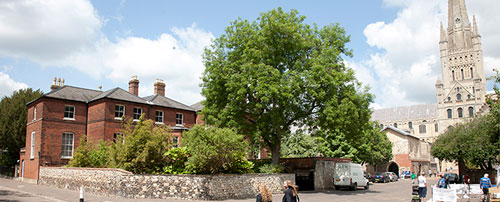
|
This is the concluding day of an international conference titled ‘Japanese Cultural Studies outside of Japan – its current status and future perspectives’ organised by the Sainsbury Institute for the Study of Japanese Arts and Cultures (SISJAC) and Centre for Japanese Studies, University of East Anglia (UEA), in association with the Global Exchange Organisation for Research and Education, Gakushuin University.
The conference will identify challenges faced by the higher education institutions and museums in the UK and elsewhere in Europe where their research, teaching and collections concern Japanese arts and cultures, and will seek to offer solutions.
| Date: | 14 July 2017 from 9.30am - 6.00pm |
| Venue: |
Weston Room, Norwich Cathedral Hostry, Norwich NR1 4DH |
Booking Information
Admission is open to all and free but registration is required. For more information please see the SISJAC website
This conference is supported by the Japan Foundation Grant Programme for Japanese Studies Projects. For more information about this programme please click here.
| Back to Top |
| Ecologies of Knowledge and Practice - Japanese Studies and the Environmental Humanities |
|
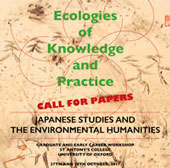
|
How does research on Japan inform ecological practice that is pertinent beyond the framework of area studies, and vice versa? If we were to place nature at the core of our studies of human activities, what new kinds of interdisciplinarity and knowledge would be possible, and how would we reorganize our academic disciplines?
This workshop invites individual papers from UK-based Postgraduates and Early Career Researchers within the Humanities for an inter-disciplinary discussion with guidance from established scholars and practitioners.
| Date: | 27 October 2017 - 28 October 2017 |
| Venue: |
St Antony's College, University of Oxford |
For more information please see the workshop website
This workshop was supported by the Japan Foundation London Grant Programme for Japanese Studies and Intellectual Exchange. For more information about this programme please click here.
| Back to Top |
| Japan Foundation at Experience Japan Exhibition 2017 |
|

|
The Experience Japan Exhibition will be back in London this November for the seventh time, bringing information on the growing range of exciting study and research opportunities available in Japan to a UK audience.
The event which is hosted by Keio University and co-hosted by the British Council will allow participants to meet representatives of Japanese universities and receive information on the various programmes of study offered for international students. There will also be a chance to find out about the variety of scholarships and research funding available to enable students to take advantage of these learning opportunities.
The seminar line-up offers participants the chance to learn about the basics of life in Japan and hear directly from people with experience of studying and researching there. Guest speakers will also be delivering presentations that provide insights into Japanese language and a new field of sports known as "superhuman sports". There will also be a special seminar on the ever-popular Japan Exchange and Teaching (JET) Programme.
This year’s seminar line-up also includes a talk by the Japan Foundation’s own Chief Japanese Language Advisor Makoto Netsu who will be discussing ‘Insights into Japanese culture through language’.
Throughout the day the Japan Foundation will also be introducing our support programmes and resources for Japanese Studies and Japanese language learning at an information stand at the exhibition, so do come and visit us for advice on your Japanese studies!
| Date: | 18 November 2017 from 12.00pm |
| Venue: |
The Royal Society, Wellcome Trust Lecture Hall, 6-9 Carlton House Terrace, London SW1Y 5AG |
Further details can be found on the Experience Japan Exhibition official website: http://www.experience-japan.jp/
| Back to Top |
| Conference: At the Roots of Visual Japan. Word-text dynamics in early-modern Japan |
|
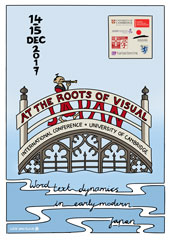
|
This two-day international conference, organised by the Faculty of Asian and Middle Eastern Studies at the University of Cambridge, brings together scholars in the field of Japanese early-modern literature with a specific remit: to examine the interaction of text(s) and image(s) in a systematic manner across the main genres of early-modern popular prose and poetry in print. This is done in dialogue with scholars who work on comics, graphic prose and manga.
Building on the methodology developed in influential works on Western illustrated texts each presentation discusses selected case studies from Japanese early-modern sources, in order to offer preliminary answers to specific research questions.
Presentations are closed each day by a wrap-up session with a view to sum up the answers emerged during the day, to highlight new research questions, and to offer points of discussion for the roundtable. A roundtable closes the conference, featuring scholars of comics, graphic prose and manga. The goal is to position early-modern Japan in a continuum with contemporary Japan and to view its visual culture as an integral part of visual cultures around the World and across time.
| Date: | 14 December 2017 - 15 December 2017 |
| Venue: |
Venue: Faculty of Asian and Middle Eastern Studies, the University of Cambridge, Sidgwick Avenue, Cambridge, CB3 9DA |
For more information please visit the conference website.
This workshop is supported by the Japan Foundation London Grant Programme for Japanese Studies and Intellectual Exchange. For more information about this programme please click here.
| Back to Top |
| JF Supported: Joint East Asian Studies Conference 2016 |
|
|
The Japan Foundation are delighted to support the Joint East Asian Studies (JEAS) Conference 2016, a triennial meeting held by the three academic associations representing East Asian Studies in the UK: The British Association for Chinese Studies (BACS), The British Association for Japanese Studies (BAJS), and the British Association for Korean Studies (BAKS). This conference provides a major venue for the dissemination of research on East Asian Studies in various disciplines for academics from both the UK and abroad.
| Date: | 7 September 2016 - 9 September 2016 |
| Venue: |
SOAS, University of London |
For more details and to register please visit the website of the Japan Research Centre at SOAS, University of London
| Back to Top |
| International Workshop on Reflective Transitions of Politics in Japanese Art |
|
|
This workshop will kick-off a research-based investigation into how contemporary Japanese arts have been shaped by political forces, from wartime militarism to the ‘neoliberal world order’. In so doing, it will look to identify the processes of atomization of society through art forms. The focus of the workshop is on empirical examples of internalized art productions and art currents, in juxtaposition to art expressing national/regional politics – focusing on the presence of political notions in Japanese fine arts, popular cultures such as manga and anime, and visual arts, and on the reflections/intersections between Western arts and representations of Japanese politics. The aim is to provide insights into the changing boundaries and concepts of Japanese/Far Eastern Art History in the 19th-21st centuries, as seen by contemporary scholars of both the West and East.
Keynote speaker: Professor Atsushi Miura (The Graduate School of Arts and Sciences, University of Tokyo)
| Date: | 24 August 2017 from 9.30am - 5.00pm |
| Venue: |
Julian Study Centre 3.02, University of East Anglia, UK |
Booking Information
Admission is open to all and free but registration is required. For more information please see the UEA website
This conference is supported by the Japan Foundation Grant Programme for Japanese Studies Projects. For more information about this programme please click here.
Image: courtesy of University of Tokyo
| Back to Top |
| Japan Orientation at the University of East Anglia |
|
Japan Orientation is a focused short course which allows students to explore the latest approaches to Japanese Studies offered as part of the University of East Anglia’s International Summer School.
The programme will be delivered by the University of East Anglia’s specialised Centre for Japanese Studies (CJS) and the Sainsbury Institute for the Study of Japanese Arts and Cultures (SISJAC) and will concentrate on stimulating discussion with speakers who are leading researchers in the field of Japanese Studies, in culture, history, international relations, business, media and much more.
The course is suited to those currently at university who are interested in Japan, East Asia and the latest approaches to Japanese Studies.
For more information please see the website of the University of East Anglia.
| Date: | 24 June 2017 - 21 July 2017 |
| Venue: |
University of East Anglia |
| Back to Top |
| BAJS Workshop: Meiji Japan in Global History |
|
|
The 2017 BAJS Workshop ‘Meiji Japan in Global History’ will feature intensive critical discussion of six pre-circulated essays on Meiji Japan during which the authors and audience members will explore in greater depth topics presented by the collected essays.
The workshop will begin with the idea that Meiji signifies a moment of global connectivity and asks how this twenty-first century starting point stimulates new questions and offers ways to re-conceptualize Japanese engagement with the late nineteenth century/early twentieth century world. Moreover, it asks what obstacles remain—including the nation-state itself and the imperialism in which its formation was embedded—and how they might help us distinguish our views from those our sources provide.
Contributors include scholars from Europe, the United States, and East Asia who are engaged in thinking about Meiji in global perspective.
The workshop is open to the UK and EU scholarly communities, and focuses on developing each article for publication. Articles will be completed in advance of the workshop and distributed to all participants, and registered members of the gallery audience, in order to best facilitate critical, constructive discussions.
| Date: | 8 September 2017 from 10.00am - 5.00pm |
| Venue: |
Room 116, First Floor, Main Building, SOAS, University of London, London |
Booking Information
Only invited papers will be presented and discussed, but the workshop is open to any interested member of the scholarly community interested in attending the workshop. For more information and to register please see the SOAS website
The Japan Foundation supports the British Association for Japanese Studies through our Support Programme for Organisations in Japanese Studies. For more information about our grant programmes for Japanese Studies and Intellectual Exchange please click here.
| Back to Top |
| Japan Foundation at Experience Japan Exhibition 2016 |
|

|
The Experience Japan Exhibition will be back in London this November for the sixth time, bringing information on the growing range of exciting study, work and research opportunities available in Japan to a UK audience.
The event which is hosted by Keio University and co-hosted by the British Council will allow participants to meet representatives of Japanese universities and receive information on the various programmes of study offered for international students. There will also be a chance to find out about the variety of scholarships and research funding available to enable students to take advantage of these learning opportunities.
The event will introduce other programmes that allow young people in the UK to experience Japan, such as the Japan Exchange and Teaching Programme (JET). Experts on working in Japan will also be taking part in the event to provide information on the job market and the opportunities available including internships.
The seminar line-up offers participants the chance to hear directly from people with experience of studying and working in Japan. Guest speakers will also be delivering sessions that will provide insight on Japanese language and popular culture.
This year’s seminar line-up includes a talk by the Japan Foundation’s own Chief Japanese Language Advisor Makoto Netsu who will be discussing ‘Insights into Japanese culture through language’
Throughout the day the Japan Foundation will also be introducing our support programmes and resources for Japanese Studies and Japanese language learning at an information stand at the exhibition, so do come and visit us for advice on your Japanese studies!
| Date: | 19 November 2016 from 12.00pm |
| Venue: |
The Royal Society, Wellcome Trust Lecture Hall, 6-9 Carlton House Terrace, London SW1Y 5AG |
Further details on pre-registration and more can be found on the Experience Japan Exhibition official website: http://www.experience-japan.jp/
| Back to Top |
| Book Launch: The Growing Power of Japan, 1967-1972 |
|

The Japan Foundation is delighted to host the launch of The Growing Power of Japan, 1967-1972: analysis and assessments from John Pilcher and the British Embassy, Tokyo, compiled and edited by Sir Hugh Cortazzi. The publishers, Renaissance Books in association with the Japan Society, would like to thank the Great Britain Sasakawa Foundation, Julia Bonas and others for their generous help towards the costs of publication.
In this volume Sir Hugh has compiled the defining reports from Sir John Pilcher’s time as ambassador to Japan from 1967 to ’72, a period in which Japan’s economy and power grew significantly and her relations with the United States became increasingly strained. Sir Hugh, who worked with Pilcher during these years and was himself Ambassador to Japan from 1980 to ’84, will open the launch with an overview of the changing character of Anglo-Japanese relations and of the first overseas visit by a Japanese Emperor. This will be followed by an open discussion led by Chairman of the Japan Society, Sir David Warren, and a drinks reception. We are delighted to announce that all attendees will receive copies of the book.
This collection of Pilcher’s reports to Whitehall provides a valuable record of Japan’s progress at this turning point in her post-war history, as well as insights into the hopes and expectations of the British Government in her dealings with Japan. Pilcher’s role during this period was that of bridge-builder between the two countries following the post-war decades of disenchantment and distrust.
Pilcher’s reports were not only unusually comprehensive but were characterised by his natural sympathy for the country and deep knowledge of its culture and religion. His writings on Japan have remained largely inaccessible, and unknown to most researchers, and The Growing Power of Japan offers readers a unique insight into the thoughts of this distinguished scholar-diplomat.
| Date: | 6 October 2014 from 6.45pm |
| Venue: |
The Japan Foundation, London |
Booking:
This event is organised by the Japan Society. To reserve your place please contact the Japan Society office on 020 3075 1996 or email events@japansociety.org.uk or submit the online booking form.
Organised by:

Supported by:

| Back to Top |
| Public Seminar: Japanese Archaeology in the Digital Age |
|
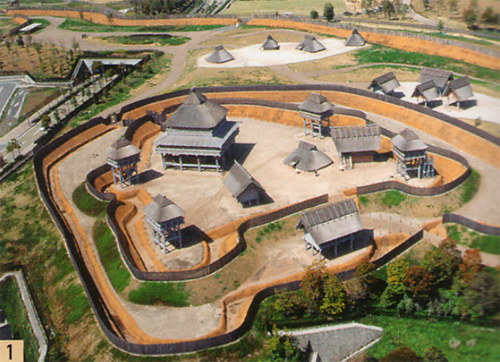
|
Japan has one of the best archaeological resources in the world. And yet many of the treasures that archaeologists have uncovered throughout the archipelago over the past 150 years remain little known to the outside world. As well as being a valuable research resource, Japan’s archaeology and cultural heritage can contribute to education in many different ways. To help teachers and students, the Sainsbury Institute for the Study of Japanese Arts and Cultures, supported by Hitachi Europe Ltd and Hitachi Solutions Ltd, has developed a new English-language Online Resource for Japanese Archaeology and Cultural Heritage (ORJACH).
The Japan Foundation is delighted to host the formal launch of ORJACH in a public seminar at our London office on 23 September. Joining us to discuss ORJACH will be Don Henson (Honorary Director of the Centre for Audio Visual Study and Practice in Archaeology at UCL), Nakamura Oki (Research Fellow at the Pan-Pacific Civilisation Research Project at Ritsumeikan University, Kyoto) and Ben Hui (Managing Director of Language Brand Communication). We are also pleased to welcome Prof Miyamoto Kazuo (Professor of Archaeology at Kyushu University) who will outline digital developments in Japanese archaeology, and Prof Julian Richards (Director of Archaeological Data Services, University of York) who joins as discussant.
The seminar will be chaired by Dr Simon Kaner, Head of the Centre for Archaeology and Heritage at the Sainsbury Institute and Director of the Centre for Japanese Studies, University of East Anglia.
| Date: | 23 September 2014 from 6.30pm |
| Venue: |
The Japan Foundation, London |
|
Download Seminar Programme
|
|
Booking:
This event is free to attend but booking is essential. To reserve a place, please e-mail the Sainsbury Institute at d.clinciu@sainsbury-institute.org


| Back to Top |
| Space and Us Symposium and Reception - UCL-Japan Youth Challenge |
 Join us on Friday 2 August at University College London (UCL) for Space and US, the UCL-Japan Youth Challenge symposium and reception.
The symposium is the culmination to the week-long summer school, attended by Japan and UK-based pre-university students. Be prepared to have your horizons expanded and your intellectual curiosity to be ignited, by the varied talks in the programme!
During the afternoon, the student participants in the UCL-Japan Youth Challenge will also present their hard work from the week.
The symposium will take place between 1pm - 5pm, with the following programme:
Symposium 1-5pm
Opening message by Prof Shin-ichi Ohnuma, UCL Institute of Ophthalmology
Biwa performance by Mr Satoshi Takemoto, Biwa performer and UCL alumnus
Lectures 1 & 2
1: Prof Lucie Green, UCL Mullard Space Science Laboratory
2: Mr Yutaro Tanaka, Mitsubishi Electric Europe
Presentations by the UCL-Japan Youth Challenge 2024 Participants
Lectures 3 & 4
3: Dr Tomoko Lisa Kate Kitagawa, Japan Aerospace Exploration Agency (JAXA)
4: Prof Anu Ojha OBE, UK Space Agency
Closing by Dr Yasu Takeuchi, UCL Division of Infection and Immunity
Reception: 6pm - 8pm
Speeches followed by food and drinks, including local specialities and sake from Fukushima Prefecture
| Date: | 2 August 2024 from 12.00am |
| Venue: |
Symposium: 1-5pm UCL Christopher Ingold Building XLG1 Chemistry Lecture Theatre 20 Gordon Street, London WC1H 0AJ Reception: 6-8pm UCL South Cloisters Gower Street, London WC1E 6BT |
|
Download UCL-Japan Youth Challenge 2024 Space and Us Symposium
|
|
| Back to Top |
| Remembering Hiroshima and Nagasaki |
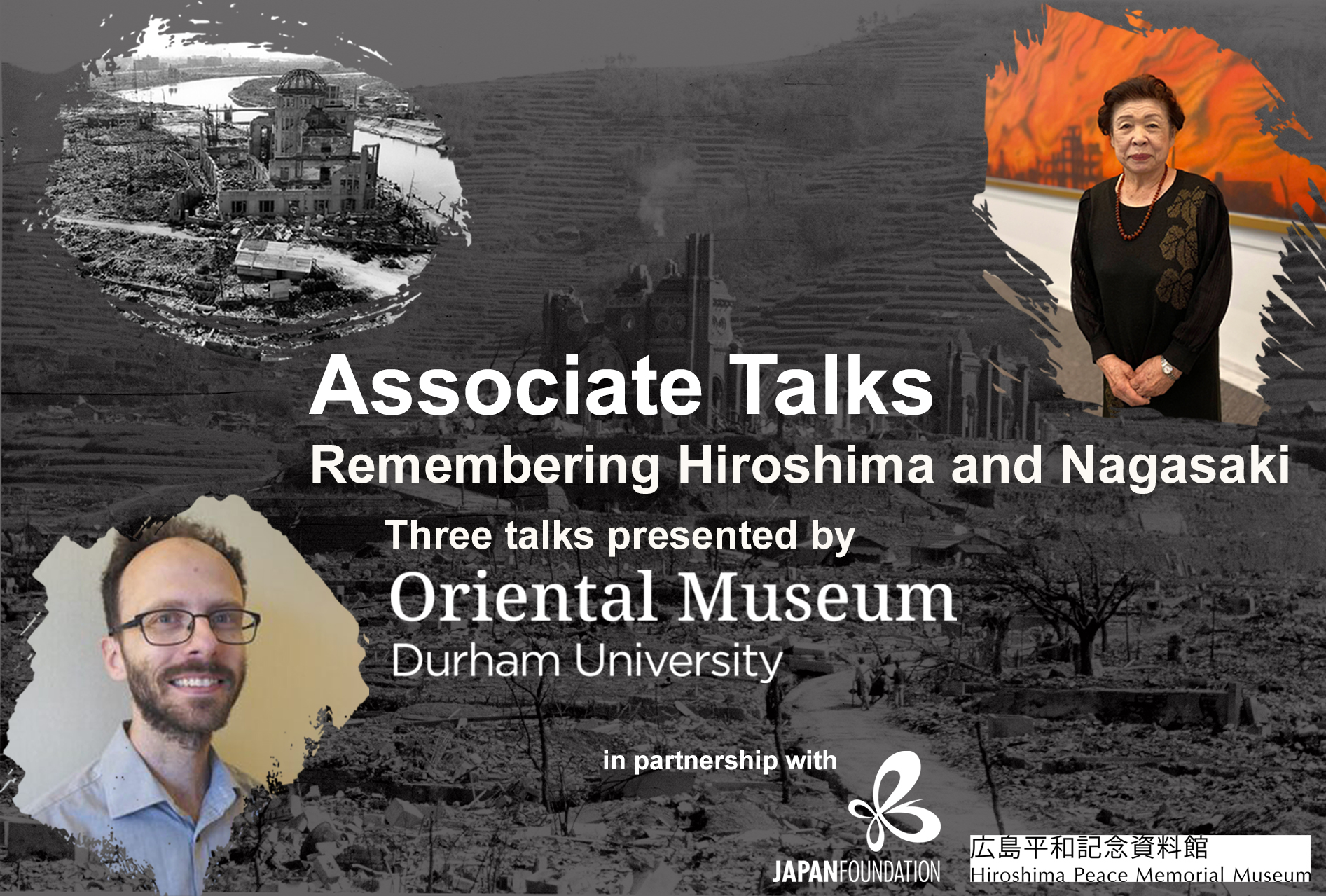
Remembering Hiroshima and Nagasaki
A Three Talk Series presented by Oriental Museum, Durham
The nuclear bombs dropped on Hiroshima and Nagasaki changed history, and it is hugely important to remember the impact they had and continue to have on the world.
The Japan Foundation, London are proud to partner with the Oriental Museum, Durham University for three upcoming talks in July, August and September 2023 related to their ongoing exhibition, Remembering Hiroshima and Nagasaki.*
To find out more about the talks, continue reading below!
*on now at Oriental Museum Durham, until Sunday 10 September 2023.
To visit the Oriental Museum Durham's website, click here.
Talk One: The Long Aftermath: How Hiroshima and Nagasaki shaped and were shaped by postwar history
The two nuclear bombs dropped on Hiroshima and Nagasaki unquestionably altered the course of the twentieth century. Yet their impact was not predetermined in August of 1945 but unfolded in historically-contingent ways over several decades. In this lecture, Dr Adam Bronson (History Department, Durham University) will explore how and why views of the atomic bombings of these two cities changed over time. Doing so highlights the many challenges faced by the survivors of the bombs, who came to be known as hibakusha, and whose testimony is now central to the portrayal and commemoration of the events. Hibakusha of different backgrounds interacted with doctors, scientists, politicians, peace activists, and writers whose postwar lives intersected with Hiroshima and Nagasaki to varying degrees. Understanding these interactions enables us to better grasp how Hiroshima and Nagasaki shaped and were shaped by postwar history.
Date: Wednesday 19th July 6.30pm BST (Hybrid online and in person)
Venue: Oriental Museum, Durham University
If you would like to attend the event either in person or online then please RSVP to oriental.museum@durham.ac.uk
This event is delivered in partnership with the Japan Foundation.
Talk Two: A-bomb Survivor Testimony
Born in 1931, Ms Kiyomi Kono was 14 years old at the time of the bombing and living on the outskirts of Hiroshima. The next day, she entered the city with her mother to look for her two elder sisters. In 2002, she painted pictures to depict scenes she witnessed and published a picture book. In 2003, she began sharing her experience in schools. Join us for an online event to hear directly from Ms Kiyomi’s as she recounts her experiences of the bombing and its aftermath.
Date: Tuesday 1st August, 9am BST
Venue: Online
If you would like to attend the online event then please RSVP to oriental.museum@durham.ac.uk
Due to the nature of the event some attendees may find the content distressing.
This event is delivered in partnership with the Hiroshima Peace Memorial Museum and the Japan Foundation.
Talk Three: In their own voices: Hiroshima National Peace Memorial Hall oral history reading

Since the bombings of Hiroshima and Nagasaki in 1945 there has been a concerted effort to record the experiences of those who survived. These heart-breaking and harrowing accounts have helped to drive the movement towards nuclear disarmament. In this talk the team from the Hiroshima National Peace Memorial Hall will discuss the work they have done in recording and preserving the stories of the survivors. There will be a short film introducing the damage caused by the blasts followed by readings of survivor memoirs and poems.
Date: 10th September – 11am (In person only)
Venue: Oriental Museum, Durham
If you would like to attend the event then please RSVP to oriental.museum@durham.ac.uk
After the talk there will be a tour of the exhibition lead by Assistant Curator, Gillian Ramsay.
Due to the nature of the event some visitors may find the content distressing.
This event is delivered in partnership with the Hiroshima Peace Memorial Museum and the Japan Foundation.
|
Presented by the Oriental Museum, Durham University
|
||
| In partnership with the Japan Foundation, London and the Hiroshima Peace Memorial Museum | ||
|


.jpg)
| Date: | 19 July 2023 - 10 September 2023 |
| Venue: |
Oriental Museum, Durham University |
| Back to Top |
| Experience Japan Exhibition 2019 |

|
Experience Japan Exhibition will be back in London this November for the 9th year, bringing information on the growing range of exciting study and research opportunities in Japan.
The event, hosted by Keio University and co-hosted by the British Council, allows participants to meet representatives of Japanese Universities and receive information on the various study programmes. There will also be a chance to find out about various scholarships and funding opportunities offered to international students and how to take advantage of them. There will also be guest speakers giving an insight into various aspects on Japan. The hugely popular JET Programme will also have a guest speaker to discuss the scheme.
Throughout the day the Japan Foundation will be introducing our support programmes and language resources for Japanese Studies and Japanese Language Learning at our information stand.
| Date: | 23 November 2019 from 12.00pm - 6.00pm |
| Venue: |
The Roal Society, 6-9 Carlton House Terrace, |
For more information and a full timetable, please visit the Experience Japan website
| Back to Top |


 E-bulletin
 The Japan Foundation, London