





 Japanese Studies & International Dialogue Navigation
What's On
Click to see what's on in these sections


 Japanese Studies Local Grant Funding Applications Open!
|

|
|
*Apply Now!* UCL-Japan Youth Challenge 2026
|
|
|
JF/BAJS PhD Workshop 2026
|
|
|
Webinar: How to Use Japanese Premodern Books (wahon) for Japanese Studies
|
|
| Japanese Studies Local Grant Funding Applications Open! |

|
Japan Foundation London Grant Programme
(Japanese Studies & Intellectual Exchange) 2026-2027
This programme is designed to provide grant assistance to projects (e.g. lectures, workshops, conferences) in any discipline of the humanities and social sciences that have a significant Japan element, or involve collaboration with Japanese researchers/practitioners.
Projects must take place in the UK to be eligible for support and applications can only be accepted from not-for-profit organisations in the UK.
Priority:
Priority will be given to projects that fall under one or more of the following descriptions:
1. Projects that will bring together researchers/ practitioners from a variety of disciplines and sectors that are relevant to Japan
2. Projects organised by, and/or involving core participation by, early career researchers/ practitioners
3. Projects that will nurture diverse interests in Japan among future generations in the UK
Applications for preliminary project development will be considered as long as such projects include some of the above elements.
Grant coverage:
Only specific items such as travel expenses, honoraria, venue hire, printing/publicity costs etc. which are deemed to be essential in order to carry out the project.
Projects must take place between 1 September 2026 and early March 2027.
Successful applicants may be granted up to £1500. As successful applicants will not necessarily be granted the full requested amount, applicants are strongly encouraged to secure additional funding from their own organisation and elsewhere.
Application Deadline: 1 August 2026 (2nd call for applications)
If you are interested in applying to this grant, please read the complete Application Instructions PDF.
Once you have read the Application Instructions, please email the Japanese Studies team at LO_JapaneseStudies@jpf.go.jp, and CC Iona_Vos@jpf.go.jp (Assistant Programme Officer for Japanese Studies) and Natsumi_Abe@jpf.go.jp (Manager of Japanese Studies Affairs)
| Date: | 2 March 2026 - 6 April 2026 |
 Download Japan Foundation London Local Grant (Japanese Studies) Application Instructions (2nd call)
|
|
| Back to Top |
| *Apply Now!* UCL-Japan Youth Challenge 2026 |
|
The UCL-Japan Youth Challenge is back again! This is a prestigious annual summer school programme.
In this summer school, pre-university students from Japan and the UK attend a series of university-style lectures on a wide range of subjects by academics from UCL, and engage in UCL Grand Challenge Workshop, which aims to investigate one of the social issues in the world and explore solutions to it through discussion between Japanese and UK-based participants. It is a great opportunity for young people interested in cultural exchange and in getting some unviersity experience.
2026 will be the 11th year of the programme. It will be held in three places in the UK:
Rikkyo School in England, West Sussex;
University of Cambridge, Cambridge;
and UCL, London.
Dates: Saturday 25 July – Sunday 2 August 2026 (9 days)*
Fee for UK-based participants: 800 GBP
*Not all dates are compulsory to attend.
For full details and to apply, please visit the official website here: https://www.ucl-japan-youth-challenge.com/join-us/
| Date: | 25 July 2026 - 2 August 2026 |
| Back to Top |
| JF/BAJS PhD Workshop 2026 |
|

Dates: Thursday 26 - Friday 27 February 2026
Venue: The University of Sheffield
Registration for the 2026 iteration of the Japan Foundation/British Association for Japanese Studies PhD Workshop, "Navigating Your Future in Japanese Studies" is now open!
If you are a PhD student conducting research related to Japan, why not come along for our workshop which aims to support the ongoing development and future of Japanese Studies in the UK?
This time, we have decided to host the workshop over two days to allow more opportunity for insightful workshops and networking, enabling attendees to build valuable connections with Japanese Studies students and researchers across the UK.
We have listened to feedback from previous workshops and concerns of postgraduate students in Japanese Studies, and have decided to focus this workshop on how to navigate the changing landscape and job market in Japanese Studies.
Exact sessions at the workshop are yet to be finalised but the tentative timetable is below.
*Please note: We are still in the early planning stages and the following is subject to change*
|
Day 1 - Thursday 26 February (Afternoon Start): 1pm - Registration opens Session 1: How to find and apply for jobs, writing applications and preparing for interviews. Session 2: Funding opportunities at different funding organisations in the UK. Session 3: Hearing from students who have completed their doctorates, and their experiences finding jobs both inside and outside academia. Drinks Reception. |
|
Day 2 - Friday 27 February (Morning Start): 9.30am - Start of Day 2 Session 1: Student presentations and feedback (in assigned groups). Session 2: Workshop on collaborative research Session 3: Roundtable with assembled academics to discuss Japanese Studies in the UK 5pm - End of Workshop. |
Please note: attendees to the workshop must be able to attend both days.
Student Submissions:
As an essential part of the workhop, PhD and MA students will be asked to present their research in front of a small group of peers. Further information about this will be provided after the registration deadline has passed. However, if you have any questions please get in touch.
Financial Support:
The following financial support is available to presenting attendees.
Travel Grant: JF will offer a partial travel grant for student participants. Once an initial 30 GBP is covered by the student, JF will provide up to a maximum of 90 GBP for public transportation to the event. For any questions, please contact Iona Vos using the contact emails at the bottom of this item.
Hotel Grant: BAJS will cover a one night stay up to a maximum of 90 GBP per attendee. If you have any questions about the hotel grant, please email BAJS Secretary Mara Patessio at mp78@soas.ac.uk.
Please note:
Attendance to this event is capped at 40 students on a first come, first served basis. As the number of participants is limited, please only register if you know you can attend both days of the workshop.
Current Ph.D. students will be prioritised. MA students will be placed on a waitlist, with places being confirmed after the deadline has passed.
If you have registered but can no longer attend, please contact us to cancel your place.
Contact
If you have any questions about the workshop, please email Iona Vos at LO_JapaneseStudies@jpf.go.jp. Please CC Natsumi_Abe@jpf.go.jp (Manager for Japanese Studies) and Iona_Vos@jpf.go.jp (Assistant Programme Officer for Japanese Studies).
| Date: | 26 February 2026 - 27 February 2026 |
| Back to Top |
| Webinar: How to Use Japanese Premodern Books (wahon) for Japanese Studies |

|
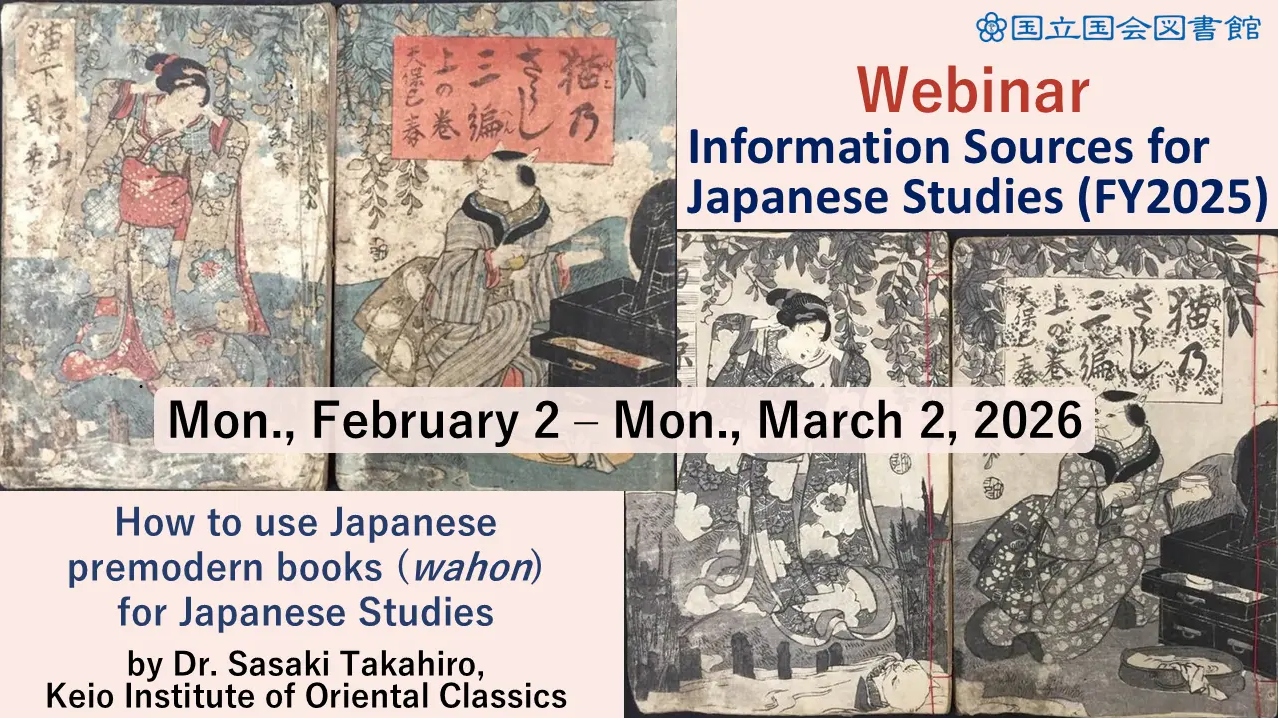
This webinar is intended for librarians, researchers, and other people outside of Japan who are engaged in Japanese studies. The goal of this webinar is to learn and improve basic skills for finding and using information related to research in Japanese studies.
The advancement of digital technology has encouraged Japanese studies outside of Japan and made it easier to obtain a wide range of information on premodern Japan, not just classical literature. Consequently, innovative and authentic research is in progress in the field of Japanese classical literature.
There is no denying that Japanese premodern books, wahon (和本), are the primary subjects or resources for conducting research in the field.
In this lecture focusing on wahon, Dr. Sasaki TAKAHIRO demonstrates the basic knowledge required when using a vast number of digital images for research, as well as methods and precautions for utilizing these images, providing specific examples.
Video available to watch on demand on YouTube. You must apply before watching the video.
Date: Video available between Monday 2 February to Monday 2 March 2026.
Eligibility:
- Librarians or researchers outside of Japan who are engaged in Japanese Studies.
* This includes students and others who have a professional interest in Japanese studies. - Librarians in Japan
Language: Japanese (no translation or interpretation)
Click here to apply to watch the video.
| Date: | 2 February 2026 - 2 March 2026 |
| Back to Top |


 E-bulletin
 The Japan Foundation, London