





 Japanese Studies & International Dialogue Navigation
28/08/2026
Our Essay Series, "Japan Up Close" aims to highlight the work of researchers undertaking Japan-related work at universities around the UK. Each essay is designed to be concise and accessible, offering a close look at Japanese society, culture, and their historical and contemporary contexts through the lens of academic research. The format includes three main sections; "Observing Japan", "Rethinking Japan" and "Looking Beyond Japan", to guide readers from observation to broader interpretation and reflection.
Vol. 2 is The Proliferation of Sports Museums Across Japan
by Dr. Christopher J. Hayes, Senior Lecturer in Events Management, Tourism and Marketing, University of Chester.
We would be very grateful if you could complete our brief survey on how you found our Essay series.
Please click here to access the survey once you have finished reading the essay.
Read Vol. 2 below!


What connects a small office above a supermarket in Yokohama's Chinatown, a public sports centre in Tokyo's Itabashi City, and an archaeological site in Okayama? They all contain sports museums. If you've spent any time in Japan, you'll know the country is packed with museums (more on that later!), but you may never have come across a sports museum. If you have, it's likely the Japan Olympic Museum in Shinjuku, a short walk from the Japan National Stadium. Yet across Japan there are dozens of sports-related museums, most operating far from that kind of visibility. In early 2026, the Japan Sport Council launched the Japan Sports Museum Network, part of its "Tsunagu" project, aiming to strengthen collaboration between these institutions. So far, only 16 have registered as members, and no one has a full picture of how many exist, short of compiling the list yourself.
Why is the existence of sports museums interesting? In many ways, it isn't. Some are entirely predictable: the Baseball Hall of Fame and Museum sits inside the Tokyo Dome, home to the Yomiuri Giants, while the Hanazono Rugby Museum sits at Japan's oldest rugby stadium, Hanazono Stadium in Higashi-Osaka. But consider the three examples I opened with. In Yokohama, a makeshift sign stuck to a second-storey window above a Chinese supermarket points the way to the Yokohama Baseball Museum. Climb the stairs, pass doors with obscured glass and business plaques, turn right, and you reach what is essentially an office: a desk and bookshelves. Yet wall to wall, floor to ceiling, baseball memorabilia fills the space. In a residential neighbourhood of Itabashi, a sports centre named after the adventurer Naomi Uemura houses a museum dedicated to his exploits, despite spending only a single summer there between climbing trips; his actual hometown, now part of Toyooka in Hyogo Prefecture, has its own Uemura museum. And in a corner of Okayama's JFE Harenokuni Stadium, a small museum splits its space evenly between sporting memorabilia and artefacts from the adjacent Tsushima archaeological site, antiquity and modern sporting culture meeting side by side.
Institutions like these sit quietly across the country, each one telling its own story about what Japan chooses to remember and celebrate through sport.
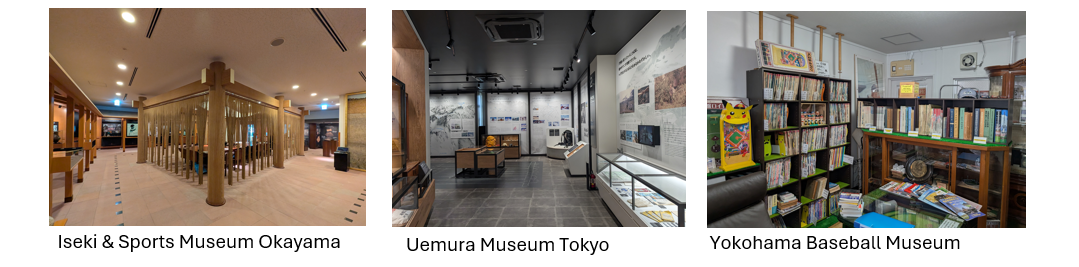

Museums are sites of communication, not neutral windows into history: they select artefacts and stories, representing histories that visitors then interpret anew. Sports museums are distinctive here. Researchers note they often display objects with little interpretive text, assuming visitors already grasp their meaning. They are also unusually bound up with nostalgia, conveying sporting heritage through trophies, kits, photographs and other ephemera, and through idiosyncratic forms like halls of fame and stadium memorials.

Sport is often overlooked as culture, overshadowed by fine art, classical music, literature and theatre. National museums in Japan rarely feature sporting artefacts, while readily showcasing ceramics, sculpture, textiles and instruments. It falls to sports museums, then, to tell Japan's sporting history.
But these institutions do more than recount history. Their sheer range, covering specific sports, events, teams, and regional achievements, reflects how significant sport is to Japanese society. They span multi-storey dedicated buildings to corners of government offices, stadia, sports centres, even offices above Chinese supermarkets.
My research, taking me from Hokkaido to Okinawa interviewing directors and curators, finds that despite differences in scale and ownership, these museums share much in common. They give fans contact with artefacts that evoke nostalgia and closeness to favourite sportspeople, while balancing entertainment with education. Museums strive for neutral narratives, yet remain aware that sport carries deep meaning: supporting a team or country is an expression of identity, and a source of local, regional or national pride.
That pride often extends to those running the museums, as with the Yokohama Baseball Museum, a passion project of Seiji Suzuki, who runs it alongside his day job as a rickshaw driver for tourists.
Sport has grown increasingly important to Japan. In 2011, the government launched a national strategy to become a "Sports Nation," backed by the Basic Act of Sport. This has been paired with an aim to become a "Tourism Nation," through hosting events like the 2019 Rugby World Cup, the Tokyo 2020 Olympics and Paralympics, and the 2025 World Athletics Championships. Sports museums bridge these two ambitions, sustaining event legacies and drawing tourists long after the crowds disperse.
This variety reflects Japan's broader museum culture. The country has 5,771 museums, though only 1,305 are legally recognized under the Museums Act of 1951 (revised 2022); the rest are “museum-like". Japan ranks third globally for museum numbers, after the United States and Germany, reflecting a deep national investment in cultural heritage, tangible and intangible.

Of course, sports museums are not unique to Japan and can be found across the world, even if the number of institutions in Japan is exceptionally high. Sports are a hugely important aspect of cultures and societies across the world. Sports bring communities together, both as players and spectators; they bring a country together through supporting national teams; sport also brings people from different countries together through the hosting of international sports events. Sports deserve to be recognised like any other part of culture. Sports museums legitimise sport’s importance in society. They act as important places for people to connect with favourite sportspeople or teams, experience nostalgia, and feel pride. As mentioned above, they preserve the memory and legacy of sports events, presenting a public record for consumption. They also contribute economically, motivating tourists to visit places and spending in local businesses.
Next time you are travelling, consider visiting a sports museum.


Dr. Christopher J. Hayes (Senior Lecturer in Events Management, Tourism and Marketing, University of Chester)
Discipline/Speciality: Tourism Studies
My research focusses on tourism development in Japan, an increasingly important industry. I am interested in how local identity, culture and heritage are leveraged in the cultivation of both a sense of place and a place brand.
More about the Author: Japan Foundation Researcher Directory
https://jpf.org.uk/japanese-studies-survey-researcher-directory.php
Thank you for reading this essay!
We would be very grateful if you could complete our brief survey on how you found our Essay series.
Please click here to access the survey once you have finished reading the essay.




 The Japan Foundation, London