




 Navigation
What's On
Click to see what's on in these sections


 School-Centred Initial Teacher Training Information Day for Applicants - April 2024
|

|
 Talk event: Mingei Then and Now with YOSHIZAWA Tomo
|
|
|
KABUKI KIMONO: Costumes of Bandō Tamasaburō V
|
|
JaLaChamp 2024 – Japanese Language Championship for Young Learners UK
|
|
|
Art Without Heroes: Mingei
|
|
Panel discussion: Mingei / Art Without Heroes
|
 Translation of Bodies: performance work of a professional puppeteer inspired by Japanese otome bunraku at Edinburgh University
|
|
|
Japanese-Language Proficiency Test (JLPT) July 2024
|
|
| School-Centred Initial Teacher Training Information Day for Applicants - April 2024 |

|
|
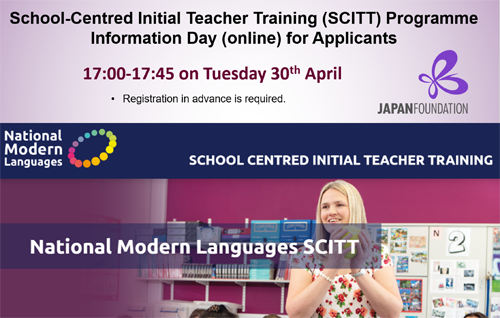
Are you interested in teaching Japanese in secondary schools in England? Would you like to get the teaching qualification to realise that ambition? If so, please don’t miss this great opportunity!
The National Modern Languages SCITT and the Japan Foundation, London will be holding an information event aimed at potential applicants for the National Modern Languages SCITT (School-Centred Initial Teacher Training). This is a national scheme approved by the government’s Department for Education. It is designed to train successful applicants to become Early Career Teachers by obtaining a QTS.
The National Modern Languages SCITT (The NML SCITT) is unique, being the only national single-subject provider to specialise solely in the teaching of modern languages. The NML SCITT programme is a great opportunity for those who are looking to gain QTS together with the recognised standard qualification of Post Graduate Certificate in Education (PGCE). The PGCE programme is offered in conjunction with Sheffield Hallam University, and comes with credits towards an eventual possible Masters-level qualification, should trainees take up the option to continue study in the future. Subject to financial, degree classification and residential qualification, participants accepted on the programme may receive a substantial bursary while training; this is currently £25,000, but please note that this is subject to annual change. The training year consists of an empowering combination of practical training in school placements, supported by University- and centre-based academic tuition.
The NML SCITT will introduce a new pathway for training Japanese language teachers as part of its programme; there will be an expectation in the first instance that Japanese will be offered alongside either French, German or Spanish in order to cater for schools’ existing curricular offers, and to ensure that there is a possibility of qualifying for the bursary. Whilst in the past the provider’s focus has mainly been on these nationally prevalent modern languages (French, German, and Spanish), Mandarin, Arabic, Russian and Italian have also featured in our trainees’ languages skill sets. The NML SCITT will be proud and pleased to add Japanese to the programme portfolio.
Please note that trainees are required to have French, German or Spanish as a primary foreign language they can potentially teach, with Japanese as an additional language. This means that trainees will be able to teach two languages.
On this information day, Mr Keith Faulkner from the National Modern Languages SCITT will give a speech about SCITT, and explain how to apply for the NML SCITT. There will be a Q&A session.
Date: 17:00-17:45 on Tuesday 30th April
- Participation fee: Free (registration in advance is required.)
- Registration deadline: 26th April
- Languages used: English
- Online (ZOOM meeting)
| Date: | 30 April 2024 from 5.00pm to 5.45pm |
| Venue: |
Online event |
| Back to Top |
| Talk event: Mingei Then and Now with YOSHIZAWA Tomo |
|

|
The Mingei Undo was a revolutionary cultural movement in Japan which started in 1926. Grandfathered by YANAGI Soetsu, it intended to identify and treasure the beauty of the hand-made works produced by anonymous craftsmen, each one created amidst the climate of each local region and to its specific daily needs. It was born against the backdrop of an existing notion that only ornately-decorated ornamental pieces had value as works of art. The re-discovery of beauty in Mingei covers media from ceramics to textiles, with the works of HAMADA Shoji regarded as some of the most representative of the movement, including within the UK.
In celebration of the exhibition Art Without Heroes: Mingei at William Morris Gallery in London, the Japan Foundation and Dovecot Studios will host a talk by YOSHIZAWA Tomo, a key partner of the exhibition, that will examine the historical significance of Mingei along with its socio-economic impact. As a granddaughter of MUNEHIRO Rikizo, a Preserver of Important Intangible Cultural Property, Tomo will also delve into Mingei’s influence on contemporary makers and craftsmen, along with the relationship between maker and user, by focusing on MUNEHIRO’s textile works.
To book, please click here for our booking form.
Please note that the confirmation email system is not automated and is subject to office opening hours.
| Date: | 13 May 2024 from 1.00pm to 2.00pm |
| Venue: |
Dovecot Studios, 10 Infirmary Street, Edinburgh, EH1 1LT |
| Back to Top |
| KABUKI KIMONO: Costumes of Bandō Tamasaburō V |
|
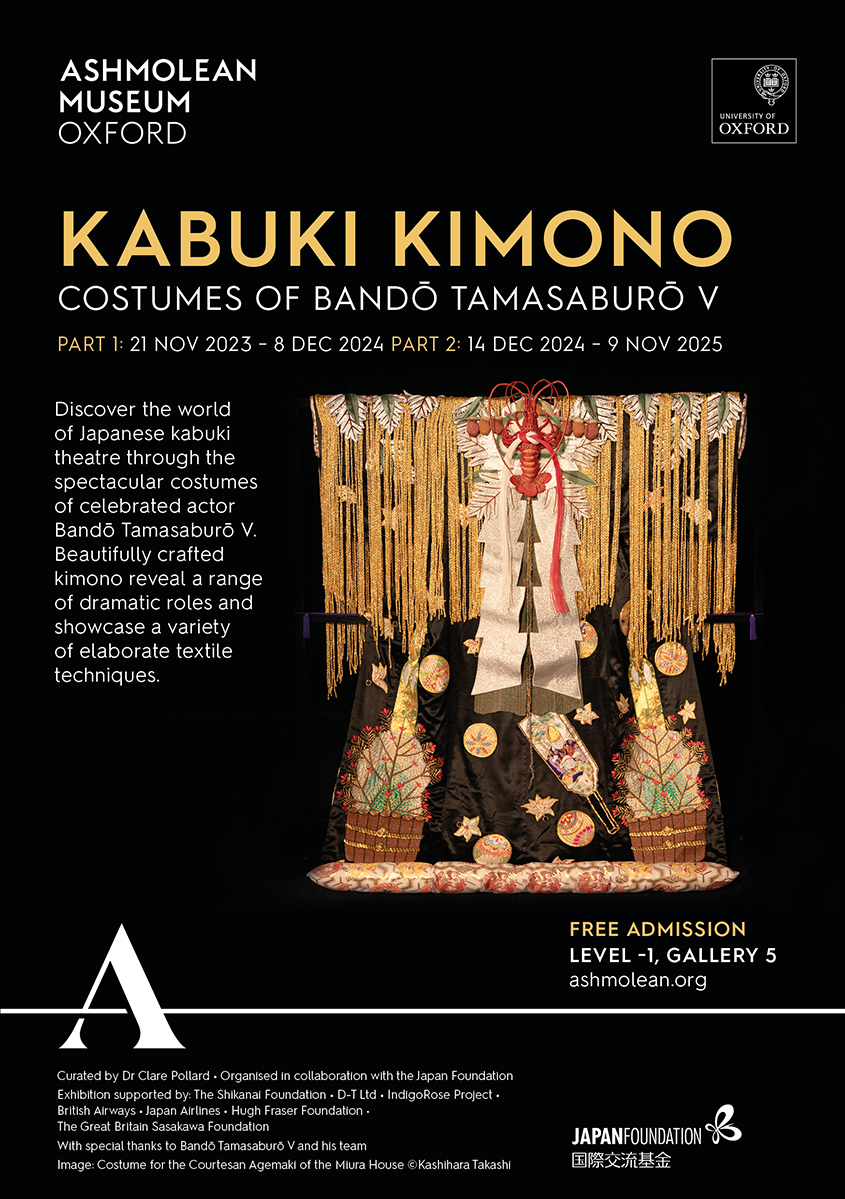
Step into the world of Kabuki with six stunning kimonos worn by the legendary actor BANDO Tamasaburo V, known for his renowned onnagata roles (male actor who performs female roles). Experience the intricate artistry of these garments, highlighting a diverse range of complex textile techniques, encompassing weaving, dyeing, embroidery, and hand-painting. We are delighted to collaborate with the Ashmolean Museum.
Date: 21 November 2023 - 8 December 2024
Venue: The Ashmolean Museum
| Date: | 21 November 2023 - 8 December 2024 |
| Back to Top |
| JaLaChamp 2024 – Japanese Language Championship for Young Learners UK |
|
|
Applications are now open for JaLaChamp 2024!
Latest updates
- 07/12 - Speech Category deadline extended!
- 31/10 - Prospective applicants and their teachers/guardians can now check out our Frequently Asked Questions document.
- 26/10 - Check out our JaLaChamp 2024 outline video!
- 18/10 - You can now download Video Creation Hints!
---
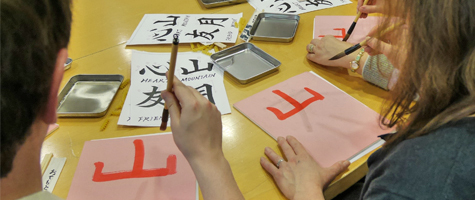
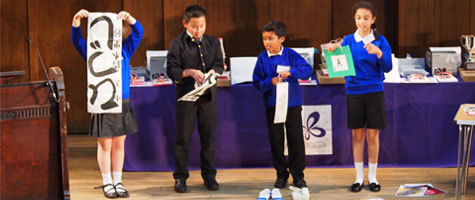
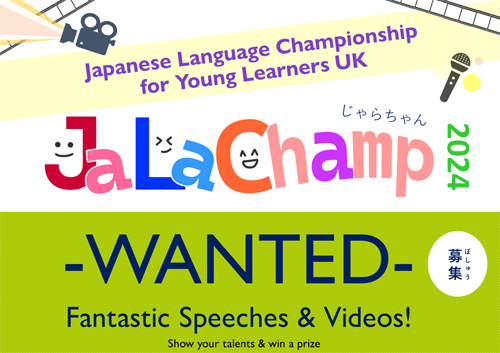
JaLaChamp, or Japanese Language Championship for Young Learners UK, is a contest for primary and secondary school students studying Japanese. There are two categories - the speech category, where students give a speech on a theme of their choice, and the video category where students are asked to create an original video either by individual or part of a group.
The world is changing very quickly. Technology is advancing, and nowadays if we have a computer or a smartphone we can send a message to anyone in the world. In a time like this, we should always consider the following questions: “What message do I want to convey and how?” Using the voice, the written word, visuals, design and more – there are many ways to express ourselves. It is important to be able to combine these different choices of expression to create a way of expressing ourselves that others can understand, empathise with or be persuaded by.
We want to encourage students to share with us their thoughts and viewpoints, as well as show us their creativity in full and have fun challenging themselves by entering this contest and using their Japanese!
---
Application deadline for the Speech Category: 6th December 2023 (Wednesday), 15:00
The Speech Category Deadline has been EXTENDED.
New Speech Category Deadline: 24th January 2024 (Wednesday), 15:00
(Please note that the application guidelines, application form, application poster etc display the previous deadline)
Application deadline for the Video Category: 24th January 2024 (Wednesday), 15:00
---
1. Download Guidelines and Event Poster
- English Guidelines
- Japanese Guidelines
- Frequently Asked Questions
- Download our JaLaChamp 2024 poster
- Watch our JaLaChamp 2024 Outline Video
2. Reference Materials for Students
---
- Finals day: 11th May 2024 (Saturday)
- Venue: Japan House London, 101-111 Kensington High Street, London, W8 5SA
* Please note: The Finals Day of JaLaChamp 2023 was held in July, however the JaLaChamp 2024 Finals Day will be held in May
| Back to Top |
| Art Without Heroes: Mingei |

|

|
In collaboration with William Morris Gallery, we're proudly presenting the UK's most wide-ranging exhibition dedicated to Mingei, the influential folk-craft movement originating in Japan during the 1920s and 1930s. Showcasing a diverse array of works including ceramics, woodwork, textiles, and more, this exhibition explores Mingei's cultural significance and its enduring relevance in contemporary craft and consumerism.
Date: now on, until 22 September 2024
Venue: William Morris Gallery
Click here for details
| Date: | 23 March 2024 - 22 September 2024 |
| Back to Top |
| Panel discussion: Mingei / Art Without Heroes |
|

|
Join curator Roisin Inglesby, along with contributors KIKUCHI Yuko, Aaron Angell, and Dasom Sung, for an exciting evening exploring and expanding on the themes of the book Mingei / Art Without Heroes, chaired by YOSHIZAWA Tomo.
Originating in Japan in the 1920s, the Mingei movement was based on the principle that beauty is inherent in handmade, everyday objects created by anonymous craftspeople. Spearheaded by the philosopher YANAGI Soetsu, and potters HAMADA Shoji and Bernard Leach, the movement sought to elevate the status of folk craft in a rapidly modernising society.
Mingei / Art Without Heroes covers a wide range of objects associated with Mingei, from ceramics and furniture to textiles and toys, alongside a series of profiles of leading designers and makers working in Japan today. Contributors from a variety of backgrounds explore Mingei’s origins, interpretations and contemporary implications, shedding new light on the ways in which the principles of the movement remain relevant to today’s personal, social and environmental concerns.
| Date: | 15 May 2024 from 6.00pm to 9.00pm |
| Venue: |
William Morris Gallery, Lloyd Park, Forest Road, Walthamstow, London, E17 4PP |
|
For more information, please click here. |
|
£7.50 per ticket, £5 concessions
| Back to Top |
| Translation of Bodies: performance work of a professional puppeteer inspired by Japanese otome bunraku at Edinburgh University |
|

Join the University of Edinburgh for the final talk in their Asian Studies Seminar Series for the academic year 2013 - 2014, in partnership with The Japan Foundation.
This free talk by Dr Caroline Astell-Burt is entitled 'Translation of Bodies: performance work of a professional puppeteer inspired by Japanese otome bunraku'.
Dr Astell-Burt first encountered puppets based on otome bunraku at a training workshop in 2009 at the London School of Puppetry. This developed into a long study of the bodily presence of the puppeteer before being formalised into a doctoral enquiry and the opportunity to observe the extremely rare and beautiful performances at Hitomiza in Japan.
She regularly writes academic articles about puppets and puppetry often within an educational or therapeutic context. She is a puppet-maker, performer and teacher and co-founder of the first full-time professional training for puppeteers in the UK. She holds two Masters Degrees from Middlesex and Royal Holloway Universities and a doctorate from Loughborough University.
No booking essential, just turn up!
To visit the event page on the University of Edinburgh's website, click here.
| Date: | 3 April 2024 from 4.00pm to 6.00pm |
| Venue: |
University of Edinburgh Project Room 1.06, 50 George Square |
| Back to Top |
| Japanese-Language Proficiency Test (JLPT) July 2024 |
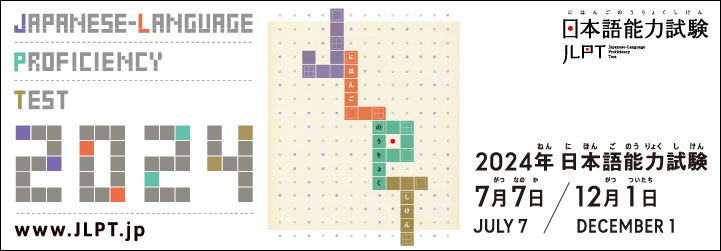
The Japanese-Language Proficiency Test (JLPT) is a test for non-native speakers of Japanese which evaluates and certifies their Japanese-Language proficiency. The test takes place twice a year (July and December) in Japan and various locations around the world. Currently, it is the largest Japanese language test in the world, with more than 1.36 million people in 87 countries worldwide having registered for the JLPT in 2019.
The next JLPT will take place on Sunday, 7th July 2024. Registration will start at each test centre in March.
Please check this page for any updates on UK test centres for the July 2024 JLPT. For application opening dates and registration details, please refer to each university’s website using the links below:
Japan Research Centre, SOAS University of London
Please note that the JLPT is very popular and registration at each test centre will close when the test centre has reached its maximum capacity.
For more information about the test, please visit JLPT website.
Ø Let’s Try Sample Questions!
Ø Download a Guide to the 2024 Japanese-Language Proficiency Test.
| Date: | 7 July 2024 |
 Download guide_2024
|
|
| Back to Top |


 E-bulletin
 The Japan Foundation, London